
A carbon fiber rigid plate earns the word rigid from geometry and layup together, not from the fiber alone. Bend stiffness scales with the cube of thickness and with the laminate's flexural modulus, which means a two-millimeter plate is roughly eight times stiffer than a one-millimeter plate of the
Introduction
A carbon fiber rigid plate earns the word rigid from geometry and layup together, not from the fiber alone. Bend stiffness scales with the cube of thickness and with the laminate's flexural modulus, which means a two-millimeter plate is roughly eight times stiffer than a one-millimeter plate of the same layup — a lever most design discussions underuse while arguing about fiber grade. This article covers the layup families that keep a plate flat, the thickness-stiffness relationship in practice, how a full carbon fiber plate stack compares to a cored panel, and how flat-press molding and post-cure decide the flatness you can actually ship.
Secondary topics follow the same engineering line: what a carbon fiber 1 plate layup (single-side reinforcement) is good for, how to verify flexural behavior without a full lab, and which handling mistakes quietly destroy the stiffness the layup designed in. The intent is a working reference for engineers and buyers specifying plates, not a materials science survey.
Layup Design for a Carbon Fiber Rigid Plate
Three layup families cover almost every rigid-plate application. Quasi-isotropic stacks — typically zero, ninety, plus forty-five and minus forty-five plies — give equal in-plane properties and resist twisting, which suits instrument beds, jigs, and anything that must stay flat under uneven clamping. Zero-ninety balanced stacks maximize bending stiffness in two directions at minimum weight, which suits drone plates, equipment brackets, and sporting plates that flex primarily about one axis. Plain symmetric layups about the mid-plane avoid post-cure warpage; asymmetry is the classic cause of a plate that springs into a bow the moment it leaves the press.
- Quasi-isotropic: equal stiffness in plane; heavier for the same bending stiffness, but predictable under multi-axis loads.
- Zero-ninety balanced symmetric: highest bending stiffness per gram about the principal axes; the default for performance plates.
- Hybrid stacks: glass plies at the surface to improve impact tolerance or electrical isolation, at the cost of a few percent stiffness.
- Single-side reinforcement: a carbon fiber 1 plate approach — carbon on one face of a substrate — used when the job is stiffening an existing panel rather than making a standalone plate.
Thickness Scaling in a Carbon Fiber Rigid Plate
The cubic law dominates every thickness decision. Doubling thickness multiplies bending stiffness by roughly eight and plate mass by two, so the stiffest plate per gram is always the thickest one the packaging and process constraints allow — until other failure modes take over. Past a practical limit, thin plates shear between plies before they reach their bending potential, thick plates develop void gradients in the press because heat and pressure take longer to reach the center, and machining time rises with every added millimeter. The working range for flat-pressed carbon fiber rigid plate stock is commonly one to eight millimeters, with two to four millimeters covering most instrument and drone work.
Specifying stiffness instead of thickness transfers the cubic law into the purchase order: give the supplier a target flexural rigidity with tolerance, and let the layup and thickness be chosen to hit it. Suppliers who only accept a thickness drawing will ship a plate that meets the drawing and misses the rigidity target by a wide margin when the ply book differs from your assumption.
Full Carbon Fiber Plate Versus Cored Stacks
A full carbon fiber plate keeps fiber from face to face; a cored stack separates two thin faces with foam or honeycomb to gain thickness cheaply. The core wins on stiffness per gram when shear modulus of the core is adequate and the faces are properly bonded — which is why sandwich panels dominate aerospace interiors. It loses on point loads, edge finishing, and moisture: a cored carbon fiber rigid plate needs sealed edges and careful fastener design, because a crushed core under a bolt washer destroys the stiffness the sandwich promised while looking perfect from above.
The practical rule: use full stacks for anything with concentrated loads, machined edges, or blind holes; consider cored panels only for large flat spans with distributed support and sealed perimeters. On small plates the labor of edge sealing erases most of the weight savings anyway.
Flat-Press Molding and Post-Cure
Flatness ships or it does not. Press molding between polished platens with a controlled ramp and hold gives plates in the zero point two millimeter flatness class over a three-hundred-millimeter span; autoclave cure of bagged flat parts does similar work with better void content. Post-cure above the glass transition locks dimensions and raises the service temperature ceiling, but it must follow a ramp schedule — dumping a warm plate onto a cold table reintroduces bow in minutes. Buyers should ask for the flatness spec with span and method, not a bare "flat" claim, and verify with a surface plate and dial indicator on incoming lots.
| Layup / stack | Typical thickness | Relative bending stiffness | Warpage risk | Best fit |
|---|---|---|---|---|
| Quasi-isotropic full | 1-6 mm | baseline | low (symmetric) | jigs, instrument beds |
| Zero-ninety full | 1-8 mm | 1.2-1.5x baseline | low if symmetric | drone and equipment plates |
| Cored sandwich | 5-20 mm | 3-8x baseline | medium (core tolerance) | large flat panels |
| Single-side carbon fiber 1 plate | substrate + 0.3-1 mm | stiffening only | bow if cure shrinkage mismatched | retrofit stiffening |
Frequently Asked Questions
How do you verify stiffness of a carbon fiber rigid plate without a lab?
Rest the plate on two supports, load the center with a known weight, and measure deflection with a dial indicator. Compare against a golden sample of the same layup; absolute modulus needs lab equipment, but lot-to-lot drift shows up clearly in this simple three-point fixture.
Why does the same thickness plate feel different between suppliers?
Usually ply book and cure, not fiber grade. A zero-ninety stack and a quasi-isotropic stack at the same thickness differ in bending stiffness by tens of percent, and an under-cured matrix drops it further. Ask for the layup drawing and cure record with the quote.
Can you machine a full carbon fiber plate with standard tooling?
Yes, with sharp carbide or diamond tooling, conservative feed rates, and dust extraction; dull tools delaminate edges and raise the void count at the machined surface. Seal machined edges if the plate sees moisture.
Conclusion
Design the plate around the cubic law and the layup family first, then pick thickness to hit a rigidity target with tolerance, and hold the supplier to a flatness spec with span and method. Symmetric layups, controlled press cycles, and post-cure ramps are what separate a plate that ships flat from one that bows in the box. YongXian molds, presses, and machines carbon plate to drawing — quasi-isotropic and zero-ninety stacks, one to eight millimeter stock, flatness verified on incoming lots. Browse full carbon fiber plate stock or send your rigidity target for a layup proposal.
Part of topic
Related Articles
- Carbon Fiber Fabric Tube: Roll-Wrap Construction Explained
- Carbon Fiber Tubes Material Properties: Modulus, Strength and Density Reference
- Carbon Flash vs Carbon Fiber: Paint Finish or Real Composite?
- Aramid Fiber vs Carbon Fiber: Toughness vs Stiffness Compared
- Carbon Fiber Rod vs Steel Rod: Weight, Stiffness and Cost
- Carbon Fiber Plate vs FR4: When Composite Wins
Interested in Our Products?
Contact our team for competitive pricing and technical specifications.
Get a QuoteRelated Products

Round Carbon Fiber Tube — 3K Plain Weave T700
Standard round carbon fiber tube manufactured from Toray T700 grade fiber with 3K plain weave. Offers balanced strength and stiffness for general industrial applications including robotics, automation, sports equipment, and aerospace structures.

Carbon Fiber Pickleball Paddle
High-performance pickleball paddle with Toray T700 carbon fiber face and polypropylene honeycomb core. Delivers excellent power-to-weight ratio, spin generation, and vibration dampening for competitive play.
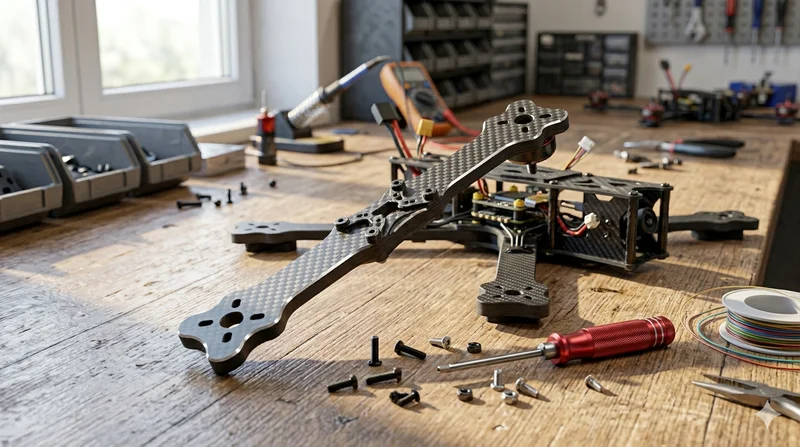
Carbon Fiber Drone Arm
Precision-molded carbon fiber drone arm combining unidirectional fiber for stiffness and woven layers for torsional strength. Designed for FPV, photography, and industrial drone platforms. Each arm is CNC-machined to exact specifications.

Square Carbon Fiber Tube — 3K Twill T700
Square cross-section carbon fiber tube manufactured with 3K twill weave for torsional strength. Preferred for structural frames, trusses, and support columns where rectangular geometry offers design flexibility.

Round Carbon Fiber Tube — UD Unidirectional T700
Unidirectional (UD) round tube with all fibers aligned axially for maximum longitudinal stiffness. Ideal for applications requiring high bending rigidity with minimal weight, such as shafts, struts, and structural reinforcements.