
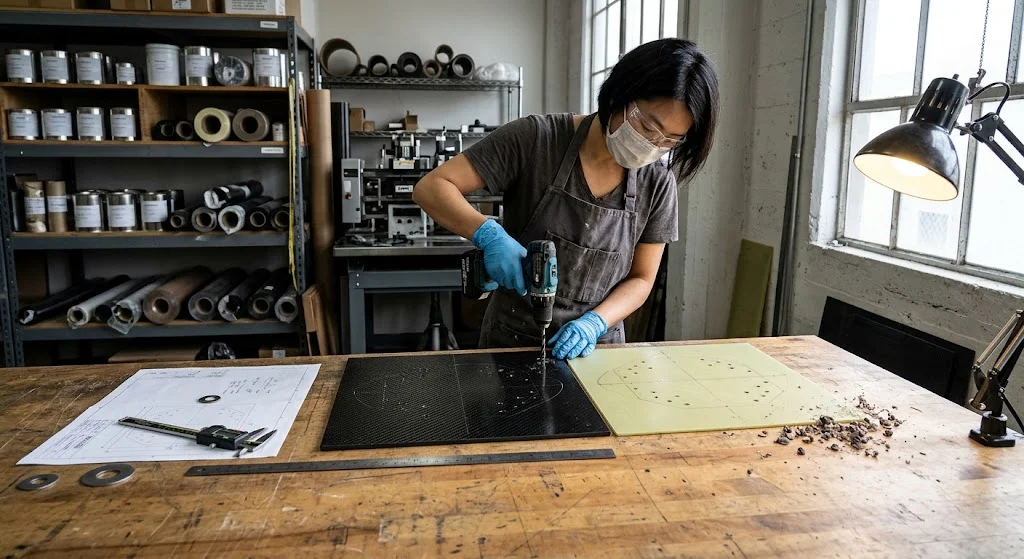
The carbon fiber plate vs fr4 question comes up whenever a jig, fixture or enclosure has to be stiff, light and flat at the same time. FR4 — the glass-epoxy laminate behind almost every printed circuit board — is cheap, stable and available off the shelf in standard sheet sizes. Carbon fiber plate t
Introduction
The carbon fiber plate vs fr4 question comes up whenever a jig, fixture or enclosure has to be stiff, light and flat at the same time. FR4 — the glass-epoxy laminate behind almost every printed circuit board — is cheap, stable and available off the shelf in standard sheet sizes. Carbon fiber plate trades price for roughly a third of the density and about twice the specific stiffness, and that ratio changes what a design can get away with.
This guide puts carbon fiber plate vs fr4 side by side with real numbers, then works through carbon fiber rigid plate selection, carbon fiber plate custom cutting, and the carbon fiber skid plate vs aluminum argument for parts that actually take hits — so the first sheet you order is the right one.
Carbon Fiber Plate vs FR4: Head-to-Head Data
Neither laminate wins outright; the useful comparison is stiffness per kilogram, dimensional stability under temperature, how each material behaves under a cutting tool, and cost per finished part. Carbon carries load along its fibers and is strongest in the layup directions, while FR4 is isotropic and predictable in every direction at a fraction of the price.
| Property | Carbon fiber plate | FR4 glass-epoxy | What it means in the shop |
|---|---|---|---|
| Density | 1.55-1.60 g/cm3 | 1.85-1.90 g/cm3 | Carbon parts land about 18% lighter |
| Flexural strength | 450-700 MPa | 300-420 MPa | Thinner carbon plate reaches the same deflection limit |
| Elastic modulus | 45-70 GPa (in-plane) | 20-25 GPa | Carbon plate is roughly twice as stiff per thickness |
| Heat tolerance | Resin softens near 120-180 C | Continuous to about 130 C | Similar service window; neither belongs near a reflow oven |
| Machining | Needs sharp bits and dust extraction | Cuts like wood, chips freely | FR4 is friendlier on a hobby mill |
| Typical sheet cost | $120-400 per m2 | $25-70 per m2 | Carbon premium only pays where mass or stiffness limits |
Read the modulus row first: at equal thickness a carbon fiber rigid plate deflects about half as much as FR4 under the same load, which is the whole argument in a precision fixture where a hundred microns of sag ruins the part.
Carbon Fiber Rigid Plate in Fixtures, Jigs and Racks
Structural benches, optical tables, inspection jigs and 3D-printer gantries are where carbon plate quietly earns its price. The goal is not saving grams for their own sake; it is holding position under load and under a room that swings ten degrees between morning and afternoon.
- Specific stiffness: carbon plate delivers roughly twice the rigidity of FR4 at lower mass, so gantries accelerate faster and drive motors run cooler.
- Flatness: quasi-isotropic layups hold flatness across a sheet, while FR4 can bow slightly after CNC routing frees internal stress.
- Damping: the carbon laminate settles vibration in a fraction of the time, which matters on probing cycles and laser alignment rigs.
- Creep: FR4 keeps taking a small permanent set under long-term clamping load; carbon fiber plate essentially does not creep at fixture loads.
Carbon Fiber Plate Custom Cutting and Sizing
Standard sheets rarely match a bolt pattern, so carbon fiber plate custom work becomes the normal path: supply a DXF or a paper template, specify thickness and layup, and have the supplier cut, drill and edge-finish in one pass. CNC routing carbon plate is routine for a qualified shop, but hole edges should be radiused and counterbores planned during programming rather than drilled on site.
- Pick thickness by deflection, not habit: 3 mm quasi-isotropic plate handles most brackets; 6-10 mm is for spans over 400 mm.
- Specify the layup: 0/90 balanced cloth for one-direction spans, quasi-isotropic for general fixtures.
- Isolate from metals: use nylon washers or a glass-veil interface so galvanic corrosion never reaches the plate.
Carbon Fiber Skid Plate vs Aluminum: When the Plate Takes Hits
Once the part lives under a vehicle or a machine tool skirt, the comparison changes from stiffness to survival. In a carbon fiber skid plate vs aluminum matchup, aluminum dents and can be straightened in the field, while carbon absorbs the strike and may hide internal delamination. FR4 is the worst choice of the three under impact: it splinters. For guards that only see dust and light scraping, a carbon or FR4 splash panel is fine; for anything that lands on a ledge, choose aluminum or a thick carbon layup and inspect after every strike.
Where FR4 Still Wins
FR4 remains the right answer for electrical insulation plates, transformer spacers, RF test fixtures that must not conduct, and any low-load cover where the invoice matters more than the mass. It machines on a basic router, takes threads reasonably well and costs less than a coffee per small panel. The honest rule: buy FR4 when nothing is demanding about the part, and switch to carbon only when stiffness, weight or flatness actually constrains the design.
Frequently Asked Questions
Is carbon fiber plate vs fr4 worth it for a PCB test fixture?
Yes, when the fixture is large, repeatedly clamped or mounted on a moving axis. Carbon keeps positional error low over long spans and does not take a permanent set from clamp pressure. For small, static, benchtop fixtures, FR4 does the job at a quarter of the price.
Can I drill and tap carbon fiber plate in the workshop?
You can, with sharp carbide or HSS bits at moderate speed, constant dust extraction and no coolant that wicks into the layup. Drill oversize for taps, seal hole edges with thin CA glue, and never clamp the plate directly in steel jaws without soft pads.
Does FR4 delaminate like carbon fiber plate?
No — FR4 fails by chipping and brittle fracture along the glass weave, while carbon plate fails by interlaminar delamination that can stay invisible under the surface. Tap-testing a carbon panel after an impact reveals the difference; FR4 damage is usually obvious on sight.
Conclusion
The carbon fiber plate vs fr4 decision follows the load case: carbon wins on stiffness per kilogram, flatness retention and creep resistance, FR4 wins on price, machinability and insulation. Most workshops end up keeping both on the shelf — FR4 for covers and spacers, carbon for the fixtures that have to hold tolerance all day.
YongXian supplies carbon fiber plate and sheet in standard and custom sizes, cut and drilled to your drawing. Browse our carbon fiber range or contact our engineering team with your dimensions and annual volume.
Part of topic
Related Articles
- Carbon Fiber Rod vs Steel Rod: Weight, Stiffness and Cost
- Carbon Fiber Skid Plate vs Aluminum: Off-Road Protection Compared
- Carbon Fiber vs Aluminum Drone Frames: Weight, Cost and Crash Data
- Pultruded vs Roll Wrapped Carbon Fiber: A Buyer Guide
- Pultruded vs Wrapped Carbon Fiber: Performance and Cost
- How to Cut Carbon Fiber Rods Cleanly: Tools, Dust Safety, and Tolerances
Interested in Our Products?
Contact our team for competitive pricing and technical specifications.
Get a QuoteRelated Products

Round Carbon Fiber Tube — 3K Plain Weave T700
Standard round carbon fiber tube manufactured from Toray T700 grade fiber with 3K plain weave. Offers balanced strength and stiffness for general industrial applications including robotics, automation, sports equipment, and aerospace structures.
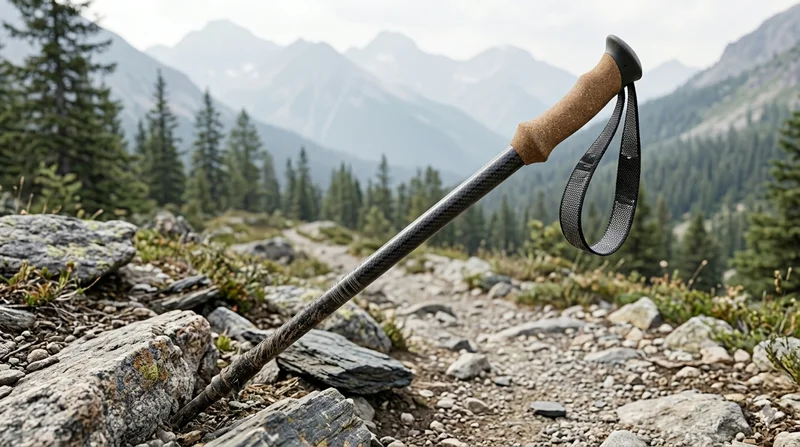
Carbon Fiber Trekking Pole
Lightweight carbon fiber trekking pole manufactured from high-grade carbon fiber tube. Weighs only 160g per pole while providing superior shock absorption and durability for hiking, trail running, and backpacking.

Carbon Fiber Pickleball Paddle
High-performance pickleball paddle with Toray T700 carbon fiber face and polypropylene honeycomb core. Delivers excellent power-to-weight ratio, spin generation, and vibration dampening for competitive play.

Square Carbon Fiber Tube — 3K Twill T700
Square cross-section carbon fiber tube manufactured with 3K twill weave for torsional strength. Preferred for structural frames, trusses, and support columns where rectangular geometry offers design flexibility.

Carbon Fiber Plate — 3K Twill T700 3.0mm
Medium-thickness 3.0mm carbon fiber plate offering significantly higher load capacity while maintaining attractive 3K twill finish. Suitable for structural brackets, reinforcement plates, and load-bearing panels.