
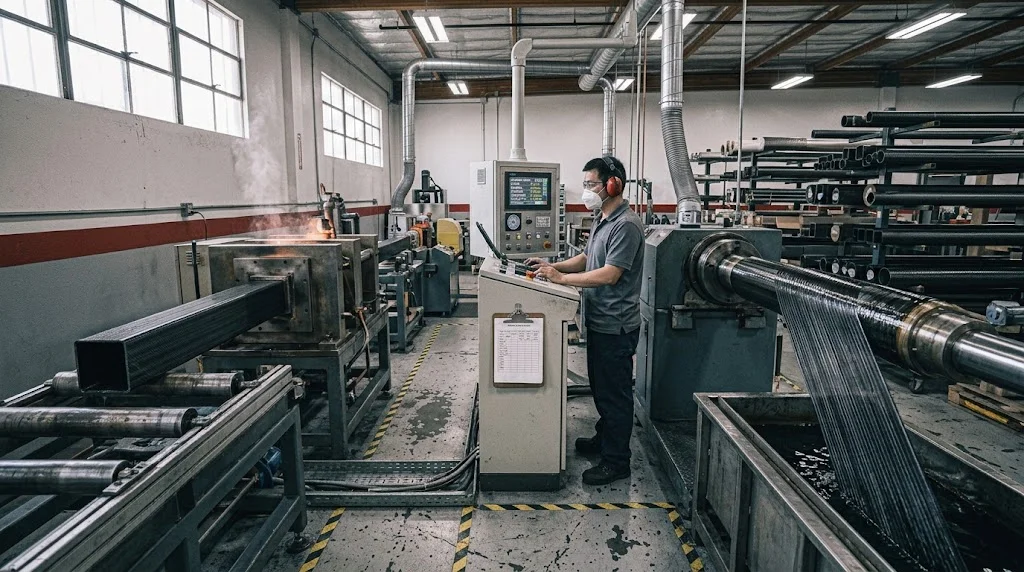
The choice between pultruded vs wrapped carbon fiber is not a quality ranking — it is a process match to your geometry, tolerance and volume. Pultrusion pulls continuous fiber through a heated die to make constant-section profiles at high line speed; roll wrapping lays prepreg or wet-wound tows onto
Introduction
The choice between pultruded vs wrapped carbon fiber is not a quality ranking — it is a process match to your geometry, tolerance and volume. Pultrusion pulls continuous fiber through a heated die to make constant-section profiles at high line speed; roll wrapping lays prepreg or wet-wound tows onto a mandrel and cures under heat and pressure to build tubes where hoop strength and wall build-up matter. Both produce real carbon fiber; the wrong choice shows up as a tolerance miss, a crush failure, or a unit cost that kills the program.
This guide covers the mechanics of each process, a side-by-side property and cost comparison for pultruded carbon fiber tube versus roll-wrapped tube, where the high-volume economics of pultrusion dominate, where roll wrapping wins on geometry and tolerance, how carbon fiber tube custom programs pick a route, and the inspection steps that catch a process mismatch before parts reach assembly.
How Pultruded and Wrapped Carbon Fiber Are Built
The two processes differ in how fiber is placed, how resin is introduced, and how the laminate consolidates — three differences that cascade into every downstream property.
| Aspect | Pultrusion | Roll wrapping (wet or prepreg) |
|---|---|---|
| Fiber placement | rovs pulled through heated die at constant speed | tows wound on mandrel under tension, programmed angles |
| Resin introduction | bath or injection at the die entrance, 35-45% by weight | resin bath wet-wind or prepreg plies laid up |
| Consolidation | heat + pull pressure inside the die, continuous | oven or autoclave cure on mandrel, batch cycle |
| Fiber volume | 60-70%, high and consistent | 55-65%, depends on debulk quality |
| Typical profiles | constant cross-section: rods, tubes, channels, angles | round tubes, conical and stepped ODs, thick walls |
| Line speed / cycle | 0.3-1.5 m/min continuous | hours per mandrel, batch dependent |
A pultruded rod is essentially a continuous extruded composite: fiber volume is high and uniform along the length, but the fibers run axially with little or no hoop component. A roll-wrapped tube can be engineered with 55-75° helical layers for hoop strength, ±angle plies for torsion, and a thick wall that a pultrusion die cannot produce in one pass.
Property Comparison: Pultruded Carbon Fiber Tube vs Roll-Wrapped
The numbers below reflect typical production ranges for a 20 mm OD, 1.5 mm wall tube in T300-class fiber with epoxy matrix. Confirm against the supplier's test data for your specific layup and cure.
| Property | Pultruded tube | Roll-wrapped tube | Notes |
|---|---|---|---|
| Longitudinal tensile strength | 1200-1600 MPa | 1000-1400 MPa | pultruded wins: continuous axial fibers |
| Hoop / transverse strength | low, matrix-dominated | 400-800 MPa with helical layers | roll-wrapped dominates on hoop duty |
| Fiber volume | 62-70% | 55-63% | pultruded higher; affects stiffness per gram |
| OD tolerance | ±0.1-0.2 mm typical | ±0.05 mm ground, ±0.1 as-cured | roll-wrapped better for fit-critical bores |
| Length capability | continuous, cut to length | limited by mandrel length, usually <6 m | pultruded for long stock |
| Crush / bearing strength | moderate | higher with hoop layers | roll-wrapped for press-fit and pin loads |
| Relative cost per meter | low at volume | moderate to high | cross-over near 500-1000 m/year |
Two lines decide most selections. Longitudinal strength favors pultruded profiles for beams, spars and drone arms running pure bending. Hoop strength and crush resistance favor roll-wrapped tubes for bearing housings, pressure sleeves and press-fit assemblies — a pultruded wall under a radial press-fit will split along the matrix between fibers.
Where Pultruded Carbon Fiber Tube Wins
Volume and constant geometry are pultrusion's home turf. The economics are almost linear: once the die is cut and the line is tuned, additional meters cost only fiber, resin and line time.
- Drone arms and booms: square, round or airfoil pultruded profiles in long lengths, cut and drilled on a router — unit cost drops sharply above a few hundred pieces.
- Sports shafts and rods: golf, hockey, fishing rod blanks that run pure axial loading benefit from the high fiber volume and consistent wall of pultrusion.
- Industrial stiffeners and channels: flat bars, C-channels and angle stock bonded into panels or welded into frames where hoop strength is irrelevant.
- Electrical and thermal management: pultruded rods and tubes used as insulating standoffs, busbar supports, or heat-spreader elements — continuous production keeps unit cost low.
If your part is a constant-section beam in annual volumes above roughly 500 meters, start the conversation with a pultruded profile and only escalate to roll wrapping if tolerance or hoop duty forces it.
Where Roll-Wrapped Carbon Fiber Wins
Geometry freedom and engineered layup are roll wrapping's advantages. When the tube wall must carry radial load, the OD must hold a press-fit, or the cross-section is stepped or conical, roll wrapping is the correct route.
- Bearing housings and bushings: helical layers at 55-75° provide hoop strength that resists press-fit expansion and pin bearing.
- Robot arms and structural links: tubes with tight OD tolerance, bonded end fittings, and ±45° torsion plies — a schedule a pultrusion die cannot produce.
- Pressure and fluid service: when a tube carries internal pressure or must resist crushing under vacuum, hoop-dominated layup is mandatory.
- Custom geometry: stepped ODs, flanged ends, conical transitions — all standard on a mandrel, all impossible on a pultrusion die.
For carbon fiber tube custom programs, the decision tree is simple: constant section and pure axial load point to pultrusion; any hoop duty, any tolerance tighter than ±0.15 mm, or any non-uniform geometry points to roll wrapping.
Inspection Checks That Catch Process Mismatch
Before a batch reaches assembly, three checks will tell you whether the process that made the tube matches the duty it will see. First, ultrasonic or tap-test the wall for voids — pultruded stock rarely has voids, but wet-wound tube with poor debulk can show 2-5% porosity that drops interlaminar shear by a third. Second, measure OD and wall along the length — a pultruded tube varies more over 6 m than a ground roll-wrapped tube does over 1 m. Third, for any press-fit application, run a controlled expansion test on a sample: pultruded walls split at 3-5% diametral strain, while hoop-wound walls survive 8-12% before matrix cracking. Document the process route on the certificate of conformance so the next buyer does not have to guess.
Frequently Asked Questions
Is pultruded carbon fiber weaker than roll-wrapped carbon fiber?
Not weaker — different. Pultruded stock has higher longitudinal strength and fiber volume, making it superior for pure axial loads like beams and spars. Roll-wrapped tube has higher hoop and crush strength from its helical layers, making it superior for press-fit, pin bearing and pressure duty. The failure mode is selecting the wrong one for the load path.
Can I get pultruded carbon fiber tube in custom sizes?
Yes, within the die's capability: OD, wall thickness and profile shape are fixed by the die, so custom sizes need a new die (typically $200-800 for simple round dies). Length is cut to order. If your custom requirement is a stepped OD or a tight ±0.05 mm tolerance, roll wrapping is usually the better custom route.
What is the cost cross-over between pultruded and roll-wrapped tube?
For a simple 20 mm round tube, pultrusion beats roll wrapping by 30-50% in unit cost above roughly 500-1000 meters per year (amortizing die cost). Below that volume, or for any tube with hoop duty or non-uniform geometry, roll wrapping is usually competitive or cheaper because no tooling is required.
Conclusion
Pultruded vs wrapped carbon fiber is a process decision, not a quality one: pultrusion delivers high-volume constant-section profiles with excellent axial properties; roll wrapping delivers engineered hoop strength, tight tolerance and geometry freedom for structural tubes. Match the process to the load path, inspect the wall and tolerance before assembly, and keep the process route on the certificate. YongXian produces both pultruded profiles and roll-wrapped custom tubes with documented layup and test data. Browse our carbon fiber tube range or contact our engineering team with your load case, tolerance and annual volume.
Part of topic
Related Articles
- Pultruded vs Roll Wrapped Carbon Fiber: A Buyer Guide
- How to Cut Carbon Fiber Rods Cleanly: Tools, Dust Safety, and Tolerances
- How to Bend Carbon Fiber Rod: Heat Forming, Cold Passes, and Custom Curves
- How to Bend Carbon Fiber Tube Stock Without Cracking
- Carbon Fiber Sheet Manufacturing Process Explained
- How to Make Carbon Fiber Plates at Small Batch Scale
Interested in Our Products?
Contact our team for competitive pricing and technical specifications.
Get a QuoteRelated Products

Round Carbon Fiber Tube — 3K Plain Weave T700
Standard round carbon fiber tube manufactured from Toray T700 grade fiber with 3K plain weave. Offers balanced strength and stiffness for general industrial applications including robotics, automation, sports equipment, and aerospace structures.

Square Carbon Fiber Tube — 3K Twill T700
Square cross-section carbon fiber tube manufactured with 3K twill weave for torsional strength. Preferred for structural frames, trusses, and support columns where rectangular geometry offers design flexibility.

Carbon Fiber Pickleball Paddle
High-performance pickleball paddle with Toray T700 carbon fiber face and polypropylene honeycomb core. Delivers excellent power-to-weight ratio, spin generation, and vibration dampening for competitive play.
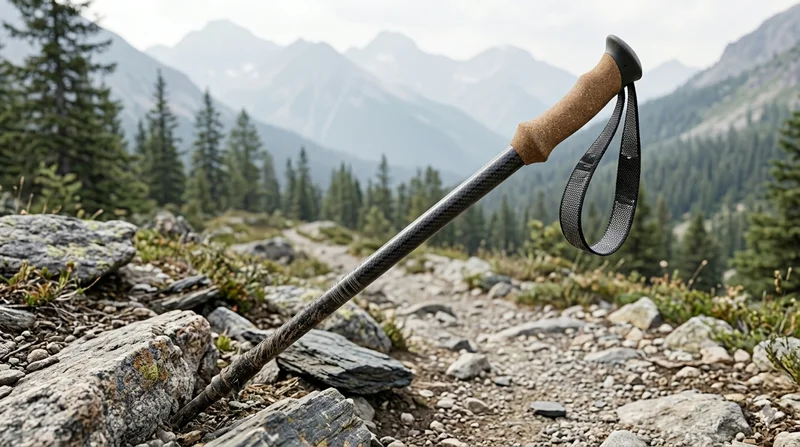
Carbon Fiber Trekking Pole
Lightweight carbon fiber trekking pole manufactured from high-grade carbon fiber tube. Weighs only 160g per pole while providing superior shock absorption and durability for hiking, trail running, and backpacking.

Round Carbon Fiber Tube — 3K Twill
Lightweight and ultra-stiff round tubes ideal for drone frames, robotics, and structural applications.