
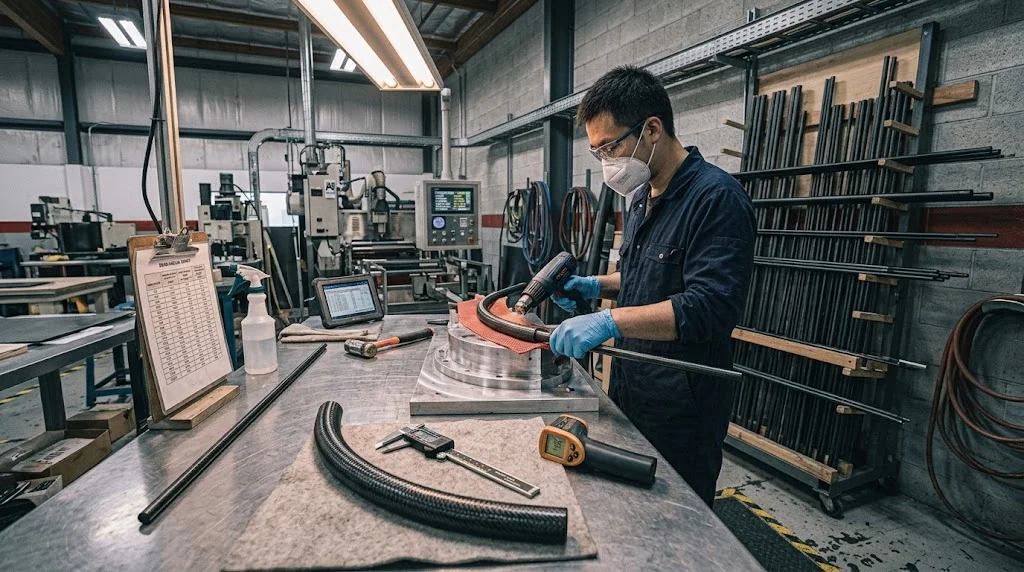
Knowing how to bend carbon fiber rod matters because a solid or pultruded rod fails differently from a tube, and the failure is sudden. A cured thermoset rod carries fibers straight along the axis; bending forces the outer face into tension and the inner into compression, and once surface strain pas
Introduction
Knowing how to bend carbon fiber rod matters because a solid or pultruded rod fails differently from a tube, and the failure is sudden. A cured thermoset rod carries fibers straight along the axis; bending forces the outer face into tension and the inner into compression, and once surface strain passes what the epoxy can hold, a white stress band appears and one more push snaps the rod or opens a delamination months later. Surface strain scales with diameter over twice the bend radius, and cured epoxy fails near 2 percent strain: a 10 mm rod cold-bent tighter than about a 250 mm radius is already past the safe line.
This guide covers the two methods that work on thermoset carbon rod, the cold-form technique that works only on small diameters, what changes when the matrix is thermoplastic instead of epoxy, and when to order a carbon fiber custom rod bent at the factory rather than forcing it in the shop.
Why Carbon Fiber Rod Is Harder to Bend Than Tube
A tube puts most material far from the neutral axis, so it flexes readily and kinks predictably. A solid rod is filled to the center, so section stiffness is much higher at the same outside diameter and it resists bending far more; the reaction at the former can be several times what an equivalent tube needs. Pultruded rod is worse: nearly all fibers run at 0 degrees with almost no off-axis plies, so shear compliance is minimal, springback reaches 0.5 to 1 degree, and whitening appears earlier than on roll-wrapped rod of the same size. Roll-wrapped rod with a small fraction of plus-or-minus 45 degree plies bends more willingly and survives more passes. Cold forming is sometimes acceptable on thin roll-wrapped rod, almost never on pultruded rod above 6 mm, and heat forming is the default for any thermoset rod that must hold a tight radius.
| Rod type | Matrix | Workable method | Practical min radius | Main risk |
|---|---|---|---|---|
| Pultruded, 3-6 mm | epoxy or polyester | multi-pass cold with support | about 20-25x diameter | sprung-back angle, whitening |
| Pultruded, above 6 mm | thermoset | not recommended to hand-form | order molded curve | snap without warning |
| Roll-wrapped rod | epoxy | cold on generous radius or factory mold | 15-20x diameter cold | delamination if pushed |
| Thermoplastic rod (PP, PA) | thermoplastic | heat form over dressed mandrel | 6-10x diameter | overheat, surface scorch |
Radius multiples are against rod diameter: a 10 mm rod at 20x means a 200 mm centerline radius. Treat anything tighter than that on a thermoset rod as a factory operation.
How to Bend Carbon Fiber Rod With Heat: Step by Step
Heat forming works when the matrix softens and lets fibers slide. Identify the resin first: a cheap frame rod is usually polypropylene and softens near 170 degrees Celsius, engineering nylon closer to 210 degrees Celsius, and cured epoxy will simply char before it bends, so do not try to heat-form an epoxy rod in a workshop.
- Dress the mandrel: wrap the rod being bent in thin silicone or rubber sheet so the surface cannot be crushed; for internal support on hollow-core thermoplastic rod, use a snug silicone plug.
- Heat the zone evenly: rotate the rod in front of a heat gun or in a forced-air oven, targeting a soft zone about 3 to 4 times the bend arc length; a single hot spot scorches the surface before the core softens.
- Bend slowly over the form: pull around the radius former at roughly 10 to 20 degrees per second; speed is what wrinkles the inner face on thermoplastic stock.
- Cool restrained: hold the rod on the former until it returns to room temperature; releasing early is where springback undoes your angle.
- Inspect and correct: check the angle against the former, look for surface whitening, and if the rod is 0.5 to 1 degree short, reheat and repeat rather than cold-touching the warm rod.
Bends held within 1 to 2 degrees of the former are achievable this way on thermoplastic rod; thermoset rods that arrive as curvatures should be treated as already failed if they show whitening.
Cold-Forming Small Carbon Fiber Rod: Multi-Pass Technique
On roll-wrapped rod under about 8 mm, a patient multi-pass cold form can reach a usable radius without heat. Support the rod along its length on a padded form, apply a light bending moment, release, rotate a few degrees, and repeat; the idea is to accumulate plastic-set in the matrix a little at a time instead of shocking it in one pull. Work increments under 5 degrees per pass, rest between sets, and stop the moment whitening appears. Never clamp in bare vise jaws or bend at a single sharp point: local crushing is permanent and invisible under the weave. Cold forming on pultruded rod is a last resort even at small diameters, because the 0-degree fiber fraction makes it springy and prone to snap.
Carbon Fiber Rod Versus Steel for Bent Parts
For a bent structural link, carbon rod versus steel comes down to stiffness, mass, and failure mode. Carbon rod is about one-quarter the density of steel and far stiffer per gram, so a bent carbon link weighs a fraction of the steel equivalent and does not corrode; but it fails brittle, without the yield warning steel gives. Steel will bend, set, and keep working past its elastic limit; carbon past its strain limit is done, even if it still looks straight. Choose carbon when the part is weight-critical and loads are predictable and mostly tensile or bending without point impacts; choose steel or bent stainless when the part must survive drop loads, repeated plastic adjustment, or contact with hard edges. For camera mounts, tool handles, fishing blanks and display frames, carbon wins on weight and feel; for clamps, levers and anything tweaked in the field, steel remains the honest answer.
When to Order a Carbon Fiber Custom Rod, Bent
There is a bright line: if the design radius is under about 15 to 20 times the rod diameter, the rod is pultruded and over 6 mm, or the batch is more than a handful, stop forming and order the curve. A custom bent rod is laid up over a mandrel inside a two-piece mold and cured in that shape, so the fibers are placed where the load will be. Expect tooling cost on the first piece, a 3 to 5 week lead for a small batch, and a part with no residual strain or hairline crack. Ask the factory for a minimum radius recommendation with your diameter and matrix; a good supplier will tell you when cold or heat forming in your shop is fine.
Frequently Asked Questions
Can you bend a pultruded carbon fiber rod?
Small pultruded rods, under about 6 mm, can be multi-pass cold formed on a generous radius with careful support, but they spring back noticeably and whiten early. Larger pultruded rods should be ordered as molded curves instead, because the nearly pure 0-degree layup gives very little warning before a snap.
What is the minimum bend radius for carbon fiber rod?
For thermoset rod, treat 15 to 20 diameters as the cold floor and expect whitening even approaching it; heat forming on thermoplastic rod reaches 6 to 10 diameters with support. Anything tighter belongs in a mold at the factory, where the curve is set during cure.
Will a bent carbon fiber rod spring back later in service?
A heat-bent thermoplastic rod cooled on the former holds its angle with under 1 degree of springback. A cold-formed thermoset rod may look fine and still carry interlaminar microcracks that grow under vibration, so structural applications should use molded bends instead of post-cure forming.
Conclusion
How to bend carbon fiber rod without breaking it comes down to matching method to rod type: multi-pass cold only on small roll-wrapped stock, heat forming only on thermoplastic matrix, and molded curves from the factory for tight radii, large pultruded stock, or batch production. When in doubt, a custom curved rod costs less than a failed assembly.
YongXian manufactures pultruded and roll-wrapped carbon fiber rod, bends thermoplastic rod to customer radii, and tools curved thermoset sections for larger programs. Browse our carbon fiber rod range or send your radius and diameter specs to our engineering team.
Part of topic
Related Articles
- How to Bend Carbon Fiber Tube Stock Without Cracking
- Carbon Fiber Sheet Manufacturing Process Explained
- How to Make Carbon Fiber Plates at Small Batch Scale
- How to Make Carbon Fiber Tubes: Filament Winding vs Roll Wrapping
- Carbon Fiber Plate Manufacturing Process: Ply Stack to Finished Panel
- How Carbon Fiber Is Made: From PAN Precursor to Composite
Interested in Our Products?
Contact our team for competitive pricing and technical specifications.
Get a QuoteRelated Products

Round Carbon Fiber Tube — 3K Plain Weave T700
Standard round carbon fiber tube manufactured from Toray T700 grade fiber with 3K plain weave. Offers balanced strength and stiffness for general industrial applications including robotics, automation, sports equipment, and aerospace structures.

Carbon Fiber Pickleball Paddle
High-performance pickleball paddle with Toray T700 carbon fiber face and polypropylene honeycomb core. Delivers excellent power-to-weight ratio, spin generation, and vibration dampening for competitive play.

Square Carbon Fiber Tube — 3K Twill T700
Square cross-section carbon fiber tube manufactured with 3K twill weave for torsional strength. Preferred for structural frames, trusses, and support columns where rectangular geometry offers design flexibility.
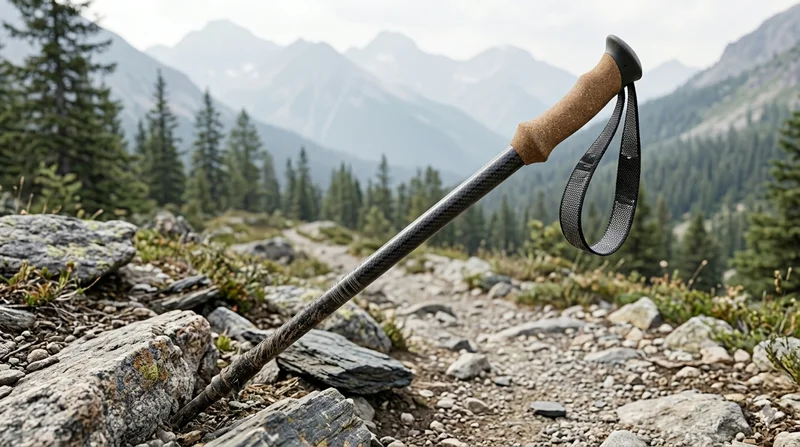
Carbon Fiber Trekking Pole
Lightweight carbon fiber trekking pole manufactured from high-grade carbon fiber tube. Weighs only 160g per pole while providing superior shock absorption and durability for hiking, trail running, and backpacking.

Round Carbon Fiber Tube — 3K Twill
Lightweight and ultra-stiff round tubes ideal for drone frames, robotics, and structural applications.