
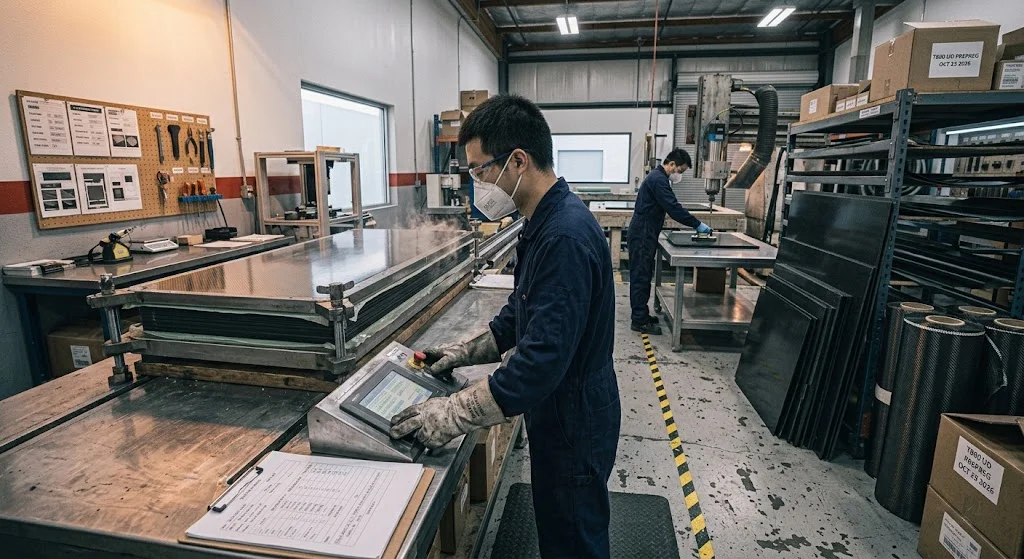
The carbon fiber plate manufacturing process turns a stack of woven or unidirectional ply into a flat panel that holds tight thickness and flatness limits across its whole area — typically ±0.1 mm on thickness for Class A plate and better than 0.5 mm/m flatness after cure. Every plate a buyer receiv
Introduction
The carbon fiber plate manufacturing process turns a stack of woven or unidirectional ply into a flat panel that holds tight thickness and flatness limits across its whole area — typically ±0.1 mm on thickness for Class A plate and better than 0.5 mm/m flatness after cure. Every plate a buyer receives is the outcome of four decisions: which fiber and resin system, which consolidation route, how the cure cycle is controlled, and how the panel is trimmed and inspected before it ships.
Understanding how to make carbon fiber plate explains most of the price spread between a hand-laid wet layup sheet and an autoclave-cured aerospace plate — often a 3-5x difference at the same nominal 3 mm thickness. This article walks the carbon fiber plate manufacturing process stage by stage, compares the consolidation routes with hard numbers, covers the carbon fiber sheet manufacturing process steps that decide void content and edge quality, and finally what changes when a project calls for carbon fiber plate custom thickness or cutouts.
Carbon Fiber Plate Manufacturing Process: From Ply Stack to Finished Panel
The process starts long before resin is introduced. Carbon fiber arrives as rolls of woven fabric (typically 200-400 g/m²) or unidirectional (UD) tape, either pre-impregnated with a calibrated resin film or dry for wet processing. Prepreg is stored at -18 °C and issued against a shelf-life clock, because resin B-stage advances even in the freezer. The sequence is then consistent across routes:
- Ply cutting and kitting: Rolls are cut to the plate outline plus trim allowance on a flatbed or ultrasonic cutter, then stacked in a documented sequence. Orientation bookkeeping matters: a [0/90]₄s and a [0/90]₂s layup look identical from outside but bend differently.
- Layup and debulk: Plies go onto a polished tool plate in order, covered with release film and a vacuum bag. Room-temperature debulk cycles remove entrapped air before full consolidation.
- Consolidation and cure: Pressure and heat are applied through one of the routes below. This is where void content, fiber volume and residual stress are set.
- Cool-down under pressure: The part cools below 40-50 °C while still pressurized. Releasing too early lets the matrix shrink against a hot tool and warp the plate.
- Trimming and inspection: Edges are CNC-routed with diamond tooling, protective film is applied, and thickness, flatness, porosity and delamination are checked before packing.
Throughput depends on the route: a wet layup plate demolds the same shift, while an autoclave plate may wait hours in queue for a cure cycle that itself runs 4-8 hours.
How to Make Carbon Fiber Plate: Three Consolidation Routes
There are three families of route, each buying a different balance of cost, void content and geometric control. The table compares them at 3 mm nominal thickness with standard-modulus T300-class fabric:
| Route | Applied pressure | Typical void content | Fiber volume | Flatness after cure | Relative cost |
|---|---|---|---|---|---|
| Wet layup + vacuum bag | ~0.1 MPa (atmospheric) | 2-4% | 45-55% | ±0.3-0.5 mm/m | 1x (lowest) |
| Resin infusion (VARTM / RTM) | 0.1 MPa vacuum + optional 0.3 MPa bag | 1-3% | 50-60% | ±0.2-0.4 mm/m | 1.5-2x |
| Prepreg + autoclave | 0.3-0.7 MPa | <1% | 55-65% | ±0.05-0.15 mm/m | 3-5x |
The mechanics are straightforward: higher pressure collapses volatiles and compacts plies, so void content falls and fiber volume rises — which is why laminate stiffness improves sharply with each route upgrade. What autoclave pressure really buys is consistency: a single low-void batch is easy with vacuum bagging, but holding <1% void over hundreds of plates requires the pressure margin an autoclave provides.
Carbon Fiber Sheet Manufacturing Process: Curing, Pressing and Trimming
After consolidation, downstream steps decide whether the finished sheet measures true. Cure control comes first: a structural epoxy plate typically cures at 120-180 °C with a 1-3 hour hold, and the ramp rate (usually 1-3 °C/min) determines how much residual stress locks in as tool and part cool at different rates.
For flat plate, matched-die hot press curing is the volume alternative to autoclave: the stack sits between heated platens at 0.5-1.5 MPa, forcing flatness by geometry rather than bag pressure alone. That constraint makes pressing the practical route for thick plates over 6 mm, where vacuum cannot generate enough compaction force.
Finishing completes the carbon fiber sheet manufacturing process:
- Edge trimming: CNC routing with diamond or PCD tooling at controlled spindle speed; running too fast burns the epoxy and opens the edge to moisture.
- Surface finishing: Peel ply leaves a uniform matte bonding surface; alternatives are light sanding (P320-P400) or a gel-coat layer for cosmetic plates.
- Non-destructive inspection: Ultrasonic C-scan maps delamination and porosity — the only reliable way to catch a dry spot under a cosmetic face.
- Flatness and thickness verification: Straightedge or laser check across diagonals, plus micrometer readings at five points, recorded against the lot number.
Carbon Fiber Plate Custom: Thickness, Cutouts and Tolerance Programs
Custom work changes the process more than most buyers expect, and usually starts from one of three requests: non-standard thickness, non-rectangular outline, or a specific stack sequence for a load case.
Thickness is easiest to vary and hardest to hold: plate thickness scales with ply count, so 2.4 mm (8 plies of 0.3 mm) is straightforward while 2.6 mm — not a whole number of plies — requires a fabric weight change or a UD overlay. Suppliers should state the tolerance they will actually hold: ±0.1 mm for press-cured plate, ±0.2 mm more realistic for hand-laid infusion above 8 mm.
Cutouts introduce stress concentration and tooling complexity. Holes up to 8 mm are usually drilled after cure; large windows are routed after cure or, for higher quality, cut in the green state with a matched die to keep fibers continuous around the opening. When an opening sits near a load path, reinforce the local layup with extra plies before cutting — this is the most common design mistake made with carbon fiber plate.
Finally, settle the tolerance program before tooling is ordered. Flatness, thickness, hole position and cosmetic grade are four separate specs; conflating them is how a plate that measures perfect gets rejected for surface waviness on a visible face.
Frequently Asked Questions
How long does the carbon fiber plate manufacturing process take from order to shipment?
Stock sizes ship from inventory. Made-to-order work takes 5-10 working days for prepreg autoclave plates (thaw, cut, cure queue, trim, inspect) and 3-7 days for wet layup or infusion. Custom tooling adds 1-2 weeks when a dedicated mold is required, and first-article inspection can add another 2-3 days.
Why is autoclave-cured plate more expensive than press-cured plate at the same thickness?
Three drivers: the autoclave is a batch machine with low throughput relative to its energy draw, prepreg costs more than dry fabric plus infusion resin, and the qualification burden is higher — every lot needs void and dimensional records. In exchange you get void content below 1%, tighter flatness and much lower plate-to-plate scatter, which is what structural programs actually pay for.
Can carbon fiber plate be welded, bonded or joined to metal?
Carbon fiber plate is joined mechanically (bolted, riveted with isolation) or adhesively with structural epoxy; it cannot be welded. When bonding to aluminum or steel, use a galvanic isolation layer — carbon fiber is cathodic to both metals and accelerates corrosion at a wet interface. Bolted joints also need oversized clearance holes and hardened washers to keep bearing stress below the matrix's capacity.
Conclusion
The carbon fiber plate manufacturing process is not one process but a family of consolidation routes chosen against cost, void content and geometric tolerance. Knowing how to make carbon fiber plate at a given quality level means specifying the route, not just the thickness: vacuum for prototypes, infusion for volume parts that need consistency, autoclave where structural scatter must stay tight.
YongXian manufactures carbon fiber plate and sheet to custom thickness, outline and tolerance, from prototype lots through series production. Browse our carbon fiber plate and panel range or contact our engineering team with your drawing for a quotation.
Part of topic
Related Articles
- How to Make Carbon Fiber Plates at Small Batch Scale
- How to Make Carbon Fiber Tubes: Filament Winding vs Roll Wrapping
- How Carbon Fiber Is Made: From PAN Precursor to Composite
- How to Cut Carbon Fiber Plate: Tools, Feed Rates and Dust Safety
- How to Cut Carbon Fiber Sheets Without Delamination
- Making Carbon Fiber Parts: From Layup to Curing
Interested in Our Products?
Contact our team for competitive pricing and technical specifications.
Get a QuoteRelated Products

Round Carbon Fiber Tube — 3K Plain Weave T700
Standard round carbon fiber tube manufactured from Toray T700 grade fiber with 3K plain weave. Offers balanced strength and stiffness for general industrial applications including robotics, automation, sports equipment, and aerospace structures.

Carbon Fiber Pickleball Paddle
High-performance pickleball paddle with Toray T700 carbon fiber face and polypropylene honeycomb core. Delivers excellent power-to-weight ratio, spin generation, and vibration dampening for competitive play.

Square Carbon Fiber Tube — 3K Twill T700
Square cross-section carbon fiber tube manufactured with 3K twill weave for torsional strength. Preferred for structural frames, trusses, and support columns where rectangular geometry offers design flexibility.
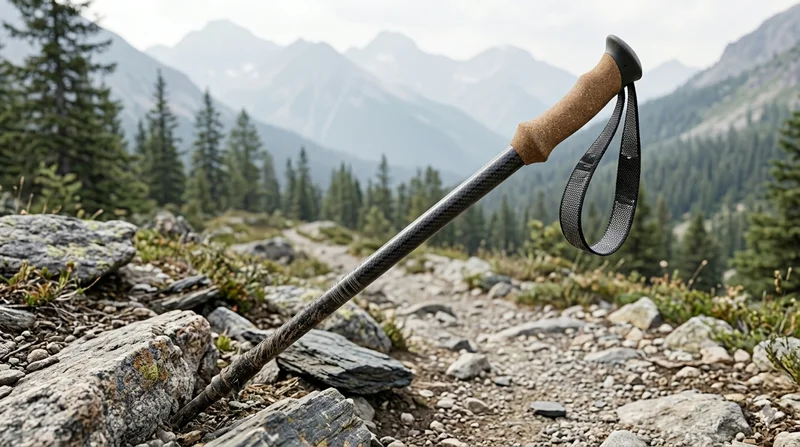
Carbon Fiber Trekking Pole
Lightweight carbon fiber trekking pole manufactured from high-grade carbon fiber tube. Weighs only 160g per pole while providing superior shock absorption and durability for hiking, trail running, and backpacking.

Carbon Fiber Plate — 3K Twill T700 3.0mm
Medium-thickness 3.0mm carbon fiber plate offering significantly higher load capacity while maintaining attractive 3K twill finish. Suitable for structural brackets, reinforcement plates, and load-bearing panels.