
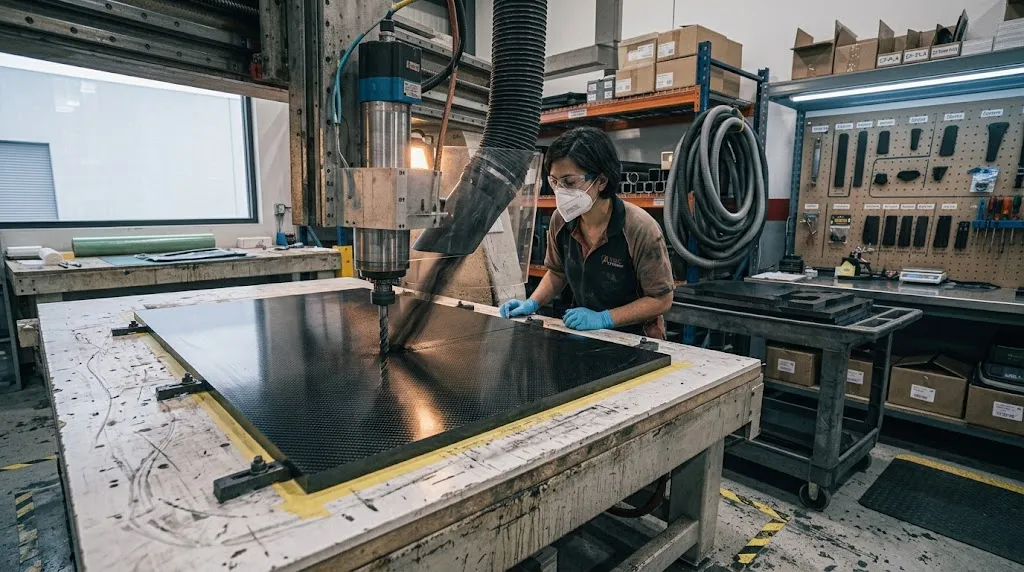
Knowing how to cut carbon fiber plate is less about raw cutting power and more about controlling three variables at once: tool sharpness, chip load, and dust. CFRP is an abrasive laminate of carbon filaments in an epoxy matrix — dull tooling frays fibers instead of severing them, an aggressive feed
Introduction
Knowing how to cut carbon fiber plate is less about raw cutting power and more about controlling three variables at once: tool sharpness, chip load, and dust. CFRP is an abrasive laminate of carbon filaments in an epoxy matrix — dull tooling frays fibers instead of severing them, an aggressive feed tears plies at the exit side, and the dust that results is both a respiratory hazard and a skin irritant. This guide covers cutting thick carbon fiber plate in the shop and on site: which process fits which thickness, practical feed and speed starting points, workholding that prevents breakout, and the extraction and PPE setup that makes the operation safe to repeat. It also covers how to cut carbon fiber rod and tube with the same tooling, notes where a carbon fiber sheet how to cut guide diverges for thin stock, and shows when it makes more sense to order parts cut-to-size as a carbon fiber plate custom job instead of cutting in-house.
Choosing a Process: How to Cut Carbon Fiber Plate from 1 to 20 mm
There is no single correct answer for how to cut carbon fiber plate — the process follows the thickness, the outline complexity and where the cutting happens:
- CNC routing (best default): diamond-coated or CVD end mills at 12,000–18,000 rpm. Accurate to ±0.1 mm, dry-cut with extraction, suits 1–10 mm plates and almost any outline. Expect tool life of 3–8 m of cut length in woven plate before edge quality drops.
- Circular saw with an abrasive or diamond blade: for straight cuts on 8–20 mm plate. Run low rpm, use a zero-clearance sacrificial board under the plate, and support the offcut — the blade exits are where delamination starts.
- Jigsaw or reciprocating saw with a fine carbide blade: only for site work and rough outlines on plates up to 6 mm thick; tooth count 18–24 TPI, short strokes, painter's tape over the cut line to limit fiber pull-out.
- Waterjet: the answer for thick plate (10–30 mm) and intricate contours; no heat, no tool wear, ±0.15–0.25 mm kerf. Dry the edge before bonding — water wicks into the laminate along cut fibers.
- Angle grinder with a diamond blade: demolition and rough sizing only, never for finished edges; heat and uncontrolled exit damage are unavoidable.
Tooling and Feed Rates for Cutting Carbon Fiber Plate
Carbon fiber wears tooling abrasively, so the economics turn on edge quality per tool, not cost per cut. These starting points assume a dry cut with strong extraction at the spindle:
| Process | Tooling | Speed / Feed Starting Point | Typical Thickness | Edge Quality |
|---|---|---|---|---|
| CNC routing | 2-flute diamond-coated end mill, 6 mm | 16,000 rpm, 1.5–2.5 m/min feed, 1–1.5 mmDOC | 1–10 mm | Clean, slightly glossy; needs sealing |
| CNC routing, stack | Compression bit, 12 mm | 12,000 rpm, 1.0–1.8 m/min | Multiple sheets stacked | Both faces clean |
| Circular saw | Diamond blade, 120+ teeth | 2,500–3,500 rpm, hand feed | 8–20 mm | Good on entry, fuzzy on exit |
| Waterjet | 0.30–0.35 mm orifice, garnet 80 mesh | 600–800 MPa, 50–200 mm/min | 5–30 mm | Matte, micro-pitted; seal before use |
| Band saw | Carbide-tipped, fine tooth | Blade speed 30–50 m/min | Up to 50 mm | Rough; requires sanding |
Two rules govern every row: never climb-cut fragile outlines in one pass — take a 0.5 mm finishing pass — and back the cut with a sacrificial board so the exit side has something to push against. When the same shop also cuts carbon fiber rod and tube, run hollow sections on a V-block at lower feed; the wall collapses long before the teeth complain.
How to Cut Carbon Fiber Plate Safely: Workholding and Dust Control
Plate that is not fully restrained vibrates, and vibration is what turns a clean cut into a delaminated edge. Clamp to a sacrificial MDF or HDPE spoilboard with tabs or a vacuum fixture, keep clamps out of the toolpath, and cut in several passes for anything over 6 mm. On the dust side, CFRP dust is a mechanical irritant and the resin fraction is a sensitizer — treat it like fine mineral dust:
- Extract at the source: a shrouded spindle or a HEPA vacuum port at the cut, minimum 400 m³/h at the hood; never blow dust off with compressed air.
- Wear PPE that fits the cut: at minimum an FFP2/N95 respirator for short bench cuts and a half-face with P3 filters for long sessions; safety glasses with side shields, since chips eject sideways.
- Contain and clean wet: wipe surfaces with a damp cloth or use a HEPA shop vacuum — dry sweeping re-suspends the fraction you most want to avoid.
- Check the local rules: several jurisdictions classify carbon fiber dust with specific exposure limits for composites work; document the control setup if you run production cutting.
After the Cut: Sealing, Inspection and When to Outsource
Once the plate is cut, the edge is open laminate: thousands of fiber ends wick moisture and abrade by hand. Light-sand with 120–180 grit, blow out (with extraction, not an open hose), and seal with a thin epoxy or polyurethane edge sealer; if the plate will be bonded later, leave a 5 mm unsealed margin instead. Inspect the cut edge under good light for pull-out and interply splits — tap-test the corner zones if the plate will carry load. If your outline has tight radii, thin tabs or thicknesses above 20 mm, compare the shop's quote against the labor and consumables of doing it yourself: that comparison is exactly where a carbon fiber plate custom cut-to-size order usually wins on both price and edge quality.
Frequently Asked Questions
What blade or bit cuts carbon fiber plate best?
For plates up to 10 mm, a 2-flute diamond-coated end mill on a CNC router gives the best combination of edge quality and tool life; abrasive general-purpose bits dull within meters. For straight cuts in 8–20 mm plate, a high-tooth-count diamond circular blade with a zero-clearance backing board is the practical shop answer. For thick or complex outlines, waterjet removes the tooling question entirely.
Can I cut carbon fiber plate with a regular circular saw?
You can, but only with a carbide or diamond blade, a fully supported offcut, eye and respiratory protection, and low feed pressure — a standard wood blade will burn, fray and delaminate the exit edge. Scribe the cut line through the face laminate first and score with a utility knife before cutting to reduce face fiber pull-out.
Why does the edge chip or delaminate when I cut?
Almost always one of three causes: dull tooling, no support under the exit side, or too aggressive a single-pass depth. Change to sharp diamond tooling, add a sacrificial board and clamp near the cut line, and finish with a 0.3–0.5 mm pass. Pre-taping the cut line and cutting at reduced feed on the final 2 mm also helps with woven plates.
Is cutting carbon fiber plate indoors safe?
Only with extraction and PPE. Carbon fiber dust is conductive and abrasive — it settles into electronics, irritates skin and airways, and the resin fraction can sensitize with repeated exposure. Cut dry with HEPA extraction at the source, wear a fitted respirator, clean wet, and keep the area off-limits to anyone without protection. Outdoors without extraction simply moves the dust problem downwind.
Conclusion
How to cut carbon fiber plate cleanly comes down to matching the process to the thickness, keeping tooling sharp and the exit supported, and treating dust as a controlled hazard rather than housekeeping. Router for most shop work, waterjet for thick and intricate parts, saws for straight site cuts — with extraction and PPE in place, edges come out dimensionally clean and ready to seal. When the geometry outgrows your tooling, send the outline out instead: cut-to-size supply is often cheaper than the consumables alone.
YongXian supplies carbon fiber plate cut to your drawing, with sealed edges and dimensional inspection included. Browse our carbon fiber plate range or contact our engineering team with your outline and thickness for a quote.
Part of topic
Related Articles
- How to Cut Carbon Fiber Sheets Without Delamination
- Making Carbon Fiber Parts: From Layup to Curing
- Filament Wound Carbon Fiber Tube: Custom Diameter and Wall Thickness Options
- Carbon Fiber Data Sheet: How to Read Tensile, Modulus and Strain Values
- Pultruded Carbon Fiber Rod: Structural Data Every Designer Should Check
- High Performance Carbon Fiber: IM and HM Grades for Demanding Loads
Interested in Our Products?
Contact our team for competitive pricing and technical specifications.
Get a QuoteRelated Products

Round Carbon Fiber Tube — 3K Plain Weave T700
Standard round carbon fiber tube manufactured from Toray T700 grade fiber with 3K plain weave. Offers balanced strength and stiffness for general industrial applications including robotics, automation, sports equipment, and aerospace structures.

Square Carbon Fiber Tube — 3K Twill T700
Square cross-section carbon fiber tube manufactured with 3K twill weave for torsional strength. Preferred for structural frames, trusses, and support columns where rectangular geometry offers design flexibility.

Carbon Fiber Pickleball Paddle
High-performance pickleball paddle with Toray T700 carbon fiber face and polypropylene honeycomb core. Delivers excellent power-to-weight ratio, spin generation, and vibration dampening for competitive play.
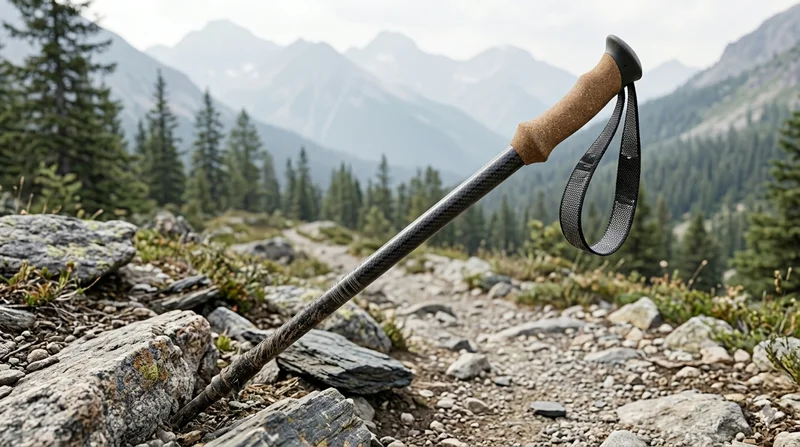
Carbon Fiber Trekking Pole
Lightweight carbon fiber trekking pole manufactured from high-grade carbon fiber tube. Weighs only 160g per pole while providing superior shock absorption and durability for hiking, trail running, and backpacking.

Round Carbon Fiber Tube — 3K Twill
Lightweight and ultra-stiff round tubes ideal for drone frames, robotics, and structural applications.