
A purchasing decision on a pultruded carbon fiber rod is only as good as the numbers behind it, and most disagreements about a shaft or brace begin with a data sheet that never said how its figures were produced. Tensile modulus, tensile strength, density, coefficient of thermal expansion, and diame
Introduction
A purchasing decision on a pultruded carbon fiber rod is only as good as the numbers behind it, and most disagreements about a shaft or brace begin with a data sheet that never said how its figures were produced. Tensile modulus, tensile strength, density, coefficient of thermal expansion, and diameter tolerance are quoted routinely, yet the same rod can appear with two modulus figures separated by twenty percent when one supplier reports a coupon average and the other reports a batch minimum. This article assembles the structural data that matters for dimensioning and load checking, shows the condensation behind a credible specification, and explains how published values become the allowables an engineer actually designs against.
The same discipline applies whether the part is a stiffener for a machine frame or one of our carbon fiber rods for sale cut to length; the data sheet, not the photograph, decides whether the part survives its first overload.
Reading a Structural Data Sheet
A complete structural data sheet separates three categories that catalogs routinely merge into one: measured material properties, process-dependent values, and guaranteed dimensional limits. Material properties belong to the fiber-and-resin system and change little between batches when the system is held constant. Process-dependent values — void content, fiber volume fraction, the exact cure profile — explain why two nominally identical rods diverge. Dimensional limits are the only column the supplier commits to contractually, so a sheet that publishes modulus but stays silent on tolerance is telling you which claims it is willing to defend.
- Material properties: tensile modulus and strength, flexural values, density, thermal expansion, Poisson ratio.
- Process indicators: fiber volume fraction (typically 55-65 percent), void content (ideally below 2 percent), cure and post-cure history.
- Dimensional limits: diameter tolerance, straightness per meter, cut-length tolerance, end-face squareness.
- Test provenance: standard referenced, specimen count, conditioning regime, and the lab that ran the series.
A family of typical values describes a product line rather than the rod that ships with your order, so request the certificate tied to your batch number. Modulus, strength, and dimensional results traced to that production run are the figures worth carrying into a calculation, and a supplier that cannot produce them is quoting a catalog instead of a process.
Pultruded Carbon Fiber Rod Material Properties
The table below condenses representative structural data for standard-modulus pultruded rod in an epoxy matrix. Treat every figure as a comparison band: the real value for your part depends on fiber architecture, cure, and specimen direction, and any supplier unable to place batch records behind these rows is selling a range, not a specification.
| Property | Typical value | Unit | Basis |
|---|---|---|---|
| Density | 1.55-1.62 | g/cm³ | Matrix and fiber volume dependent |
| Tensile modulus | 100-150 | GPa | Coupon average, axial |
| Tensile strength | 1,200-1,800 | MPa | Ultimate, axial |
| Flexural strength | 1,000-1,500 | MPa | Three-point bend |
| Compressive strength | 600-900 | MPa | Column or crush mode |
| Poisson ratio | 0.28-0.32 | - | Axial coupon |
| Thermal expansion, axial | 0 to 1 | ppm/°C | Near-zero, fiber dominated |
| Thermal expansion, radial | 25 to 35 | ppm/°C | Matrix dominated |
| Diameter tolerance | ±0.1 (standard) / ±0.05 (precision) | mm | Contractual limit |
How the Test Numbers Are Produced
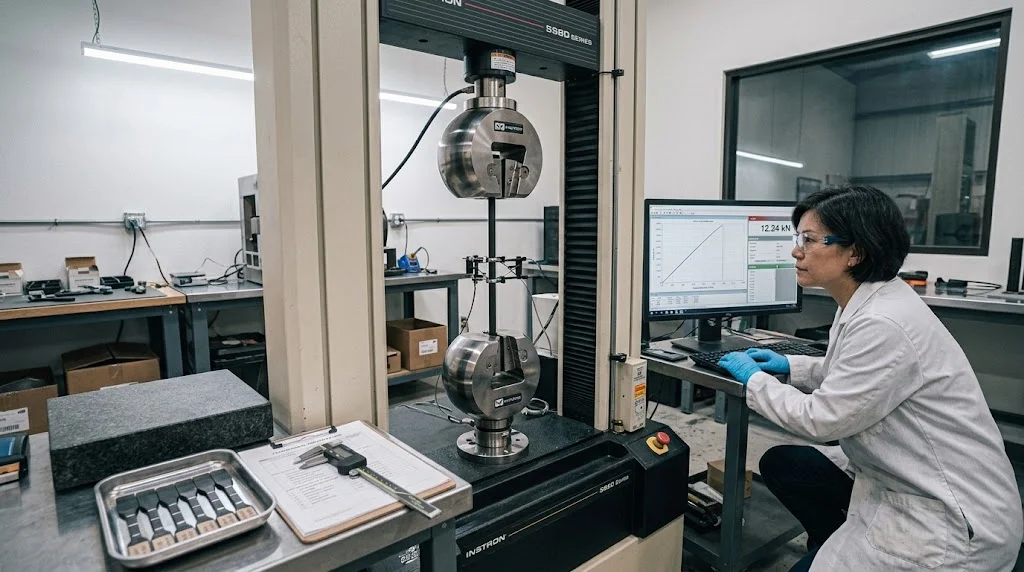
Tensile values for these coupons follow ASTM D3039, with specimens cut from production rod, tabbed where grip crush would dominate, and pulled at a constant rate until failure; flexural values follow a three-point bend arrangement with a documented span-to-depth ratio. Conditioning matters as much as geometry: as-received, humidity-equilibrated, and post-cured coupons can differ by several percent, and the data sheet should state which regime produced the headline figure. A test series of five coupons with a reported standard deviation is evidence of control; a single beautiful number with no specimen count is an advertisement.
Conditioning and specimen geometry move the numbers as much as the material does. A coupon conditioned at elevated humidity can give up several percent of matrix-dominated strength, while grip effects on a short gauge inflate apparent modulus, which is why specimen geometry and conditioning regime belong beside every figure on the sheet rather than in a footnote.
Where pultruded carbon fibre rods come from a newly tooled die, responsible suppliers rerun the series before releasing the batch, because die wear shifts fiber distribution and void content just enough to move the modulus outside the claimed band.
Pultruded Carbon Fiber Rod Dimensional Tolerances
Material data earns attention, but tolerances decide whether the part fits. Standard pultruded rod commonly holds ±0.1 mm on diameter; precision grades reach ±0.05 mm, which usually costs a slower line speed and a tighter inspection sampling plan. Straightness is specified separately — a rod that meets diameter tolerance but bows two millimeters per meter will still fail an assembly that assumes a true axis.
- Diameter: ±0.1 mm standard, ±0.05 mm precision, measured at several points along the length.
- Straightness: bow limit per meter, checked against a surface plate or roller fixture.
- Cut length: typically ±0.5 mm for machined ends, wider for saw-cut stock.
- End squareness: chamfer and squareness calls for bonded or clamped joints.
From Data Sheet to Design Allowables
The published modulus is a starting point, not a working stress. Engineers convert data-sheet values into allowables by applying knock-down factors for environment (heat, moisture, UV), duration (creep under sustained load), and scatter (batch-to-batch variation), then dividing by the chosen safety factor — three to five for static structure is common, higher where failure is catastrophic or inspection is difficult. Buckling, not material rupture, governs slender pultruded carbon fiber rod in compression long before the table's compressive strength is reached, so column checks come first. Share your load case, span, and end conditions with the engineering team and the allowable conversation becomes specific to your part instead of generic to the catalog.
Batch scatter feeds that factor directly. A process whose batch-to-batch modulus spread holds within five percent supports a leaner factor than one whose spread drifts across fifteen, and the supplier who charts that spread across a year can hand over the evidence needed to justify the difference instead of hiding it inside margin.
Frequently Asked Questions
Which data-sheet value is most often overstated?
Tensile strength carries the widest spread because it is sensitive to grip condition, fiber alignment, and void content, and headline figures sometimes come from ideal coupons rather than production batches. Ask for the specimen count, the standard followed, and the standard deviation; a modulus band with five coupons behind it usually deserves more trust than a peak strength figure with no provenance. If a supplier publishes both an average and a minimum, design against the minimum.
How does diameter tolerance interact with the modulus figures?
Indirectly but materially: stiffness of a rod in bending scales with the fourth power of diameter, so a tolerance band of ±0.1 mm on a small rod translates into several percent of stiffness scatter that no modulus number captures. Precision-grade rod narrows that scatter at a price, and assemblies with tight fit or closed-loop control are usually where that price pays for itself.
Can published structural data be used for dynamic or fatigue loading?
Static data sheets describe monotonic failure, not fatigue life; sustained-load creep and cyclic damage accumulate far below the ultimate tensile strength. For moving structures, request fatigue test data at the intended stress ratio and cycle count, or design with a substantially reduced allowable and a scheduled inspection interval. The same caution applies to thermal cycling, where the near-zero axial expansion and larger radial expansion of these rods can generate internal stress inside bonded joints.
Conclusion
Structural data is the contract between a rod and the structure it joins: modulus and strength set the ceiling, tolerances set the fit, and test provenance decides how much of the ceiling you can actually claim. Suppliers who show batch records, specimen counts, and die-change history behind the numbers are selling a controlled process — and that is what arrives with your shipment. Both the material ceiling and the dimensional contract deserve a named test method and a traceable batch behind them.
Start with your load case and required fit, then request a quote that names the standard, the tolerance class, and the conditioning regime. Browse our pultruded carbon fibre rods and profiles or send your drawing to our engineering team, and we will return data specific to your part rather than averages specific to our catalog.
Part of topic
Related Articles
- Filament Wound Carbon Fiber Tube: Custom Diameter and Wall Thickness Options
- Carbon Fiber Data Sheet: How to Read Tensile, Modulus and Strain Values
- High Performance Carbon Fiber: IM and HM Grades for Demanding Loads
- Filament Wound Carbon Fiber Tubes vs Roll Wrapped: Manufacturing and Selection
- Carbon Fiber Plate Bambu Printer Guide: Bed Compatibility and Surface Prep
- Carbon Fiber Sheet Cutting Service: CNC Routed Parts and Tolerances
Interested in Our Products?
Contact our team for competitive pricing and technical specifications.
Get a QuoteRelated Products

Round Carbon Fiber Tube — 3K Plain Weave T700
Standard round carbon fiber tube manufactured from Toray T700 grade fiber with 3K plain weave. Offers balanced strength and stiffness for general industrial applications including robotics, automation, sports equipment, and aerospace structures.

Square Carbon Fiber Tube — 3K Twill T700
Square cross-section carbon fiber tube manufactured with 3K twill weave for torsional strength. Preferred for structural frames, trusses, and support columns where rectangular geometry offers design flexibility.

Carbon Fiber Trekking Pole
Lightweight carbon fiber trekking pole manufactured from high-grade carbon fiber tube. Weighs only 160g per pole while providing superior shock absorption and durability for hiking, trail running, and backpacking.

Carbon Fiber Pickleball Paddle
High-performance pickleball paddle with Toray T700 carbon fiber face and polypropylene honeycomb core. Delivers excellent power-to-weight ratio, spin generation, and vibration dampening for competitive play.

Round Carbon Fiber Tube — 3K Twill
Lightweight and ultra-stiff round tubes ideal for drone frames, robotics, and structural applications.