
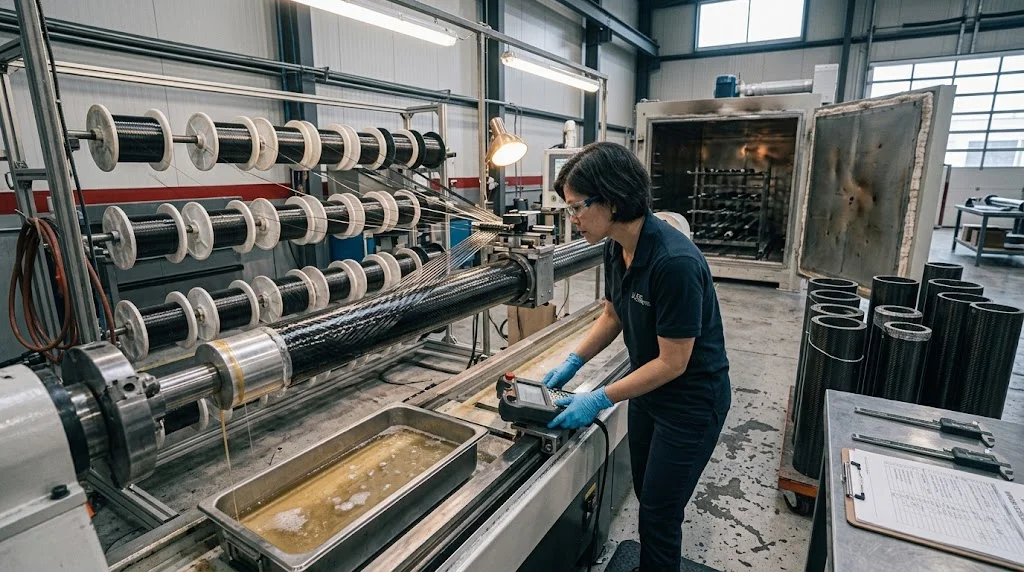
A filament wound carbon fiber tube is ordered differently from stock pultruded pipe: the diameter is set by the mandrel you or the shop loads, the wall is built up pass by pass, and the winding angle decides whether the part will be stiff in hoop, axial or both. That freedom is exactly why buyers ge
Introduction
A filament wound carbon fiber tube is ordered differently from stock pultruded pipe: the diameter is set by the mandrel you or the shop loads, the wall is built up pass by pass, and the winding angle decides whether the part will be stiff in hoop, axial or both. That freedom is exactly why buyers get quotes that vary threefold for what looks like the same part number, and why an unspecified request for a quote usually comes back with the thickest standard wall on the shelf.
This article lays out the working diameter and wall ranges for custom winding, the tolerance you can realistically hold at each size, how winding angle changes performance, and the point at which filament wound construction stops making sense against pultruded stock or roll-wrapped roll goods. Use it to write a request for a quote that a shop can answer with one number instead of three clarifying emails.
What Is a Filament Wound Carbon Fiber Tube
Continuous tow is pulled through a resin bath and wound onto a rotating mandrel at a controlled angle, layer by layer, until the calculated wall is reached; the assembly then cures under heat before the mandrel is removed or left in place. Because every pass lays fiber along a programmed path, the process builds tubes that are anisotropic by design: near-hoop winding resists internal pressure and point crush, helical angles balance axial stiffness against burst strength, and longitudinal passes add bending stiffness where the load demands it.
The same setup that makes performance tunable also fixes the practical limits. Outside diameter follows the mandrel, so each new diameter means a new tool; wall thickness is built from the fiber and resin laid down, so it moves in increments rather than in arbitrary decimals; and the mandrel decides whether the inside surface is smooth enough for a slip fit or needs a finishing pass. Shops that run filament wound carbon fiber tubes daily will ask for the mandrel diameter, the required inside or outside control surface, the load direction and the annual volume before they quote.
Winding Angle, Layers and What the Tube Is Asked to Do
Angle is the primary design variable, and it is worth settling before diameter. A tube wound close to ninety degrees behaves like a hoop vessel: excellent burst and crush resistance, weak in bending. A tube wound near zero degrees behaves like a pultrusion: stiff along the axis, vulnerable to split ends and point loads. Most structural tube work lands somewhere between thirty and fifty-five degrees, where helical passes give a usable mix of bending stiffness and damage tolerance, with one or two hoop plies added at the ends if the part sees clamping or press-fit loads.
| Winding angle | Best at | Weak at | Typical use |
|---|---|---|---|
| Close to 90 degrees (hoop) | Burst, crush, ring stiffness | Bending, end split | Pressure sections, sleeves |
| 30 to 55 degrees (helical) | Balanced stiffness, damage tolerance | Pure axial strength peak | Masts, structural tube |
| Close to 0 degrees (axial) | Bending stiffness, column load | Hoop strength, impact | Booms, spars, guides |
| Helical plus hoop plies | Clamp zones, press-fit ends | Weight, cost per part | Grip sections, fittings |
Wall thickness interacts with angle: adding hoop plies raises crush and burst quickly but adds little bending stiffness, while adding axial or helical plies raises stiffness roughly with each pass but costs the hoop margin that protects the tube where it is gripped. The practical sequence is to fix the dominant load direction first, then choose wall to meet it, then add the minority plies where the hardware loads the part locally.
Custom Filament Wound Carbon Fiber Tube: Diameter and Wall Ranges
For filament wound carbon fiber tubes built on shop mandrels, common outside diameters run from about 6 mm on small precision winders up to 300 mm and beyond on heavy machines, with the middle of the range, roughly 20 to 120 mm, carrying the best pricing because those mandrels are already tooled. Wall thickness usually starts around 0.5 mm for small diameters and steps up to 15 mm or more on large vessels; the guide bands below reflect typical production practice rather than hard machine limits.
| Outside diameter | Practical wall range | Diameter tolerance | Notes |
|---|---|---|---|
| 6 to 20 mm | 0.5 to 3 mm | Plus or minus 0.1 mm on inside | Small mandrels, slip-fit bores |
| 20 to 120 mm | 1 to 8 mm | Plus or minus 0.2 mm on inside | Best stocked tooling, shortest lead |
| 120 to 300 mm | 3 to 15 mm | Plus or minus 0.3 to 0.5 mm | New mandrel likely, plan tooling fee |
| Above 300 mm | By calculation | Per drawing agreement | Split or collapsible mandrel, longer cure |
Control surface matters as much as the numbers: if the tube must slip over a shaft, control the inside diameter and let the outside float with the layup; if it must fit a housing, control the outside and accept inside variation. Tightening tolerance beyond about plus or minus 0.05 mm on a wound part usually means a mandrel finish pass or post-cure machining, and the quote line for that operation is cheaper than discovering it after delivery. Also confirm the cut length tolerance: wound tubes are trimmed after cure, and squareness on long thin sections can drift a few tenths of a millimeter per meter unless it is specified.
Choosing Filament Wound Carbon Fiber Epoxy Tubes over Alternatives
Filament wound epoxy tubes earn their price in three situations: diameters outside pultrusion die stock, walls thicker than roll-wrapped goods carry, and parts whose winding angle must match a load direction. Below about 40 mm and in high volume, pultruded tube usually wins on price per meter because the process is continuous and the die holds tolerance without a mandrel program; above that, or for one-off and pilot builds, winding is the flexible answer because you pay for material and machine time rather than for a tooling change.
- Pick winding for custom diameters, thick walls, tuned angles, hoop reinforcement at fittings, and low to mid volumes.
- Pick pultrusion for standard sizes, long runs, tight axial properties, and lowest cost per meter.
- Pick roll-wrapping for precision outside diameters and smooth painted surfaces on small to mid diameters.
- Ask for both quotes when the diameter sits near 40 mm, because the crossover moves with fiber price and annual volume.
Resin choice follows the environment: standard epoxy suits most structural work and holds the glass transition needed for hot cabins or engine bays, vinyl ester is cheaper for corrosion service, and high-temperature systems are worth the premium only when the part actually sees sustained heat. Whatever the system, request the glass transition result and the fiber volume fraction tied to the lot number, because those two numbers explain most of the spread between a low bid and a qualified part.
Frequently Asked Questions
What is the minimum order for a custom wound tube?
Many shops will run a single sample on an existing mandrel, but production pricing usually assumes a lot of ten pieces or more once the setup, cure cycle and inspection are amortized. For a new mandrel, expect a tooling charge that does not disappear even on small lots, so if you need three sizes, it is often cheaper to agree on one mandrel diameter with a heavier wall than to tool three thin-wall variants. Ask the supplier to separate tooling, sample and series pricing in the quote so the crossover volume is visible.
Can filament wound tubes be made to a controlled inside diameter?
Yes, and it is the common choice, because the inside surface is the one molded against the mandrel: specify the mandrel diameter as your controlled inside feature, then state the wall or outside diameter as the built dimension. Tolerance on that inside surface is normally a few tenths of a millimeter for diameters under 120 mm, better if the mandrel is ground and released rather than used as-is. If both faces must be tight, budget for a finishing operation on the outside after cure.
How long does a custom wound tube take?
Against an existing mandrel, sample parts commonly ship in two to four weeks depending on cure scheduling and inspection load; a new mandrel adds one to three weeks for fabrication and release coating before any fiber is wound. Add more time if the drawing calls for post-cure machining, NDT, or a qualification batch with mechanical coupons. State the annual volume in the first email, because shops sequence pilot runs ahead of open-ended one-offs when they know a series follows.
Where do wound tubes usually fail first?
At the ends and at clamp zones: split plies initiate where the tube is cut or gripped, especially on parts wound with a heavy axial bias and no hoop reinforcement at the fitting. Specify a cleanup cut length, add hoop plies where hardware clamps the wall, and chamfer the cut ends so the first impact does not start a delamination. In service, inspect the fitting zone for fine circumferential cracks after any overload event; that is where the winding angle story shows up first.
Conclusion
Specifying a filament wound carbon fiber tube comes down to four decisions made in order: the controlled surface, the winding angle that matches the dominant load, the wall band that meets it, and the volume that determines whether winding beats pultrusion on cost. Settle those before the quote, and diameter and tolerance follow from them instead of being negotiated after the fact.
Send the load direction, controlled surface and target volume with your drawing. Browse our carbon fiber tube range or contact our engineering team and we will quote the winding schedule that fits the part instead of the mandrel already on the machine.
Part of topic
Related Articles
- Carbon Fiber Data Sheet: How to Read Tensile, Modulus and Strain Values
- Pultruded Carbon Fiber Rod: Structural Data Every Designer Should Check
- High Performance Carbon Fiber: IM and HM Grades for Demanding Loads
- Filament Wound Carbon Fiber Tubes vs Roll Wrapped: Manufacturing and Selection
- Carbon Fiber Plate Bambu Printer Guide: Bed Compatibility and Surface Prep
- Carbon Fiber Sheet Cutting Service: CNC Routed Parts and Tolerances
Interested in Our Products?
Contact our team for competitive pricing and technical specifications.
Get a QuoteRelated Products

Round Carbon Fiber Tube — 3K Plain Weave T700
Standard round carbon fiber tube manufactured from Toray T700 grade fiber with 3K plain weave. Offers balanced strength and stiffness for general industrial applications including robotics, automation, sports equipment, and aerospace structures.

Square Carbon Fiber Tube — 3K Twill T700
Square cross-section carbon fiber tube manufactured with 3K twill weave for torsional strength. Preferred for structural frames, trusses, and support columns where rectangular geometry offers design flexibility.
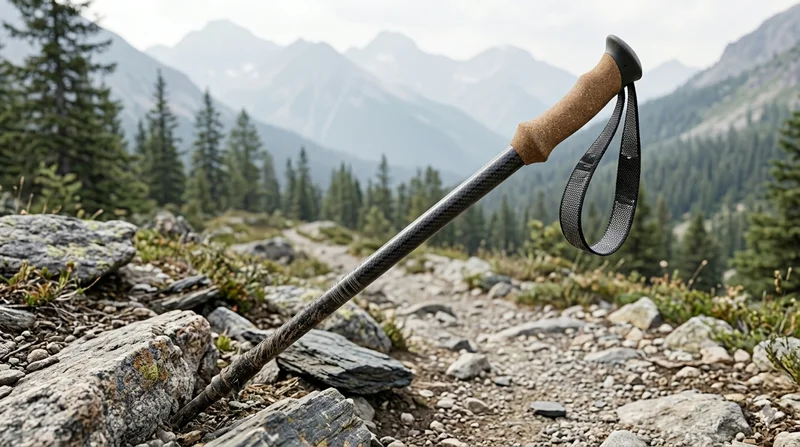
Carbon Fiber Trekking Pole
Lightweight carbon fiber trekking pole manufactured from high-grade carbon fiber tube. Weighs only 160g per pole while providing superior shock absorption and durability for hiking, trail running, and backpacking.

Carbon Fiber Pickleball Paddle
High-performance pickleball paddle with Toray T700 carbon fiber face and polypropylene honeycomb core. Delivers excellent power-to-weight ratio, spin generation, and vibration dampening for competitive play.

Round Carbon Fiber Tube — 3K Twill
Lightweight and ultra-stiff round tubes ideal for drone frames, robotics, and structural applications.