
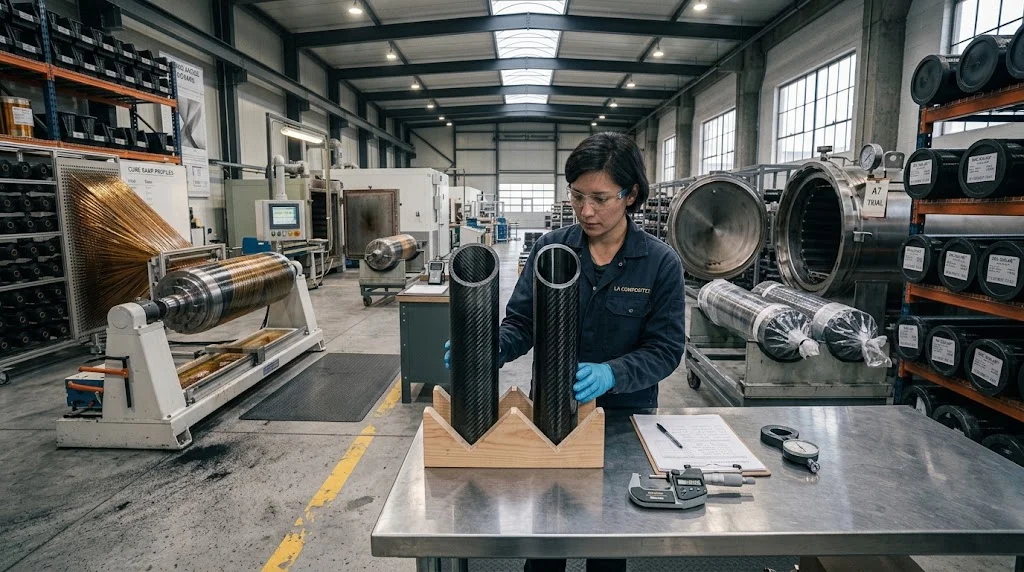
Choosing a filament wound carbon fiber tube or a roll wrapped tube is choosing where the strength sits, not which material you get. Both are carbon fiber and epoxy; the difference is how the fibers are laid on the mandrel, and that difference decides whether the tube resists crushing and internal pr
Introduction
Choosing a filament wound carbon fiber tube or a roll wrapped tube is choosing where the strength sits, not which material you get. Both are carbon fiber and epoxy; the difference is how the fibers are laid on the mandrel, and that difference decides whether the tube resists crushing and internal pressure better or resists bending and tip loads better. This article compares the two processes side by side — winding patterns, resin systems, tolerances, surface finish and price — and maps each method to the applications where it wins.
Both processes start from the same ingredients: carbon fiber tows and an epoxy resin system. What changes is the path the fiber takes from creel to mandrel, and how much control you keep over fiber angle. That control is the whole story — it decides crush resistance, bending stiffness, how the tube looks on a shelf, and what you pay per meter. Neither method is a downgrade of the other; they are two answers to two different engineering questions, and most carbon programs end up using both.
How Filament Wound Carbon Fiber Tubes Are Made
In filament winding, dry or pre-impregnated tows are pulled from creels through a resin bath or heated nip, then wound onto a rotating mandrel by a carriage that traverses back and forth. The carriage speed relative to mandrel rotation sets the fiber angle: near 90 degrees gives hoop windings that resist radial loads, while shallower helical angles lay fiber along the axis for bending stiffness. Most production filament wound epoxy tubes combine both — helical layers for axial strength, hoop bands where crushing resistance matters.
The mandrel is steel or plated aluminum, stripped after cure. Because the fiber is never cut during winding, the tube has continuous reinforcement with no seams. Wall thickness is built up layer by layer, and the outer surface carries the texture of the winding pattern unless the tube is post-ground. Open-mandrel winding (no mandrel, cure on a collapsible form) produces seamless continuous lengths that can be cut to any size — the reason filament wound tube stock ships in long standard lengths and is cut to order.
- Fiber angle is the design variable: 55-75 degree helix for balanced axial and hoop strength, 80-90 degree hoop bands for crush and pressure resistance.
- Continuous fiber: no cut ends inside the wall, so fatigue performance follows the fiber, not the resin.
- High fiber volume: typical 60-65% by volume, close to the practical ceiling for wound parts.
How Roll Wrapped Tubes Are Made
Roll wrapping starts from prepreg — carbon fiber pre-impregnated with epoxy and stored cold. Sheets are cut to width, wrapped around a polished steel mandrel under controlled tension, then bagged, vacuumed and cured in an autoclave or oven. Sometimes a layer of release film or a heat-shrink sleeve applies consolidation pressure during cure.
The advantages are orientation control and finish. Because the prepreg sheet is unidirectional, nearly all fibers can run parallel to the tube axis — maximum bending stiffness per gram. The outer ply can be a woven twill or plain-weave cosmetic layer, giving the glossy woven look buyers associate with premium carbon parts. Ends can be mandrel-shaped with step features, and the polish of the mandrel transfers directly to the inner bore, so roll wrapped tubes hold tighter bore tolerances than most wound stock. Cure cycles are slower too: bagging, vacuum hold and oven or autoclave time add hours per batch compared with continuous winding, which is where the price gap opens.
Head to Head: Filament Wound Carbon Fiber Tubes vs Roll Wrapped
The two methods produce tubes that look similar in a catalog and behave differently in a structure:
| Property | Filament wound | Roll wrapped |
|---|---|---|
| Fiber direction | Helical plus hoop, angle-tuned | Mostly axial; optional woven cosmetic ply |
| Best load case | Internal pressure, crush, torsion with hoop component | Bending, tip loads, column buckling |
| Surface finish | Winding texture; can be ground smooth | Glossy; woven outer available |
| Bore tolerance | Good after reaming; varies with mandrel | Excellent; mirror of polished mandrel |
| Typical sizes | Long stock, cut to length; large diameters economical | Short to medium runs; complex profiles |
| Relative cost | Lower per meter at volume | Higher; autoclave cycle adds cost |
Neither method is universally better. A driveshaft or pressure vessel wants the hoop and helical balance of filament winding. A drone arm or camera jib wants the axial fiber density and clean finish of roll wrapping. When a catalog lists a filament wound carbon fiber tube next to a roll wrapped tube of the same diameter and wall thickness, the wound tube is usually the cheaper workhorse and the roll wrapped tube the precision part.
Choosing Between the Two Processes
Start from the load, not the process:
- Pressure, crush or hoop-dominated loads: filament wound epoxy tubes. Helical-plus-hoop build resists ovalization under clamp loads and internal pressure without the cost of an all-axial layup that does nothing for those cases.
- Pure bending with weight at a premium: roll wrapped. Axial fiber delivers the highest second moment of mass per gram; the woven outer ply also survives handling better than wound texture.
- Long spans cut from stock: filament wound tube stock. Seamless lengths cut to size beat custom roll wrapped runs on lead time and price, and splicing two short roll wrapped sections never recovers the continuity a wound span already has.
- Tight bore fit or shaped ends: roll wrapped. Mandrel polish and near-net shaping remove secondary machining.
Resin choice follows the environment for both processes: standard epoxy for dry indoor structures, toughened epoxy for impact-prone parts, and high-temperature epoxy when the part sits near motors or in a hot enclosure. Both filament wound epoxy tubes and roll wrapped tubes accept the same resin families — the process does not lock you out of a chemistry.
Frequently Asked Questions
Are filament wound carbon fiber tubes stronger than roll wrapped tubes?
It depends on the load direction. Filament wound tubes carry more hoop and crush strength because they place fiber around the circumference; roll wrapped tubes carry more bending stiffness because they place fiber along the axis. Compare the fiber angle spec, not the process name, when two tubes claim similar numbers.
Can a filament wound tube be cut and threaded like aluminum?
Yes, with the right tooling. Use abrasive-rated cut-off wheels or diamond blades, keep the cut wet or at low feed to avoid delamination, and chase threads with sharp dies at low speed. Ream the bore if your design needs a press fit — winding texture varies bore diameter slightly before finishing.
Why do roll wrapped tubes cost more?
Prepreg material, cold storage, bagging consumables and autoclave cycles all add cost. You are paying for axial fiber density, bore tolerance and cosmetic finish. For pure structural work where those three do not matter, filament winding delivers better price performance.
Do both tube types use the same epoxy?
They use the same families — standard, toughened and high-temperature epoxy — but the formulations differ in processing: winding resins must stay wet long enough to wet out tows on the mandrel, while prepreg resins are staged for wrap-and-cure. Specify by service temperature and toughness, not by process.
Conclusion
Filament winding optimizes the circumference; roll wrapping optimizes the axis. Match the fiber angle to the load and the process to the geometry — hoop and crush want filament wound epoxy tubes, precision bending and shaped ends want roll wrapped, and long stock spans stay the economical home of the filament wound tube. For stock sizes, custom winding programs and full material specifications, browse our carbon fiber tube range. To match a process to a specific load case, contact our engineering team with your diameter, wall and load path — we answer with a process recommendation, not a brochure.
Part of topic
Related Articles
- High Performance Carbon Fiber: IM and HM Grades for Demanding Loads
- Carbon Fiber Plate Bambu Printer Guide: Bed Compatibility and Surface Prep
- Carbon Fiber Sheet Cutting Service: CNC Routed Parts and Tolerances
- Carbon Fiber Build Plate: 3D Printer Bed Materials Compared
- Pultruded Carbon Fiber: Continuous Profiles and Their Mechanical Limits
- Carbon Fiber Tube Connector: Joining Methods and Hardware
Interested in Our Products?
Contact our team for competitive pricing and technical specifications.
Get a QuoteRelated Products

Round Carbon Fiber Tube — 3K Plain Weave T700
Standard round carbon fiber tube manufactured from Toray T700 grade fiber with 3K plain weave. Offers balanced strength and stiffness for general industrial applications including robotics, automation, sports equipment, and aerospace structures.
Carbon Fiber Plate — 3K Twill T700 1.5mm
Thin 1.5mm carbon fiber plate with 3K twill weave surface. Lightweight and stiff, commonly used for covers, panels, drone bodies, and applications requiring a premium aesthetic appearance.

Carbon Fiber Pickleball Paddle
High-performance pickleball paddle with Toray T700 carbon fiber face and polypropylene honeycomb core. Delivers excellent power-to-weight ratio, spin generation, and vibration dampening for competitive play.

Square Carbon Fiber Tube — 3K Twill T700
Square cross-section carbon fiber tube manufactured with 3K twill weave for torsional strength. Preferred for structural frames, trusses, and support columns where rectangular geometry offers design flexibility.

Carbon Fiber Trekking Pole
Lightweight carbon fiber trekking pole manufactured from high-grade carbon fiber tube. Weighs only 160g per pole while providing superior shock absorption and durability for hiking, trail running, and backpacking.