
Choosing a carbon fiber tube connector is usually the decision that decides whether a frame performs like the analysis said it would or fails at the joint. Carbon fiber tube is strong along its axis and weak across it, it crushes easily under a fastener, and it bonds better than almost any structura
Introduction
Choosing a carbon fiber tube connector is usually the decision that decides whether a frame performs like the analysis said it would or fails at the joint. Carbon fiber tube is strong along its axis and weak across it, it crushes easily under a fastener, and it bonds better than almost any structural metal once the surface is prepared properly. Those three facts rule the design space: the best joint spreads load into the fibre, never points a screw at a bare wall, and gives the adhesive or the hardware a surface it can work with.
This guide compares the practical families of joint for tubular structures, from bonded sleeves and potted spigots to clamps, ferrules and quick releases, and gives the numbers needed to size them: adhesive shear strength, bond area, crush limits of the wall and typical joint efficiency. It also covers the carbon fiber tube connect sequence that determines bond quality, the role of carbon fiber tube inserts in any threaded connection, and where carbon fiber tube fittings make more sense than a pure adhesive joint.
Bonded Joints: Sleeves, Spigots and Adhesive Choice
Bonding is the default for permanent structures because it spreads load over an area instead of concentrating it at a hole. The two basic forms are an external sleeve that slips over both tube ends and an internal spigot that plugs inside the bore, and both work on the same arithmetic: load equals shear strength of the adhesive multiplied by the bond area. A typical two-part structural epoxy gives a lap shear strength of 15 to 30 megapascals on a properly prepared carbon surface, structural acrylics run 20 to 30 and polyurethanes about 10 to 20. Take a 25 millimetre outside diameter tube with a 1.0 millimetre wall and a sleeve bonded over a 75 millimetre length, and the cylindrical bond area is about 5800 square millimetres; at 20 megapascals of allowable shear that joint can carry over a hundred kilonewtons, which is more than the tube itself will take before it splits.
That is why bonded joints usually fail somewhere else: at the sleeve end where peel stress peaks, in the wall under a bad clamp, or in the laminate after a void was left in the glue line. Design rules follow from that. Put a fillet or a taper at the sleeve end to reduce peel, keep the adhesive line uniform with a shim or a machined shoulder so the tube cannot touch the sleeve wall on one side, and never let the joint sit outdoors unsealed, because moisture creeps into an unprimed interface and degrades the bond over months.
| Joint type | Typical strength basis | Best for | Main risk |
|---|---|---|---|
| External bonded sleeve | 15 to 30 MPa adhesive shear over large area | Permanent splices, frame nodes | Peel at sleeve end, voids in glue line |
| Internal bonded spigot | Shear over bore surface plus shoulder bearing | Aligning two tubes end to end | Thin wall shear area, alignment drift |
| Potted threaded insert | Bond area of insert body plus thread strength | Any bolted connection | Short bond length if insert is too stubby |
| Clamp collar with sleeve | Friction on a sleeve, limited by clamp pressure | Adjustable or demountable joints | Wall crush without a sleeve |
| Crimp ferrule | Plastic deformation of ferrule on tube | Light, low cost, repeat assemblies | Not reusable, poor in tension spikes |
| Quick release or cam lock | Hardware rating plus bearing on insert | Folding frames, quick swap rigs | Rattle, point loading at the latch |
Adhesive selection follows the service rather than the datasheet headline. Slow cure epoxies with a thirty to sixty minute pot life give time to align a node and reach full strength at room temperature overnight; five minute epoxies are for tacking a sleeve in place before the real bond, not for carrying load. Heat curing raises glass transition temperature and shear strength, which matters if the frame sits near a motor, a lamp bank or an engine bay, and a flexible toughened epoxy tolerates the difference in thermal expansion between carbon and an aluminium fitting far better than a brittle one.
Carbon Fiber Tube Fittings and Inserts for Frame Assembly
Mechanical hardware wins where a joint must come apart, be adjusted, or be serviced without destroying the tube. The safe pattern is always the same: the carbon never carries the concentrated load directly. A clamp collar closes on a sleeve or a bushing, a set screw lands on an insert rather than on laminate, and a bolt passes through a potted insert with a shoulder inside the bore so pull-out load is carried by a long bonded surface instead of by a thin ring of resin. Carbon fiber tube fittings made for this purpose — aluminium or engineering plastic connectors with a shoulder, a sleeve and a defined clamp — take the guesswork out of the joint and keep the wall out of trouble.
Wall limits set the numbers. Transverse and hoop strength of a pultruded tube sits around 40 to 80 megapascals while axial strength runs 1200 to 1800, so a fastener point load crushes the wall long before the tube reaches its rating. Insert choice follows tube size: a pressed nylon or PEEK sleeve for small bores, an anodised aluminium insert with an internal thread for M4 to M8 hardware, and a bonded flanged insert where the joint sees bending. For any threaded connection the carbon fiber tube inserts should be bonded, not merely press fitted, because a press fit loosens under vibration and thermal cycling while a bonded insert transfers load into the fibre over its whole body.
- Permanent and loaded: bond a sleeve or spigot, taper the ends, and seal the interface against moisture.
- Bolted connection: pot a threaded insert with a shoulder and size the bond length at least two to three times the outside diameter.
- Adjustable joint: clamp on a sleeve or bushing, never on bare wall, and torque to a stated value.
- Demountable frame: use fittings with a defined bearing surface so repeated assembly does not ream the bore.
- Point load anywhere: spread it with a shoulder washer, a ferrule or a local wrap before it reaches laminate.
- Outdoor or wet service: seal the joint and prefer coated or UV protected tube so the resin at the bond line is not the first thing to age.
Carbon Fiber Tube Connect: Surface Preparation and Sequence
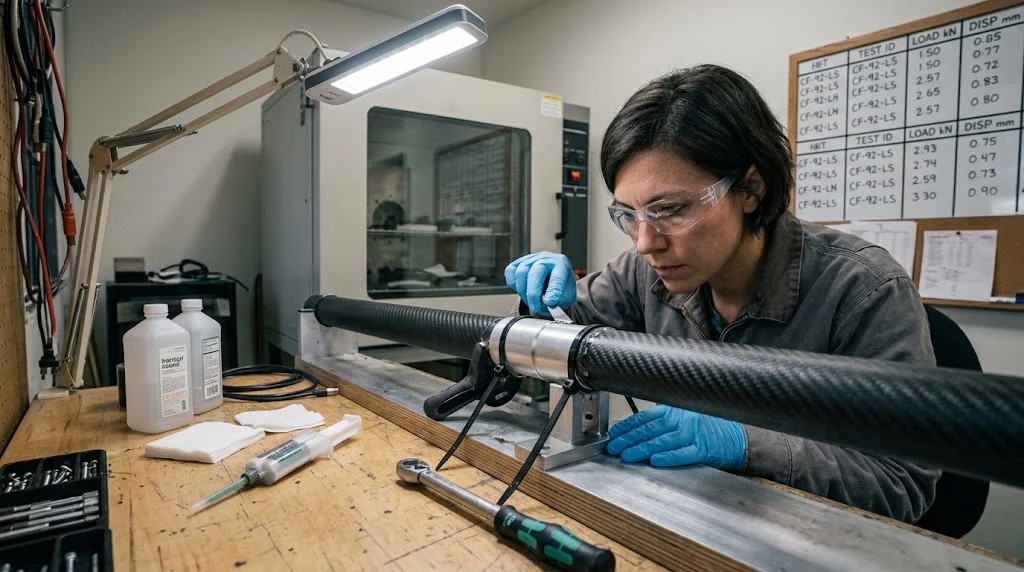
Bond strength is made or broken in the fifteen minutes before the adhesive is mixed. The sequence that works is mechanical roughening, cleaning, priming where the system calls for it, a dry fit, and then glue-up within the primer window. Scuff the bond zone with 240 to 400 grit paper until the gloss is gone and the surface is uniformly matte, wipe with isopropyl alcohol and a lint free cloth until the cloth comes away clean, and keep fingers and chips off the prepared area. A scuffed and cleaned surface routinely doubles the effective bond compared with a glossy as-pulled tube, because the adhesive keys into the scratch pattern instead of sitting on a resin skin.
The assembly steps after mixing are just as practical: coat both surfaces, assemble within the open time, hold alignment with a fixture rather than by hand, and squeeze out a uniform bead at the sleeve end so a fillet forms naturally. Wipe the excess before it gels, because cured squeeze-out has to be sanded and sanding near a thin wall risks cutting into it. Full strength arrives after the stated cure, typically twenty-four hours at room temperature or a few hours at elevated temperature, and a joint loaded before that cure will creep and lose load permanently. On a node that will see vibration, a light secondary seal over the sleeve end keeps moisture out and makes the joint inspectable.
Frequently Asked Questions
Which carbon fiber tube connector is strongest?
A bonded sleeve or spigot joint with correct surface preparation is typically the strongest option, because the adhesive spreads load over an area measured in thousands of square millimetres and develops more capacity than the tube itself. Mechanical clamps and crimps are weaker by comparison since they rely on friction and local bearing, and they are chosen for adjustability rather than for peak load. The honest answer for a given design is to compare the adhesive shear area against the tube rating, then check the peel and crush paths, because joints almost always fail at a stress concentration rather than in average shear.
Can I bolt directly through a carbon fiber tube?
Only with local reinforcement, and never as the sole load path. A hole in a thin unidirectional wall is a stress raiser and a delamination start point, and a bolt bearing on the wall crushes it at modest torque. Use a potted insert with a shoulder, back the fastener with a sleeve or bushing, and if a through bolt is unavoidable, add a local laminate patch or a thicker wall section around the hole so the joint can develop load without crushing or splitting.
How long does a bonded carbon fiber joint take to reach full strength?
Room temperature epoxies reach handling strength in a few hours and full strength after roughly twenty-four hours at ambient, while heat cured systems reach full properties faster at the temperature the manufacturer specifies. Temperature matters: a cold garage slows cure dramatically, so a joint assembled at ten degrees can be far weaker at the twenty-four hour mark than the same joint cured at twenty-three degrees. Load the assembly only after the stated cure, and re-check alignment once the adhesive has fully hardened.
Conclusion
The right carbon fiber tube connector follows the material rather than habit: bond for permanence, insert for threads, sleeve for clamps, and always move a concentrated load off the bare wall before it can crush or split the laminate. Surface preparation, bond area and crush limits explain nearly every joint failure in tubular composite structures, so those three numbers are worth checking before hardware is ordered. YongXian supplies carbon fiber tube and rod in stocked sizes alongside bonded sleeves, fittings and inserts, and our engineers will size the joint against your load, environment and assembly sequence before you commit to a design. Browse our carbon fiber products or contact us with your tube size, joint loads and whether the frame must come apart in service.
Part of topic
Related Articles
- Carbon Fiber Tube for PC: Composite Structural Parts in Custom Builds
- 3K Carbon Fiber vs Carbon Fiber: Tow Size, Weave and Mechanical Trade-Offs
- Pultruded Carbon Fiber Tubes: Properties, Standard Sizes and Design Data
- Custom Cut Carbon Fiber: Sizing, Tolerances and Cost Drivers for Sheet and Plate
- Carbon Fiber Tubes 6mm OD: Precision Small-Diameter Options
- Large Diameter Carbon Fiber Tube: Winding vs Pultrusion for Big Profiles
Interested in Our Products?
Contact our team for competitive pricing and technical specifications.
Get a QuoteRelated Products

Carbon Fiber Plate — 3K Twill T700 1.5mm
Thin 1.5mm carbon fiber plate with 3K twill weave surface. Lightweight and stiff, commonly used for covers, panels, drone bodies, and applications requiring a premium aesthetic appearance.

Carbon Fiber Plate — 3K Twill T700 3.0mm
Medium-thickness 3.0mm carbon fiber plate offering significantly higher load capacity while maintaining attractive 3K twill finish. Suitable for structural brackets, reinforcement plates, and load-bearing panels.

Square Carbon Fiber Tube — 3K Twill T700
Square cross-section carbon fiber tube manufactured with 3K twill weave for torsional strength. Preferred for structural frames, trusses, and support columns where rectangular geometry offers design flexibility.

Carbon Fiber Trekking Pole
Lightweight carbon fiber trekking pole manufactured from high-grade carbon fiber tube. Weighs only 160g per pole while providing superior shock absorption and durability for hiking, trail running, and backpacking.

Carbon Fiber Pickleball Paddle
High-performance pickleball paddle with Toray T700 carbon fiber face and polypropylene honeycomb core. Delivers excellent power-to-weight ratio, spin generation, and vibration dampening for competitive play.