
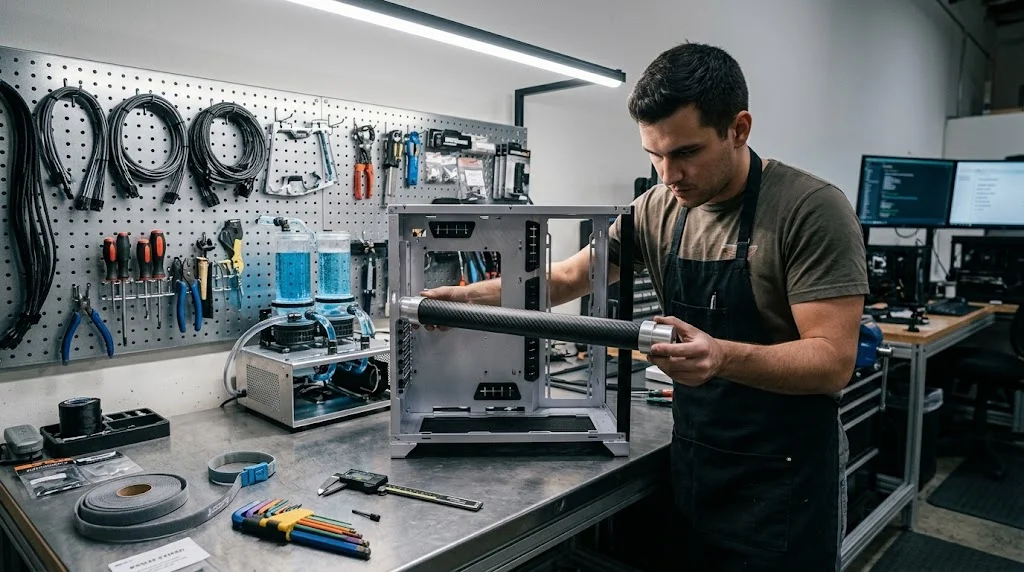
A carbon fiber tube for pc building is no longer a novelty prop; it is a structural member that happens to sit next to a motherboard. Builders reach for it when a bracket must stay rigid without adding mass, when a frame has to look like part of the machine, and when a support arm must not soften or
Introduction
A carbon fiber tube for pc building is no longer a novelty prop; it is a structural member that happens to sit next to a motherboard. Builders reach for it when a bracket must stay rigid without adding mass, when a frame has to look like part of the machine, and when a support arm must not soften or creep as the case warms up during a long render or gaming session. The material behaves differently from the steel and aluminium most cases use, and the differences that matter are stiffness per gram, dimensional stability with temperature, and electrical behaviour around live boards.
This guide covers where carbon fiber tube for pc projects actually earns its cost, which sizes fit common builds, how the tube is cut and finished, and how to mount it without shorting a trace or crushing the wall. It also explains why carbon fiber tube inserts at every mounting point are the difference between a durable build and a bracket that fails after a few thermal cycles, and how the carbon fiber tube connect method should be chosen for each joint.
Carbon Fiber Tube for PC Case Frames and GPU Brackets
The first real application is the GPU support bracket, sometimes called an anti-sag arm. Modern cards hang heavy coolers off a single slot, and the PCB flexes over months of service. A tube spanning from the case floor or a drive cage to the corner of the card takes that load in axial compression or bending, and because the modulus of a pultruded tube is roughly 120 to 150 gigapascals against 69 for aluminium, the same stiffness arrives with about forty percent less mass. The second application is the frame itself: open air benches, test rigs and custom chassis built from pillars and cross members, where a tube frame keeps the structure light, stiff and visually consistent with a black build.
Thermal behaviour is the quiet advantage. Axial coefficient of thermal expansion for a pultruded carbon fiber tube sits near zero, in the range of 0 to 1 times ten to the minus six per kelvin, against about 23 for aluminium and 11 for steel. Inside a case that swings from idle to load and back every hour, a bracket made from the tube holds its set position instead of walking with temperature, so a GPU support that is adjusted once stays adjusted. Vibration damping is also higher than metal, which helps on a pump-heavy water cooling loop where a hard line bracket would otherwise ring.
| Property | Carbon fiber tube | Aluminium tube | Steel rod |
|---|---|---|---|
| Density (g/cm3) | 1.55 to 1.65 | 2.70 | 7.85 |
| Tensile modulus (GPa) | 120 to 150 | 69 | 200 |
| Bending stiffness per gram | Highest | Medium | Low |
| Axial thermal expansion (10^-6/K) | 0 to 1 | 23 | 11 |
| Electrical conduction | Yes, along the fibre | Yes | Yes |
| Typical visual role | Visible weave, premium finish | Industrial | Hidden hardware |
Sizing follows the same rules as any small structure. Stock outside diameters run 3, 4, 5, 6, 8, 10, 12, 15, 16, 20, 25 and 30 millimetres with wall thicknesses of 0.5, 1.0, 1.5, 2.0 and 3.0 millimetres, and because bending stiffness rises with the fourth power of diameter while weight rises only with area, a fatter thin-wall tube beats a smaller thick-wall one for stiffness per gram. A GPU bracket in 16 by 14 millimetres at a 1.0 millimetre wall gives a second moment near 1300 millimetres to the fourth at about 73 grams per metre, which is far more than the two kilogram card load needs, while an 8 millimetre tube stays convenient for hand sized frames and light accessories.
Carbon Fiber Tube Inserts: Mounting and Electrical Isolation
Carbon fiber is electrically conductive: the fibre itself carries current along its axis, and a pultruded tube will happily bridge a live trace to a chassis ground if it touches both. Every mounting point therefore needs a carbon fiber tube insert or a bushing that isolates the wall from the board and spreads the clamp load. Common choices are a nylon or PEEK sleeve pressed into the bore, an anodised aluminium standoff with a polymer shoulder, or a potted threaded insert bonded into the end of the tube with a two-part epoxy. The insert does three jobs at once: it prevents bare carbon from contacting the printed circuit board, it stops a set screw or bolt from crushing a thin unidirectional wall, and it gives the joint a serviceable thread instead of a hole drilled through laminate.
Wall crush is the second failure mode builders hit. A transverse or hoop strength of a pultruded tube is only about 40 to 80 megapascals against 1200 to 1800 along the axis, so a fastener tightened directly on the wall flattens it long before the tube reaches its rated load. Spread the pressure with a shoulder washer or sleeve, torque to a modest value rather than to feel, and avoid set screws entirely against bare laminate. Where the tube must carry a threaded connection, a bonded insert with a shoulder inside the bore transfers load into the fibre over a long gluing area instead of a point.
- Isolate first: no bare carbon against PCB surfaces, standoffs or radiator fins; use a sleeve or shoulder at every interface.
- Clamp on a sleeve: use a shoulder washer or bushing so the set load lands on the insert, not on the wall.
- Bond rather than drill: a potted insert in the bore gives threads without creating a delamination start point.
- Tape the cut zone: masking tape on both sides of the cut line reduces exit splintering on a thin wall.
- Plan the joint: decide the carbon fiber tube connect method, sleeve, clamp or potted insert, before ordering lengths, because it changes the cut length.
- Ground deliberately: if the frame is meant to carry a ground, bond it in one controlled place instead of relying on an accidental contact.
Do Carbon Fiber Tubes for PC Builds Conduct Electricity and EMI?
Yes to conduction, and that has consequences in both directions. Along the fibre the tube is a conductor, with a volume resistivity in the low range for a structural material, so it can serve as a deliberate ground strap or an electromagnetic shield wall behind a pump or a set of drives if it is bonded properly. The same property means a tube routed across an open socket, an exposed VRM pad or a RGB header becomes a fault waiting for vibration to close it, and a tube touching both a screw boss and a board edge can create a ground loop that shows up as coil whine or audio noise.
The practical rule is simple: treat the tube as bare metal. Route it away from exposed contacts, isolate every mount, and if the build uses a metal side panel and a carbon frame together, decide where the single bonding point will be so currents have one path. Thermal and lighting design follows the same discipline. A carbon fiber tube blocks radio and light equally well, so it makes a clean LED channel when lined with a diffuser strip, and it will not melt or soften near a radiator the way an acrylic hard line can soften if a run sits too close to a hot fitting. Inspect the assembly after the first few heat cycles, re-check the clamp torque on inserts, and confirm that no sleeve has walked out of the bore.
Frequently Asked Questions
Is a carbon fiber tube for PC use worth the cost over aluminium?
For a visible bracket or frame member, usually yes, and for a hidden support, usually not. The tube gives roughly forty percent less mass at equal stiffness, near-zero thermal growth so a set position holds, and a woven finish that looks deliberate in a glass side panel build. Aluminium is cheaper, easier to drill and naturally conductive, which simplifies grounding. Decide by role: spend on carbon where the part is seen and where dimensional stability matters, and use aluminium where the part hides and only carries load.
Will a carbon fiber tube short out my motherboard?
Only if you let bare carbon touch live metal. The fibre conducts, so isolation is mandatory: sleeve or bush the bore, use shoulder washers at every clamp, and keep the tube away from exposed sockets and headers. With inserts fitted at each mount, the tube is no more dangerous than an aluminium stand-off, and it becomes genuinely useful if you bond it to ground in one controlled location.
How do I cut carbon fiber tube without splintering it?
Use a carbide tooth hole saw or a diamond cutoff wheel at modest speed with extraction running, keep the feed slow, and back the cut with tape on both faces of the wall. Support the tube in a vee block so it cannot spin, and finish the end with fine sandpaper on a flat surface so the face stays square for the insert. Dry carbon dust is an irritant and conductive, so wear a mask and wipe the part before assembly rather than blowing it out over the build.
Conclusion
A carbon fiber tube for pc projects is a legitimate structural part when it is chosen for the properties it actually has: high stiffness per gram, near-zero thermal expansion, good damping and a finish that belongs in a visible build. It is a liability when it is treated like plastic or like a decorative rod, because the wall is thin, the fibre conducts and the transverse strength is a fraction of the axial number. Size the tube from stiffness, isolate every mounting point with a proper insert, plan the joint before you cut, and the bracket or frame will outlast the hardware it supports. YongXian supplies pultruded carbon fiber tube, rod and sheet in stocked diameters with matched inserts and fittings, and our team will check the load, the clearances and the isolation scheme with you before cutting. Browse our carbon fiber products or contact us with your drawing, target diameter and wall, and whether you need the tubes cut to length.
Part of topic
Related Articles
- Carbon Fiber Tube Connector: Joining Methods and Hardware
- 3K Carbon Fiber vs Carbon Fiber: Tow Size, Weave and Mechanical Trade-Offs
- Pultruded Carbon Fiber Tubes: Properties, Standard Sizes and Design Data
- Custom Cut Carbon Fiber: Sizing, Tolerances and Cost Drivers for Sheet and Plate
- Carbon Fiber Tubes 6mm OD: Precision Small-Diameter Options
- Large Diameter Carbon Fiber Tube: Winding vs Pultrusion for Big Profiles
Interested in Our Products?
Contact our team for competitive pricing and technical specifications.
Get a QuoteRelated Products

Carbon Fiber Plate — 3K Twill T700 1.5mm
Thin 1.5mm carbon fiber plate with 3K twill weave surface. Lightweight and stiff, commonly used for covers, panels, drone bodies, and applications requiring a premium aesthetic appearance.

Carbon Fiber Plate — 3K Twill T700 3.0mm
Medium-thickness 3.0mm carbon fiber plate offering significantly higher load capacity while maintaining attractive 3K twill finish. Suitable for structural brackets, reinforcement plates, and load-bearing panels.

Square Carbon Fiber Tube — 3K Twill T700
Square cross-section carbon fiber tube manufactured with 3K twill weave for torsional strength. Preferred for structural frames, trusses, and support columns where rectangular geometry offers design flexibility.

Carbon Fiber Trekking Pole
Lightweight carbon fiber trekking pole manufactured from high-grade carbon fiber tube. Weighs only 160g per pole while providing superior shock absorption and durability for hiking, trail running, and backpacking.

Carbon Fiber Pickleball Paddle
High-performance pickleball paddle with Toray T700 carbon fiber face and polypropylene honeycomb core. Delivers excellent power-to-weight ratio, spin generation, and vibration dampening for competitive play.