
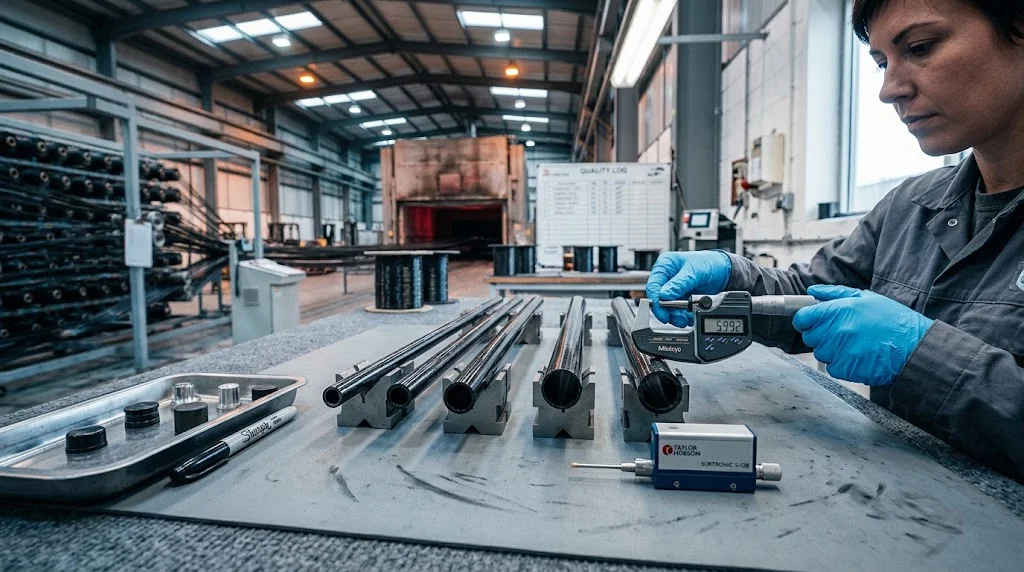
Carbon fiber tubes with 6mm OD sit at the small end of the commercial stock range, where the engineering priorities shift from raw load capacity to dimensional precision. At 6mm outside diameter, a tube is too small to carry the bending loads of a drone boom or a robot link, but it is exactly the ri
Introduction
Carbon fiber tubes with 6mm OD sit at the small end of the commercial stock range, where the engineering priorities shift from raw load capacity to dimensional precision. At 6mm outside diameter, a tube is too small to carry the bending loads of a drone boom or a robot link, but it is exactly the right size for pushrods, sensor housings, antenna masts, fishing rod tips, and the countless slender members inside test equipment and medical devices. Buyers searching for a 6mm carbon fiber tube usually have a fit already defined by a bearing, a ferrule, or a printed circuit board stack, and the purchasing question is which inner diameter and wall tolerance will actually assemble.
This article covers the standard 6mm configurations, how they compare with neighbouring sizes such as 4mm and 8mm, how a small tube relates to larger sizes like carbon fiber tube 23mm stock, and what to specify when you need a carbon fiber tube you need at 50 mm OD and 47 mm ID scaled down to miniature work.
Standard Configurations of Carbon Fiber Tubes 6mm OD
At 6mm OD, suppliers almost always quote the inner diameter directly, because wall thickness becomes the working variable. The common pultruded stock configurations are summarized below.
| Specification | 6mm OD / 5mm ID | 6mm OD / 4mm ID | 6mm OD / 3mm ID | 4mm OD / 3mm ID | 8mm OD / 6mm ID |
|---|---|---|---|---|---|
| Wall thickness | 0.5 mm | 1.0 mm | 1.5 mm | 0.5 mm | 1.0 mm |
| Weight per meter | ~4.7 g | ~9.0 g | ~12.8 g | ~3.6 g | ~16.9 g |
| Second moment of area | 0.018 mm⁴ | 0.034 mm⁴ | 0.046 mm⁴ | 0.012 mm⁴ | 0.059 mm⁴ |
| Typical OD tolerance | +/-0.05 mm | +/-0.05 mm | +/-0.05 mm | +/-0.05 mm | +/-0.08 mm |
| Standard length | 1 m / 2 m | 1 m / 2 m | 1 m / 2 m | 1 m / 2 m | 1 m / 2 m / 3 m |
| Primary use | Ferrules, antenna tips | Pushrods, sensor housings | Structural pins, thick walled inserts | Miniature linkages | Robotic fingers, camera arms |
The 1.0 mm wall version is the workhorse: stiff enough to resist handling damage, light enough for moving assemblies, and compatible with most 5mm and 4mm rod-end bearings. The 0.5 mm version behaves almost like a sleeve and is chosen when every gram counts and the tube is supported along its length. The 1.5 mm version is effectively a carbon fiber tube thick walled in miniature, used when the tube itself must carry a press-fit or a threaded insert.
Tolerances and Roundness for 6mm OD Carbon Fiber Tubes
Tolerance discipline matters more at 6mm than at 23mm or 50mm, because the same absolute error is a much larger fraction of the dimension. A commercial pultruded 6mm tube typically holds OD at +/-0.05 mm and ID at +/-0.10 mm, with roundness within 0.05 mm. Roll-wrapped tubes can be produced to tighter ID control when the mandrel is ground, but they cost more and are usually ordered to specification rather than from stock.
Three practical checks separate reliable small-diameter stock from hobby-grade tube. Measure the OD at three points along a sample length and look for ovality, which shows up as inconsistent caliper readings across rotations. Check straightness over a full meter, because a bowed 6mm tube will bind in any linear bearing. And confirm the wall is concentric: an eccentric wall shifts the neutral axis and produces asymmetric bending behavior that shows up in precision linkages.
Where 6mm Fits Against Other Diameters
Choosing 6mm is a fit decision first and a stiffness decision second.
- Below 6mm (3-4mm OD): Reserved for instrument work, antenna elements, and model aircraft pushrods. Handling fragility increases sharply, and wall options narrow to 0.3-0.8 mm.
- 6-8mm OD: The sweet spot for precision mechanical linkages, sensor housings, and lightweight camera masts. Both sizes share pultruded tooling families, so availability is good and pricing is stable.
- 10-16mm OD: Where structural applications such as small robot links and drone landing gear begin to make sense on bending stiffness alone.
- 23mm and above: Full structural territory. A carbon fiber tube 23mm stock tube handles drone booms and machine rails; scaling further to sizes like a carbon fiber tube you need 50 mm OD 47 mm id moves into pressure vessels, large rollers, and heavy-duty shafts where filament-wound construction takes over from pultrusion.
Sourcing and Fabrication Notes
Small tubes are easy to buy badly. Order from suppliers who publish tolerance tables rather than those quoting a single "6mm" size, ask whether the quoted tolerance is on the OD, the ID, or both, and request a sample length before committing to a production lot. Cutting 6mm tube requires a fine-tooth blade and a light feed: the thin wall is prone to splintering at the exit side of a chop saw, so a scored-and-snapped method or a diamond blade in a rotary tool gives a cleaner face. Bonding is the standard assembly method at this scale: sleeve the tube 8-12mm over an aluminum or steel pin, use a toughened epoxy with 0.1-0.15 mm bondline, and let the adhesive carry the interface rather than relying on a press fit alone.
Frequently Asked Questions
What inner diameter options exist for a 6mm carbon fiber tube?
Stock pultruded 6mm OD tube is commonly offered at 5mm, 4mm, and 3mm inner diameters, giving wall thicknesses of 0.5, 1.0, and 1.5 mm. The 1.0 mm wall version covers the widest range of rod-end bearings and pushrod ends. Custom ID is possible on roll-wrapped construction down to about 0.5 mm wall, at higher cost and longer lead time, since the mandrel must be ground to your dimension.
Can a 6mm OD carbon fiber tube be used as a structural member?
Only in lightly loaded or well-supported roles. The second moment of area of a 6mm tube with 1mm wall is roughly one fifth of a 10mm tube with the same wall, so bending stiffness falls off quickly with diameter. Use 6mm tube for pins, sleeves, sensor housings, and short linkages with pinned or bonded ends; step up to 10-16mm for anything that must carry significant bending over a free span.
How do I cut and finish 6mm carbon fiber tube without delaminating it?
Cut at moderate speed with a fine-tooth or diamond blade, support the offcut so it does not vibrate, and avoid abrasive wheels that generate heat and smear resin. A light countersink or chamfer on both ends removes the fray-prone exit fibers. After cutting, wipe with a slightly damp cloth to remove carbon dust, dry fully, and mask the ends before bonding so adhesive does not wick into the outer plies.
Conclusion
Carbon fiber tubes with 6mm OD are precision components first and structural parts second. The 1.0 mm wall pultruded version covers most pushrod, sensor, and linkage work; the 0.5 mm version serves weight-critical sleeves; and the 1.5 mm version handles press fits and inserts. Specify the inner diameter as carefully as the outer, demand roundness and straightness data, and cut and bond with small-diameter technique rather than treating the tube like scaled-down structural stock. YongXian manufactures pultruded and roll-wrapped carbon fiber tubes from 3mm to 50mm OD, including precision 6mm stock and custom wall configurations. View our carbon fiber tube range or contact our team with your OD, ID, tolerance, and length requirements.
Part of topic
Related Articles
- Large Diameter Carbon Fiber Tube: Winding vs Pultrusion for Big Profiles
- Carbon Fiber Rod Wrap: Roll-Wrapped Rods for High Bending Loads
- Density of Pultruded Carbon Fiber: Fiber Volume Fraction and Laminate Weight
- Custom Carbon Fiber Parts: A Buyer's RFQ Checklist That Avoids Cost Overruns
- How to Make Custom Carbon Fiber Parts: Prototype to Low-Volume Production Routes
- Custom Carbon Fiber Manufacturing: A Buyer's Capability Checklist for OEMs
Interested in Our Products?
Contact our team for competitive pricing and technical specifications.
Get a QuoteRelated Products

Carbon Fiber Plate — 3K Twill T700 1.5mm
Thin 1.5mm carbon fiber plate with 3K twill weave surface. Lightweight and stiff, commonly used for covers, panels, drone bodies, and applications requiring a premium aesthetic appearance.

Carbon Fiber Plate — 3K Twill T700 3.0mm
Medium-thickness 3.0mm carbon fiber plate offering significantly higher load capacity while maintaining attractive 3K twill finish. Suitable for structural brackets, reinforcement plates, and load-bearing panels.

Carbon Fiber Trekking Pole
Lightweight carbon fiber trekking pole manufactured from high-grade carbon fiber tube. Weighs only 160g per pole while providing superior shock absorption and durability for hiking, trail running, and backpacking.

Carbon Fiber Pickleball Paddle
High-performance pickleball paddle with Toray T700 carbon fiber face and polypropylene honeycomb core. Delivers excellent power-to-weight ratio, spin generation, and vibration dampening for competitive play.

Square Carbon Fiber Tube — 3K Twill T700
Square cross-section carbon fiber tube manufactured with 3K twill weave for torsional strength. Preferred for structural frames, trusses, and support columns where rectangular geometry offers design flexibility.