
Density of pultruded carbon fiber is one of the most frequently requested specifications from engineers designing with continuous fiber profiles. Unlike prepreg laminates where fiber volume fraction varies widely depending on layup and cure pressure, pultrusion produces remarkably consistent density
Introduction
Density of pultruded carbon fiber is one of the most frequently requested specifications from engineers designing with continuous fiber profiles. Unlike prepreg laminates where fiber volume fraction varies widely depending on layup and cure pressure, pultrusion produces remarkably consistent density values because the process combines continuous fiber tension, heated die compaction, and precise resin metering in a single pass. Understanding what determines pultruded carbon fiber density — and how to verify it — is essential for accurate weight estimation, structural analysis, and cost modeling.
Pultruded profiles are used across aerospace, automotive, civil infrastructure, and industrial applications where predictable mechanical properties and low weight are critical. The density of a pultruded carbon fiber profile directly affects its specific stiffness and specific strength, which are the key metrics for lightweight design. This article examines the factors that control density in pultruded carbon fiber, presents typical values for different fiber and resin systems, and explains how to measure and verify density in quality control.
What Determines Density of Pultruded Carbon Fiber
The density of pultruded carbon fiber is governed by three primary factors: fiber volume fraction, resin density, and void content. Fiber volume fraction (Fv) is the dominant variable — it represents the proportion of the composite cross-section occupied by carbon fiber rather than resin or voids. In pultrusion, the heated die applies continuous compaction pressure as the resin cures, achieving fiber volume fractions of 55-65% for most carbon fiber systems. Higher fiber volume fractions produce lower density because carbon fiber (approximately 1.75-1.80 g/cm³) is denser than the resin matrix (typically 1.10-1.25 g/cm³ for epoxy or vinyl ester).
Resin selection also influences density. Epoxy resins used in pultrusion typically have densities of 1.10-1.20 g/cm³, while vinyl ester resins range from 1.05-1.15 g/cm³. Polyurethane resins can be as low as 1.00-1.10 g/cm³, offering further weight reduction. Void content — microscopic air bubbles trapped during the pultrusion process — reduces density slightly but is generally kept below 2% in well-controlled pultrusion. The table below shows how these variables combine to determine the final laminate density:
| Parameter | Typical Range | Effect on Density |
|---|---|---|
| Fiber volume fraction (Fv) | 55-65% | Higher Fv = lower density |
| Carbon fiber density | 1.75-1.80 g/cm³ | Fixed by fiber type |
| Resin density (epoxy) | 1.10-1.20 g/cm³ | Lower resin density = lower composite density |
| Resin density (vinyl ester) | 1.05-1.15 g/cm³ | Slightly lower than epoxy |
| Void content | 0.5-2.0% | Higher voids = slightly lower density |
Fiber Volume Fraction and Laminate Weight Calculation
The relationship between fiber volume fraction and laminate density follows the rule of mixtures. For a pultruded carbon fiber profile with 60% fiber volume fraction using standard modulus carbon fiber (1.78 g/cm³) and epoxy resin (1.15 g/cm³), the composite density calculates as: (0.60 × 1.78) + (0.40 × 1.15) = 1.068 + 0.460 = 1.528 g/cm³. This is the value most commonly cited for pultruded carbon fiber profiles in structural design handbooks.
Laminate weight — the mass per unit area of a pultruded sheet or plate — is directly derived from density and thickness. A 3 mm thick pultruded carbon fiber plate at 1.53 g/cm³ has an areal weight of approximately 4.59 kg/m². For designers comparing pultruded profiles against aluminum (2.70 g/cm³) or steel (7.85 g/cm³), the density advantage translates directly to weight savings of 43-53% against aluminum and 80-81% against steel at equal volume.
- Standard modulus carbon fiber (T300/T700): Density 1.75-1.80 g/cm³, composite density 1.50-1.58 g/cm³ at 55-65% Fv
- High modulus carbon fiber (M40/M55J): Density 1.85-1.92 g/cm³, composite density 1.58-1.68 g/cm³ at 55-65% Fv
- Ultra-high modulus (M60J): Density 1.93-1.95 g/cm³, composite density 1.65-1.72 g/cm³ at 55-65% Fv
Comparison with Other Composite Manufacturing Processes
Pultruded carbon fiber achieves higher and more consistent fiber volume fractions than most other composite manufacturing processes. This is because pultrusion applies continuous longitudinal tension to the fibers while the heated die compacts the laminate under pressure as the resin cures. The result is a dense, void-minimized structure with fibers aligned precisely along the loading direction.
| Manufacturing Process | Typical Fv (%) | Composite Density (g/cm³) | Void Content (%) |
|---|---|---|---|
| Pultrusion (carbon fiber) | 55-65 | 1.50-1.60 | 0.5-2.0 |
| Filament winding (carbon fiber) | 50-60 | 1.45-1.58 | 1.0-3.0 |
| Prepreg autoclave (carbon fiber) | 55-62 | 1.50-1.58 | 0.5-1.5 |
| RTM / infusion (carbon fiber) | 45-55 | 1.40-1.52 | 1.5-3.5 |
| Compression molding (SMC) | 25-35 | 1.30-1.45 | 2.0-4.0 |
The data shows that pultrusion produces carbon fiber composites with density values at the lower end of the range, reflecting the high fiber volume fraction and low void content achievable with this process. For weight-critical applications, pultruded profiles offer the most predictable density values, simplifying structural calculations and reducing the need for safety factors.
Measuring and Verifying Density in Quality Control
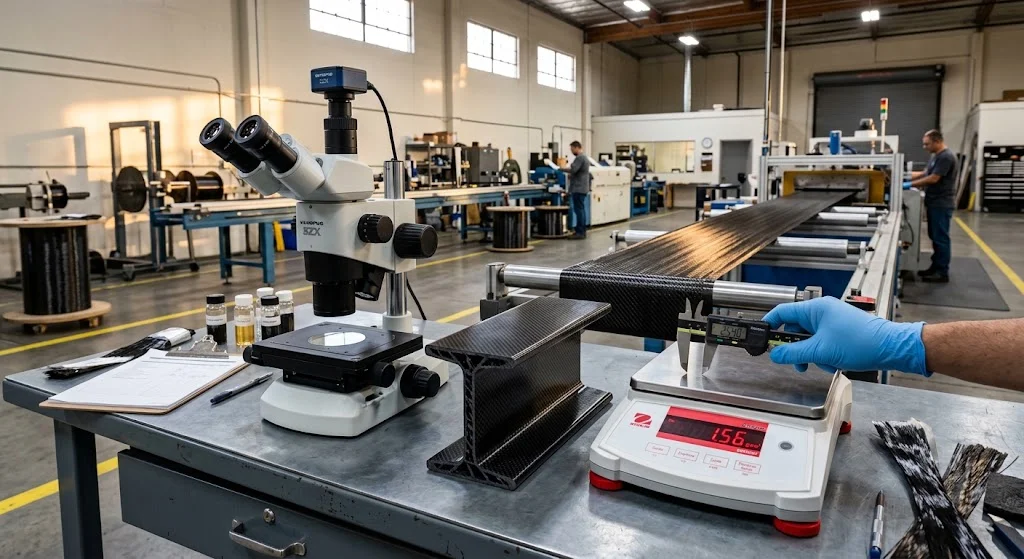
Density of pultruded carbon fiber is measured using several standardized methods. The most common is the Archimedes method (ASTM D792), which measures the sample's weight in air and in a liquid of known density to calculate volume and density. For pultruded profiles with complex cross-sections, this method provides accurate results because it measures the entire sample volume regardless of geometry.
Cross-sectional microscopy is used to verify fiber volume fraction and void content. A polished cross-section of the pultruded profile is examined under optical or scanning electron microscopy, and image analysis software calculates the area fraction of fiber, resin, and voids. This method is destructive but provides the most direct measurement of the internal structure. Acid digestion (ASTM D3171) dissolves the resin matrix, leaving the carbon fiber skeleton for weighing and calculation of fiber volume fraction.
For production quality control, most pultrusion manufacturers use a combination of Archimedes density measurement for every batch and periodic cross-sectional microscopy for verification. Density values that fall outside the expected range — typically 1.48-1.62 g/cm³ for standard carbon fiber epoxy systems — trigger investigation into fiber tension, resin temperature, or die wear issues.
Frequently Asked Questions
What is the typical density of pultruded carbon fiber profiles?
The typical density of pultruded carbon fiber profiles ranges from 1.50 to 1.60 g/cm³ for standard modulus carbon fiber (T300 or T700 grade) in an epoxy resin matrix at 55-65% fiber volume fraction. High modulus fibers (M40, M55J) produce slightly higher densities of 1.58-1.68 g/cm³ due to the higher density of the fiber itself. These values are lower than aluminum (2.70 g/cm³) and dramatically lower than steel (7.85 g/cm³), making pultruded carbon fiber an attractive choice for weight-critical structural applications.
How does fiber volume fraction affect the density of pultruded carbon fiber?
Fiber volume fraction is the primary determinant of pultruded carbon fiber density. Because carbon fiber (1.75-1.80 g/cm³) is denser than the resin matrix (1.10-1.20 g/cm³), increasing the fiber volume fraction actually increases the composite density. However, higher fiber volume fraction also increases stiffness and strength, so the slight density increase is more than offset by the mechanical property gains. Pultrusion typically achieves 55-65% Fv, compared to 45-55% for RTM or infusion processes.
Can the density of pultruded carbon fiber be customized for specific applications?
Yes, the density of pultruded carbon fiber can be adjusted within limits by changing the fiber type, resin system, and process parameters. Using lower-density resin systems such as polyurethane (1.00-1.10 g/cm³) can reduce composite density to approximately 1.45-1.50 g/cm³. Increasing fiber volume fraction through higher die pressure or lower resin viscosity also affects density. However, the achievable range is narrower than with other manufacturing processes because pultrusion is optimized for high fiber alignment and consistent quality rather than density customization.
Conclusion
Density of pultruded carbon fiber is a well-controlled property that reflects the process's ability to achieve high fiber volume fractions with minimal void content. Typical values of 1.50-1.60 g/cm³ for standard modulus carbon fiber profiles provide a 43-53% weight advantage over aluminum and 80-81% over steel, making pultrusion the preferred manufacturing method for weight-critical continuous fiber applications. Understanding the relationship between fiber volume fraction, resin selection, and composite density enables engineers to make informed material selections and accurate structural calculations.
For projects requiring pultruded carbon fiber profiles with specific density and mechanical property targets, explore our pultruded carbon fiber product range or contact our engineering team to discuss custom fiber-resin systems and process optimization for your application.
Part of topic
Related Articles
- Large Diameter Carbon Fiber Tube: Winding vs Pultrusion for Big Profiles
- Carbon Fiber Rod Wrap: Roll-Wrapped Rods for High Bending Loads
- Custom Carbon Fiber Parts: A Buyer's RFQ Checklist That Avoids Cost Overruns
- How to Make Custom Carbon Fiber Parts: Prototype to Low-Volume Production Routes
- Custom Carbon Fiber Manufacturing: A Buyer's Capability Checklist for OEMs
- Carbon Fiber Rod 1mm: Micro-Rods for Models, Tooling and Probes
Interested in Our Products?
Contact our team for competitive pricing and technical specifications.
Get a QuoteRelated Products

Carbon Fiber Plate — 3K Twill T700 1.5mm
Thin 1.5mm carbon fiber plate with 3K twill weave surface. Lightweight and stiff, commonly used for covers, panels, drone bodies, and applications requiring a premium aesthetic appearance.

Carbon Fiber Plate — 3K Twill T700 3.0mm
Medium-thickness 3.0mm carbon fiber plate offering significantly higher load capacity while maintaining attractive 3K twill finish. Suitable for structural brackets, reinforcement plates, and load-bearing panels.

Carbon Fiber Trekking Pole
Lightweight carbon fiber trekking pole manufactured from high-grade carbon fiber tube. Weighs only 160g per pole while providing superior shock absorption and durability for hiking, trail running, and backpacking.

Carbon Fiber Pickleball Paddle
High-performance pickleball paddle with Toray T700 carbon fiber face and polypropylene honeycomb core. Delivers excellent power-to-weight ratio, spin generation, and vibration dampening for competitive play.

Square Carbon Fiber Tube — 3K Twill T700
Square cross-section carbon fiber tube manufactured with 3K twill weave for torsional strength. Preferred for structural frames, trusses, and support columns where rectangular geometry offers design flexibility.