
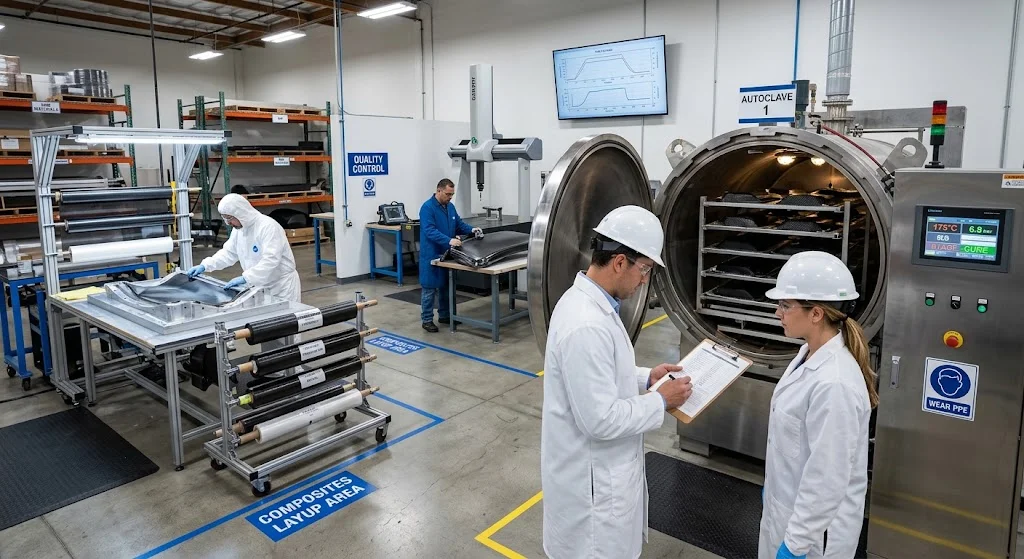
Custom carbon fiber manufacturing is a high-stakes procurement decision for OEMs. Unlike catalog purchases of standard sheets or tubes, custom carbon fiber fabrication involves tooling investment, process qualification, and multi-year supply commitments — decisions that lock an OEM into a manufactur
Introduction
Custom carbon fiber manufacturing is a high-stakes procurement decision for OEMs. Unlike catalog purchases of standard sheets or tubes, custom carbon fiber fabrication involves tooling investment, process qualification, and multi-year supply commitments — decisions that lock an OEM into a manufacturing partner for the life of a program. Yet too many sourcing decisions are made on quotation price alone, without a structured assessment of the supplier's actual capability to deliver consistent, certified parts at rate.
This article provides a practical buyer's capability checklist for evaluating custom carbon fiber manufacturing partners. It covers the five capability domains every OEM audit should examine — facility and equipment, process control, quality systems, material management, and commercial structure — with specific criteria, measurable thresholds, and the red flags that signal a supplier is not ready for OEM-grade work. Procurement teams can use this checklist as a scoring rubric during RFQ evaluation and supplier qualification.
Why Custom Carbon Fiber Manufacturing Needs a Capability Checklist
Carbon fiber parts failures rarely come from a single dramatic defect. They accumulate from process drift, material substitution, cure cycle variation, and inspection gaps that compound across thousands of units. An OEM buying custom carbon fiber assemblies for a five-year automotive program or a twenty-year aerospace structure is not just buying parts — it is buying confidence that the hundred-thousandth part will match the first-article sample. A capability checklist makes that confidence measurable.
The cost of getting it wrong is substantial. Tooling requalification after a supplier change typically costs $20,000-150,000 depending on part complexity. Line stoppages from late or nonconforming deliveries average $10,000-50,000 per incident in automotive assembly. Aerospace nonconformance dispositions can delay certification milestones by months. Against these risks, a two-day facility audit and a structured scorecard are inexpensive insurance.
Custom Carbon Fiber Manufacturing: Facility and Equipment Criteria
The first capability domain is physical infrastructure. A supplier's facility tells you whether they can hold tolerances, manage environmental conditions, and scale output. Key audit criteria include:
- Cleanroom and environmental control: Prepreg layup areas should maintain 20-24°C temperature and 40-60% relative humidity, with particulate monitoring. Unclean environments introduce foreign object inclusions and void content that ultrasonic inspection will later flag as scrap.
- Autoclave and cure equipment: Autoclave capacity (diameter × length), maximum temperature (180°C for standard epoxy, 200°C+ for high-temp systems), and pressure rating (6-7 bar typical). Multiple autoclaves or redundant capability reduce single-point failure risk for rate production.
- CNC machining capability: In-house 5-axis CNC routing with diamond-coated tooling, plus dimensional inspection via CMM or laser scanning. Outsourced machining introduces lead time variability and chain-of-custody gaps.
- Freezer and cold storage: Dedicated -18°C freezers for prepreg storage, with temperature logging and shelf-life tracking. Room-temperature prepreg storage voids material certification.
- Production floor space per program: Adequate space for dedicated layup stations, tooling storage, and WIP staging. Crowded floors correlate with mix-ups and damage events.
Process Control and Quality Systems Checklist
Equipment without process control is a liability. The second and third capability domains — process control and quality management — determine whether parts are consistently good or intermittently defective. The table below summarizes the core criteria OEM buyers should score during supplier qualification:
| Capability Domain | Criterion | Acceptable Threshold | Red Flag |
|---|---|---|---|
| Cure control | Cure cycle data logging per part | Continuous T/p logging, archived ≥ program life | Manual thermocouples only, no digital archive |
| Dimensional control | First-article + in-process CMM | FAI per AS9102; Cpk ≥ 1.33 on CTQ dims | Spot checks only, no Cpk data |
| NDT coverage | Ultrasonic inspection of structural parts | 100% UT on structural; porosity <2% | Visual only for structural parts |
| Quality system | Certification scope | AS9100 (aero) or IATF 16949 (auto) | ISO 9001 only for OEM programs |
| Traceability | Material-to-part genealogy | Fiber/resin lot tracked to finished part | Lots tracked to batch, not part serial |
| Change management | PCN / 4PCN notification | Written change procedure, customer approval | Informal notification, no written procedure |
Cpk (process capability index) values deserve special attention. A Cpk of 1.33 means the process mean sits at least four standard deviations from the nearest specification limit — the automotive industry standard for production release. Aerospace programs often require 1.67 or higher on flight-critical dimensions. A supplier who cannot produce Cpk data for critical-to-quality dimensions does not have the process control an OEM program demands.
Certification and Documentation Requirements
OEM custom carbon fiber manufacturing programs typically require a documentation package that goes far beyond a certificate of conformance. Essential documents include:
- Material certifications: Fiber grade certificates (Toray, Hexcel, or equivalent), resin batch certificates with lot numbers and cure reactivity data, and storage condition logs from receipt through layup.
- Process records:
- Inspection reports: First Article Inspection Reports (FAIR) per AS9102 for aerospace, dimensional inspection reports per drawing revision, and NDT reports (ultrasonic, thermographic) with indication mapping.
- Nonconformance and corrective action records: Open NCRs, 8D or CAPA reports for systemic issues, and evidence of closure effectiveness.
Ask prospective suppliers for a sample documentation package from a comparable program before awarding tooling. The quality of that package — completeness, clarity, consistency — predicts the quality of documentation you will receive on your program.
Commercial Red Flags During Supplier Evaluation
Technical capability is necessary but not sufficient. Commercial behavior during the RFQ and qualification phase often predicts long-term partnership quality. Watch for these warning signs:
- Quotations without lead-time commitments: A supplier who prices parts but will not commit to delivery windows is signaling capacity uncertainty or poor planning.
- Reluctance to share process data: Requests for cure cycle details, inspection procedures, or quality metrics met with resistance indicate a supplier who views process transparency as a threat rather than a trust-building necessity.
- Unusually low pricing: Quotations 30-40% below the competitive band often mean material substitution (off-grade fiber, recycled prepreg), skipped inspection steps, or loss-leader pricing that will rise after tooling is committed.
- No dedicated program manager: OEM programs need a named single point of contact with authority over scheduling, engineering changes, and escalations. Shared or rotating contacts correlate with communication failures.
- Inability to provide references: Suppliers with genuine OEM experience can provide customer references (with NDA protections) or case studies describing comparable programs.
Frequently Asked Questions
How long does supplier qualification for custom carbon fiber manufacturing typically take?
A complete OEM supplier qualification — from RFQ issue through facility audit, first-article approval, and production release — typically takes 3-6 months for non-aerospace programs and 6-12 months for aerospace or medical programs requiring Nadcap or FDA-related process approvals. Timeline depends on part complexity, tooling lead time, and the supplier's existing quality system maturity. Accelerating qualification by skipping process audits or documentation reviews is a common source of downstream quality escapes.
What certifications should a carbon fiber products manufacturer hold for automotive OEM work?
For automotive OEM programs, IATF 16949 certification is the baseline requirement, reflecting the automotive industry's process-approach quality management standard. ISO 14001 (environmental management) is increasingly expected. For aerospace OEM work, AS9100 Rev D is mandatory, with Nadcap accreditation for special processes (composites processing, NDT, chemical processing) required by most primes. Medical device programs may additionally require ISO 13485. A supplier holding only ISO 9001 may be suitable for industrial or consumer applications but typically lacks the process discipline OEM programs require.
How do I evaluate a supplier's ability to scale from prototype to rate production?
Scale readiness is assessed across four dimensions: equipment capacity (autoclave size and count, CNC hours available, freezer space), process maturity (documented work instructions, trained operator depth, statistical process control history), supply chain resilience (dual-source material qualification, buffer stock policies), and financial stability (audited financials, credit references). A supplier who excels at prototypes but has never run a multi-thousand-unit annual program may lack the planning discipline, inventory management, and shift coverage that rate production demands. Ask specifically about their largest completed annual volume for a comparable part family.
Conclusion
Custom carbon fiber manufacturing capability is not a single attribute — it is the interaction of equipment, process control, quality systems, material management, and commercial discipline. OEM buyers who structure supplier evaluation around a capability checklist — scoring facility criteria, verifying process metrics like Cpk and NDT coverage, demanding complete documentation packages, and watching for commercial red flags — dramatically reduce the risk of costly qualification failures and field quality escapes. The checklist approach also creates a common language between procurement and engineering, ensuring technical and commercial requirements are assessed together rather than in isolation.
YongXian supports OEM programs with custom carbon fiber fabrication backed by AS9100-aligned quality systems, full material traceability, and documented process control from prepreg storage through final inspection. Explore our carbon fiber product range or contact our engineering team to discuss your custom carbon fiber assemblies requirements and receive a capability questionnaire response package.
Part of topic
Related Articles
- Carbon Fiber Rod 1mm: Micro-Rods for Models, Tooling and Probes
- Filament-Wound Composites: Process Parameters for Tubular Structures
- Carbon Fiber Plate Sheets: Sizes, Grades and Sourcing Options
- What Is Pultruded Carbon Fiber? Process, Properties and Common Profiles
- Carbon Fiber Sheet Machining: Tolerances, Tooling and Process Selection
- Carbon Fiber Sheets 1/4 Thick: 1/4 Inch Plate Guide
Interested in Our Products?
Contact our team for competitive pricing and technical specifications.
Get a QuoteRelated Products

Carbon Fiber Plate — 3K Twill T700 1.5mm
Thin 1.5mm carbon fiber plate with 3K twill weave surface. Lightweight and stiff, commonly used for covers, panels, drone bodies, and applications requiring a premium aesthetic appearance.

Carbon Fiber Plate — 3K Twill T700 3.0mm
Medium-thickness 3.0mm carbon fiber plate offering significantly higher load capacity while maintaining attractive 3K twill finish. Suitable for structural brackets, reinforcement plates, and load-bearing panels.

Carbon Fiber Trekking Pole
Lightweight carbon fiber trekking pole manufactured from high-grade carbon fiber tube. Weighs only 160g per pole while providing superior shock absorption and durability for hiking, trail running, and backpacking.

Square Carbon Fiber Tube — 3K Twill T700
Square cross-section carbon fiber tube manufactured with 3K twill weave for torsional strength. Preferred for structural frames, trusses, and support columns where rectangular geometry offers design flexibility.

Carbon Fiber Pickleball Paddle
High-performance pickleball paddle with Toray T700 carbon fiber face and polypropylene honeycomb core. Delivers excellent power-to-weight ratio, spin generation, and vibration dampening for competitive play.