Filament-wound composites are tubular or cylindrical structures manufactured by winding continuous fiber tows (typically carbon fiber, glass fiber, or aramid) onto a rotating mandrel under controlled tension, then curing the resin-impregnated fibers to form a rigid composite part. Filament winding i
Introduction
Filament-wound composites are tubular or cylindrical structures manufactured by winding continuous fiber tows (typically carbon fiber, glass fiber, or aramid) onto a rotating mandrel under controlled tension, then curing the resin-impregnated fibers to form a rigid composite part. Filament winding is one of the most established composite manufacturing processes, used extensively for pressure vessels, rocket motor cases, pipe, driveshafts, helicopter rotor blades, and tubular structural members where high strength-to-weight ratio and excellent hoop (circumferential) properties are required.
The process is distinguished from other composite manufacturing methods (pultrusion, filament winding, tape laying) by its use of a rotating mandrel and the continuous winding of fiber tows, which enables precise control over fiber orientation, tension, and placement. By adjusting the winding angle — the angle of the fibers relative to the mandrel axis — engineers can tailor the composite's mechanical properties to match the expected loading conditions: high hoop strength for internal pressure vessels, high axial strength for compression members, or balanced properties for combined loading.
This article covers the filament winding process step by step, the key process parameters that determine part quality and performance, common applications for filament wound tubes and vessels, and practical guidance for selecting filament wound epoxy tubes for demanding structural and pressure applications.
The Filament Winding Process
The filament winding process involves several sequential steps, each of which must be carefully controlled to achieve consistent part quality:
- Mandrel preparation: A cylindrical mandrel (made of steel, aluminum, or soluble composite material) is cleaned, coated with a release agent, and mounted between the headstock and tailstock of the winding machine. Mandrel diameter and length define the internal geometry of the finished part.
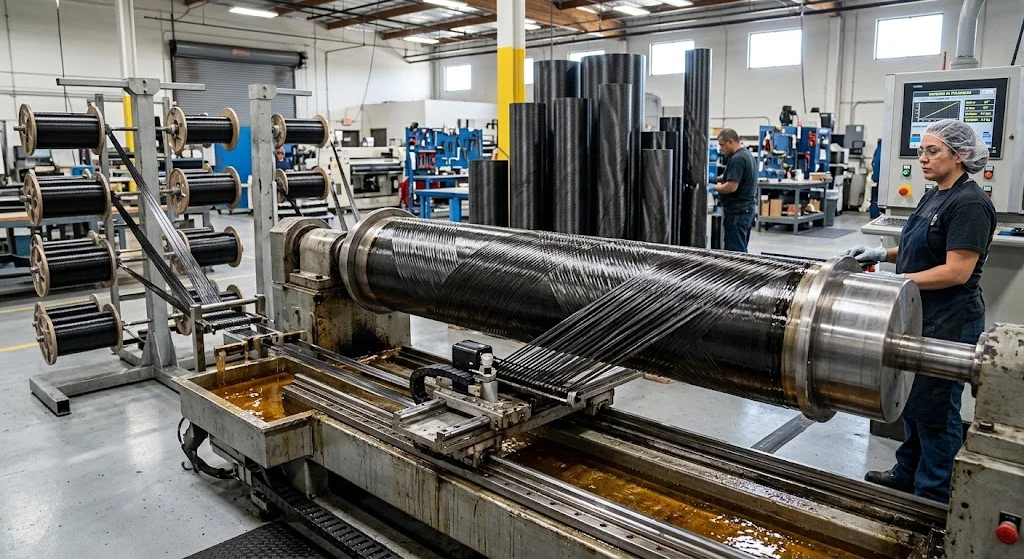
- Fiber tensioning and impregnation: Carbon fiber or glass fiber tows are unwound from creels, passed through a tensioning system, and impregnated with resin — either by passing through a resin bath (wet winding) or by using pre-impregnated towpreg (dry winding). Tension is controlled typically in the range of 5-50 N per tow, depending on fiber type and tow size, to ensure uniform compaction and fiber alignment during winding.
- Winding: The impregnated tow is wound onto the rotating mandrel by a computer-controlled carriage that traverses back and forth along the mandrel length while the mandrel rotates. The winding pattern (helical, circumferential, or polar) and winding angle are programmed to achieve the desired fiber orientation and coverage. Typical winding angles range from 10-15° (near-axial, for compression members) to 75-90° (near-hoop, for pressure vessels).
- Curing: After winding, the part is cured — typically at elevated temperature (80-180 °C, depending on resin system) either in an oven (for wet-wound parts) or in an autoclave (for high-performance applications requiring higher pressure and temperature). The cure cycle consolidates the plies, drives out volatiles, and cross-links the resin matrix to achieve final mechanical properties.
- Mandrel removal: Once cured, the part is removed from the mandrel. For internal geometries with undercuts or complex shapes, soluble mandrels (e.g., salt, sugar, or soluble polymer) or collapsible mandrels may be used. For simple cylindrical parts, rigid mandrels can be reused after reaming and re-coating.
The entire process is highly automated, with computer-controlled winding machines capable of producing complex, multi-layer wound structures with precise fiber placement and tension control. This automation enables high repeatability and consistent quality across production batches.
Key Process Parameters
The mechanical performance and quality of filament-wound composites are governed by several interacting process parameters. The table below summarizes the key parameters and their typical ranges for carbon fiber filament winding with epoxy resin:
| Parameter | Typical Range (Carbon Fiber/Epoxy) | Effect on Part Quality |
|---|---|---|
| Winding angle | 10-90° (relative to mandrel axis) | Controls balance of axial vs. hoop strength; 54.7° is the "magic angle" for equal axial and hoop stiffness |
| Fiber tension | 5-50 N per tow | Too low: fiber bridging and voids; too high: fiber breakage and mandrel deflection |
| Resin content (fiber volume fraction) | 55-70% Vf (wet winding), 40-55% Vf (towpreg) | Higher Vf increases strength and stiffness but reduces toughness and increases void sensitivity |
| Winding speed | 0.5-3 m/s (tow delivery rate) | Affects resin wet-out time, tension control, and production throughput |
| Cure temperature | 80-180 °C (epoxy systems) | Determines degree of cure, glass transition temperature (Tg), and residual stresses |
| Cure pressure | 0-7 bar (autoclave), ambient (oven cure) | Higher pressure reduces voids and improves interlaminar properties |
| Mandrel material | Steel, aluminum, soluble composite | Affects thermal expansion during cure, surface finish, and mandrel reusability |
Among these parameters, winding angle is the most influential for part performance, as it directly determines the fiber orientation relative to the expected loading. For pressure vessels, a combination of helical (±20-30°) and circumferential (85-90°) layers is typically used to balance axial and hoop stresses. For pure tension or compression members (e.g., driveshafts, structural tubes), near-axial winding (10-20°) maximizes longitudinal strength and stiffness.
Filament Wound Tubes: Specifications and Properties
Filament wound tubes are the most common filament-wound composite product, used in applications ranging from industrial driveshafts to aerospace structural members. The table below summarizes typical specifications for carbon fiber filament wound epoxy tubes:
| Parameter | Typical Range | Notes |
|---|---|---|
| Outer diameter | 10-300 mm | Smaller diameters (10-50 mm) for driveshafts and robotic arms; larger diameters (100-300 mm) for pressure vessels and pipe |
| Wall thickness | 1-30 mm | Multiple layers wound in successive passes to achieve target thickness |
| Fiber volume fraction | 55-68% | Higher Vf (60-68%) for high-performance applications; lower Vf (55-60%) for improved toughness |
| Tensile strength (axial) | 1,200-2,000 MPa | Depends on winding angle and fiber grade (standard vs. intermediate modulus) |
| Tensile modulus (axial) | 120-180 GPa | Lower than pultruded tubes due to off-axis fiber content in helical layers |
| Hoop tensile strength | 800-1,500 MPa | Dominant property for pressure vessel applications |
| Internal pressure rating | 5-200 bar (depending on diameter and wall thickness) | Design governed by hoop stress: σ = PD/(2t) for thin-wall vessels |
Filament wound tubes offer a unique combination of high hoop strength, excellent fatigue performance, and good corrosion resistance, making them ideal for rotating equipment (driveshafts, rotor shafts), pressure-containing applications (gas cylinders, pipe), and structural members requiring high torsional stiffness (masts, booms, robotic arm segments).
Applications of Filament-Wound Composites
Filament-wound composites are used across a broad range of industries, taking advantage of the process's ability to produce high-strength, lightweight tubular structures:
- Pressure vessels: Type III (metal liner) and Type IV (polymer liner) composite overwrapped pressure vessels (COPVs) for hydrogen storage, compressed natural gas (CNG), and aerospace applications. Filament winding is the dominant manufacturing process for COPVs, with carbon fiber winding providing the structural strength to contain pressures up to 700 bar.
- Aerospace: Rocket motor cases, satellite launch vehicle structures, helicopter rotor blade spars, and aircraft control actuators. Filament winding enables the production of lightweight, high-strength structures that withstand extreme internal pressures and mechanical loads.
- Industrial driveshafts: Composite driveshafts for pumps, compressors, and industrial machinery, where the high torsional stiffness and vibration damping of filament wound tubes replace heavier steel shafts, reducing energy consumption and extending bearing life.
- Marine and offshore: Filament wound tubes for ship masts, riser pipes, and underwater vehicle (ROV/AUV) buoyancy tubes, where corrosion resistance and buoyancy control are critical.
- Renewable energy: Wind turbine blade root inserts, tidal turbine shafts, and hydrogen storage tanks for fuel cell systems.
- Sports and recreation: Fishing rod blanks, bicycle frame tubes, and ski poles — consumer applications that demonstrate the material's performance at accessible price points.
Across all applications, the common value proposition is the same: a lightweight, high-strength tubular structure with tailored mechanical properties (axial vs. hoop strength, stiffness, fatigue life) achieved through precise control of filament winding process parameters.
Selecting Filament Wound Epoxy Tubes
When selecting filament wound epoxy tubes for structural or pressure applications, buyers and engineers should evaluate several key criteria:
- Fiber grade and winding pattern: Standard modulus carbon fiber (e.g., T300-class) suits most industrial applications; intermediate modulus (T800-class) is used in aerospace and high-performance applications where higher strength justifies the cost. The winding angle pattern should match the expected loading: near-hoop for pressure vessels, near-axial for driveshafts and compression members.
- Resin system: Standard epoxy resins provide a good balance of strength, toughness, and cost for general applications. High-temperature epoxy systems (service temperature up to 150-180 °C) are needed for applications involving elevated temperatures (e.g., under-hood automotive, industrial ovens). Toughened epoxy resins improve impact and delamination resistance for aerospace and defense applications.
- Dimensional tolerances: Filament wound tubes typically achieve outer diameter tolerances of ±0.2-0.5 mm and wall thickness tolerances of ±5-10%, depending on tube size and winding precision. Applications requiring tighter tolerances (e.g., precision driveshafts) may need post-winding machining (grinding or honing) of the outer surface.
- Non-destructive testing (NDT): High-performance applications (aerospace, pressure vessels) require ultrasonic inspection (UT) or X-ray CT scanning to verify the absence of voids, delaminations, and fiber misalignment. Suppliers should provide NDT reports with each production batch.
- Certification and traceability: Aerospace and pressure vessel applications require full material certification (fiber grade traceability, cure records, NDT reports) per AS9100, ISO 9001, or specific pressure vessel codes (e.g., ISO 11119, EN 12245). Buyers should verify supplier certifications and request documentation packages for regulated applications.
YongXian supplies filament wound carbon fiber tubes and custom filament-wound structures in a range of fiber grades, resin systems, and winding patterns, with full material certification and NDT inspection available for aerospace, pressure vessel, and industrial applications. Explore our carbon fiber product range or contact our engineering team to discuss your filament wound tube requirements.
Frequently Asked Questions
What is filament winding used for?
Filament winding is primarily used to manufacture high-strength tubular and cylindrical composite structures. Common applications include composite overwrapped pressure vessels (COPVs) for hydrogen and compressed natural gas storage, rocket motor cases, helicopter rotor blade spars, industrial driveshafts, pipe and riser systems, and marine masts. The process excels in applications requiring high hoop (circumferential) strength for internal pressure containment or high torsional stiffness for rotating equipment.
What is the difference between filament winding and pultrusion?
Filament winding and pultrusion are both continuous composite manufacturing processes, but they differ in how the fibers are formed and cured. In filament winding, fiber tows are wound onto a rotating mandrel under controlled tension, allowing precise control over fiber orientation (winding angle) and enabling the production of complex, multi-layer structures with tailored properties. In pultrusion, fibers are pulled through a heated die in a continuous, steady-state process that produces constant cross-section profiles with all fibers aligned in the axial direction. Filament winding is preferred for tubular, pressure-containing, and multi-directional loading applications; pultrusion is preferred for high-volume production of simple, constant cross-section profiles.
How does winding angle affect filament wound tube properties?
The winding angle — the angle of the fibers relative to the mandrel axis — is the primary design parameter for filament wound tubes, as it directly determines the balance of axial (longitudinal) and hoop (circumferential) properties. High winding angles (75-90°) maximize hoop strength for pressure vessel applications; low winding angles (10-20°) maximize axial strength and stiffness for driveshafts and compression members. An angle of approximately 54.7° (the "magic angle") provides equal axial and hoop stiffness, useful for balanced multi-directional loading. In practice, most filament wound tubes use a combination of helical (±15-45°) and circumferential (85-90°) layers to achieve the required property balance for the specific application.
What are the typical fiber volume fractions for filament wound composites?
For wet-wound filament composites (fibers impregnated with resin during winding), typical fiber volume fractions range from 55-70%, with 60-65% being most common for carbon fiber/epoxy systems. Higher fiber volume fractions (65-70%) maximize strength and stiffness but are more difficult to achieve without introducing voids. For towpreg (pre-impregnated tow) winding, fiber volume fractions are typically lower (40-55%) due to the resin content pre-impregnated into the tow, but the process offers better consistency and lower void content. For structural and pressure vessel applications, fiber volume fractions of 60-65% are generally specified to balance mechanical performance and manufacturability.
Conclusion
Filament-wound composites represent a mature, highly automated composite manufacturing process for producing high-strength tubular structures with tailored mechanical properties. By controlling key process parameters — winding angle, fiber tension, resin content, and cure cycle — engineers can optimize filament wound tubes and vessels for specific applications, from hydrogen storage pressure vessels and aerospace rocket motor cases to industrial driveshafts and marine masts.
Understanding the filament winding process, the role of winding angle in determining axial vs. hoop properties, and the quality verification methods used by reputable suppliers enables procurement teams to select filament wound epoxy tubes with confidence for demanding structural and pressure applications.
YongXian supplies filament wound carbon fiber tubes and custom filament-wound structures in a range of fiber grades, resin systems, and winding patterns, backed by full material certification and NDT inspection. Explore our carbon fiber product range or contact our engineering team to discuss your filament wound tube requirements.
Related Articles
- Custom Carbon Fiber Manufacturing: A Buyer's Capability Checklist for OEMs
- Carbon Fiber Rod 1mm: Micro-Rods for Models, Tooling and Probes
- Carbon Fiber Plate Sheets: Sizes, Grades and Sourcing Options
- What Is Pultruded Carbon Fiber? Process, Properties and Common Profiles
- Carbon Fiber Sheet Machining: Tolerances, Tooling and Process Selection
- Carbon Fiber Sheets 1/4 Thick: 1/4 Inch Plate Guide
Interested in Custom Carbon Fiber Products?
Contact our team for competitive pricing and technical specifications.
Get a Quote