
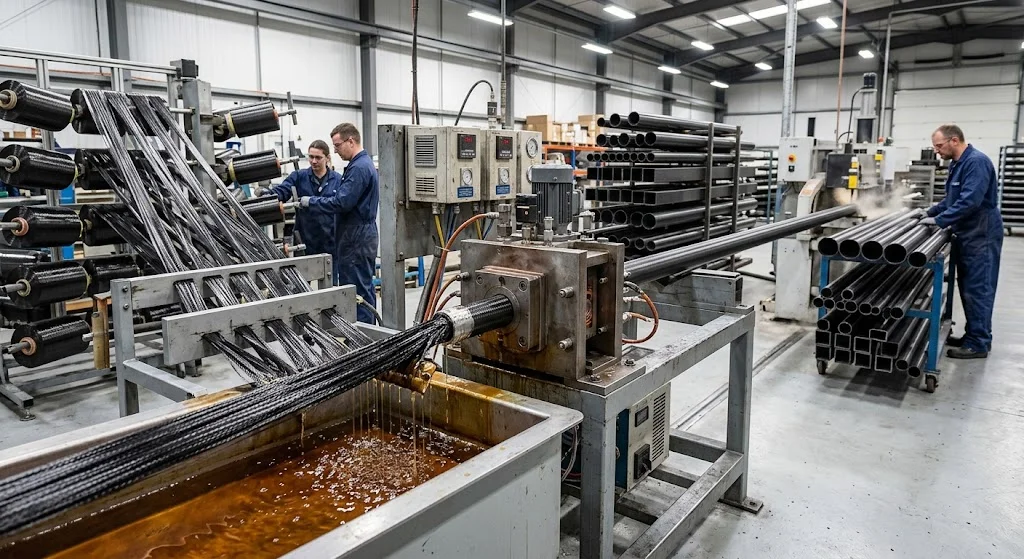
What is pultruded carbon fiber? In simple terms, it is a composite profile made by continuously pulling carbon fibers through liquid resin and then through a heated forming die that shapes and cures the material in a single, continuous operation. Unlike other composite manufacturing methods that rel
Introduction
What is pultruded carbon fiber? In simple terms, it is a composite profile made by continuously pulling carbon fibers through liquid resin and then through a heated forming die that shapes and cures the material in a single, continuous operation. Unlike other composite manufacturing methods that rely on hand layup, compression molding, or filament winding, pultrusion is a steady-state, high-volume process that produces constant cross-section profiles with excellent fiber alignment and consistent mechanical properties. Pultruded carbon fiber tubes, rods, angles, and custom profiles are widely used in aerospace, robotics, renewable energy, marine, and industrial applications where lightweight, corrosion-resistant structural members are required.
For engineers and procurement teams evaluating composite materials, understanding what pultruded carbon fiber is — and what it is not — is essential for selecting the right material system. This article covers the pultrusion process step by step, the mechanical properties and density of pultruded carbon fiber, the common profile shapes available, and practical guidance for sourcing pultruded carbon fiber tubes for demanding structural applications.
The Pultrusion Process Step by Step
Pultrusion (from "pull" + "extrusion") is a continuous manufacturing process in which reinforcing fibers are pulled through a series of stations that impregnate, form, and cure the composite. The basic sequence is as follows:
- Fiber creel and tensioning: Carbon fiber rovings and/or织 fabrics are unwound from creels and guided through a tensioning system that ensures uniform fiber alignment and consistent feed rate. Tension control is critical — too little tension causes fiber waviness, while too much can break individual filaments.
- Resin impregnation: The fibers pass through a resin bath or injection chamber containing thermoset resin (typically epoxy, vinyl ester, or polyester). The resin wets the fibers completely, and excess resin is removed by metering plates or rollers to achieve the target fiber volume fraction, typically 55-70% for pultruded carbon fiber.
- Forming and curing: The impregnated fibers enter a heated steel die whose cross-sectional shape defines the final profile geometry. The die is maintained at 120-200 °C (depending on resin system), and the resin cures as the material is pulled through. Line speeds typically range from 0.3-2 meters per minute depending on profile thickness and resin chemistry.
- Continuous pulling: A puller mechanism ( reciprocating clamps or continuous belt puller) grips the cured profile downstream of the die and pulls it at constant speed. This continuous pulling action is what distinguishes pultrusion from extrusion, where material is pushed through a die.
- Cutting to length: An inline saw or abrasive cutter cuts the continuous profile to specified lengths without stopping the line, enabling high-throughput production of pultruded carbon fiber tubes and other shapes.
The entire process is highly automated and well suited to long production runs of constant cross-section profiles. Because the fibers are continuously pulled and aligned in the axial direction, pultruded carbon fiber exhibits excellent unidirectional mechanical properties — tensile strength and stiffness in the fiber direction that approach the theoretical limits of the carbon fiber itself.
Mechanical Properties and Density of Pultruded Carbon Fiber
The mechanical properties of pultruded carbon fiber depend primarily on the fiber type (standard modulus, intermediate modulus, or high modulus), fiber volume fraction, and resin system. The density of pultruded carbon fiber is typically in the range of 1.55-1.65 g/cm³, depending on fiber content — this is approximately one-fifth the density of steel (7.85 g/cm³) and about two-thirds that of aluminum (2.70 g/cm³), giving carbon fiber composites a significant specific strength and specific stiffness advantage.
The table below summarizes typical mechanical properties for pultruded carbon fiber profiles using standard modulus carbon fiber (e.g., T300-class) with epoxy resin:
| Property | Typical Value (Standard Modulus CF, 60% Vf) | Comparison: Aluminum 6061-T6 |
|---|---|---|
| Density | 1.58-1.62 g/cm³ | 2.70 g/cm³ |
| Tensile strength (axial) | 1,500-2,000 MPa | 310 MPa |
| Tensile modulus (axial) | 135-150 GPa | 69 GPa |
| Compressive strength (axial) | 1,200-1,500 MPa | 276 MPa |
| Flexural strength | 1,400-1,800 MPa | 228 MPa |
| Poisson's ratio | 0.27-0.30 | 0.33 |
These properties make pultruded carbon fiber attractive for weight-critical structural applications, but designers must account for the material's orthotropic nature: properties in the transverse (radial) direction and through-thickness are significantly lower than axial properties, typically by a factor of 5-10 in strength. Pultruded carbon fiber tubes and profiles should be loaded primarily along the fiber axis to take full advantage of their mechanical performance.
Common Pultruded Carbon Fiber Profiles
Pultrusion can produce a wide range of constant cross-section profiles. The most common shapes available from composite suppliers include:
- Tubes: Round, square, and rectangular pultruded carbon fiber tubes are the most widely used profile. Applications include robotic arms, driveshafts, bicycle frames, mast and spar structures, and telescoping poles. Tube diameters typically range from 3 mm to 150 mm, with wall thicknesses from 0.5 mm to 10 mm.
- Rods: Solid round rods from 1 mm to 50 mm diameter, used in tension members, antenna masts, golf club shafts, and fishing rod blanks.
- Angles (L-profiles): Equal-leg and unequal-leg angles used as structural framing members, stiffeners, and edge reinforcements in lightweight assemblies.
- Channels (U-profiles): Structural channels for beam and frame construction, offering a good balance of bending stiffness and low weight.
- I-beams and T-beams: Pultruded I and T sections for applications requiring high bending stiffness, such as overhead crane rails and bridge deck stringers.
- Flat bars and strips: Pultruded carbon fiber flat bars for reinforcement strips, edge protectors, and composite-metal hybrid designs.
- Custom profiles: Pultrusion dies can be designed to produce almost any constant cross-section shape, including multi-cavity profiles and hybrid shapes with glass fiber or aramid inclusions for tailored properties.
Among these, pultruded carbon fiber tubes dominate the market due to their versatility, excellent bending and torsional stiffness, and suitability for both structural and dynamic (vibrating) applications. When selecting pultruded carbon fiber tubes, key parameters include outer diameter, wall thickness, fiber volume fraction, fiber modulus grade, and resin system (standard epoxy for general use, or high-temperature epoxy, vinyl ester, or polyurethane for specialized environments).
Applications of Pultruded Carbon Fiber
Pultruded carbon fiber profiles are used across a broad range of industries:
- Robotics and automation: Lightweight robotic arms, end effectors, and linear motion rails where low inertia enables faster cycle times and higher precision.
- Aerospace and UAVs: Structural spars, stringers, and secondary structure where high specific stiffness and fatigue resistance are required.
- Renewable energy: Wind turbine blade spar caps (pultruded planks), hydrofoil struts, and solar panel mounting systems.
- Marine: Masts, booms, spars, and fishing rod blanks that benefit from carbon fiber's corrosion resistance and high stiffness-to-weight ratio.
- Industrial equipment: Print rollers, conveyor rollers, and inspection arms where dimensional stability and corrosion resistance are important.
- Sports and recreation: Bicycle frames, ski poles, and tent poles — consumer applications that demonstrate the material's mechanical performance at scale.
The common thread across these applications is the need for a constant cross-section structural member with high specific stiffness, excellent fatigue performance, and resistance to environmental degradation — properties that pultruded carbon fiber delivers consistently.
How to Source Pultruded Carbon Fiber Tubes
When sourcing pultruded carbon fiber tubes, buyers should evaluate suppliers on several criteria:
- Fiber grade and certification: Aerospace-grade applications may require certified carbon fiber (e.g., Toray T300, T700, or equivalent) with full traceability. Industrial applications can often use standard commercial-grade fiber at lower cost.
- Dimensional tolerance: Pultruded tubes typically achieve outer diameter tolerances of ±0.1-0.3 mm and wall thickness tolerances of ±5-10%, depending on profile size. Tighter tolerances may require post-processing (precision grinding or honing).
- Resin system selection: Standard epoxy suits most applications; high-temperature epoxy (continuous service up to 150-180 °C) is needed for under-hood automotive or industrial oven applications. Vinyl ester offers better corrosion resistance for chemical environments.
- Minimum order quantity (MOQ): Pultrusion is most economical at high volume, but many suppliers offer stock tubes in standard sizes with low MOQ, and custom pultrusion runs with MOQs typically starting at 100-500 meters per profile.
- Value-added services: Cutting to length, CNC machining (drilling, milling), surface finishing, and bonding of end fittings can simplify assembly and reduce total cost.
YongXian supplies pultruded carbon fiber tubes, rods, and custom profiles in a range of fiber grades and resin systems, with cutting and machining services available to meet project-specific requirements. Our engineering team can help select the right profile geometry and material system for structural, robotics, and industrial applications.
Frequently Asked Questions
What is pultruded carbon fiber used for?
Pultruded carbon fiber is used in structural applications requiring lightweight, high-stiffness constant cross-section profiles. Common uses include robotic arms, aerospace spars and stringers, wind turbine blade components, marine masts and spars, industrial rollers, and sports equipment such as bicycle frames and ski poles. The material is particularly valued in applications where low weight, high specific stiffness, and corrosion resistance are critical.
What is the density of pultruded carbon fiber?
The density of pultruded carbon fiber typically ranges from 1.55 to 1.65 g/cm³, depending on fiber volume fraction and resin content. For a typical pultruded tube with 55-65% carbon fiber volume fraction, the density is approximately 1.58-1.62 g/cm³. This is about 58% lower than aluminum (2.70 g/cm³) and 80% lower than steel (7.85 g/cm³), giving carbon fiber composites a significant weight advantage in structural applications.
How do pultruded carbon fiber tubes compare to roll-wrapped or pultrusion-wound tubes?
Pultruded carbon fiber tubes are made in a continuous process with fibers aligned strictly in the axial (0°) direction, giving them excellent axial tensile and compressive properties but relatively lower transverse and hoop strength. Roll-wrapped or filament-wound tubes, by contrast, can incorporate fibers at multiple orientations (e.g., ±45°, 90°) to improve torsional, hoop, or multi-directional strength. For pure axial loading applications, pultruded tubes offer the best cost-performance ratio; for combined loading (torsion, internal pressure), multi-directional wound or layup tubes may be preferred.
Can pultruded carbon fiber tubes be machined or bonded?
Yes. Pultruded carbon fiber tubes can be cut, drilled, and CNC machined using standard composite tooling — diamond-coated or carbide cutting tools with proper dust extraction are recommended to manage abrasive carbon dust. Tubes can also be bonded with structural adhesives (epoxy, polyurethane), pinned, or mechanically fastened. When bonding, surface preparation (sanding and solvent cleaning) is important to ensure reliable adhesive joints.
Conclusion
Pultruded carbon fiber is a versatile, high-performance composite material manufactured by a continuous pulling process that produces constant cross-section profiles with excellent axial mechanical properties and low density (1.55-1.65 g/cm³). Understanding the pultrusion process, mechanical properties, and common profile types — especially pultruded carbon fiber tubes — enables engineers and procurement teams to select the right material system for structural, robotics, aerospace, and industrial applications.
YongXian supplies a full range of pultruded carbon fiber profiles, including tubes, rods, angles, and custom shapes, in multiple fiber grades and resin systems. Explore our carbon fiber product range or contact our engineering team to discuss your pultruded carbon fiber requirements.
Part of topic
Related Articles
- Custom Carbon Fiber Manufacturing: A Buyer's Capability Checklist for OEMs
- Carbon Fiber Rod 1mm: Micro-Rods for Models, Tooling and Probes
- Filament-Wound Composites: Process Parameters for Tubular Structures
- Carbon Fiber Plate Sheets: Sizes, Grades and Sourcing Options
- Carbon Fiber Sheet Machining: Tolerances, Tooling and Process Selection
- Carbon Fiber Sheets 1/4 Thick: 1/4 Inch Plate Guide
Interested in Our Products?
Contact our team for competitive pricing and technical specifications.
Get a QuoteRelated Products

Carbon Fiber Plate — 3K Twill T700 1.5mm
Thin 1.5mm carbon fiber plate with 3K twill weave surface. Lightweight and stiff, commonly used for covers, panels, drone bodies, and applications requiring a premium aesthetic appearance.

Carbon Fiber Plate — 3K Twill T700 3.0mm
Medium-thickness 3.0mm carbon fiber plate offering significantly higher load capacity while maintaining attractive 3K twill finish. Suitable for structural brackets, reinforcement plates, and load-bearing panels.

Carbon Fiber Trekking Pole
Lightweight carbon fiber trekking pole manufactured from high-grade carbon fiber tube. Weighs only 160g per pole while providing superior shock absorption and durability for hiking, trail running, and backpacking.

Square Carbon Fiber Tube — 3K Twill T700
Square cross-section carbon fiber tube manufactured with 3K twill weave for torsional strength. Preferred for structural frames, trusses, and support columns where rectangular geometry offers design flexibility.

Carbon Fiber Pickleball Paddle
High-performance pickleball paddle with Toray T700 carbon fiber face and polypropylene honeycomb core. Delivers excellent power-to-weight ratio, spin generation, and vibration dampening for competitive play.