
A carbon fiber rod 1mm in diameter occupies a unique niche in the composites catalog: too small for structural airframe work, too stiff and stable for plastic substitutes, and exactly the right size for model aircraft longerons, precision jig pins, sensor probe shafts and delicate linkage rods. At t
Introduction
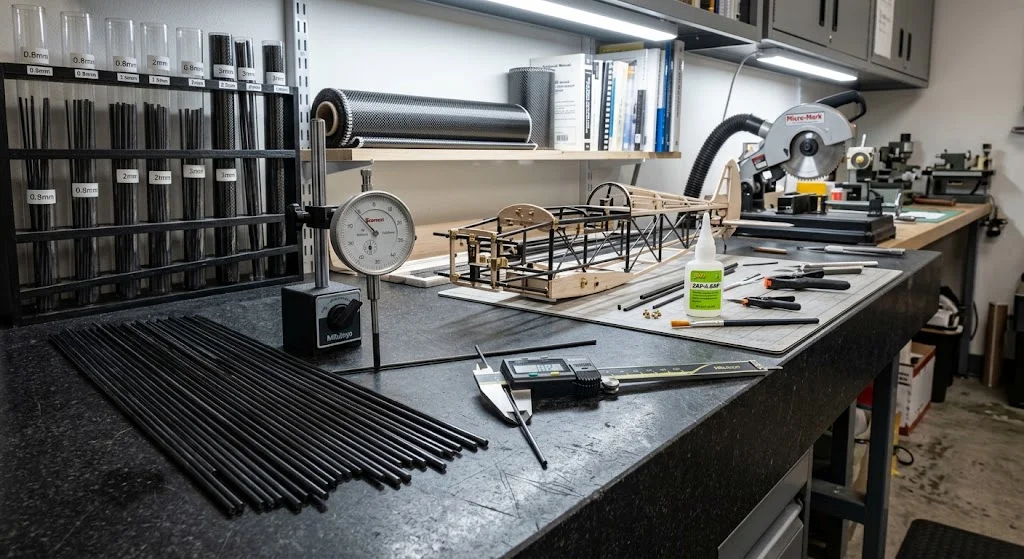
A carbon fiber rod 1mm in diameter occupies a unique niche in the composites catalog: too small for structural airframe work, too stiff and stable for plastic substitutes, and exactly the right size for model aircraft longerons, precision jig pins, sensor probe shafts and delicate linkage rods. At this diameter the manufacturing process matters more than the fiber grade — a 1mm rod that is 0.05mm out of round or 0.3mm bowed over 300mm will bind in a jig bore or wobble a sensor head, while a properly pultruded or roll-wrapped micro-rod holds straightness within 0.1mm per 100mm. This article covers practical specifications for small carbon fiber rods at the 1mm scale: diameters and tolerances, pultruded versus roll-wrapped construction, modulus data, cutting methods, and applications where carbon fiber solid rod stock outperforms alternatives.
Diameter Range and Tolerances for Small Carbon Fiber Rods
Micro-rods are manufactured in standard diameters with tighter tolerance bands than larger stock:
| Nominal diameter | Diameter tolerance | Straightness (per 100mm) | Typical stock lengths |
|---|---|---|---|
| 0.5 mm | ±0.02 mm | ≤0.15 mm | 200-500 mm |
| 1.0 mm | ±0.03 mm | ≤0.10 mm | 250-1000 mm |
| 1.5 mm | ±0.03 mm | ≤0.08 mm | 250-1000 mm |
| 2.0 mm | ±0.05 mm | ≤0.08 mm | 300-1200 mm |
| 3.0 mm | ±0.05 mm | ≤0.05 mm | 500-2000 mm |
The 1mm carbon fiber rod is the most commonly stocked micro-diameter. Tighter tolerances (±0.01mm diameter, ≤0.05mm straightness) are available for probe and instrument applications at a 30-50% premium.
Pultruded vs Roll-Wrapped: Two Manufacturing Routes for Micro-Rods
Small carbon fiber rods are made by two processes, and the choice affects surface finish, fiber content and cost:
- Pultruded: continuous fibers pulled through a resin bath and a heated die. At 1mm diameter, pultruded rods have a smooth surface, 65-75% fiber volume, and good pricing for long runs. Limitation: unidirectional fibers mean low transverse strength — it crushes easily in a vise.
- Roll-wrapped: prepreg sheet wrapped around a mandrel and cured, then the mandrel removed. At micro-diameters this is used more for hollow tubes (0.8-3mm OD) than solid rods, but solid roll-wrapped stock exists for quasi-isotropic properties. Surface shows the wrap spiral; fiber volume is lower (55-65%) but transverse and torsional properties are better.
- Hybrid micro-pull: some suppliers combine a pultruded core with a thin roll-wrapped outer layer, capturing pultrusion consistency with improved crush resistance. Preferred for jig pins that see repeated clamping.
For most model and linkage applications, pultruded solid rod is the right default: lowest cost, best straightness, and sufficient strength.
Mechanical Properties: What a 1mm Rod Actually Carries
Properties scale with fiber volume and resin system, but typical values for a pultruded 1mm carbon fiber rod in standard epoxy:
| Property | Pultruded (unidirectional) | Roll-wrapped (quasi-iso) | Fiberglass 1mm rod |
|---|---|---|---|
| Density (g/cm³) | 1.55-1.60 | 1.50-1.55 | 1.85-1.95 |
| Tensile strength (MPa) | 1200-1600 | 700-900 | 800-1100 |
| Tensile modulus (GPa) | 120-150 | 60-80 | 40-45 |
| Compressive strength (MPa) | 600-800 | 500-700 | 500-600 |
| Flexural strength (MPa) | 1400-1800 | 800-1100 | 900-1200 |
The tensile modulus matters for probe shafts and jig pins: at 120-150 GPa, a 1mm pultruded carbon rod deflects roughly one-sixth as much as fiberglass under the same side load. For a 200mm probe shaft, that means sub-0.1mm deflection under 50g lateral force — inside the tolerance budget for most inspection work.
Cutting, Drilling and Finishing Micro-Rods
At 1mm diameter, standard workshop methods for larger carbon stock do not work — the rod snaps or delaminates. Correct techniques:
- Cutting: use a fresh, fine-tooth diamond saw blade or a dedicated micro-tube cutter at low speed. Score-and-snap works on pultruded stock: score the circumference with a sharp blade, then snap over a table edge. Never use side cutters — they crush the section.
- Length tolerance: cut to length on a micro-chop saw with a length stop; ±0.2mm is achievable, ±0.5mm is standard commercial tolerance.
- End finishing: square the ends on a fine diamond file or sanding stick; a square end matters when the rod seats in a jig bore or glue socket. Seal the cut end with thin CA glue.
- Drilling: rarely needed at 1mm — most assemblies use the rod as a pin in a clearance hole, or bond it into a socket. If a transverse hole is required, use a 0.3-0.5mm carbide drill at low speed with the rod supported in a V-block.
- Straightening: minor bow (0.2-0.3mm over 300mm) can be corrected by gentle rolling on a flat granite surface under light hand pressure; significant bow indicates a bad cure and the rod should be rejected.
Application Categories for Carbon Fiber Solid Rod at Micro-Diameters
Where carbon fiber rod 1mm stock earns its premium over steel wire, brass rod or fiberglass:
- Model aircraft and drones: longerons, pushrod linkages, antenna masts and servo extensions. Carbon wins on stiffness-per-mass and does not permanently bend after a rough landing the way soft steel wire does.
- Jigs and fixtures: locating pins, alignment rods and stop pins. Carbon's low thermal expansion (2-5 µm/m·°C versus 17 for steel) means jig dimensions hold through temperature swings.
- Sensor and probe shafts: thermocouple sheaths, displacement sensor stems and inspection probe shafts. High modulus keeps the sensing tip on-target; the conductive surface can be coated if isolation is needed.
- Robotics and RC linkages: servo pushrods, steering linkages and control horns. At 1mm, carbon rods are stiff enough for control loads and light enough not to slow servo response.
- Precision instruments: dial indicator extensions, probe stylus shafts and optical bench supports. The vibration-damping properties reduce resonance-induced measurement noise.
For higher load capacity, step up to 2-3mm rod or carbon fiber tube — the same processes scale cleanly, and YongXian supplies both solid rod and tube in matched diameter families.
Frequently Asked Questions
Can I use a 1mm carbon fiber rod as a structural pin in a drone frame?
Yes, for secondary structure: camera gimbal pivots, antenna standoffs and linkage rods are all appropriate. Do not use 1mm rod as a primary arm or landing gear member — the buckling load at that diameter is too low for crash or hard-landing energy. For primary structure, step up to 3mm rod or 4-6mm tube.
How straight is a typical 1mm carbon fiber rod from the factory?
Standard stock: ≤0.10mm bow per 100mm. Premium stock for instrument applications: ≤0.05mm per 100mm. Straightness is measured on a V-block roller gauge after cure; rods outside specification are rejected or sold as "craft grade" at a discount.
Will a 1mm carbon fiber rod conduct electricity?
Yes — CFRP is electrically conductive along the fiber axis (surface resistivity typically 10⁻³ to 10⁻¹ Ω·sq). If you need electrical isolation, use a heat-shrink sleeve or thin epoxy coating; for RF applications, be aware that an uncoated carbon rod will interact with nearby antenna fields.
Conclusion
A carbon fiber rod 1mm in diameter is a precision component, not a miniature structural tube: diameter tolerance, straightness and end finish are the specifications that matter, and pultruded unidirectional stock delivers the best combination of modulus, straightness and cost for model, tooling and probe applications. YongXian manufactures pultruded and roll-wrapped carbon fiber solid rod and tube from 0.5mm to 50mm diameter, with custom cutting, facing and straightening to customer drawings. Browse our carbon fiber rod and tube catalog or contact our engineering team to discuss diameter tolerances, straightness specs and packaging for your next micro-rod program.
Related Articles
- Custom Carbon Fiber Manufacturing: A Buyer's Capability Checklist for OEMs
- Filament-Wound Composites: Process Parameters for Tubular Structures
- Carbon Fiber Plate Sheets: Sizes, Grades and Sourcing Options
- What Is Pultruded Carbon Fiber? Process, Properties and Common Profiles
- Carbon Fiber Sheet Machining: Tolerances, Tooling and Process Selection
- Carbon Fiber Sheets 1/4 Thick: 1/4 Inch Plate Guide
Interested in Our Products?
Contact our team for competitive pricing and technical specifications.
Get a QuoteRelated Products

Carbon Fiber Plate — 3K Twill T700 1.5mm
Thin 1.5mm carbon fiber plate with 3K twill weave surface. Lightweight and stiff, commonly used for covers, panels, drone bodies, and applications requiring a premium aesthetic appearance.

Carbon Fiber Plate — 3K Twill T700 3.0mm
Medium-thickness 3.0mm carbon fiber plate offering significantly higher load capacity while maintaining attractive 3K twill finish. Suitable for structural brackets, reinforcement plates, and load-bearing panels.

Carbon Fiber Trekking Pole
Lightweight carbon fiber trekking pole manufactured from high-grade carbon fiber tube. Weighs only 160g per pole while providing superior shock absorption and durability for hiking, trail running, and backpacking.

Square Carbon Fiber Tube — 3K Twill T700
Square cross-section carbon fiber tube manufactured with 3K twill weave for torsional strength. Preferred for structural frames, trusses, and support columns where rectangular geometry offers design flexibility.

Carbon Fiber Pickleball Paddle
High-performance pickleball paddle with Toray T700 carbon fiber face and polypropylene honeycomb core. Delivers excellent power-to-weight ratio, spin generation, and vibration dampening for competitive play.