
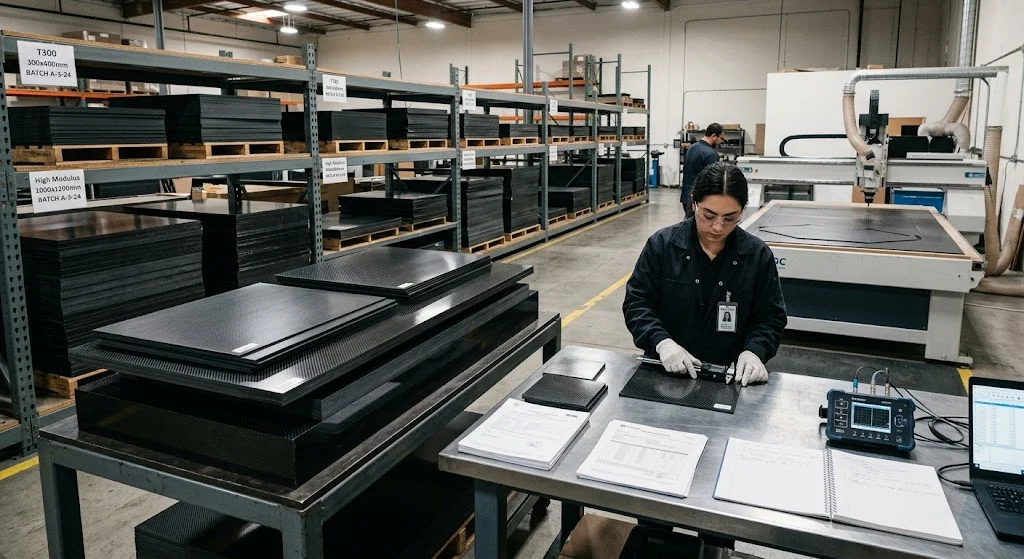
Carbon fiber plate sheets — also referred to as carbon fiber plates, carbon fiber sheets, or flat carbon fiber panels — are one of the most widely used forms of carbon fiber composite in engineering applications. A carbon fiber plate sheet consists of multiple layers (plies) of carbon fiber fabric o
Introduction
Carbon fiber plate sheets — also referred to as carbon fiber plates, carbon fiber sheets, or flat carbon fiber panels — are one of the most widely used forms of carbon fiber composite in engineering applications. A carbon fiber plate sheet consists of multiple layers (plies) of carbon fiber fabric or unidirectional tape, laminated together with epoxy resin under heat and pressure to form a flat, rigid panel with high specific strength and stiffness. Common applications include aerospace structural panels, drone and UAV airframes, racing car components, industrial fixtures and jigs, architectural cladding, and reinforcement of concrete and timber structures.
For procurement teams and design engineers, selecting the right carbon fiber plate sheet involves understanding the available sizes and thicknesses, the material grades and layup configurations that determine mechanical performance, the surface finish options, and the quality verification methods used by reputable suppliers. This article provides a comprehensive overview of carbon fiber plate sheets, covering specification, grading, sourcing, and inspection — helping buyers make informed decisions when purchasing carbon fiber plates for demanding applications.
Carbon Fiber Plate Sheets: Standard Sizes and Dimensions
Carbon fiber plate sheets are manufactured in a range of standard sizes, with custom sizes available to order. The most common standard sheet size is the 4×8 foot panel (approximately 1220 × 2440 mm), which mirrors standard plywood and metal sheet dimensions and fits common CNC routing tables and layup facilities. Smaller stock sizes and larger custom panels are also available depending on the supplier.
The table below summarizes typical carbon fiber plate sheet sizes and thicknesses available from composite suppliers:
| Sheet Size | Dimensions (mm) | Common Thicknesses | Typical Use |
|---|---|---|---|
| Full sheet (4×8 ft) | 1220 × 2440 | 1-30 mm | Aerospace panels, drone airframes, industrial tooling |
| Half sheet | 1220 × 1220 | 1-20 mm | Automotive components, fixtures, brackets |
| Quarter sheet | 600 × 1220 | 1-15 mm | Small structural parts, reinforcement plates |
| Custom cut | To specification | 0.5-50 mm | Project-specific panels, CNC-finished blanks |
Thickness is the most critical dimensional parameter for carbon fiber plate sheets, as it directly determines bending stiffness (proportional to the cube of thickness) and strength (proportional to thickness for a given layup). Common thicknesses for structural applications range from 2 mm to 10 mm; thinner sheets (0.5-2 mm) are used for surface panels and cosmetic applications, while thicker plates (10-50 mm) are used for heavy-duty tooling, molds, and structural reinforcements.
Material Grades and Layup Configurations
The mechanical properties of a carbon fiber plate sheet are primarily determined by the carbon fiber grade, fiber volume fraction, and layup configuration (the orientation of the individual plies). Understanding these parameters is essential for selecting a plate that meets the strength and stiffness requirements of the application.
Key material grade options include:
- Standard modulus (SM) carbon fiber: Tensile modulus 230-240 GPa, tensile strength 3,500-4,900 MPa (e.g., Toray T300, T700, or equivalent Chinese grades). This is the most common and cost-effective grade for general structural applications, offering an excellent balance of strength, stiffness, and price.
- Intermediate modulus (IM) carbon fiber: Tensile modulus 275-294 GPa, tensile strength 5,500-6,000 MPa (e.g., Toray T800, T1000). Used in aerospace and high-performance applications where higher stiffness and strength justify the cost premium (typically 2-3× standard modulus pricing).
- High modulus (HM) carbon fiber: Tensile modulus 350-600 GPa, with lower tensile strength (2,500-3,500 MPa). Used in applications demanding extreme dimensional stability, such as satellite structures, optical benches, and precision instruments, where stiffness-to-weight ratio is the primary design driver.
The layup configuration — the sequence and orientation of the carbon fiber plies — determines the plate's directional properties. Common layup configurations for carbon fiber plate sheets include:
| Layup | Ply Orientations | Properties | Best For |
|---|---|---|---|
| Quasi-isotropic | [0/±45/90]s (symmetric) | Near-equal properties in all in-plane directions | General structural panels, multi-directional loading |
| Unidirectional | All 0° | Maximum axial strength and stiffness; weak transverse | Bending-dominated beams, reinforcement strips |
| Balanced | [0/90]s or [±45]s | Equal strength in two orthogonal directions | Two-way loaded panels, torsion tubes |
| Custom | Per design | Tailored to specific load cases | Aerospace, racing, specialized structures |
For most general-purpose applications, quasi-isotropic layup ([0/±45/90]s) is the standard choice, as it provides predictable, direction-independent properties that simplify design calculations. When the loading direction is known and predominantly unidirectional (e.g., a cantilever beam), a unidirectional or heavily 0°-biased layup can reduce weight and cost while maximizing stiffness in the load direction.
Surface Finish Options
Carbon fiber plate sheets are available in several surface finish options, selected based on the application's functional and aesthetic requirements:
- As-manufactured (peel ply finish): A matte, slightly textured surface produced by peel ply removal after curing. This surface is suitable for bonding and painting but is not intended for direct visual exposure.
- Glossy (tooling grade): A smooth, glossy finish produced against a polished mold surface. Common for molds, plugs, and patterns, as well as cosmetic applications where a high-gloss appearance is desired.
- Matte (cosmetic): A controlled matte finish, often achieved with a textured mold surface or secondary processing. Used in architectural cladding and consumer products where a non-reflective appearance is preferred.
- Coated: Plates can be supplied with protective coatings (UV-resistant clear coat, anti-static coating, or wear-resistant surface layer) for specific environmental or functional requirements.
The surface finish also affects secondary operations: peel ply surfaces are optimized for adhesive bonding (no sanding required), while glossy surfaces typically require sanding and solvent cleaning before bonding or painting.
Quality Verification and Inspection
When sourcing carbon fiber plate sheets, quality verification is essential to ensure the material meets the specified mechanical and dimensional requirements. Key inspection methods include:
- Visual inspection: Checking for surface defects (wrinkles, porosity, foreign object inclusions, resin-rich or resin-starved areas) and dimensional conformance (flatness, edge squareness).
- Ultrasonic inspection (UT): Pulse-echo or through-transmission ultrasonic testing to detect internal voids, delaminations, and porosity. Acceptance criteria typically specify maximum allowable porosity (e.g., <2% by volume for aerospace applications) and prohibit any delaminations in structural zones.
- Dimensional verification: Measuring thickness, length, width, and flatness with calipers, micrometers, and straight edges to confirm conformance to the specified tolerances (typically ±0.1 mm on thickness for plates up to 10 mm).
- Coupon testing: For critical applications, suppliers can provide test coupons from the same production batch, tested for tensile strength, compressive strength, interlaminar shear strength (ILSS), and fiber volume fraction per ASTM or ISO standards.
- Material certification: Aerospace and defense applications require full material certification, including fiber grade traceability, cure cycle records, and NDT reports, documented per Nadcap or AS9100 quality standards.
Reputable suppliers provide inspection reports and material certificates with each batch, enabling buyers to verify quality and maintain traceability for regulated applications.
Sourcing Options for Carbon Fiber Plate Sheets
Procurement teams have several sourcing options for carbon fiber plate sheets, each with different trade-offs in terms of cost, lead time, customization, and quality assurance:
- Stock plates (off-the-shelf): Standard sizes (e.g., 4×8 ft, standard thicknesses) and layup configurations (typically quasi-isotropic, standard modulus) are available from stock for immediate shipment. Lead times are short (1-2 weeks), and unit costs are lower due to production scale. Best for standard applications, prototyping, and maintenance, repair, and overhaul (MRO) requirements.
- Custom cut plates: Stock plates cut to customer-specified dimensions (length, width, thickness) via CNC routing or waterjet cutting. Lead times are moderate (2-4 weeks), and costs are slightly higher than full sheets but lower than custom layup. Ideal when standard sheet sizes are close but not exact, and for reducing material waste.
- Custom layup plates: Plates manufactured to order with customer-specified fiber grade, layup sequence, thickness, and surface finish. Lead times are longer (4-8 weeks, depending on complexity and quantity), and unit costs are higher due to custom tooling and setup. Necessary for aerospace, racing, and specialized applications where standard stock does not meet the design requirements.
- Import sourcing: Carbon fiber plate sheets sourced from international suppliers (e.g., Chinese manufacturers) offer significant cost advantages (typically 30-50% lower than Western suppliers for equivalent quality) but require careful quality verification, longer lead times (6-12 weeks including shipping), and compliance with import regulations (including dual-use export controls for certain carbon fiber grades).
When selecting a sourcing strategy, buyers should balance unit cost against lead time, quality assurance requirements, and total landed cost (including shipping, duties, and inspection). For high-volume or long-term programs, establishing a qualified supplier relationship with regular production runs and batch testing is the most cost-effective approach.
Frequently Asked Questions
What sizes do carbon fiber plate sheets come in?
Carbon fiber plate sheets are available in standard sizes ranging from small panels (600 × 1220 mm) to full sheets (1220 × 2440 mm, equivalent to 4×8 feet), with custom sizes available to order. Common thicknesses range from 0.5 mm to 50 mm, with the most popular structural thicknesses being 2-10 mm. For drone, aerospace, and industrial applications, the 4×8 ft quasi-isotropic sheet is the most commonly stocked format.
What is the difference between carbon fiber plates and carbon fiber sheets?
The terms "carbon fiber plates" and "carbon fiber sheets" are often used interchangeably, but there is a general industry convention: "sheets" typically refer to thinner panels (generally <3 mm thick) used for surface panels, cosmetic applications, and light structural reinforcement, while "plates" refer to thicker panels (≥3 mm, commonly 5-20 mm) used for structural members, tooling, molds, and heavy-duty applications. The material composition (carbon fiber fabric or unidirectional tape, laminated with epoxy) is the same for both; the distinction is primarily based on thickness and typical application.
How do I choose between standard modulus and intermediate modulus carbon fiber plates?
Standard modulus carbon fiber plates (230-240 GPa tensile modulus) are suitable for most general structural applications, offering an excellent strength-to-cost ratio. Intermediate modulus plates (275-294 GPa tensile modulus) provide approximately 20-25% higher stiffness and 30-40% higher strength at a cost premium of 2-3×. Choose intermediate modulus when weight savings are critical (aerospace, racing) or when higher stiffness is needed to meet deflection limits. For cost-sensitive industrial applications, standard modulus is the preferred choice.
Can carbon fiber plate sheets be CNC machined?
Yes. Carbon fiber plate sheets are routinely CNC routed, waterjet cut, and drilled using standard composite machining practices. Diamond-coated or solid carbide cutting tools are recommended to manage the abrasive nature of carbon fiber and achieve clean edges. Proper dust extraction is essential, as carbon fiber dust is a respiratory irritant and can cause skin irritation. When machining carbon fiber plates, use low feed rates, high spindle speeds, and climb milling to minimize delamination and fiber pullout at the edges.
Conclusion
Carbon fiber plate sheets are versatile composite panels available in a wide range of sizes, thicknesses, material grades, and layup configurations to suit structural, aerospace, automotive, and industrial applications. Understanding the standard sizes (4×8 ft full sheets being the most common), material grade options (standard vs. intermediate modulus), layup configurations (quasi-isotropic for general use, unidirectional for axial loading), and quality verification methods enables procurement teams to specify and source carbon fiber plates with confidence.
YongXian supplies carbon fiber plate sheets in standard and custom sizes, with a range of material grades and surface finishes, backed by full material certification and inspection reports. Explore our carbon fiber product range or contact our engineering team to discuss your carbon fiber plate sheet requirements.
Part of topic
Related Articles
- Custom Carbon Fiber Manufacturing: A Buyer's Capability Checklist for OEMs
- Carbon Fiber Rod 1mm: Micro-Rods for Models, Tooling and Probes
- Filament-Wound Composites: Process Parameters for Tubular Structures
- What Is Pultruded Carbon Fiber? Process, Properties and Common Profiles
- Carbon Fiber Sheet Machining: Tolerances, Tooling and Process Selection
- Carbon Fiber Sheets 1/4 Thick: 1/4 Inch Plate Guide
Interested in Our Products?
Contact our team for competitive pricing and technical specifications.
Get a QuoteRelated Products

Carbon Fiber Plate — 3K Twill T700 1.5mm
Thin 1.5mm carbon fiber plate with 3K twill weave surface. Lightweight and stiff, commonly used for covers, panels, drone bodies, and applications requiring a premium aesthetic appearance.

Carbon Fiber Plate — 3K Twill T700 3.0mm
Medium-thickness 3.0mm carbon fiber plate offering significantly higher load capacity while maintaining attractive 3K twill finish. Suitable for structural brackets, reinforcement plates, and load-bearing panels.

Carbon Fiber Trekking Pole
Lightweight carbon fiber trekking pole manufactured from high-grade carbon fiber tube. Weighs only 160g per pole while providing superior shock absorption and durability for hiking, trail running, and backpacking.

Square Carbon Fiber Tube — 3K Twill T700
Square cross-section carbon fiber tube manufactured with 3K twill weave for torsional strength. Preferred for structural frames, trusses, and support columns where rectangular geometry offers design flexibility.

Carbon Fiber Pickleball Paddle
High-performance pickleball paddle with Toray T700 carbon fiber face and polypropylene honeycomb core. Delivers excellent power-to-weight ratio, spin generation, and vibration dampening for competitive play.