
Carbon fiber sheets 1/4 thick — 6.35 mm in metric terms — sit in the heavy-plate class of the CFRP sheet market: too thick for decorative inlays, just right for structural tooling, machine bases, robotics end plates and load-bearing fixtures. This guide explains what governs quality in a 1/4 inch ca
Introduction
Carbon fiber sheets 1/4 thick — 6.35 mm in metric terms — sit in the heavy-plate class of the CFRP sheet market: too thick for decorative inlays, just right for structural tooling, machine bases, robotics end plates and load-bearing fixtures. This guide explains what governs quality in a 1/4 inch carbon fiber plate, how carbon fiber sheet thickness drives bending stiffness and mass, when a carbon fiber plate 4mm is the smarter buy, and what changes in carbon fiber sheet machining once the cutter moves from 2 mm stock to plate that is three times as thick.
The 1/4 inch thickness class is where buyer questions shift from "is this real carbon" to "how flat is it, how true are the faces, and what happens at the drill press." Those are the questions this article answers, with the numbers needed to specify the sheet before it ships.
Carbon Fiber Sheets 1/4 Thick: What the Spec Actually Specifies
A 1/4 inch designation means nominal 6.35 mm total thickness, but three parameters decide whether a sheet performs in a structural role:
- Tolerance band: quality plate holds ±0.15 to ±0.3 mm on thickness across the sheet; economy sheet runs ±0.5 mm or more, which shows up as uneven clamping pressure on a vacuum fixture.
- Flatness: spec-grade sheets hold 0.5 mm/m or better; laid-up plate that cured without a caul plate can warp 2-3 mm across a one-meter sheet, and no amount of clamping on the ends will hold a fixture flat.
- Face finish: one side usually carries the tool-side gloss from the cauled cure; the bag side is matte. For bearing surfaces, request both faces post-machined or specifying the gloss side out saves a skimming pass.
Under the surface, the same sheet may be built as a quasi-isotropic [0/±45/90] stack, a heavy 0-degree-dominant layup for beam stiffness, or a mix tuned for a specific fixture load. Nominal thickness alone does not tell the buyer which one arrived — ask for the layup drawing.
Carbon Fiber Sheets 1/4 Thick: How Sheet Thickness Drives Stiffness and Mass
Bending stiffness scales with the cube of thickness while mass scales linearly — the trade that makes thickness selection the single highest-leverage decision on a plate order. Representative numbers for standard-modulus quasi-isotropic sheet at 1.6 g/cm3 density:
| Thickness | Mass per area | Relative bending stiffness | Typical structural role |
|---|---|---|---|
| 3 mm (1/8 in) | ~4.8 kg/m2 | 1.0x baseline | Covers, light brackets, non-sag panels |
| 4 mm (5/32 in) | ~6.4 kg/m2 | ~2.4x | Robot end plates, camera plates, jig plates |
| 6 mm | ~9.6 kg/m2 | ~8.0x | Machine tooling, vacuum fixture bases |
| 6.35 mm (1/4 in) | ~10.2 kg/m2 | ~9.5x | Structural fixtures, CNC sub-bases, load frames |
| 10 mm | ~16.0 kg/m2 | ~37x | Heavy tooling plates, press platens |
Reading the table: 1/4 inch sheet is roughly ten times stiffer in bending than 3 mm sheet and about four times stiffer than 4 mm — but carries 56% more mass than the 4 mm plate. If the deflection budget is tight and mass matters, the jump to 6.35 mm is usually cheaper than adding support structure to a thinner sheet. If weight is the binding constraint, stay at 4 mm and stiffen with ribs or a sandwich core instead.
Carbon Fiber Plate 4mm: When the Lighter Plate Wins
The 4 mm class is the workhorse of composite jig plate, and it beats 1/4 inch sheet in three recurring scenarios:
- Mass-limited tooling: end-of-arm tooling on a robot, portable inspection jigs, or hand-carried drill templates — anywhere an operator lifts the fixture repeatedly, 6.4 kg/m2 versus 10.2 kg/m2 decides shift-end fatigue.
- Through-bolted assemblies: at 4 mm, M5 and M6 hardware still has full thread engagement in a counterbored hole; at 6.35 mm the same fastener leaves excess shank that either needs a longer bolt or a counterbore that thins the remaining wall.
- Thinner stack-ups under vacuum: 4 mm plate flexes into vacuum seals more forgivingly on small fixtures, reducing the bagging complexity that rigid 1/4 inch bases resist.
The honest limit: beyond roughly 800 mm unsupported span carrying distributed load, 4 mm quasi-isotropic plate deflects visibly, and the 6.35 mm class becomes the minimum credible choice for a flat reference surface.
Carbon Fiber Sheet Machining on 1/4 Inch Plate: Cutting, Drilling and Edge Work
Thick plate punishes the shortcuts that pass on 2 mm sheet. Machining parameters that hold up in production:
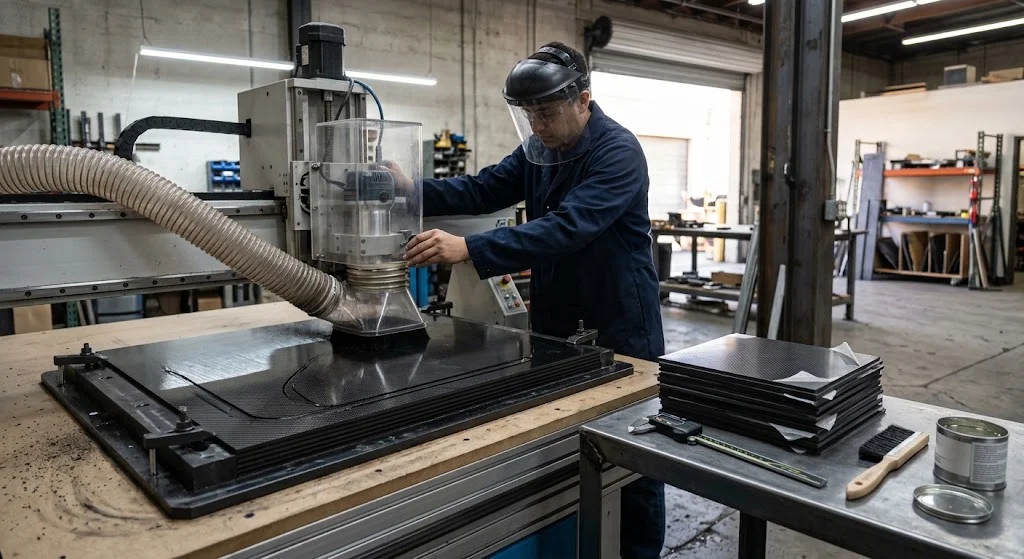
- Routing: compression bits at 18,000-24,000 rpm with a chip load around 0.08-0.12 mm per tooth; climb milling on the finish pass keeps the top ply from lifting. Vacuum extraction is mandatory — dust is conductive and a respiratory hazard.
- Drilling: use carbide drill bits with a 118-degree point and peck cycles over 6 mm depth; back the exit with sacrificial stock. Hole quality on 6.35 mm plate is the difference between a fixture that holds tolerance for a year and one that wallows out after a hundred bolt cycles.
- Edge sealing: after cutting, seal exposed edges with thin epoxy or edge-band tape; open laminate edges wick moisture and abrade under handling, and on a fixture base that becomes a flatness problem within months.
- Threaded inserts: for repeated assembly, bond steel or brass inserts rather than tapping the laminate; carbon's anisotropic threads strip under the torque that steel takes happily.
For suppliers: the shop that owns its own CNC cell and cuts plate to drawing — rather than reselling cut-offs — is the shop that can hold ±0.2 mm positional tolerance across a 600 mm fixture pattern, which is the number that matters when the plate is one component of an assembly.
Frequently Asked Questions
Is 1/4 inch carbon fiber sheet overkill for a camera plate or bracket?
Usually yes. For brackets under 300 mm span and light sensor mounts, 3-4 mm plate carries the load at a fraction of the mass, and the extra stiffness of 6.35 mm only matters if the assembly resonates or the span grows. Step up to 1/4 inch when the sheet itself is the structural reference — machine bases, vacuum fixture decks, and load frames — not when it is simply a mounting surface.
Why does my 1/4 inch sheet arrive slightly warped, and does it matter?
Warp comes from asymmetric cure: if the tool face and bag face saw different temperature or pressure during layup, the residual stress bows the plate. For clamped fixtures the warp is irrelevant — bolt it down flat. For free-standing reference surfaces it is disqualifying; specify caul-plated cure and a flatness callout (0.5 mm/m is a workable target) on the purchase order, and expect to pay for the extra processing.
Can 1/4 inch carbon plate be tapped directly for threads?
It can, but it should not carry production torque. Carbon laminate threads pull out at a fraction of steel's torque capacity, and repeated assembly galls the composite. Bonded inserts — stainless for wear, brass for cost — give repeatable clamp load and can be replaced; reserve direct tapping for low-cycle jigs where the plate is considered consumable.
Conclusion
Carbon fiber sheets 1/4 thick earn their place when bending stiffness, dimensional stability and a flat working surface outrank mass: structural fixtures, CNC sub-bases, machine tooling and load frames. The buying criteria are tolerance band, flatness under cure, face finish and — most often overlooked — the layup behind the nominal 6.35 mm; the 4 mm class remains the right answer for mass-limited jigs and through-bolted assemblies, and machining discipline (compression routing, peck drilling, edge sealing, bonded inserts) decides whether the plate holds tolerance in service. YongXian supplies quasi-isotropic and custom-layup CFRP plate including the 1/4 inch and 4 mm classes, cut to size with CNC machining, edge sealing and pressed-in inserts. Browse our carbon fiber plate range or contact our engineering team to specify thickness, tolerance and layup for your fixture or tooling application.
Part of topic
Related Articles
- Carbon Fiber Sheet Machining: Tolerances, Tooling and Process Selection
- Filament Wound Epoxy Tubes Disadvantages: Limitations and Failure Modes
- Carbon Fiber K Rating: Security Laminate Grades
- Carbon Fiber Solid Rod: Properties and Applications
- Carbon Fiber Plate Density: What to Expect from Laminates
- Carbon Fiber Plate 4mm: Stiffness, Machining and Applications
Interested in Our Products?
Contact our team for competitive pricing and technical specifications.
Get a QuoteRelated Products

Carbon Fiber Plate — 3K Twill T700 1.5mm
Thin 1.5mm carbon fiber plate with 3K twill weave surface. Lightweight and stiff, commonly used for covers, panels, drone bodies, and applications requiring a premium aesthetic appearance.

Carbon Fiber Plate — 3K Twill T700 3.0mm
Medium-thickness 3.0mm carbon fiber plate offering significantly higher load capacity while maintaining attractive 3K twill finish. Suitable for structural brackets, reinforcement plates, and load-bearing panels.

Carbon Fiber Trekking Pole
Lightweight carbon fiber trekking pole manufactured from high-grade carbon fiber tube. Weighs only 160g per pole while providing superior shock absorption and durability for hiking, trail running, and backpacking.

Square Carbon Fiber Tube — 3K Twill T700
Square cross-section carbon fiber tube manufactured with 3K twill weave for torsional strength. Preferred for structural frames, trusses, and support columns where rectangular geometry offers design flexibility.

Carbon Fiber Pickleball Paddle
High-performance pickleball paddle with Toray T700 carbon fiber face and polypropylene honeycomb core. Delivers excellent power-to-weight ratio, spin generation, and vibration dampening for competitive play.