
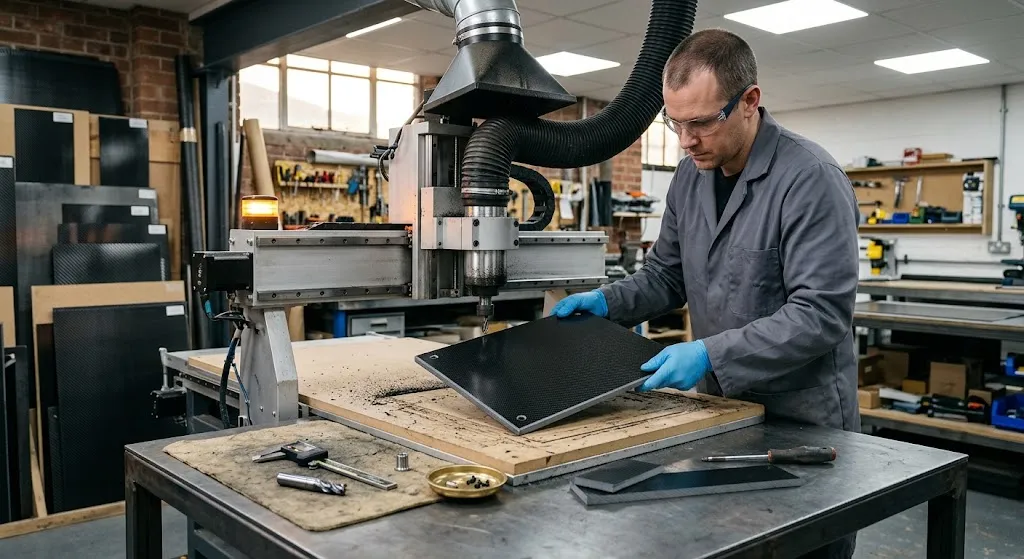
Four millimetres is the thickness at which a carbon fiber plate 4mm section stops being a cosmetic part and starts carrying real load: it weighs about 6.2 kilograms per square metre, spans 200 millimetres as a bracket face with roughly 0.6 millimetres of deflection under a 50 newton point load, and
Introduction
Four millimetres is the thickness at which a carbon fiber plate 4mm section stops being a cosmetic part and starts carrying real load: it weighs about 6.2 kilograms per square metre, spans 200 millimetres as a bracket face with roughly 0.6 millimetres of deflection under a 50 newton point load, and still routes cleanly on a standard CNC router. That combination is why 4 mm is the default call for robot chassis plates, motorsport brackets, drone landing gear and industrial fixture faces.
This article gives the numbers behind that default — how stiffness and mass scale against the other common thicknesses of carbon fiber plates, how layup shifts the result, what carbon fiber plate density to expect, and the tooling and fixturing needed for carbon fiber plate cutting without delaminating the edge.
Why a Carbon Fiber Plate 4mm Thick Is the Structural Default
Bending stiffness of a plate scales with the cube of its thickness while mass scales only linearly, so thickness is the cheapest stiffness lever a designer has. Moving from 3 to 4 millimetres costs 33 percent more material and returns 78 percent more stiffness; moving from 4 to 6 millimetres costs 50 percent more material and returns 3.4 times the stiffness, but usually breaks the weight budget first. Four millimetres sits near the knee of that curve:
- Deflection under load: on a 200 millimetre span a 4 millimetre plate keeps a 50 newton point load to about 0.6 millimetres of movement, inside the tolerance of most bolted assemblies.
- Fastener bearing: 4 mm leaves enough laminate around an M5 clearance hole for bearing loads, where 1 to 2 millimetre plate lets the insert pull through under vibration.
- Edge stability: the section routes, countersinks and accepts heat-set inserts without the exit plies lifting — a routine failure mode on 2 millimetre plate.
- Drop-in metal replacement: a 4 millimetre carbon bracket matches a 3 to 4 millimetre aluminium one at roughly a fifth of the mass, so parts swap without re-engineering the mount.
Stiffness and Weight Data for a Carbon Fiber Plate 4mm
The table assumes a quasi-isotropic 3K twill layup at a carbon fiber plate density of 1.55 grams per cubic centimetre, simply supported over a 200 millimetre span, 50 millimetres wide, loaded with 50 newtons at mid-span and an elastic modulus of 50 gigapascal:
| Thickness | Mass (kg/m²) | Relative stiffness (t³) | Mid-span deflection at 50 N | Typical role |
|---|---|---|---|---|
| 2 mm | 3.10 | 0.13× | 5.00 mm | Covers, light panels, cosmetic plates |
| 3 mm | 4.65 | 0.42× | 1.48 mm | Drone arms, bracing, non-primary brackets |
| 4 mm | 6.20 | 1.00× | 0.63 mm | Chassis plates, fixture faces, structural brackets |
| 5 mm | 7.75 | 1.95× | 0.32 mm | Heavy fixtures, machine guards |
| 6 mm | 9.30 | 3.38× | 0.19 mm | Tooling bases, load-bearing panels |
| 8 mm | 12.40 | 8.00× | 0.08 mm | Machine beds, jig plates, hinge blocks |
Carbon fiber plate density barely moves across that range — standard twill and unidirectional laminates both fall between 1.50 and 1.60 grams per cubic centimetre — so a 400 × 300 millimetre plate weighs about 740 grams at 4 millimetres whether it is twill or unidirectional. What does change is directionality: aligning the majority of plies with the load can roughly double stiffness at the same mass, which is why layup selection matters more than fibre grade on a flat part.
Carbon Fiber Plate Cutting and Machining at 4 Millimetres
Four millimetres is thick enough to behave like a small plate rather than a sheet during machining, which makes fixturing easier and the margin for tool error wider:
- Routing: a two-flute diamond-coated or upcut carbide end mill at 12,000 to 18,000 rpm with a feed of 25 to 45 millimetres per second, taking 2 millimetre depth passes down to the spoilboard rather than full depth in one cut. A compression cutter on the final pass keeps both faces clean.
- Hold-down: vacuum table or low-profile clamps outside the tool path, plus a sacrificial MDF spoilboard; the plate must not be allowed to lift into the cutter, which is what tears the exit plies.
- Drilling: carbide bits at 2,000 to 4,000 rpm with a backing board, then deburr from the exit side. For repeated fastening, brass heat-set inserts in 5 millimetre holes outperform directly tapped laminate.
- Edge sealing: seal routed edges with thin epoxy or a rubber trim; the cut edge is where moisture wicks into an otherwise impermeable laminate.
- Extraction: carbon dust is conductive and an irritant — cut under extraction, and never blow dust out of electronics with air that passed a cutting station.
Where a 4 Millimetre Carbon Fiber Plate Is Used
The applications split by which property dominates the design:
- Robotics and automation: chassis plates, end-of-arm tooling faces and fixture plates where rigidity must come without steel mass.
- Drones and e-mobility: landing gear, battery trays and motor mounts; 4 mm is common on heavy-lift frames where 3 mm arms flex.
- Motorsport and automotive: splitter supports, seat mounts, brackets and shifting mechanisms; also decorative carbon fiber plate cover panels that must survive vibration.
- Industrial guarding: way covers, sensor guards and inspection windows that see impact.
- Marine and outdoor: hatch stiffeners and instrument plates, where sealed edges and UV-stable clear coat decide service life.
Frequently Asked Questions
How much does a carbon fiber plate 4mm weigh?
At a density of 1.55 grams per cubic centimetre, a 4 millimetre plate weighs 6.2 kilograms per square metre. Practical blanks: 300 × 200 millimetres is about 372 grams, 400 × 300 millimetres is about 744 grams, and a full 1000 × 500 millimetre sheet is about 3.1 kilograms — roughly a fifth of the equivalent aluminium plate, and the reason 4 mm carbon is used as a direct metal replacement.
Can you tap threads directly into a 4 mm carbon fiber plate?
You can, but only light-duty threads hold well. Direct tapping in laminate gives short thread engagement and crushes the matrix under torque, so for parts that are assembled repeatedly use brass or steel heat-set inserts installed in an oversize hole instead. For one-way fixtures a through-bolt with a nylon lock nut is the simplest and most inspectable choice.
What actually changes between 3 mm and 4 mm plate?
Mass rises 33 percent, stiffness rises 78 percent, and mid-span deflection under the same load falls by about 43 percent. The practical difference shows up at the fastener: 4 millimetres carries M5 bearing loads and resists edge chipping during carbon fiber plate cutting, while 3 millimetres remains the better choice when every gram counts and the span is short.
Conclusion
Four millimetres earns its place as the structural default because it is the thinnest section that still tolerates real fasteners, real machining and real impact while staying a fifth of metal's mass: 6.2 kilograms per square metre, about 0.6 millimetres of deflection on a 200 millimetre span at 50 newtons, and 740 grams for a 400 × 300 millimetre blank. Specify the layup first — stiffness follows fibre direction far more than grade — then treat carbon fiber plate density as a constant near 1.55 grams per cubic centimetre and let thickness do the tuning. For stock sheets, cut blanks or plates machined to your drawing, browse our carbon fiber plate range or contact our technical team with your dimensions, layup and load case.
Part of topic
Related Articles
- Carbon Fiber Plate Density: What to Expect from Laminates
- Carbon Fiber Tube Repair: Methods, Limits and When to Replace
- Carbon Fiber Tube Thick Walled: Design Considerations and Applications
- Carbon Fiber Tube Weight: How to Estimate Weight per Meter
- Carbon Fiber Rod vs Fiberglass: Stiffness, Fatigue and Cost
- Carbon Fiber Rod vs Graphite: Key Differences Explained
Interested in Our Products?
Contact our team for competitive pricing and technical specifications.
Get a QuoteRelated Products

Carbon Fiber Plate — 3K Twill T700 1.5mm
Thin 1.5mm carbon fiber plate with 3K twill weave surface. Lightweight and stiff, commonly used for covers, panels, drone bodies, and applications requiring a premium aesthetic appearance.

Carbon Fiber Plate — 3K Twill T700 3.0mm
Medium-thickness 3.0mm carbon fiber plate offering significantly higher load capacity while maintaining attractive 3K twill finish. Suitable for structural brackets, reinforcement plates, and load-bearing panels.

Carbon Fiber Pickleball Paddle
High-performance pickleball paddle with Toray T700 carbon fiber face and polypropylene honeycomb core. Delivers excellent power-to-weight ratio, spin generation, and vibration dampening for competitive play.

Square Carbon Fiber Tube — 3K Twill T700
Square cross-section carbon fiber tube manufactured with 3K twill weave for torsional strength. Preferred for structural frames, trusses, and support columns where rectangular geometry offers design flexibility.

Carbon Fiber Trekking Pole
Lightweight carbon fiber trekking pole manufactured from high-grade carbon fiber tube. Weighs only 160g per pole while providing superior shock absorption and durability for hiking, trail running, and backpacking.