
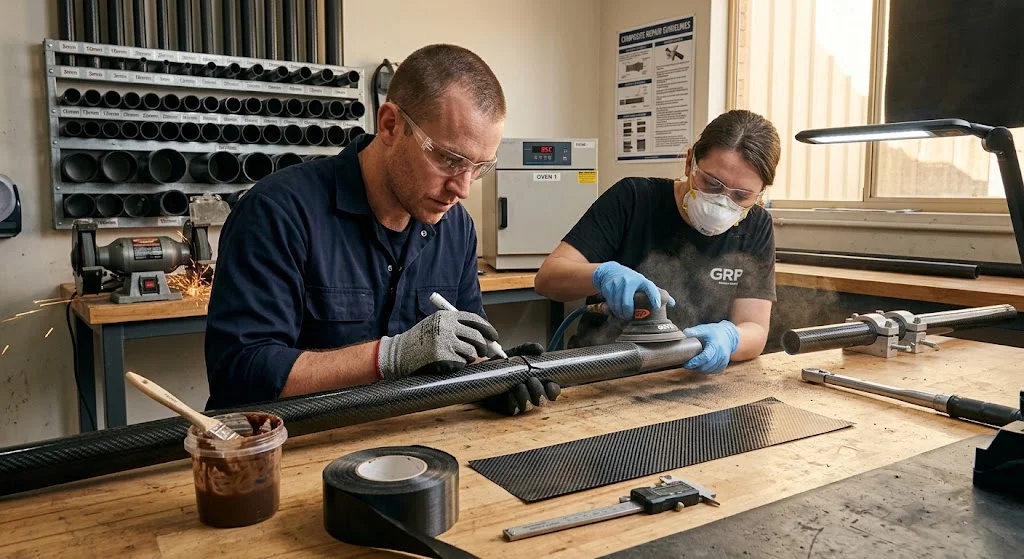
Carbon fiber tube repair is asked about whenever a drone arm, robot link, bike frame or tripod leg takes a knock, because a carbon tube is expensive and replacing it is not always easy. The good news is that many carbon tubes can be brought back to a useful fraction of their original strength. The b
Introduction
Carbon fiber tube repair is asked about whenever a drone arm, robot link, bike frame or tripod leg takes a knock, because a carbon tube is expensive and replacing it is not always easy. The good news is that many carbon tubes can be brought back to a useful fraction of their original strength. The bad news is that carbon fibre does not yield or dent like metal; it fails suddenly, so a repair must restore stiffness and the load path rather than simply fill a hole. This guide explains how to judge whether a tube is worth repairing, the four practical repair methods, and when carbon fiber tube repair should give way to replacement.
The decision starts with three questions: what kind of damage it is, where it sits on the tube, and how much of the original load the tube must carry again. A cosmetic scratch on a lightly loaded tube is a different problem from a delaminated spar in a drone arm that sees repeated bending. The sections below answer those questions in order and end with a clear rule.
When Carbon Fiber Tube Repair Is Worth It
Repair is normally worthwhile when the damage is local, the tube still carries a reasonable load, and the repaired zone can be protected from further impact. It is normally not worthwhile when the tube is part of a certified structure, when the damage runs along a large part of the length, or when the failure has left the tube out of straight. As a rule of thumb, damage within one tube diameter of the end, or affecting less than about ten percent of the length, is a good repair candidate. Damage that has cracked the wall right through in a highly loaded region usually is not.
Cost decides as well. A standard-modulus carbon tube may cost eight to twenty times a comparable aluminum tube per metre, so a repair that takes a few hours of work is often cheaper than replacing a long or custom tube. Where the tube is short, cheap and mass-produced, replacement is usually faster and safer.
Assessing Damage Before You Repair
Inspect the tube properly first, because the visible damage is often smaller than the damage beneath the surface.
- Surface scratches: A scratch that does not break fibres is cosmetic and needs only a resin seal coat. A scratch that cuts fibres across the load direction should be treated as structural.
- Cracks: A crack through the wall will grow under load. Tap-test around it and, if possible, check for delamination with an ultrasonic probe or a careful coin tap.
- Delamination: Layers separating inside the wall are the hardest to see and the most damaging. A dull sound on tap-test, or a soft area under thumb pressure, points to delamination.
- Crush and ovalisation: A tube crushed at a clamp or joint has lost section stiffness. If the ovality is more than a few percent of the diameter, much of the bending capacity is gone.
- Worn ends: Ends worn oval or frayed at an insert are best repaired by cutting back to sound material and bonding a new sleeve or insert.
Carbon Fiber Tube Repair Methods: Wrap, Patch, Sleeve and Splint
Four methods cover most workshop repairs, and they differ mainly in how much strength they restore and how much skill they demand. The table compares them for a pultruded or roll-wrapped tube of the kind used in drone arms and robot links.
| Method | Best for | Strength recovery | Skill level | Typical cure | Relative cost |
|---|---|---|---|---|---|
| Wet lay-up overwrap | Local cracks and small holes | 50-70% of original | Medium | Room temp, 24 h | Low |
| Prepreg patch | Structural cracks in thin walls | 70-85% of original | High | Oven, 120-130 C | High |
| Bonded sleeve | Damaged ends and inserts | 80-95% of original | Medium | Room temp or warm, 24 h | Medium |
| Clamp splint | Field damage, quick return to use | 40-60% of original | Low | None | Low |
The numbers make the trade-off clear. Wet lay-up is cheap and needs no oven but leaves more resin and less fibre, so it recovers less strength. A prepreg patch gives the best mechanical result but needs higher cure temperature and more skill. A bonded sleeve is often the strongest option because it restores the load path over a long bond length rather than patching a point. A clamp splint is the fastest fix and is best seen as a way to keep a machine running until a proper repair or replacement can be scheduled.
Step-by-Step Carbon Fiber Tube Repair Process
Whichever method is chosen, the sequence is the same, and preparation matters more than the lay-up itself.
- Remove the load: Take the tube out of service and support it so no bending acts on the repair zone.
- Map the damage: Mark the limits of the damage and extend the repair at least 25 mm beyond it on each side, or three wall thicknesses, whichever is greater.
- Scarf or step the surface: Grind a shallow taper of about 1:20 and clean the surface with solvent so the bond can carry shear.
- Apply the repair: Lay fibres in the same direction as the host tube where possible, so stiffness is restored along the load path.
- Cure and post-cure: Follow the resin schedule exactly. An under-cured joint is the most common cause of a weak repair.
- Restore the surface and re-check: Sand, seal and re-measure straightness before returning the tube to service.
Protecting the Repair Zone with Clamps and Protectors
A repaired tube is only as good as the way it is held. Carbon tubes are brittle at bolt holes, and a bolt tightened directly against the wall will crush the fibres and start a new failure next to the repair. Carbon fiber tube clamps spread the bolt load over a wide area and, when sized correctly, keep the connection below the crushing stress of the laminate. A carbon fiber tube protector, in the form of a thin sleeve or a sacrificial end cap, absorbs the small impacts that would otherwise chip the repaired zone. Where a repaired tube meets another member, a well-designed carbon fiber tube connection with a bonded sleeve and a clamping collar distributes the load far better than a single through-bolt. Treat the repair and its protection as one system, not two separate steps.
Frequently Asked Questions
Can a cracked carbon fiber tube be repaired to full strength?
Not quite. A well-made bonded sleeve repair can recover 80-95% of the original strength, and a good prepreg patch 70-85%, but no field or workshop repair reliably returns a cracked tube to 100%. For low-consequence uses such as a hobby drone arm, a 90% repair is normally acceptable. For a certified or human-rated structure, repair is usually not permitted, and the tube should be replaced or the design rebuilt with an approved method.
What resin should I use for carbon fiber tube repair?
Use a structural epoxy, not polyester or vinylester, because epoxy bonds far better to the cured laminate and to aluminium inserts. For wet lay-up, a room-temperature epoxy with an extended pot life gives the best wet-out. For prepreg repair, the patch resin must match the cure temperature the tube can tolerate; many pultruded tubes use a matrix that can be post-cured at 120-130 C, but a tube with a thermoplastic matrix cannot be repaired the same way. Always test the repair on a scrap piece of the same tube before committing to the real part.
When should I replace a carbon tube instead of repairing it?
Replace when the damage is not local, when the tube is part of a certified or human-rated structure, when straightness cannot be restored, or when the repair cost approaches the price of a new tube. Also replace when the failure is at a clamp and the wall has ovalised, because the section stiffness is gone and a patch cannot bring it back. For cheap, short, mass-produced tubes, replacement is almost always the better choice.
Conclusion
Carbon fiber tube repair is a practical option for local damage on lightly to moderately loaded tubes, and the four methods above cover almost every workshop case. Choose wet lay-up for cheap local fixes, a prepreg patch for structural cracks, a bonded sleeve for damaged ends, and a clamp splint only as a temporary measure. Whatever the method, the repair recovers stiffness only if the load path is restored and the joint is protected from crushing and impact.
If you are selecting tubes that can be repaired and re-jointed cleanly, or you need clamps and sleeves that will not crush a thin wall, browse our carbon fiber tube range, or contact our engineering team for repair guidance and matched hardware.
Part of topic
Related Articles
- Carbon Fiber Tube Thick Walled: Design Considerations and Applications
- Carbon Fiber Tube Weight: How to Estimate Weight per Meter
- Carbon Fiber Rod vs Fiberglass: Stiffness, Fatigue and Cost
- Carbon Fiber Rod vs Graphite: Key Differences Explained
- Carbon Fiber Tube vs Steel: Strength-to-Weight Analysis
- Carbon Fiber Tube vs Aluminum: Which Material Wins for Your Application
Interested in Our Products?
Contact our team for competitive pricing and technical specifications.
Get a QuoteRelated Products

Carbon Fiber Plate — 3K Twill T700 1.5mm
Thin 1.5mm carbon fiber plate with 3K twill weave surface. Lightweight and stiff, commonly used for covers, panels, drone bodies, and applications requiring a premium aesthetic appearance.

Carbon Fiber Plate — 3K Twill T700 3.0mm
Medium-thickness 3.0mm carbon fiber plate offering significantly higher load capacity while maintaining attractive 3K twill finish. Suitable for structural brackets, reinforcement plates, and load-bearing panels.

Square Carbon Fiber Tube — 3K Twill T700
Square cross-section carbon fiber tube manufactured with 3K twill weave for torsional strength. Preferred for structural frames, trusses, and support columns where rectangular geometry offers design flexibility.
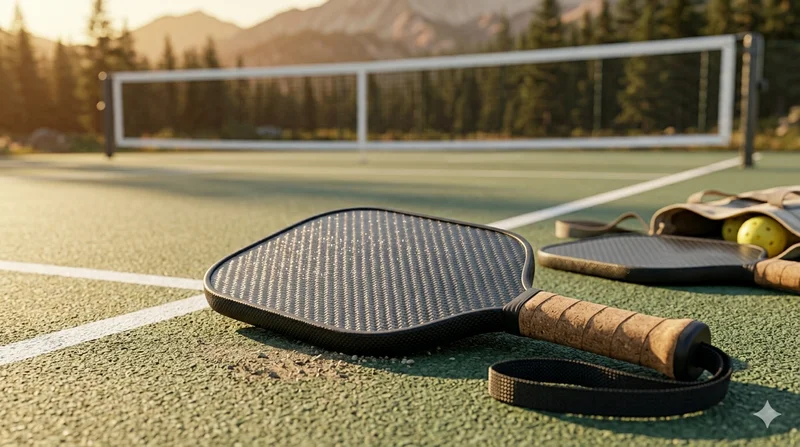
Carbon Fiber Pickleball Paddle
High-performance pickleball paddle with Toray T700 carbon fiber face and polypropylene honeycomb core. Delivers excellent power-to-weight ratio, spin generation, and vibration dampening for competitive play.
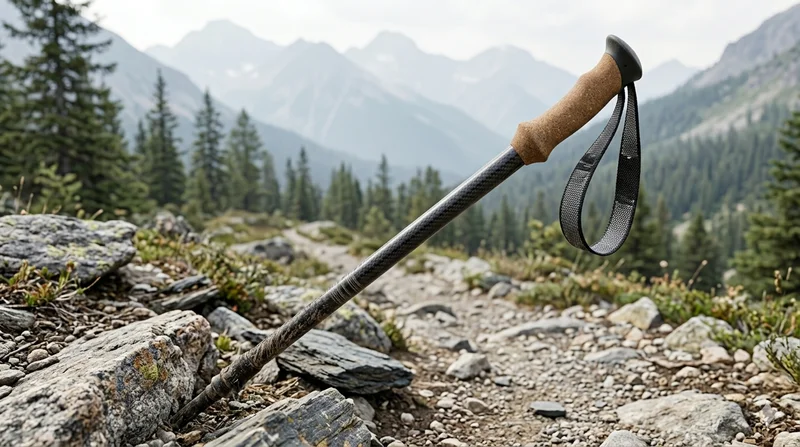
Carbon Fiber Trekking Pole
Lightweight carbon fiber trekking pole manufactured from high-grade carbon fiber tube. Weighs only 160g per pole while providing superior shock absorption and durability for hiking, trail running, and backpacking.