
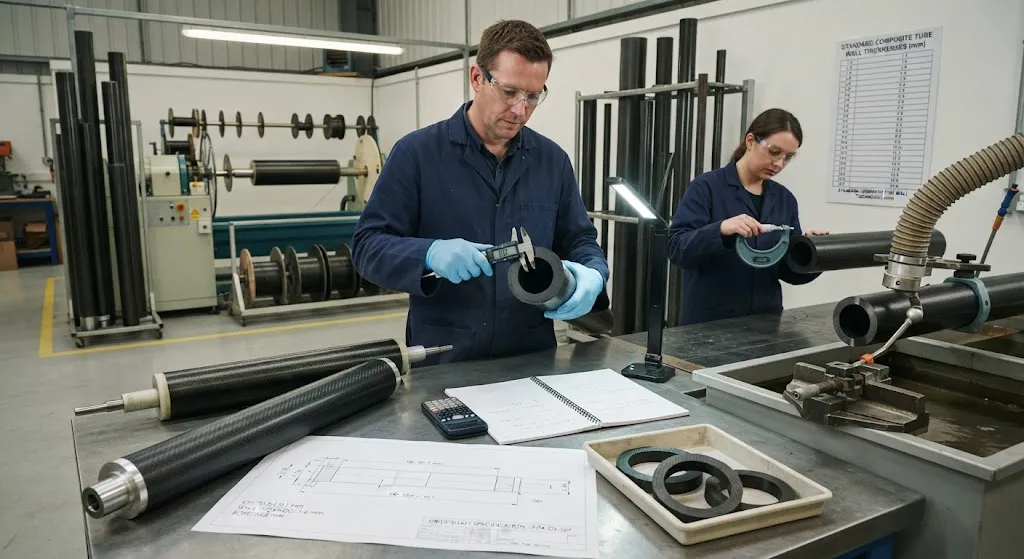
A carbon fiber tube thick walled in section solves a different problem from the thin tubes that dominate drone arms and tripod legs. Thin tubes are optimised for stiffness per unit weight, and they work well until they are asked to carry high torque, to resist crushing, or to accept a thread or a pr
Introduction
A carbon fiber tube thick walled in section solves a different problem from the thin tubes that dominate drone arms and tripod legs. Thin tubes are optimised for stiffness per unit weight, and they work well until they are asked to carry high torque, to resist crushing, or to accept a thread or a press fit. At that point the thin wall buckles locally, and the answer is to add wall thickness. A thick-walled carbon fiber tube trades some of the mass efficiency of a thin tube for far greater resistance to buckling, torsion and local damage.
Thick-walled tubes are the choice for drive shafts, winding rollers, marine rudder shafts, robotics links and heavy-lift booms. This article explains what makes a tube thick walled, quantifies the stiffness and weight trade-off as the wall grows, covers the design considerations that govern the choice, and describes how these tubes are manufactured and machined.
What Counts as a Carbon Fiber Tube Thick Walled
There is no single threshold, but engineers generally treat a tube as thick walled when the wall is a significant fraction of the outside diameter. A common rule is that a tube with a diameter-to-thickness ratio below about 20, meaning a wall greater than roughly five percent of the outside diameter, is no longer thin walled, and many composite tubes described as thick walled have a wall of ten percent of the outside diameter or more. In practice, a carbon fiber tube with a wall above three to five millimetres, or with a diameter-to-thickness ratio below ten, is treated as thick walled.
The distinction matters because the two regimes fail in different ways. A thin-walled tube loaded in bending or torsion fails first by local buckling of the wall, well below the material's strength, so adding material to a thin wall buys a large increase in load capacity. A thick-walled tube is governed more by the material's own strength and by the fibre orientation, and its failure is closer to a material failure than to a buckling collapse. Designing in the wrong regime, either too thin for the torque or far thicker than the load requires, produces a part that is either unreliable or unnecessarily heavy.
Thick-Walled vs Thin-Walled: Stiffness, Weight and Failure
The table below models a 50 millimetre tube with increasing wall thickness, using a density of 1.55 grams per cubic centimetre and taking the thinnest wall as the reference for bending stiffness. It shows why the wall is the central design lever.
| Wall (mm) | Inside diameter (mm) | Mass (kg/m) | Relative bending stiffness | Failure mode |
|---|---|---|---|---|
| 1.5 | 47 | 0.354 | 1.00 | local buckling |
| 3.0 | 44 | 0.687 | 1.82 | buckling, then material |
| 5.0 | 40 | 1.096 | 2.69 | material strength |
| 10.0 | 30 | 1.948 | 3.97 | material strength |
| solid | 0 | 3.043 | 4.56 | material strength |
The table carries two lessons. First, bending stiffness rises quickly at first and then flattens: going from a 1.5 to a 3 millimetre wall adds 82 percent stiffness for 94 percent more mass, and going all the way to solid adds only a further 150 percent stiffness for nearly nine times the mass of the thin tube. Second, and more important, the failure mode shifts from local buckling to material strength as the wall thickens. A thick-walled tube is not chosen because it is the lightest, but because it resists the failure mode that would otherwise govern.
Design Considerations: Buckling, Crushing and Fatigue
Four considerations govern thick-walled tube design:
- Local buckling: the wall thickness needed to prevent crippling sets a minimum, and this minimum often drives the design more than bending stress does. The required wall grows with diameter and with the applied bending and torsional load.
- Crushing and impact: thick walls tolerate clamp loads, bolt bearing and handling damage far better than thin walls, which is why rollers and drive shafts, which see concentrated point loads, are thick walled.
- Fatigue: thick sections distribute stress over more material, lowering the peak stress that drives fatigue, so they last longer under cyclic torsion and bending.
- Connections: thick walls can be threaded, keyed or press fitted, and can accept a bonded metallic insert, whereas a thin wall cannot.
These factors combine so that the wall is often set by the connection or the buckling load, not by the bending stress. A designer who sizes a shaft purely on bending stress and ignores buckling may specify a wall that fails in service, while one who ignores connections may specify a wall that cannot be joined.
Manufacturing a Thick-Walled Carbon Fiber Tube
Thick-walled tubes are usually made by filament winding, where resin-wetted fibre is wound onto a mandrel at controlled angles to build the wall in a single pass. The winding angle sets the balance between hoop, axial and torsional properties: a mix of hoop windings for crush resistance and angled windings for torsion is common. Roll wrapping of prepreg is used for thick plain tubes where a specific layup is required, and pultrusion is generally limited to thinner, constant-section tubes. The mandrel is removed after cure, either by extraction or by a removable or dissolvable core, and the resulting tube has a continuous wall with no seams. Thick walls cure with a higher thermal mass, so the cure cycle is slower and residual stresses must be managed to avoid internal cracking.
Cutting and Machining Thick-Walled Tube
Carbon fiber tube cutting and machining on a thick wall needs only the right tooling and technique:
- Cutting: use an abrasive or diamond saw, or waterjet, at a controlled feed. A waterjet gives a clean edge with no delamination and is preferred where the cut face will be bonded.
- Support: a thick-walled tube resists ovalisation better than a thin one, but the bore should still be supported during clamping, and a soft jaw should be used to avoid crushing the wall at the contact points.
- Drilling and threading: thick walls can be drilled and even threaded, but carbide or diamond tooling is required, and the cut must avoid pulling fibres from the laminate. For load-bearing threads a bonded insert is still safer than a bare thread.
- Edge finishing: seal or lightly sand cut and machined edges to prevent fraying and moisture ingress at exposed fibres.
Weight and Strength Trade-offs
Weight and strength must be read together on a thick-walled tube. The mass per meter follows from the cross-sectional area and the density, the same calculation used for any tube, and it rises with the wall. The strength, in turn, rises faster than the mass while the failure mode is buckling, and more slowly once the tube is governed by material strength. A carbon fiber tube strength calculator, fed with the outside diameter, the wall and the fibre modulus, shows where the two curves cross for a given load. The practical target is the thinnest wall that prevents buckling and meets the connection requirement, because anything thicker adds mass for little further benefit. Thick walls are used when torsional load, crush resistance or a threaded connection set that minimum, not because thickness is good in itself.
Frequently Asked Questions
What counts as a thick-walled carbon fiber tube?
Engineers usually treat a tube as thick walled when the wall is a significant fraction of the outside diameter, often taken as a diameter-to-thickness ratio below about 20, or a wall of five to ten percent of the outside diameter or more. In practice, a carbon fiber tube with a wall above three to five millimetres, or a diameter-to-thickness ratio below ten, is treated as thick walled.
Why use a thick-walled tube instead of a thin one?
A thick wall resists local buckling, which is the failure mode that governs thin-walled tubes under bending and torsion, and it adds torsional and crush strength as well as the ability to accept a thread or press fit. A thin tube is more mass-efficient for pure bending, but it cannot carry high torque or survive concentrated clamp loads. The thick wall is chosen when those loads, not weight alone, set the design.
Can a thick-walled carbon fiber tube be threaded or machined like metal?
It can be cut, drilled and even threaded, but not with the same ease as aluminum. Cutting needs an abrasive or diamond saw or a waterjet, drilling and threading need carbide or diamond tooling, and the bore should be supported during clamping to avoid crushing. For load-bearing threads a bonded insert is still safer than a bare thread in the laminate, and cut edges should be sealed to prevent fraying.
Conclusion
A carbon fiber tube thick walled in section is the answer when torque, crushing or a connection governs the design rather than pure bending. The wall thickness controls not just stiffness and weight but the failure mode itself, moving a tube from local buckling to material strength as it thickens. Thick-walled tubes are worth their extra mass in drive shafts, rollers, marine shafts and robotics links, where concentrated loads and torque would defeat a thin wall. The right design is the thinnest wall that prevents buckling and meets the connection requirement, confirmed with a weight calculation and a strength calculator before manufacture.
If you need thick-walled carbon fiber tubes with defined wall thickness, diameter and fibre orientation, browse our carbon fiber tube range, or contact our team for design support and custom wall thicknesses.
Part of topic
Related Articles
- Carbon Fiber Tube Repair: Methods, Limits and When to Replace
- Carbon Fiber Tube Weight: How to Estimate Weight per Meter
- Carbon Fiber Rod vs Fiberglass: Stiffness, Fatigue and Cost
- Carbon Fiber Rod vs Graphite: Key Differences Explained
- Carbon Fiber Tube vs Steel: Strength-to-Weight Analysis
- Carbon Fiber Tube vs Aluminum: Which Material Wins for Your Application
Interested in Our Products?
Contact our team for competitive pricing and technical specifications.
Get a QuoteRelated Products

Carbon Fiber Plate — 3K Twill T700 1.5mm
Thin 1.5mm carbon fiber plate with 3K twill weave surface. Lightweight and stiff, commonly used for covers, panels, drone bodies, and applications requiring a premium aesthetic appearance.

Carbon Fiber Plate — 3K Twill T700 3.0mm
Medium-thickness 3.0mm carbon fiber plate offering significantly higher load capacity while maintaining attractive 3K twill finish. Suitable for structural brackets, reinforcement plates, and load-bearing panels.

Square Carbon Fiber Tube — 3K Twill T700
Square cross-section carbon fiber tube manufactured with 3K twill weave for torsional strength. Preferred for structural frames, trusses, and support columns where rectangular geometry offers design flexibility.

Carbon Fiber Pickleball Paddle
High-performance pickleball paddle with Toray T700 carbon fiber face and polypropylene honeycomb core. Delivers excellent power-to-weight ratio, spin generation, and vibration dampening for competitive play.

Carbon Fiber Trekking Pole
Lightweight carbon fiber trekking pole manufactured from high-grade carbon fiber tube. Weighs only 160g per pole while providing superior shock absorption and durability for hiking, trail running, and backpacking.