
Carbon fiber plate density sits in a narrow band — about 1.45 to 1.62 grams per cubic centimetre for solid epoxy laminates — and it is one of the most stable numbers in a composite datasheet. A carbon fiber plate 4 millimetres thick weighs 6.2 kilograms per square metre whether it is twill or unidir
Introduction
Carbon fiber plate density sits in a narrow band — about 1.45 to 1.62 grams per cubic centimetre for solid epoxy laminates — and it is one of the most stable numbers in a composite datasheet. A carbon fiber plate 4 millimetres thick weighs 6.2 kilograms per square metre whether it is twill or unidirectional, which is roughly a fifth of aluminium and a fifth of steel, and that predictable mass is why mass-driven industries from drones to motorsport specify by plate thickness rather than chasing lighter grades.
This article explains where the number comes from, how carbon fiber plate density changes with layup and cure pressure, how to convert it into mass for any thickness, how voids push the measured value below the theoretical one, and how to verify a batch with a simple Archimedes test.
What Sets Carbon Fiber Plate Density
A cured plate is two phases: carbon fibre at 1.76 to 1.80 grams per cubic centimetre, and epoxy at 1.10 to 1.20. The laminate density follows the rule of mixtures:
ρlaminate = Vf · ρfibre + (1 − Vf) · ρresin
So the only meaningful variable is fibre volume fraction Vf, which is set by fabric areal weight and cure pressure — not by fibre grade. Moving from a vacuum-bagged layup at 45 to 50 percent fibre volume to an autoclave cure at 60 percent adds about 0.10 grams per cubic centimetre and roughly 30 percent to every stiffness and strength value at once. Resin choice shifts the result by less than 0.03 grams per cubic centimetre across common epoxies.
- Fabric areal weight: heavier fabrics leave less room for resin between plies at the same thickness, pushing fibre volume up.
- Cure pressure: autoclave pressure consolidates plies and squeezes excess resin; vacuum bagging alone typically stalls near 50 percent.
- Voids: trapped air and volatiles lower measured density below the rule-of-mixtures value; every 1 percent of voids removes roughly 0.016 grams per cubic centimetre.
Carbon Fiber Plate Density by Construction
Table values assume PAN-based standard-modulus fibre at 1.78 grams per cubic centimetre and epoxy at 1.15:
| Construction | Fibre volume | Theoretical density (g/cm³) | Typical measured (g/cm³) | Typical void content |
|---|---|---|---|---|
| Vacuum bagged, 3K twill | 45–50% | 1.44–1.48 | 1.42–1.50 | 2–5% |
| Autoclave, 3K twill | 55–60% | 1.51–1.55 | 1.50–1.57 | 0.5–2% |
| Autoclave, unidirectional | 58–62% | 1.53–1.57 | 1.53–1.61 | <1% |
| Prepreg, high pressure | 60–65% | 1.55–1.59 | 1.55–1.62 | <1% |
| RTM / infusion | 40–48% | 1.40–1.46 | 1.38–1.48 | 1–4% |
| Carbon-epoxy sandwich (honeycomb core) | Face 55–60% | 0.40–0.80 effective | 0.45–0.80 | n/a |
The practical read: stock plates sold as standard carbon fiber plates are usually autoclave or high-pressure cured twill at 1.52 to 1.58 grams per cubic centimetre, while infused or vacuum-only panels sit nearer 1.45. Sandwich panels are the exception — their carbon fiber sheet density belongs to the face sheets, and the panel's effective density is dominated by the core.
From Density to Mass: Carbon Fiber Sheet Density Tables
At 1.55 grams per cubic centimetre, mass per area is simply thickness in millimetres × 1.55 kilograms per square metre — so a carbon fiber plate 4mm thick weighs 6.2 kilograms per square metre before any cut-outs:
| Thickness | Mass per m² at 1.50 | Mass per m² at 1.55 | Mass per m² at 1.60 | 400 × 300 mm blank |
|---|---|---|---|---|
| 1 mm | 1.50 kg | 1.55 kg | 1.60 kg | 180–192 g |
| 2 mm | 3.00 kg | 3.10 kg | 3.20 kg | 360–384 g |
| 3 mm | 4.50 kg | 4.65 kg | 4.80 kg | 540–576 g |
| 4 mm | 6.00 kg | 6.20 kg | 6.40 kg | 720–768 g |
| 6 mm | 9.00 kg | 9.30 kg | 9.60 kg | 1.08–1.15 kg |
| 8 mm | 12.00 kg | 12.40 kg | 12.80 kg | 1.44–1.54 kg |
Against other materials at plate level: aluminium 2.70, glass fibre laminate 1.85 to 2.00, titanium 4.43, mild steel 7.85 grams per cubic centimetre. The carbon plate wins every comparison on mass, and the gap between the 1.45 and 1.62 ends of the carbon band is smaller than the gap between any two of those materials — which is why density should be treated as a constant in early design and thickness as the variable.
How to Measure and Verify Laminate Density
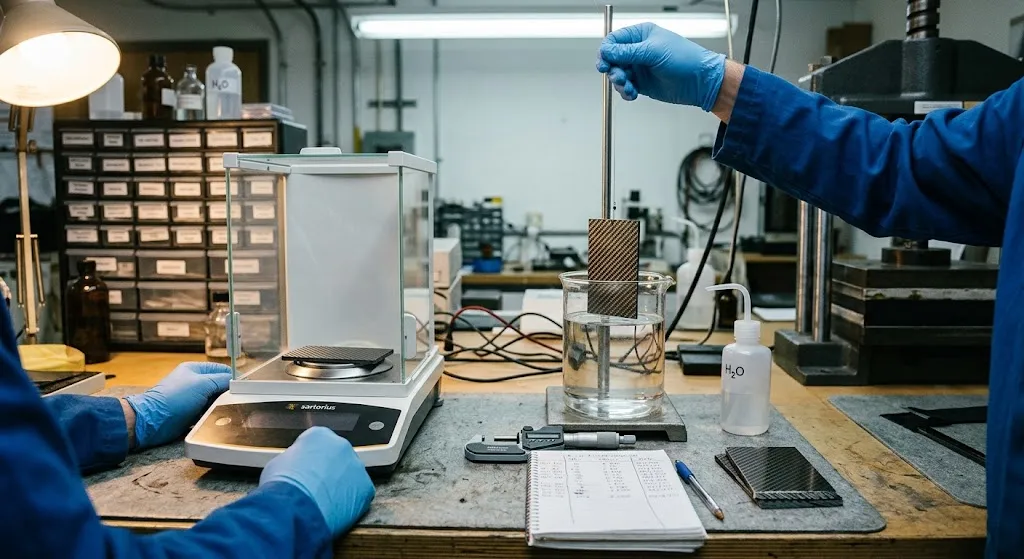
Suppliers should report density per ASTM D792 (Archimedes principle). The bench test is simple:
- Weigh dry: record the specimen mass in air to 0.01 gram.
- Weigh immersed: hang the specimen on a fine wire submerged in distilled water at 23 °C and record the apparent mass. Seal cut edges with thin varnish first, or water wicks into the fibre bed and the reading drifts high.
- Compute: ρ = dry mass / (dry − immersed) — for a plate the result is typically 1.45 to 1.60 grams per cubic centimetre.
- Back out voids: if the layup is known, void content ≈ 1 − (measured density / theoretical density at that fibre volume). Under 1 percent is autoclave quality; above 3 percent usually means the cure did not consolidate.
A quick sanity check without equipment: measure thickness with a micrometer at five points, weigh the blank, and divide mass by volume. On flat plates this lands within about 2 percent of the Archimedes value and is enough to catch a mis-shipped layup.
Why Density Alone Does Not Predict Stiffness
Two plates at 1.56 grams per cubic centimetre can differ twofold in stiffness. Density follows fibre volume; modulus follows fibre direction. A quasi-isotropic twill plate near 1.55 grams per cubic centimetre has an in-plane modulus around 45 to 55 gigapascal, while a unidirectional plate at the same density reaches 120 to 140 gigapascal along the fibres. Strength behaves the same way — 700 to 900 megapascal quasi-isotropic versus over 1,500 along 0 degrees in a UD layup. So use carbon fiber plate density to predict mass, and layup to predict mechanical performance; neither substitutes for the other.
Frequently Asked Questions
What is the density of a carbon fiber plate?
Standard solid epoxy laminates fall between 1.45 and 1.62 grams per cubic centimetre, with autoclave-cured twill and unidirectional stock typically at 1.52 to 1.58. Honeycomb-core sandwich panels are far lighter at 0.45 to 0.80 because their effective density is set by the core, not by the carbon face sheets.
Does carbon fiber plate density change with thickness?
No. Density is a material property of the laminate; mass scales linearly with thickness. A 2 millimetre and a 6 millimetre plate cut from the same sheet have identical density, and the 6 millimetre plate simply weighs three times as much — 9.3 versus 3.1 kilograms per square metre at 1.55 grams per cubic centimetre.
How do I check the density of a plate I already have?
Weigh it, measure thickness at several points with a micrometer, and divide mass by volume; that gives a result within roughly 2 percent of a formal ASTM D792 Archimedes test. If you suspect a different layup than advertised, ask the supplier for fibre volume and void content as well — two plates at the same density can still differ twofold in stiffness.
Conclusion
Treat carbon fiber plate density as a constant near 1.55 grams per cubic centimetre and let thickness do the work: 1.55 kilograms per square metre per millimetre, about 744 grams for a 400 × 300 millimetre plate at 4 millimetres, and a measured value 0.05 to 0.15 below theory whenever voids are present. The number predicts mass reliably; it does not predict stiffness, which follows fibre direction instead. For stock sheets, blanks to your mass budget, or a certified density report on a production lot, browse our carbon fiber plate range or contact our technical team with your target thickness, layup and tolerance.
Part of topic
Related Articles
- Carbon Fiber Plate 4mm: Stiffness, Machining and Applications
- Carbon Fiber Tube Repair: Methods, Limits and When to Replace
- Carbon Fiber Tube Thick Walled: Design Considerations and Applications
- Carbon Fiber Tube Weight: How to Estimate Weight per Meter
- Carbon Fiber Rod vs Fiberglass: Stiffness, Fatigue and Cost
- Carbon Fiber Rod vs Graphite: Key Differences Explained
Interested in Our Products?
Contact our team for competitive pricing and technical specifications.
Get a QuoteRelated Products

Carbon Fiber Plate — 3K Twill T700 1.5mm
Thin 1.5mm carbon fiber plate with 3K twill weave surface. Lightweight and stiff, commonly used for covers, panels, drone bodies, and applications requiring a premium aesthetic appearance.

Carbon Fiber Plate — 3K Twill T700 3.0mm
Medium-thickness 3.0mm carbon fiber plate offering significantly higher load capacity while maintaining attractive 3K twill finish. Suitable for structural brackets, reinforcement plates, and load-bearing panels.

Carbon Fiber Pickleball Paddle
High-performance pickleball paddle with Toray T700 carbon fiber face and polypropylene honeycomb core. Delivers excellent power-to-weight ratio, spin generation, and vibration dampening for competitive play.

Square Carbon Fiber Tube — 3K Twill T700
Square cross-section carbon fiber tube manufactured with 3K twill weave for torsional strength. Preferred for structural frames, trusses, and support columns where rectangular geometry offers design flexibility.

Carbon Fiber Trekking Pole
Lightweight carbon fiber trekking pole manufactured from high-grade carbon fiber tube. Weighs only 160g per pole while providing superior shock absorption and durability for hiking, trail running, and backpacking.