
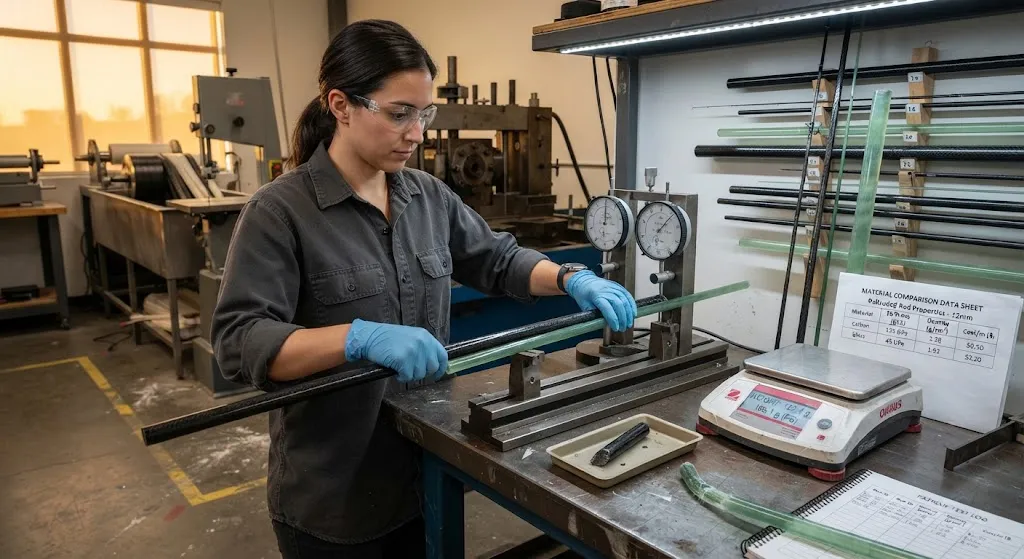
Carbon fiber rod vs fiberglass is one of the oldest choices in composites, and it appears in everything from fishing rods and arrow shafts to kite spars, tent poles, flagpoles and antenna masts. The two materials sit at opposite ends of the same spectrum: a pultruded carbon fiber rod is about three
Introduction
Carbon fiber rod vs fiberglass is one of the oldest choices in composites, and it appears in everything from fishing rods and arrow shafts to kite spars, tent poles, flagpoles and antenna masts. The two materials sit at opposite ends of the same spectrum: a pultruded carbon fiber rod is about three to four times stiffer per kilogram than a fiberglass rod, carries a fatigue life that barely degrades over millions of cycles, and weighs roughly a third as much for the same stiffness, while fiberglass costs a fraction as much, survives impact far better and warns you with visible damage before it fails. This guide compares the two on stiffness, fatigue, impact and cost, with a property table and practical selection rules.
The short answer is that carbon wins where stiffness, weight and fatigue decide the design, and fiberglass wins where cost, impact tolerance and tough handling decide it. Fishing, archery, kites, drones and robotics all sit somewhere between those extremes, as the sections below show.
Carbon Fiber Rod vs Fiberglass: How the Fibres Differ
Both rods are made by pultrusion, where continuous fibre is pulled through a resin bath and a heated die, but the fibres themselves could not be more different. E-glass fibre has a modulus near 72 to 76 gigapascals and a density around 2.5 grams per cubic centimetre, and glass fibres stretch remarkably far before breaking, with failure strains near 4.5 to 4.8 percent. Standard-modulus carbon fibre has a modulus of 230 to 294 gigapascals at a density of roughly 1.76, but it fails at only 1.5 to 1.9 percent strain. Because the rod properties follow the fibre, a pultruded glass rod lands around 30 to 45 gigapascals in bending, while a carbon rod lands at 120 to 140 gigapascals, and the glass rod is noticeably heavier because borosilicate glass is denser than carbon fibre and resin.
That single difference drives everything else. Stiffness per kilogram is roughly four times higher for carbon, which is why carbon rods dominate where light, stiff and slender are requirements. Strain to failure is two to three times higher for glass, which is why glass rods absorb shock and local damage without giving up. Epoxy or polyester resin surrounds both fibres, and both rods are made to the same diameters, so the comparison is truly fibre against fibre.
Carbon Fiber Rod vs Fiberglass in Stiffness, Fatigue and Cost
The table compares a 3 millimetre solid pultruded rod in standard-modulus carbon and in E-glass.
| Property | Carbon Fiber Rod | Fiberglass Rod |
|---|---|---|
| Fibre modulus | 230-294 GPa | 72-76 GPa |
| Rod modulus (bending) | 120-140 GPa | 30-45 GPa |
| Tensile strength | 1,000-1,500 MPa | 500-1,000 MPa |
| Density | 1.5-1.6 g/cm³ | 1.9-2.1 g/cm³ |
| Failure strain | 1.5-1.9 percent | 3-4.5 percent |
| Fatigue behaviour | Flat S-N curve, high strength | Loses strength with cycling |
| Relative stiffness for equal mass | 3-4 times fiberglass | Baseline |
| Relative cost per metre | 3-6 times fiberglass | Baseline |
The bending stiffness figures deserve a worked note. For a solid rod of equal diameter, bending stiffness is the modulus times the second moment of area, so carbon at 130 gigapascals is about 3.5 times stiffer than glass at 37 gigapascals. Because carbon is also lighter, a carbon rod matched to a glass rod's stiffness can be thinner and still weigh far less. Against that, the glass rod stretches to nearly three times the strain before breaking, which is why it survives being stepped on, dropped and swung into rocks in a way carbon cannot match.
Carbon Fiber Rod vs Fiberglass in Fatigue and Impact
Fatigue is where carbon resets the argument. Under repeated bending, carbon fibre shows a nearly flat stress-life curve: a rod loaded to a given fraction of its strength can run for millions of cycles with almost no loss of capacity, which is why carbon driveshafts and drone arms trust the same cross-section for their whole life. Glass holds up far less cleanly. Microcracks grow through the laminate with every cycle and the stiffness slowly steps down, so a glass part designed for high cycling must start larger and heavier. In a fishing rod cast tens of thousands of times or a flagpole swaying in the wind for years, carbon's fatigue margin is a real structural credit, not a marketing claim.
Impact is where the roles reverse. Glass fibre can absorb a surprising amount of energy: a rod that flexes to 4 percent strain stores far more strain energy before failure than one that breaks at 1.7 percent, so glass parts dent, delaminate or crack locally while continuing to work, whereas a carbon rod hit hard enough often fails catastrophically at the point of contact. For tools, pushrods, kite frames and anything exposed to drops, collisions or transport damage, that difference routinely outweighs carbon's stiffness. The honest engineering answer is to design for the dominant load: stiffness and fatigue favour carbon, impact and handling damage favour glass.
Carbon Fiber Rod vs Fiberglass in Fishing and Outdoor Gear
The sporting-goods market makes the trade-off visible in real products:
- Carbon fiber rods fishing tackle: A modern carbon rod casts farther with less effort, feels bites through the blank and stays light in the hand, so competition and technique fishing choose carbon. Its weakness is a genuine one: a carbon tip that is snagged, stepped on or crushed in a rod locker can break cleanly, where a glass tip bends out of the way.
- Arrows and kite spars: Carbon shafts fly straighter and stiffer, which is why tournament arrows and competition kites use them, while beginner arrows and budget kites use glass because they bend instead of shattering on a bad release.
- Carbon fiber solid rod in pushrods and linkages: For drone controls, RC linkages and robotics pushrods, a carbon fiber solid rod is chosen for compression stiffness and fatigue life, with glass reserved for the parts that get knocked about.
- Cost-sensitive volume parts: When a rod is a commodity, such as a tent pole or a garden stake, fiberglass wins on price and survives the rough life of the product, and carbon is specified only where the weight or performance pays for it.
And because the terms overlap, it helps to remember how fiberglass relates to carbon fiber rod vs graphite: a "graphite" rod is a carbon product under another name, while fiberglass is always a different fibre, so the two comparisons never mix.
Frequently Asked Questions
Is a carbon fiber rod stronger than a fiberglass rod?
That depends on the load. On a per-kilogram basis carbon is stronger and much stiffer, reaching 1,000 to 1,500 megapascals against 500 to 1,000 for a glass rod, with three to four times the stiffness for equal mass. But a glass rod survives impact better because it stretches to 3 to 4.5 percent strain before breaking, while carbon fails near 1.7 percent. Strength is not one number: carbon wins in stiffness and fatigue, glass wins in impact and damage tolerance.
Why are carbon fiber rods so much more expensive than fiberglass?
The fibre is the cost. Carbon fibre is made by oxidising and carbonising polyacrylonitrile at over 1,000 degrees Celsius in energy-intensive furnaces, then surface-treated and sized, while E-glass fibre is spun from melted sand-like minerals at far lower processing cost. On the finished rod that becomes a three to six times price difference per metre, which is why glass rods dominate commodity products and carbon is reserved for performance parts.
Should I choose a carbon fiber rod or a fiberglass rod for fishing?
Choose carbon when casting distance, sensitivity, stiffness and long-term fatigue matter and you can protect the rod, as in competition and technique fishing. Choose fiberglass when durability, forgiveness and budget matter more, as in beginner tackle, heavy braid fishing around structure and travel rods that get packed roughly. Many anglers keep one of each: glass for the abuse, carbon for the performance.
Conclusion
Carbon fiber rod vs fiberglass is not a question of which is better but of which load wins the design. Carbon delivers three to four times the stiffness per kilogram, a flat fatigue curve that survives millions of cycles, and roughly a third of the weight of a stiffness-matched glass rod, which is why it dominates competition fishing tackle, arrows, drone parts and robotics pushrods. Fiberglass delivers a fraction of the cost, two to three times the strain to failure and a gradual, visible failure mode, which is why it survives what carbon cannot. Matching the fibre to the dominant load, and remembering that a carbon fiber solid rod serves compression and buckling while fiberglass serves impact, turns the comparison into a specification.
If you need carbon fiber rods and fiberglass rods supplied with clear modulus, diameter, straightness and fatigue data, browse our carbon fiber rod range, or contact our team for datasheets and application support.
Part of topic
Related Articles
- Carbon Fiber Tube Repair: Methods, Limits and When to Replace
- Carbon Fiber Tube Thick Walled: Design Considerations and Applications
- Carbon Fiber Tube Weight: How to Estimate Weight per Meter
- Carbon Fiber Rod vs Graphite: Key Differences Explained
- Carbon Fiber Tube vs Steel: Strength-to-Weight Analysis
- Carbon Fiber Tube vs Aluminum: Which Material Wins for Your Application
Interested in Our Products?
Contact our team for competitive pricing and technical specifications.
Get a QuoteRelated Products

Carbon Fiber Plate — 3K Twill T700 1.5mm
Thin 1.5mm carbon fiber plate with 3K twill weave surface. Lightweight and stiff, commonly used for covers, panels, drone bodies, and applications requiring a premium aesthetic appearance.

Carbon Fiber Plate — 3K Twill T700 3.0mm
Medium-thickness 3.0mm carbon fiber plate offering significantly higher load capacity while maintaining attractive 3K twill finish. Suitable for structural brackets, reinforcement plates, and load-bearing panels.

Square Carbon Fiber Tube — 3K Twill T700
Square cross-section carbon fiber tube manufactured with 3K twill weave for torsional strength. Preferred for structural frames, trusses, and support columns where rectangular geometry offers design flexibility.
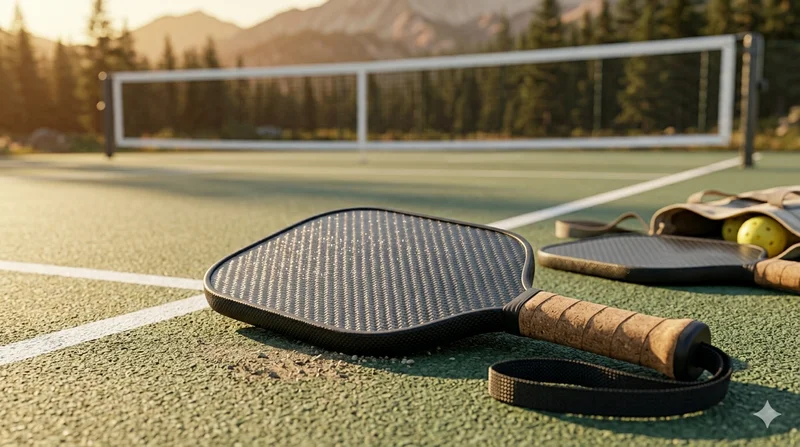
Carbon Fiber Pickleball Paddle
High-performance pickleball paddle with Toray T700 carbon fiber face and polypropylene honeycomb core. Delivers excellent power-to-weight ratio, spin generation, and vibration dampening for competitive play.
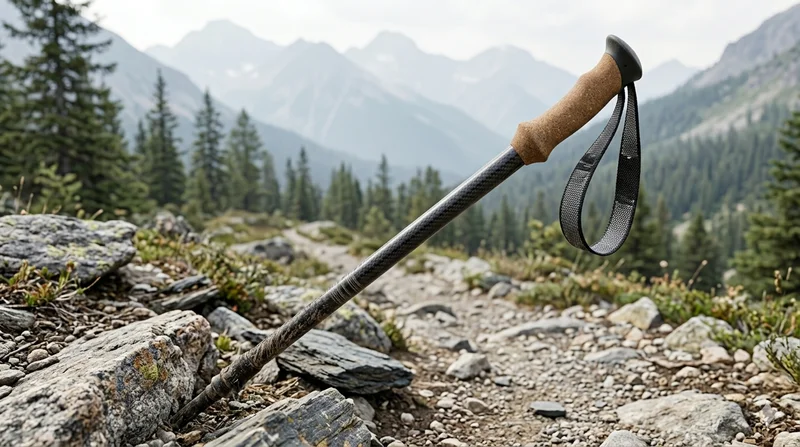
Carbon Fiber Trekking Pole
Lightweight carbon fiber trekking pole manufactured from high-grade carbon fiber tube. Weighs only 160g per pole while providing superior shock absorption and durability for hiking, trail running, and backpacking.