
Filament wound epoxy tubes are everywhere in pressure service, drive shafts, tooling spars and FRP piping — wound from continuous roving onto a rotating mandrel and cured into thin-walled anisotropic cylinders with excellent axial stiffness per gram. Their disadvantages are equally structural, and t
Introduction
Filament wound epoxy tubes are everywhere in pressure service, drive shafts, tooling spars and FRP piping — wound from continuous roving onto a rotating mandrel and cured into thin-walled anisotropic cylinders with excellent axial stiffness per gram. Their disadvantages are equally structural, and they catch buyers who specified the process for its strengths without pricing its weaknesses. This article catalogues the filament wound epoxy tubes disadvantages that matter in procurement and design — anisotropy, porosity and void distribution, end and joint vulnerability, environmental degradation — maps them to the failure modes seen in service, and shows what proper filament wound epoxy tubes testing reveals before the field does.
The Core Disadvantages of Filament Wound Epoxy Tubes
Five limitations dominate the technology, and they trace back to the winding process itself:
- Radial weakness and anisotropy: helical and hoop layers give strong axial and circumferential properties, but interlaminar and radial tensile strength remain matrix-controlled — typically 20-60 MPa. Internal pressure that separates layers at a permeation site starts as a matrix problem, not a fiber one.
- Porosity and void content: wet winding entraps air between tows; unless cure cycles include proper compaction and bleed control, void content of 2-5% is common. Voids shorten fatigue life disproportionately — every 1% of voids can cost 10-20% of hydroburst life.
- End and joint weakness: the tube ends where loads enter are the Achilles' heel. Cut faces expose fiber ends, and mechanical couplings concentrate bearing stress on a thin anisotropic wall. Most field failures are joint failures.
- UV and moisture sensitivity: epoxy matrices chalking and moisture ingress at the resin-rich surface degrade interlaminar properties over years of outdoor exposure unless a gelcoat or UV-resistant topcoat is specified.
- Repair difficulty and inspection limits: a dented wound tube cannot be hammered back; bonded repairs restore function only if the damage depth is known, which brings us to testing.
Filament Wound Epoxy Tubes Disadvantages: Failure Modes in Service
Wound tube failures cluster into a short list of mechanisms. Recognizing them early dictates whether a fleet is maintainable or disposable:
| Failure mode | Root cause | Typical detection | Where it appears |
|---|---|---|---|
| Interlaminar delamination | Low radial strength; impact; hygrothermal cycling | Tap test, ultrasonic C-scan | Impact zones, joint edges |
| Matrix microcracking | Over-cure embrittlement; thermal spikes; high strain cycles | Acoustic emission, CT scan | Full length under fatigue |
| Leakage through permeation | Void networks; resin-starved regions | Pressure decay, dye penetrant | Seams and hoop-to-helix transitions |
| Buckling under compression/bending | Thin wall, high slenderness; barely adequate EI | Load-deflection curve deviation | Long unsupported spans |
| End split at couplings | Bearing stress concentration; poor adhesive surface prep | Visual, torque-loss monitoring | Fittings and glued sockets |
| UV chalking / blistering | Resin-rich surface without UV protection | Visual gloss loss, blister check | Outdoor exposed runs |
Two patterns deserve emphasis. First, joints and ends accumulate a disproportionate share of incidents — designing the coupler as carefully as the tube pays for itself. Second, damage is often invisible until pressure or bending makes it leak: hydrostatic tests after impact and regular tap testing of accessible runs are cheap insurance.
Shared Weaknesses with Filament Wound FRP Pipe and Tanks
The same winding physics show up in larger infrastructure. Filament wound FRP pipe suffers analogous disadvantages — permeation corrosion when the liner is breached, joint leakage at bell-and-spigot connections, and strength knock-down from manufacturing voids that never appear on the datasheet. Filament wound tank vessels add another layer: multi-port nozzles interrupt the winding pattern, creating stress concentrations that require local reinforcement and careful schedule review. If you have specified one of these products successfully, you already know most of the disadvantages of smaller wound epoxy tubes — the scale changes, the mechanisms do not.
How Testing Exposes the Disadvantages
Good filament wound epoxy tubes testing does not just certify a batch; it quantifies the specific weaknesses above:
- Hydrostatic burst and proof pressure: reveals void content and interlaminar quality through the failure location — fiber rupture mid-span says the winding is sound; delamination at the end ring says the joint or cure is not.
- Ultrasonic and radiographic inspection: C-scan maps void clusters and delaminations before they become leaks; CT on first-article parts calibrates the process window.
- Torsion and fatigue rigs: drive-shaft duty cycles expose matrix microcracking long before static burst would — 106-cycle torsion tests are the honest screen for rotating applications.
- Environmental conditioning: hot-wet soak before mechanical test quantifies the matrix's moisture penalty; unconditioned data flatters the tube.
- Impact followed by residual strength: drop-weight impact then compression/tension residual testing tells you whether the tube can stay in service after a forklift bump.
Requesting these results — and reading failure locations, not just pass/fail numbers — is how buyers convert a marketing datasheet into a design allowable.
Mitigating the Disadvantages in Design and Procurement
None of the disadvantages is disqualifying; each is manageable with deliberate choices. Wind with consistent tension and controlled compaction to hold voids below 1-2%. Specify standard-modulus fiber for impact-prone service. Design metal end fittings with generous adhesive land lengths (5-8x wall thickness), abraded and degreased surfaces, and a mechanical retention feature so the adhesive is not the only load path. Add UV-stable gelcoat on exposed runs. Require hydrostatic proof plus ultrasonic inspection on pressure parts, and put impact-and-residual-strength testing on the qualification plan for any tube that will live near forklifts, cranes or tool drops. The filament wound epoxy tubes disadvantages are real — but on a specified, tested, joint-aware design, they are bounded, documented and priced.
Frequently Asked Questions
Why do filament wound epoxy tubes leak when the fibers are stronger than steel?
Because the leak path is almost never through fiber. Permeation follows void networks and resin-starved zones in the matrix, or starts at a delaminated end ring. Fiber tensile strength governs burst; matrix quality governs leaks — they are different acceptance criteria.
Can a damaged filament wound tube be repaired in the field?
Only if damage depth is known and limited. Shallow dents with no delamination can be put back in service after inspection. Deep impacts or delaminations require a bonded sleeve repair engineered for the load case — the repair must be designed, not just wrapped. Tubes that have buckled are scrap: the fibers have micro-buckled and static strength will not recover.
How do wound tubes compare with pultruded tubes on disadvantages?
Pultrusion trades winding's tailor-made fiber angles for a fully aligned, higher void-quality process: pultruded tube is stiffer per gram axially and more consistent, but it cannot place hoop fibers for internal pressure and is even weaker in torsion and transverse impact. Choose winding for pressure and combined loads; choose pultrusion for straight axial members where consistency rules.
Conclusion
The filament wound epoxy tubes disadvantages — radial weakness, porosity, end and joint vulnerability, environmental sensitivity and hard-to-inspect damage — are the predictable output of a process that excels at placing fibers along principal stresses. They do not disqualify wound tubes from pressure, drive and structural duty; they specify the discipline required: compaction-controlled winding, engineered end fittings, UV protection, and a testing regime that looks at failure locations instead of only burst numbers. YongXian manufactures filament wound and roll-wrapped carbon and glass epoxy tubes with documented void content, optional gelcoat, and end-fitting engineering support for demanding pressure and drive applications. Browse our carbon fiber product range or contact our technical team to review layup, testing and joint options for your wound tube program.
Related Articles
- Carbon Fiber K Rating: Security Laminate Grades
- Carbon Fiber Solid Rod: Properties and Applications
- Carbon Fiber Plate Density: What to Expect from Laminates
- Carbon Fiber Plate 4mm: Stiffness, Machining and Applications
- Carbon Fiber Tube Repair: Methods, Limits and When to Replace
- Carbon Fiber Tube Thick Walled: Design Considerations and Applications
Interested in Custom Carbon Fiber Products?
Contact our team for competitive pricing and technical specifications.
Get a QuoteRelated Products

Custom Carbon Fiber Musical Instrument Parts
Carbon fiber components for musical instrument manufacturing offering superior dimensional stability, low weight, and consistent acoustic properties. We produce carbon fiber bows, guitar necks, violin chin rests, drum shells, and wind instrument bodies. Carbon fiber instruments are immune to humidity changes and temperature fluctuations that affect wooden instruments.
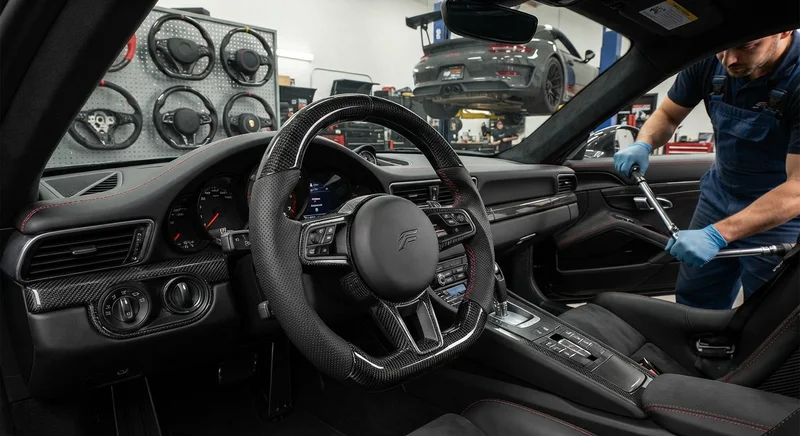
Carbon Fiber Steering Wheel — Custom Leather-Wrapped with CF Inlay
Custom carbon fiber steering wheel with genuine leather wrapping and carbon fiber inlay sections. Molded from T700 3K prepreg for maximum rigidity with a 30% weight reduction over OEM wheels. Available in D-shape (flat bottom) and round profiles. Direct bolt-on fitment for popular sports car and performance vehicle models. Custom stitching color and leather grade available.
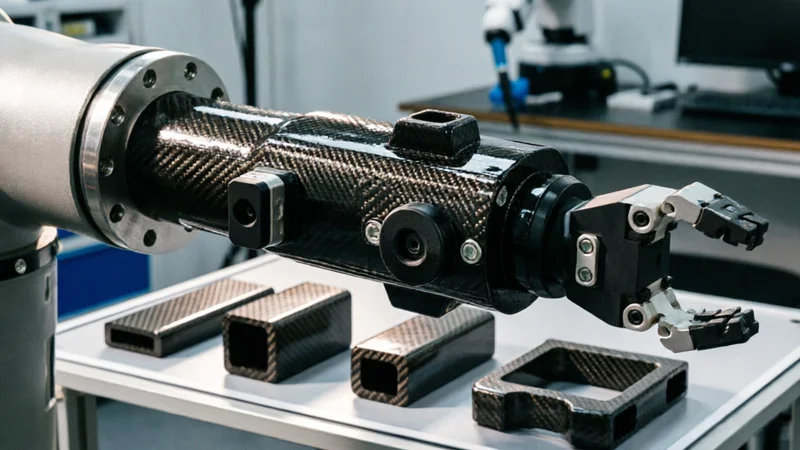
Carbon Fiber Robot End Effector Link — Custom Shape & Sensor Integration
Custom-shaped carbon fiber end effector links for robotic arms. Designed for automation integrators and research labs requiring lightweight, rigid connections between the robot wrist and gripper/tool. Can incorporate sensor mounting bosses, cable routing channels, and quick-change interfaces.
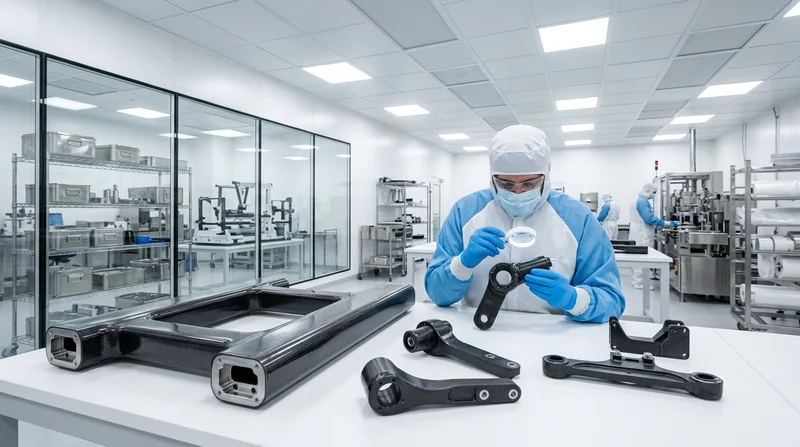
Custom Carbon Fiber Medical Device Components
Medical-grade carbon fiber components manufactured for imaging equipment, surgical instruments, and patient support systems. Carbon fiber's radiolucency (X-ray transparency) and high strength-to-weight ratio make it ideal for CT scanner beds, wheelchair frames, surgical robot arms, and MRI-compatible accessories. Biocompatible resin systems available.
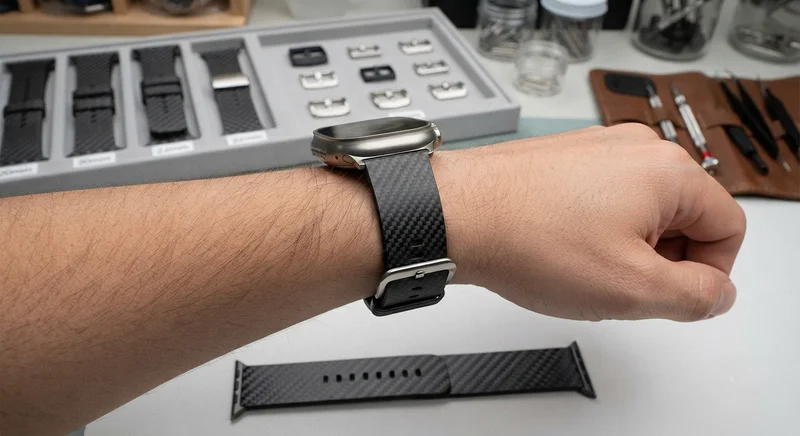
Carbon Fiber Watch Strap — 20mm/22mm Quick-Release
Premium carbon fiber watch strap with quick-release spring bars. Woven from T700 3K twill prepreg with a flexible resin system that conforms to the wrist. Available in 20mm and 22mm lug widths, compatible with Apple Watch, Samsung Galaxy Watch, Garmin, and traditional mechanical watches. Features a stainless steel buckle and carbon fiber keepers. The natural weave pattern makes each strap unique.