
Learning how to make custom carbon fiber parts requires understanding a chain of decisions that begins with the part geometry and ends with a cured, finished component. Carbon fiber composites are not processed like metals — there is no universal stamping or machining step that turns raw fiber into
Introduction
Learning how to make custom carbon fiber parts requires understanding a chain of decisions that begins with the part geometry and ends with a cured, finished component. Carbon fiber composites are not processed like metals — there is no universal stamping or machining step that turns raw fiber into a finished part. Instead, the manufacturing route is shaped by the part's complexity, the required mechanical properties, the target surface finish, and the production volume. A bracket prototyped for a racing team follows a completely different path than a low-volume run of 200 drone frames, even if both start with the same carbon fiber fabric.
The global custom carbon fiber parts market has grown steadily as the material moves from aerospace-only applications into automotive, robotics, consumer electronics, and industrial equipment. Engineers who understand the manufacturing options can avoid the two most common failure modes: over-specifying an expensive aerospace-grade process for a simple prototype, or under-specifying tooling and process control for a production run that demands consistent mechanical properties. This article walks through each stage of how custom carbon fiber parts are made, compares the dominant manufacturing routes, and provides decision criteria for moving from prototype into low-volume production.
Design and Engineering Considerations
Before any material is cut or any mold is machined, the part design must be adapted for composite manufacturing. Unlike isotropic metals, carbon fiber composites are anisotropic — their properties depend on fiber orientation. A well-designed custom carbon fiber part places fibers along the primary load paths and uses quasi-isotropic layups only where multi-directional loading is unavoidable.
- Fiber orientation: Unidirectional (UD) prepreg offers maximum stiffness and strength along one axis but requires careful stacking to handle off-axis loads. Woven fabric (twill or plain weave) provides balanced in-plane properties and better drape over complex curves at a modest cost in peak performance.
- Wall thickness: Most custom parts use 1.5–5 mm wall sections. Thicker sections risk void formation during cure unless vacuum pressure and resin flow are carefully controlled. Thin sections (<1 mm) are achievable with UD prepreg but require precise tooling to maintain tolerance.
- Draft angles: Parts destined for compression molding or RTM need 1–3° draft on vertical walls to release from the mold. Hand layup parts can use zero-draft tooling because the mold is often sacrificed or the part is laid up on a removable former.
- Tolerances: Machined carbon fiber parts can hold ±0.1 mm, while molded parts typically achieve ±0.3–0.5 mm depending on tooling quality and cure shrinkage. Design critical dimensions with appropriate tolerances to avoid secondary machining costs.
Tooling Options: From 3D Printed to Machined Aluminum
The tooling choice is often the single largest cost driver in custom carbon fiber parts, and it is closely tied to the selected manufacturing route. Tooling must withstand the temperatures and pressures of the cure cycle without deforming.
| Tooling Material | Cost Range (USD) | Lead Time | Best For | Durability |
|---|---|---|---|---|
| 3D printed PLA/PETG | $20–$150 | 1–3 days | Prototype, hand layup, vacuum bagging | 1–5 cycles |
| 3D printed high-temp resin | $80–$400 | 2–5 days | Prototype RTM, moderate-temperature cures | 5–20 cycles |
| Machined MDF | $100–$500 | 3–7 days | Prototype, low-volume hand layup | 5–15 cycles |
| Machined aluminum | $500–$5,000 | 1–4 weeks | Low-volume production, RTM, compression molding | 500–5,000+ cycles |
| Invar steel | $10,000–$50,000 | 4–12 weeks | High-volume aerospace, precision parts | 10,000+ cycles |
For prototype and low-volume work under 50 parts, machined aluminum molds offer the best balance of durability and surface finish. They can be machined from CAD models in days, polished to a Class-A finish, and reused across dozens of cycles. For one-off prototypes, 3D printed tooling is sufficient if the cure temperature stays below the glass transition temperature of the printed material — typically 60–80°C for standard PLA and up to 150°C for high-temperature photopolymer resins.
Manufacturing Route Comparison
Four manufacturing routes dominate custom carbon fiber parts production. Each has distinct cost, quality, and lead time characteristics that make it suitable for different stages of product development.
Hand Layup with Vacuum Bagging
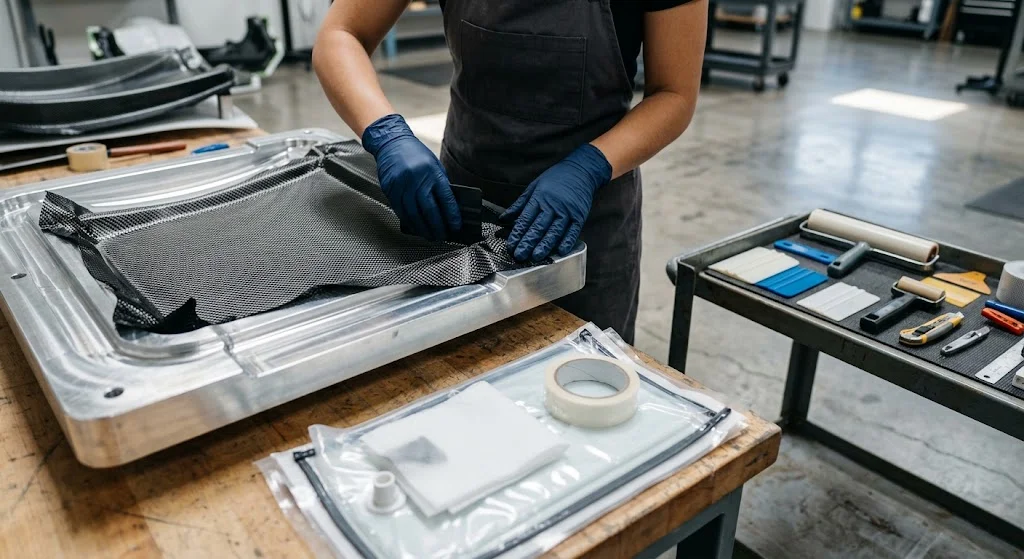
The most accessible method for making custom carbon fiber parts involves hand layup: carbon fiber fabric is cut to shape, placed in or on a mold, saturated with resin (prepreg or wet layup), covered with breather and bagging film, and cured under vacuum pressure. This route requires minimal equipment — a mold, vacuum pump, and oven or autoclave — and produces parts with fiber volume fractions of 50–60%.
Hand layup is ideal for prototypes and parts with complex geometry that cannot be processed by compression molding. Labor content is high (2–8 hours per part depending on size), and quality consistency depends heavily on operator skill. Surface finish on the mold side is excellent; the bag side requires finishing. For low-volume production under 50 parts, hand layup often has the lowest total cost because it avoids the tooling and equipment investment of other routes.
Resin Transfer Molding (RTM)
RTM is a closed-mold process where dry carbon fiber preform is placed in a matched two-part mold, the mold is clamped shut, and resin is injected under pressure (typically 3–10 bar). The resin flows through the preform, saturating the fibers, and cures at elevated temperature. RTM produces parts with good dimensional consistency, two finished surfaces, and fiber volume fractions of 55–65%.
The tooling cost for RTM is significantly higher than hand layup — matched aluminum molds with clamping systems and injection ports cost $2,000–$20,000 depending on size and complexity. However, per-part cycle times of 20–60 minutes and the ability to produce near-net-shape parts with minimal finishing make RTM cost-effective for production runs of 100–1,000 parts. RTM is the preferred route for custom carbon fiber parts that need two cosmetic surfaces and consistent mechanical properties across the production run.
Compression Molding with Prepreg
Compression molding uses a matched metal mold in a hydraulic press. Prepreg material is laid into the lower mold half, the upper half closes, and heat (120–180°C) and pressure (20–100 bar) are applied. Cycle times range from 5–30 minutes depending on thickness and resin system. This route achieves the highest fiber volume fractions (60–70%) and the best dimensional repeatability of any open or closed molding process.
The capital equipment cost is the primary barrier — a production-grade press with precision platens and temperature control costs $50,000–$500,000. Tooling is similarly expensive, requiring hardened steel molds that can withstand hundreds of thousands of cycles. Compression molding becomes cost-competitive at volumes above 500–1,000 parts, where the per-part cost drops below $5–$20 for simple geometries.
Low-Volume Production Strategy
Moving from prototype to low-volume production (50–500 parts) requires a deliberate transition plan. The following framework helps engineers decide when to switch routes:
| Volume | Recommended Route | Tooling Investment | Per-Part Cost | Lead Time per Batch |
|---|---|---|---|---|
| 1–10 parts | Hand layup + 3D printed tooling | $50–$300 | $200–$800 | 3–7 days |
| 10–50 parts | Hand layup + machined aluminum | $500–$2,000 | $80–$250 | 1–2 weeks |
| 50–200 parts | RTM or compression molding | $2,000–$10,000 | $40–$120 | 2–4 weeks |
| 200–1,000 parts | Compression molding | $5,000–$30,000 | $15–$60 | 3–6 weeks |
The key insight is that tooling amortization, not labor, drives per-part cost at low volumes. Investing in machined aluminum tooling at 20 parts — when hand layup would require 40 hours of skilled labor at $50/hour — already makes RTM or compression molding the lower-cost option.
Quality Control and Testing
Every custom carbon fiber part should pass inspection before shipment. The minimum quality control protocol for non-structural parts includes visual inspection for surface defects (voids, dry spots, resin-rich areas), dimensional verification against CAD with calipers or CMM, and a tap test for delamination. For structural parts, additional testing includes:
- Ultrasonic C-scan: Detects internal voids, delaminations, and fiber misorientation. Required for aerospace and safety-critical automotive parts.
- Mechanical testing: Tensile, compression, and flexural coupons cured alongside the part provide representative mechanical data. Destructive testing of sample parts validates the production process.
- Void content measurement: Acid digestion or microscopic cross-section analysis determines void content; aerospace parts typically require <2%, while industrial parts accept <5%.
- Fiber volume fraction: Measured by burn-off or resin digestion, this parameter directly correlates with mechanical properties and is a key process control metric.
Frequently Asked Questions
How long does it take to make a custom carbon fiber part?
Lead time depends on the manufacturing route. A hand-laid prototype with 3D printed tooling can be completed in 3–7 days. RTM or compression molding parts with machined aluminum tooling require 2–4 weeks for the first article, including mold fabrication. For production runs, per-part cycle times range from 20 minutes (compression molding) to several hours (hand layup), so a batch of 50 parts typically ships within 2–3 weeks of order confirmation.
What is the minimum order quantity for custom carbon fiber parts?
Most custom fabricators accept orders as low as one part for prototyping, though the per-part cost is high due to tooling and setup. The minimum economical order quantity is typically 10–50 parts, depending on the manufacturing route. Some suppliers offer "prototype-friendly" pricing for 1–5 parts using shared tooling or simplified processes.
Can I make custom carbon fiber parts at home?
Simple custom carbon fiber parts can be made at home using hand layup with wet resin (epoxy or polyester), a vacuum bag, and an oven for curing. The process is accessible but limited to fiber volume fractions of 40–50% and surface quality that requires significant finishing. For parts requiring structural performance or cosmetic quality, professional fabrication with controlled cure cycles and quality inspection is strongly recommended.
How much does it cost to make custom carbon fiber parts?
Cost depends on part size, complexity, manufacturing route, and volume. A small prototype (100×100 mm) costs $200–$800 by hand layup. The same part in a 100-piece RTM run drops to $40–$120. Large structural parts (500×500 mm+) in low-volume compression molding typically cost $150–$500 per part. Material cost (prepreg, resin, consumables) is usually 20–40% of total cost; labor and tooling amortization account for the remainder.
Conclusion
How to make custom carbon fiber parts is ultimately a question of matching the manufacturing route to the production volume, quality requirements, and budget. Hand layup with 3D printed or machined aluminum tooling is the fastest path to a prototype. RTM offers the best balance of quality and cost for low-volume production of 50–200 parts. Compression molding delivers the highest quality and lowest per-part cost for volumes above 500. Understanding these trade-offs upfront avoids costly rework and ensures that each part is manufactured by the most appropriate process.
Ready to move from design to production? Explore our custom carbon fiber parts range or request a manufacturing consultation to discuss the optimal route for your application.
--- *Word count: 1,647*Part of topic
Related Articles
- Large Diameter Carbon Fiber Tube: Winding vs Pultrusion for Big Profiles
- Carbon Fiber Rod Wrap: Roll-Wrapped Rods for High Bending Loads
- Density of Pultruded Carbon Fiber: Fiber Volume Fraction and Laminate Weight
- Custom Carbon Fiber Parts: A Buyer's RFQ Checklist That Avoids Cost Overruns
- Custom Carbon Fiber Manufacturing: A Buyer's Capability Checklist for OEMs
- Carbon Fiber Rod 1mm: Micro-Rods for Models, Tooling and Probes
Interested in Our Products?
Contact our team for competitive pricing and technical specifications.
Get a QuoteRelated Products

Carbon Fiber Plate — 3K Twill T700 1.5mm
Thin 1.5mm carbon fiber plate with 3K twill weave surface. Lightweight and stiff, commonly used for covers, panels, drone bodies, and applications requiring a premium aesthetic appearance.

Carbon Fiber Plate — 3K Twill T700 3.0mm
Medium-thickness 3.0mm carbon fiber plate offering significantly higher load capacity while maintaining attractive 3K twill finish. Suitable for structural brackets, reinforcement plates, and load-bearing panels.

Carbon Fiber Trekking Pole
Lightweight carbon fiber trekking pole manufactured from high-grade carbon fiber tube. Weighs only 160g per pole while providing superior shock absorption and durability for hiking, trail running, and backpacking.

Carbon Fiber Pickleball Paddle
High-performance pickleball paddle with Toray T700 carbon fiber face and polypropylene honeycomb core. Delivers excellent power-to-weight ratio, spin generation, and vibration dampening for competitive play.

Square Carbon Fiber Tube — 3K Twill T700
Square cross-section carbon fiber tube manufactured with 3K twill weave for torsional strength. Preferred for structural frames, trusses, and support columns where rectangular geometry offers design flexibility.