
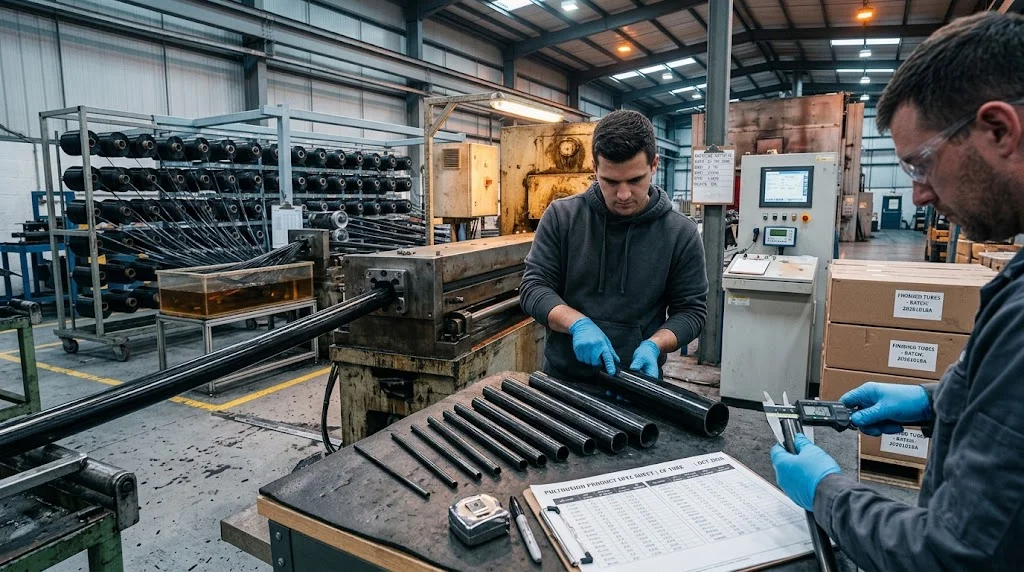
Pultruded carbon fiber tubes are the workhorse structural profile of the composites world: continuous fiber is pulled through a resin bath and a heated die, cured into a constant section with a very high axial fiber fraction, then cut to length. Roughly nine out of ten carbon fiber tubes sold by the
Introduction
Pultruded carbon fiber tubes are the workhorse structural profile of the composites world: continuous fiber is pulled through a resin bath and a heated die, cured into a constant section with a very high axial fiber fraction, then cut to length. Roughly nine out of ten carbon fiber tubes sold by the metre are pultruded rather than roll-wrapped, because the process is continuous, economical per metre and highly repeatable, and because it delivers the axial stiffness that most structures actually want.
This guide covers what the pultrusion process does to the properties of a tube, the standard outside diameters, wall thicknesses and lengths kept in stock, and the design data you need to size a tube for a given load. The figures are typical values for standard-modulus pultruded tubes and should be treated as a starting point for design rather than a certified datasheet for a specific batch.
Pultruded Carbon Fiber Tubes: How the Process Sets the Properties
Pultrusion pulls fiber along the axis of the part, so the finished tube is almost entirely unidirectional. A standard pultruded tube runs a fiber volume fraction near sixty-five percent with standard-modulus fiber, giving an axial tensile modulus around one hundred and twenty gigapascals and an axial tensile strength in the range of twelve hundred to eighteen hundred megapascals, at a density near one and a half grams per cubic centimetre. Those numbers make a pultruded tube roughly four times stiffer and five times stronger than an aluminium tube of the same weight in the axial direction.
The same alignment that gives the axial advantage limits the other directions. Because there is little fiber across the tube, the transverse and hoop strength are a small fraction of the axial values, and torsional stiffness is governed by the thin wall rather than by the fiber. A pultruded tube is therefore excellent in tension, compression and bending along its length, and poor in local crushing, cross-axis bending and torque unless it is reinforced at the ends or overwrapped. Good design uses it for what it is good at and adds a bonded sleeve, an insert or a local laminate where the load path turns a corner.
| Property | Typical pultruded value | Unit | Note |
|---|---|---|---|
| Fibre volume fraction | 60 to 70 | percent | Standard modulus fiber |
| Density | 1.5 to 1.6 | g/cm³ | Versus 2.7 for aluminium |
| Axial tensile modulus | 100 to 150 | GPa | Use 120 for planning |
| Axial tensile strength | 1200 to 1800 | MPa | Drops with wall thinness |
| Transverse and hoop strength | 40 to 80 | MPa | Weak axis, clamp with care |
| Thermal expansion, axial | About 0 to 1 | 10^-6/K | Near zero, unlike metal |
Standard Sizes of Pultruded Carbon Fiber Tubes
Tubes are specified by outside diameter, inside diameter and wall thickness, and the stocked ladder is built around those three numbers rather than around arbitrary dimensions. Common outside diameters step through 3, 4, 5, 6, 8, 10, 12, 15, 16, 20, 25, 30, 40 and 50 millimetres, and the wall is chosen from a set of standard thicknesses, most often 0.5, 1.0, 1.5, 2.0, 2.5 and 3.0 millimetres. A tube quoted as 10 x 8 mm has a ten millimetre outside diameter and an eight millimetre bore, which fixes the wall at one millimetre.
The table below gives the stocked sizes and the numbers a designer needs first: the second moment of area that sets bending stiffness, and the mass per metre that sets weight.
| Size OD x ID (mm) | Wall (mm) | Mass (g/m) | Second moment I (mm4) | Bending stiffness EI (N·m2) |
|---|---|---|---|---|
| 6 x 4 | 1.0 | 24 | 51 | 6.1 |
| 10 x 8 | 1.0 | 44 | 290 | 34.8 |
| 12 x 10 | 1.0 | 54 | 527 | 63.3 |
| 16 x 14 | 1.0 | 73 | 1332 | 160 |
| 20 x 18 | 1.0 | 93 | 2702 | 324 |
| 25 x 23 | 1.0 | 117 | 5441 | 653 |
| 30 x 28 | 1.0 | 141 | 9595 | 1151 |
Two sizing habits save cost. First, because stiffness rises with the fourth power of diameter and only linearly with wall, a fatter thin-wall tube almost always beats a smaller thick-wall tube for bending stiffness per gram. Second, standard sizes and standard walls ship from stock with no die or minimum-order penalty, so a design that lands on the stocked ladder is cheaper and faster to replenish than one that demands a custom outside diameter. Where a delivered tube is close but not exact, buying the next stocked size up and machining the ends is usually cheaper than commissioning a new die.
Design Data for Pultruded Carbon Fiber Tubes
Sizing a tube for stiffness is a two-line calculation. The second moment of area for a hollow circular section is
I = pi (OD^4 - ID^4) / 64,
and the bending stiffness is EI, with E taken as one hundred and twenty gigapascals for a standard-modulus pultruded tube. For a simply supported beam of length L under a central point load P, deflection is PL³ / (48 EI); under a uniformly distributed load w per unit length, it is 5wL^4 / (384 EI). Those two cases cover most struts, spreaders and frame members, and a spreadsheet with the table above closes the loop quickly.
The checks that follow stiffness are usually what decide the final tube:
- Buckling: a long slender tube under compression fails far below its material strength, so Euler buckling has to be checked with the pinned-pinned or fixed-pinned length that matches the real end conditions.
- Local crushing and clamp pressure: bolt clamps and set screws crush a thin unidirectional wall easily, so clamp pressure is spread with a bonded sleeve or a bushing, or the joint is potted rather than clamped.
- End reinforcement: where a tube is drilled, bolted or pressed onto an insert, the ends carry a local laminate or a thicker wall so the joint does not become the weak link.
- Hoop and torque: because the fiber is axial, any twisting or radial pressure load has to be checked against the much lower transverse properties, or handled with an overwrap.
- Environment: pultruded epoxy takes UV and moisture well when coated, but bare tubes in outdoor structures should carry a paint or gel coat to protect the resin from sunlight.
Frequently Asked Questions
What standard sizes are pultruded carbon fiber tubes available in?
Stocked outside diameters commonly run from three millimetres up to about fifty millimetres, in steps of 3, 4, 5, 6, 8, 10, 12, 15, 16, 20, 25, 30, 40 and 50 millimetres, with wall thicknesses of 0.5, 1.0, 1.5, 2.0, 2.5 and 3.0 millimetres. Tubes ship in stock lengths, most often one or two metres, and are cut to order. Sizes outside the ladder are made to a custom die, which carries a tooling charge and a minimum run, so it is worth checking whether the next stocked size can be machined to suit before ordering a custom diameter.
What is the modulus and strength of a pultruded carbon fiber tube?
A standard-modulus pultruded tube typically shows an axial tensile modulus of one hundred to one hundred and fifty gigapascals and an axial tensile strength of twelve hundred to eighteen hundred megapascals, with a density near one and a half to one and a half grams per cubic centimetre. Transverse and hoop properties are much lower, in the range of forty to eighty megapascals, because the fiber runs along the axis only. Intermediate and high-modulus fiber raises the axial modulus to two hundred or three hundred and ninety gigapascals at higher cost, and is chosen when a stiffness target cannot be met by increasing diameter.
Can pultruded carbon fiber tubes be machined and bonded?
Yes to both, with care. Tubes drill and turn with carbide tooling and dust extraction, but the unidirectional wall splinters on exit, so cuts are made with backing on the far side and slow feed. Bonding with a two-part epoxy is the preferred joint, ideally with a scuffed and cleaned surface and a machined or molded sleeve to spread load. Mechanical fasteners through a thin wall should always be backed by a sleeve, a bushing or a local thickening, because a bolt bearing directly on a one millimetre wall will crush it long before the tube reaches its rated load.
Conclusion
Pultruded carbon fiber tubes are the cheapest and most repeatable way to get a very stiff, very light axial member, and the design decisions that matter are all visible on the size ladder: outer diameter sets bending stiffness, wall sets weight and clamp resistance, and the ends decide whether the joint or the tube fails first. Size the tube from EI first, then check buckling, local crushing and the joint, and buy from the stocked ladder rather than a custom die wherever the design allows. YongXian supplies pultruded carbon fiber tubes, pultruded carbon fiber rod and matched sheet and plate, and our team will run the stiffness and buckling numbers against your load case and confirm the stocked size that fits. Browse our carbon fiber products or contact us with your span, load and end conditions, and whether you are comparing carbon fiber pultrusion suppliers in the USA or sourcing from Asia.
Part of topic
Related Articles
- Carbon Fiber Tube Connector: Joining Methods and Hardware
- Carbon Fiber Tube for PC: Composite Structural Parts in Custom Builds
- 3K Carbon Fiber vs Carbon Fiber: Tow Size, Weave and Mechanical Trade-Offs
- Custom Cut Carbon Fiber: Sizing, Tolerances and Cost Drivers for Sheet and Plate
- Carbon Fiber Tubes 6mm OD: Precision Small-Diameter Options
- Large Diameter Carbon Fiber Tube: Winding vs Pultrusion for Big Profiles
Interested in Our Products?
Contact our team for competitive pricing and technical specifications.
Get a QuoteRelated Products

Carbon Fiber Plate — 3K Twill T700 1.5mm
Thin 1.5mm carbon fiber plate with 3K twill weave surface. Lightweight and stiff, commonly used for covers, panels, drone bodies, and applications requiring a premium aesthetic appearance.

Carbon Fiber Plate — 3K Twill T700 3.0mm
Medium-thickness 3.0mm carbon fiber plate offering significantly higher load capacity while maintaining attractive 3K twill finish. Suitable for structural brackets, reinforcement plates, and load-bearing panels.

Square Carbon Fiber Tube — 3K Twill T700
Square cross-section carbon fiber tube manufactured with 3K twill weave for torsional strength. Preferred for structural frames, trusses, and support columns where rectangular geometry offers design flexibility.

Carbon Fiber Trekking Pole
Lightweight carbon fiber trekking pole manufactured from high-grade carbon fiber tube. Weighs only 160g per pole while providing superior shock absorption and durability for hiking, trail running, and backpacking.

Carbon Fiber Pickleball Paddle
High-performance pickleball paddle with Toray T700 carbon fiber face and polypropylene honeycomb core. Delivers excellent power-to-weight ratio, spin generation, and vibration dampening for competitive play.