
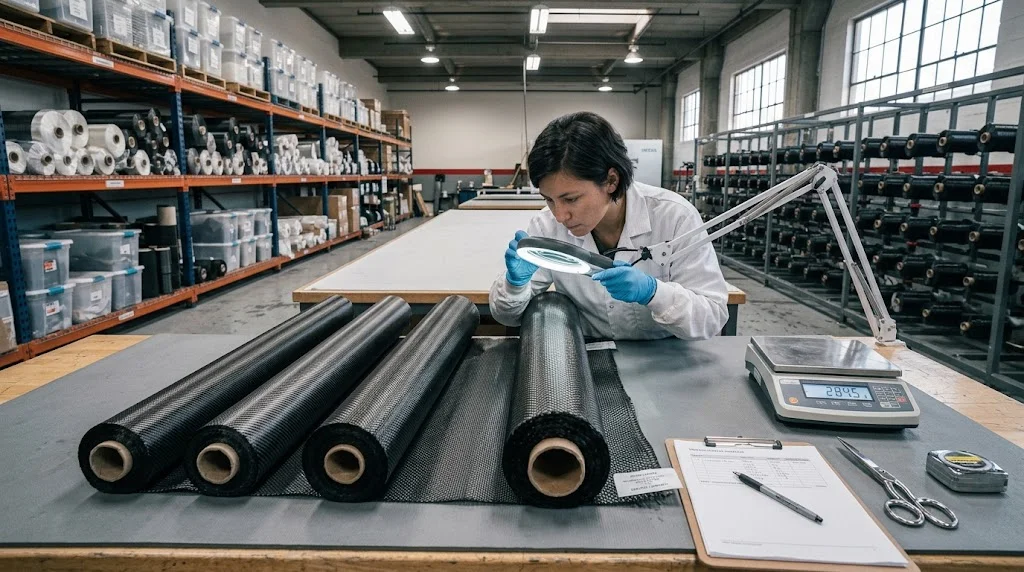
When buyers search for 3k carbon fiber vs carbon fiber , they are usually trying to decode a specification rather than compare two different materials. 3K is not a separate grade of carbon fiber; it is a tow size, meaning a bundle of 3,000 continuous filaments, and every carbon fiber product on the
Introduction
When buyers search for 3k carbon fiber vs carbon fiber, they are usually trying to decode a specification rather than compare two different materials. 3K is not a separate grade of carbon fiber; it is a tow size, meaning a bundle of 3,000 continuous filaments, and every carbon fiber product on the market is sold in some tow size, from 1K up to 50K. The differences that matter in practice are weave style, fabric weight, surface appearance, drapability and price per part, not a hidden difference in the fibre chemistry itself.
This article breaks down what the 3K designation changes and what it does not. It compares 3K against 6K, 12K and 24K tows on the numbers that appear in a carbon fiber data sheet, explains how tow size interacts with weave and layup when the product becomes a carbon fiber sheet material, and gives concrete guidance on when the finer 3K weave is worth its premium and when a coarser tow delivers the same structural performance for less money.
What 3K Means: Tow Size, Filament Count and Weave Style
A tow is a bundle of untwisted filaments. Each filament is about 5 to 7 micrometres in diameter, roughly one tenth the width of a human hair, and the K rating counts how many filaments sit in the bundle. A 1K tow holds 1,000 filaments, a 3K tow holds 3,000, and the industrial workhorse 12K tow holds 12,000. Filament diameter and the underlying PAN precursor and carbonization process are what set tensile strength and modulus; the K number only describes how those filaments are bundled for weaving or pultrusion. The carbon fiber raw material, meaning the PAN-based filament produced upstream, is identical across tow sizes of the same grade.
Weaving converts tows into fabric. A 3K tow produces a finer yarn, so a 3K plain or twill weave shows a tight, regular pattern with small cells, the classic carbon fiber look used on visible panels. A 12K tow produces a coarser yarn with fewer, fatter basket cells across the width. Unidirectional layouts are not affected by tow count in the same visual way, but tow size still governs the width of the UD strip and the number of tows needed to cover a given width on the placement head.
- Filament count: 1K equals 1,000 filaments, 3K equals 3,000, 6K equals 6,000, 12K equals 12,000, and 24K equals 24,000. Filament diameter stays near 5 to 7 microns regardless of tow size.
- Yarn fineness: smaller K numbers give finer yarns, tighter weave cells and a smoother surface after cure.
- Fabric weight: a 2x2 twill in 3K commonly runs about 200 g/m2, while the same weave family in 12K runs 400 to 480 g/m2 depending on construction.
- Price: finer tows cost more per kilogram because weaving throughput is lower and cosmetic reject rates are higher on visible-grade fabric.
3K Carbon Fiber vs Carbon Fiber in Coarser Tows: Mechanical Trade-Offs
On a fibre-volume-normalised basis, laminate properties track the fibre, not the tow count. A quasi-isotropic layup made from 3K twill and one made from 12K plain weave of the same fibre grade, such as a T300 or T700 class fibre, land within a few percent of each other on tensile modulus, tensile strength and interlaminar shear strength, provided cure pressure and fibre volume fraction are held equal. The measurable differences show up in surface quality, fabric-stage drapability, handling damage sensitivity and cost.
| Parameter | 3K tow | 6K tow | 12K tow | 24K tow |
|---|---|---|---|---|
| Filaments per tow | 3,000 | 6,000 | 12,000 | 24,000 |
| Typical twill fabric weight (g/m2) | 190-240 | 280-320 | 400-480 | 800 and above |
| Visible weave cell size | Fine | Medium | Coarse | Very coarse |
| Laminate tensile strength (MPa) | 700-900 | 700-900 | 700-900 | 700-900 |
| Laminate tensile modulus (GPa) | 45-60 | 45-60 | 45-60 | 45-60 |
| Relative fabric price per kg | 1.0 baseline | About 0.9 | 0.75-0.85 | 0.65-0.75 |
| Best fit | Cosmetic parts | Mid-volume structures | Industrial structures | Large panels, pultrusion |
Three practical differences deserve attention. First, surface appearance: 3K shows the tight basket pattern buyers associate with premium carbon parts, while 12K shows wide cells that read as industrial. Second, drapability over double curvature: finer tows conform more cleanly, with fewer bridged corners and fewer wrinkles after debulk. Third, damage handling during layup: coarse tows with high areal weight are stiffer in-plane as fabric, so they resist small-radius forming and can lift at sharp radii unless they are cut and plied carefully.
Reading a Carbon Fiber Data Sheet: What Tow Size Changes
A carbon fiber data sheet describes the fibre, not the fabric. Tensile strength, tensile modulus, elongation, density and linear density in tex are properties of the fibre produced in that tow, and they are identical whether the tow is woven into 3K twill or 12K plain weave. What does change with tow size on the specification side is linear density: a 3K tow of standard-modulus fibre runs roughly 200 tex, a 6K near 400 tex, and a 12K near 800 tex. That number matters when sizing a pultrusion or filament-winding line, not when choosing a cosmetic sheet.
Where the numbers do move is in the fabric and laminate data: areal weight, crimp level, and the resulting in-plane properties of the cured laminate. Twill has more crimp than plain weave, and plain weave more than unidirectional tape. A UD laminate using the same fibre reaches 1,500 to 2,000 MPa tensile strength and 120 to 150 GPa modulus along the fibre direction, because there is no weave crimp to knock the fibres off axis. If a design is stiffness-driven and appearance does not matter, moving from woven 3K to UD or coarse-tow non-crimp fabric is worth more than any tow-size swap within woven grades.
Choosing Between 3K and Coarser Carbon Fiber Sheet Material
Selection comes down to four questions. Is the part visible? If yes, 3K or 1K twill or plain weave is the default, and the premium buys the appearance. Is the geometry complex with tight radii? Finer tows drape better and reduce bridging. Is the part large and structural with a painted or hidden surface? 12K or 24K cuts material cost by 15 to 35 percent with no structural penalty at equal fibre volume. Is the process pultrusion, roll-wrapping or filament winding rather than layup? Tow size is set by process economics, and 12K to 50K dominate because throughput matters more than weave appearance.
- Visible cosmetic panels: 3K twill or 1K plain weave for automotive trim, instrument housings and display parts.
- Drone frames and sporting goods: 3K sheet for the visible layup; some builders step to 6K on hidden cores to save cost.
- Industrial structures: 12K or 24K fabric and UD for brackets, enclosures and panels that will be painted or hidden.
- Continuous processes: pultrusion and filament winding consume 12K to 50K tows where weave appearance never appears in the finished part.
A common mistake is assuming 3K fabric is stronger. It is not, per fibre volume. The strength difference people measure between a 3K part and a 12K part usually traces back to fibre volume fraction, void content or cure pressure, not the K rating. When comparing quotes, ask for the fabric areal weight, the fibre volume fraction of the cured laminate and the fibre grade designation such as T300 or T700, and normalize price per part rather than price per square metre.
Frequently Asked Questions
Is 3K carbon fiber stronger than 12K carbon fiber?
Not inherently. Both are bundles of the same filaments made by the same process; the K number only counts filaments in the tow. At equal fibre volume fraction and cure quality, laminates from 3K and 12K fabric of the same fibre grade show tensile and flexural properties within a few percent of each other. 3K buys a finer weave surface and better drapability, not extra strength.
When should I pay the premium for 3K fabric?
Pay it when the surface is visible, when the part has tight radii that need fine-tow drapability, or when the part is small enough that fabric price is a minor share of total part cost. For painted structures, internal brackets, large panels, or process routes like pultrusion, coarser tows deliver the same mechanical performance at lower cost per part.
Does tow size appear in the tensile data on the carbon fiber data sheet?
The strength and modulus figures on a fibre data sheet apply to the fibre grade itself, not to the tow size. Tow size shows up in the linear density in tex and in the fabric areal weight. Laminate properties depend on fibre grade, fibre volume fraction, layup and cure; quote those numbers when comparing a 3K part against a 12K part.
Conclusion
The 3k carbon fiber vs carbon fiber question dissolves once the specification is read correctly: 3K is a tow size inside the carbon fiber family, and the mechanical properties that appear on a data sheet follow the fibre grade and the laminate, not the K rating. Choose 3K when appearance and drapability drive the decision, choose 6K to 12K for structural parts with hidden or painted surfaces, and always compare quotes on fibre grade, fibre volume fraction and areal weight rather than on the weave label alone.
YongXian supplies 3K, 6K and 12K carbon fiber fabric, sheet and cut-to-size plate in standard-modulus and intermediate-modulus grades. Browse our carbon fiber products or contact our engineering team with your target geometry and load case, and we will recommend the tow size and layup that meet it at the best cost.
Part of topic
Related Articles
- Carbon Fiber Tube Connector: Joining Methods and Hardware
- Carbon Fiber Tube for PC: Composite Structural Parts in Custom Builds
- Pultruded Carbon Fiber Tubes: Properties, Standard Sizes and Design Data
- Custom Cut Carbon Fiber: Sizing, Tolerances and Cost Drivers for Sheet and Plate
- Carbon Fiber Tubes 6mm OD: Precision Small-Diameter Options
- Large Diameter Carbon Fiber Tube: Winding vs Pultrusion for Big Profiles
Interested in Our Products?
Contact our team for competitive pricing and technical specifications.
Get a QuoteRelated Products

Carbon Fiber Plate — 3K Twill T700 1.5mm
Thin 1.5mm carbon fiber plate with 3K twill weave surface. Lightweight and stiff, commonly used for covers, panels, drone bodies, and applications requiring a premium aesthetic appearance.

Carbon Fiber Plate — 3K Twill T700 3.0mm
Medium-thickness 3.0mm carbon fiber plate offering significantly higher load capacity while maintaining attractive 3K twill finish. Suitable for structural brackets, reinforcement plates, and load-bearing panels.

Square Carbon Fiber Tube — 3K Twill T700
Square cross-section carbon fiber tube manufactured with 3K twill weave for torsional strength. Preferred for structural frames, trusses, and support columns where rectangular geometry offers design flexibility.

Carbon Fiber Trekking Pole
Lightweight carbon fiber trekking pole manufactured from high-grade carbon fiber tube. Weighs only 160g per pole while providing superior shock absorption and durability for hiking, trail running, and backpacking.

Carbon Fiber Pickleball Paddle
High-performance pickleball paddle with Toray T700 carbon fiber face and polypropylene honeycomb core. Delivers excellent power-to-weight ratio, spin generation, and vibration dampening for competitive play.