
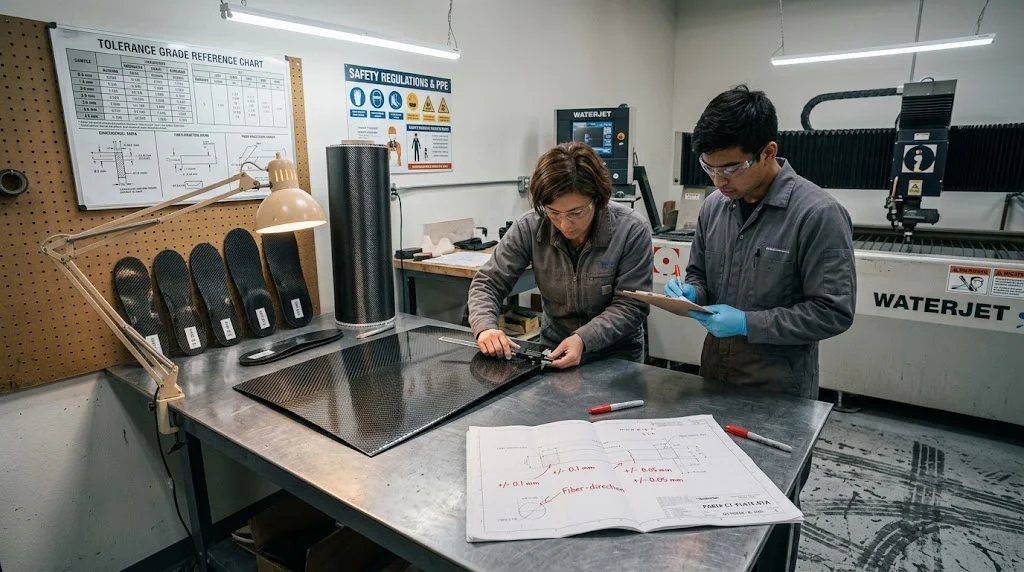
Custom cut carbon fiber sheet and plate work is decided long before a saw or a waterjet touches the laminate, because the stock size you order, the tolerance grade you accept and the cost drivers you leave undefined on the drawing all set the final price. Buyers who treat cutting as a downstream com
Introduction
Custom cut carbon fiber sheet and plate work is decided long before a saw or a waterjet touches the laminate, because the stock size you order, the tolerance grade you accept and the cost drivers you leave undefined on the drawing all set the final price. Buyers who treat cutting as a downstream commodity discover too late that a panel nested in the wrong stock size, or held to a tolerance the process cannot hold economically, costs more than a slightly larger panel cut from a deliberate plan.
This guide covers the sizing decisions behind custom cut carbon fiber, the tolerance grades suppliers quote, the cost drivers behind those quotes, and the drawing information a carbon fiber sheet cutting service needs in order to price the job correctly the first time.
Custom Cut Carbon Fiber Sizing: Start From Stock Sizes
Nearly every laminate sheet is produced in one of a handful of standard formats, and the cheapest part is the one nested inside an existing stock size rather than the one that forces a special panel order. Standard woven sheets ship in 1000 x 1000 mm, 1200 x 1200 mm and 1220 x 2440 mm formats, while unidirectional plate stock commonly runs 1000 x 2000 mm. Thickness follows a fixed ladder: 0.5, 1, 1.5, 2, 3, 4, 5, 6, 8 and 10 mm, with intermediate values available only as laminated buildup or CNC-thinned specials that carry a tooling charge.
| Stock format | Typical sizes (mm) | Common thicknesses | Best fit |
|---|---|---|---|
| Woven cosmetic sheet | 1000 x 1000, 1200 x 1200 | 0.5-4 mm | Drone frames, covers, decorative panels |
| Woven structural sheet | 1220 x 2440 (4 x 8 ft) | 2-10 mm | Machine guards, jigs, tooling boards |
| Unidirectional plate | 1000 x 2000 | 1.5-6 mm | Stiffeners, splice plates, reinforcement |
| Machined plate blank | Cut from 5-20 mm plate | 5-20 mm | Precision brackets, fixtures, mounts |
Three sizing rules decide the cost of the blank before cutting begins. Order from the stock ladder rather than from the finished dimension, so offcuts stay usable for the next part instead of becoming scrap. Plan the nest with the weave orientation marked, because a part rotated by fifteen degrees to save material can put warp and weft directions where the load does not want them. Leave machining allowance on edges that will later be bonded or clamped, typically 0.5-1 mm, rather than cutting to final size on a surface that still needs skimming.
Tolerance Grades and What They Cost in Custom Cut Carbon Fiber
Suppliers quote carbon fiber sheet cutting in three or four grades, and the gap between grades is process capability, fixture time and inspection effort rather than a fixed surcharge. Kerf drives part of that gap: a standard routing bit removes 3.0-3.2 mm of material, an abrasive waterjet removes roughly 0.8-1.2 mm depending on abrasive flow, and a laser removes less than 0.3 mm while heat-affecting the resin at the edge.
| Grade | Linear tolerance | Typical process | Edge condition | Relative cost |
|---|---|---|---|---|
| Blank trim | +/- 1.0 mm | Table saw, no fixture | Saw marks acceptable | 1.0x |
| Commercial | +/- 0.5 mm | CNC router, standard vacuum fixture | Deburred, light fuzz on exit face | 1.1x |
| Precision | +/- 0.2 mm | CNC router or abrasive waterjet | Clean edge, no visible delamination | 1.4x |
| Tight contour | +/- 0.1 mm | Precision router with datum fixture, 100 percent inspection | Sealed edge, inspected on all features | 1.9x |
Tolerance stacks up from several small sources, and each one has to be controlled separately if the finished part is going to close:
- Kerf compensation and tool wear: a 3.175 mm bit that has cut three hundred meters will leave a different edge than a new one, so shops program kerf from measured tool wear rather than from the nominal diameter.
- Datum scheme: locate every hole from one or two datums taken from the same layup face, because referencing features across faces lets the thickness tolerance of the sheet enter the position tolerance.
- Stock thickness variation: woven laminate typically carries a plus or minus 10 percent thickness tolerance, which is why clamp and press-fit joints should be designed around a measured panel rather than a nominal value.
- Hold-down and support: thin sheet bridging between supports chatters at the cutter and chips the exit edge, so support blocks sit under the cut path, not only at the fixture perimeter.
Cost Drivers for Custom Cut Carbon Fiber Sheet and Plate
Most custom carbon fiber cutting quotes are built from five cost elements, and the buyer can influence three of them before any machining starts. The table below shows a typical share of the quote and what moves each line.
| Cost element | Share of quote | What moves it |
|---|---|---|
| Machine time | 25-35% | Contour length, sheet thickness, feed rate |
| Material yield | 15-25% | Nest efficiency and chosen stock size |
| Setup and fixturing | 15-25% | Repeat orders, reusable fixture, program reuse |
| Edge finishing and drilling | 10-20% | Hole count, chamfer, sealing, cosmetic face |
| Dust control, tooling wear, inspection | 10-15% | Bit life, tolerance grade, documentation |
Yield is the lever most buyers miss. A bracket that consumes 62 percent of a 1000 x 1000 mm sheet at one unit, and 79 percent at four units arranged in a two by two nest, changes the material line of the quote more than any negotiation on machine rate. Volume also amortizes setup: the first piece carries the full programming and fixture cost, the tenth carries almost none of it, which is why carbon fiber sheet cutting priced per piece drops sharply between one and fifty units before flattening out.
Edge finishing is the second lever. An as-cut edge that will be potted in a housing needs nothing more than deburring, while an edge that stays visible and takes a sealant needs a sanded and sealed finish, and an edge that will be bonded needs a defined wedge or chamfer so the adhesive line has a predictable geometry. Specify the edge condition explicitly and the quote stops carrying a guessing allowance.
What a Carbon Fiber Sheet Cutting Service Needs on Your Drawing
A complete package for a carbon fiber sheet cutting service fits on one sheet, and every missing item turns into an assumption somebody else makes for you. The checklist below separates a repeatable quote from a hopeful one.
- Overall dimensions with a datum scheme, plus the tolerance grade named as a grade rather than as a general call for accuracy.
- Thickness and stock grade, with the cosmetic face identified, because the two faces of a woven sheet are rarely identical after cure.
- Hole table giving diameter, position and depth, and stating whether every hole is drilled through the supported panel rather than left unbacked at the edge.
- Edge condition for each edge class: as-cut, deburred, chamfered, or sanded and sealed for a visible face.
- Weave orientation marked against a part edge, so the nest does not silently rotate a load-bearing part.
- Quantity and offcut policy, including whether remnants return to you and how partial sheets are charged.
Most custom carbon fiber cutting failures are drawing failures rather than machine failures. A note that says hold tight tolerance without naming which features, or a sketch without a datum, forces the shop to guess, and the guess appears later as a rework order. The same discipline applies when you compare carbon fiber sheet cutting offers: ask each supplier which grade they quoted, what kerf they compensated for, and how many pieces per sheet they nested, and the quotes become comparable line by line rather than by headline price.
Frequently Asked Questions
What tolerance should I specify for custom cut carbon fiber?
Start at plus or minus 0.2 mm on linear dimensions for machined sheet and plate, which is what most CNC routers and waterjets hold comfortably in production. Go to plus or minus 0.1 mm only where a mating part, a dowel fit or an optical alignment demands it, because the tighter grade raises the quote by roughly forty to ninety percent. Below plus or minus 0.1 mm you are usually buying grinding or fine machining rather than cutting, and the process choice should be stated on the drawing.
Is it cheaper to buy a full sheet and cut it in house?
For one or two simple rectangular blanks, buying cut to size from the sheet supplier is almost always cheaper, because their nest is already optimized and their setup is amortized across thousands of panels. In-house cutting starts to pay when you run repeat parts weekly, when offcuts feed the next revision, or when lead time matters more than the machine rate. A practical threshold is a few hundred parts a year of the same shape: below that, buy cut; above it, invest in a fixture and a program.
Can you supply cut to size sheets with holes already drilled?
Yes, and it removes an entire setup from your own process. Send the drawing with the hole table and edge condition, state the tolerance grade, and ask for the nest layout so you can confirm grain direction before the run starts. Suppliers can also return the offcuts with the order when the remnants are large enough to be reused, which matters if your next revision shares the same stock size.
Conclusion
Custom cut carbon fiber is a sizing and tolerancing problem before it is a machining problem: choose the stock format first, name a tolerance grade instead of a general wish for accuracy, and write the edge condition, datum scheme and offcut policy onto the drawing. Do that and the quote stops carrying allowances for guessing, the parts fit the first time, and the material line falls because the nest was planned rather than patched. YongXian supplies woven and unidirectional sheet, plate stock and cut to size blanks, and our engineering team will review your drawing for nesting, tolerance grade and edge preparation before the first cut is programmed. Browse our carbon fiber products or contact us with your dimensions, quantity and tolerance requirements.
Part of topic
Related Articles
- Carbon Fiber Tube Connector: Joining Methods and Hardware
- Carbon Fiber Tube for PC: Composite Structural Parts in Custom Builds
- 3K Carbon Fiber vs Carbon Fiber: Tow Size, Weave and Mechanical Trade-Offs
- Pultruded Carbon Fiber Tubes: Properties, Standard Sizes and Design Data
- Carbon Fiber Tubes 6mm OD: Precision Small-Diameter Options
- Large Diameter Carbon Fiber Tube: Winding vs Pultrusion for Big Profiles
Interested in Our Products?
Contact our team for competitive pricing and technical specifications.
Get a QuoteRelated Products

Carbon Fiber Plate — 3K Twill T700 1.5mm
Thin 1.5mm carbon fiber plate with 3K twill weave surface. Lightweight and stiff, commonly used for covers, panels, drone bodies, and applications requiring a premium aesthetic appearance.

Carbon Fiber Plate — 3K Twill T700 3.0mm
Medium-thickness 3.0mm carbon fiber plate offering significantly higher load capacity while maintaining attractive 3K twill finish. Suitable for structural brackets, reinforcement plates, and load-bearing panels.

Square Carbon Fiber Tube — 3K Twill T700
Square cross-section carbon fiber tube manufactured with 3K twill weave for torsional strength. Preferred for structural frames, trusses, and support columns where rectangular geometry offers design flexibility.

Carbon Fiber Trekking Pole
Lightweight carbon fiber trekking pole manufactured from high-grade carbon fiber tube. Weighs only 160g per pole while providing superior shock absorption and durability for hiking, trail running, and backpacking.

Carbon Fiber Pickleball Paddle
High-performance pickleball paddle with Toray T700 carbon fiber face and polypropylene honeycomb core. Delivers excellent power-to-weight ratio, spin generation, and vibration dampening for competitive play.