
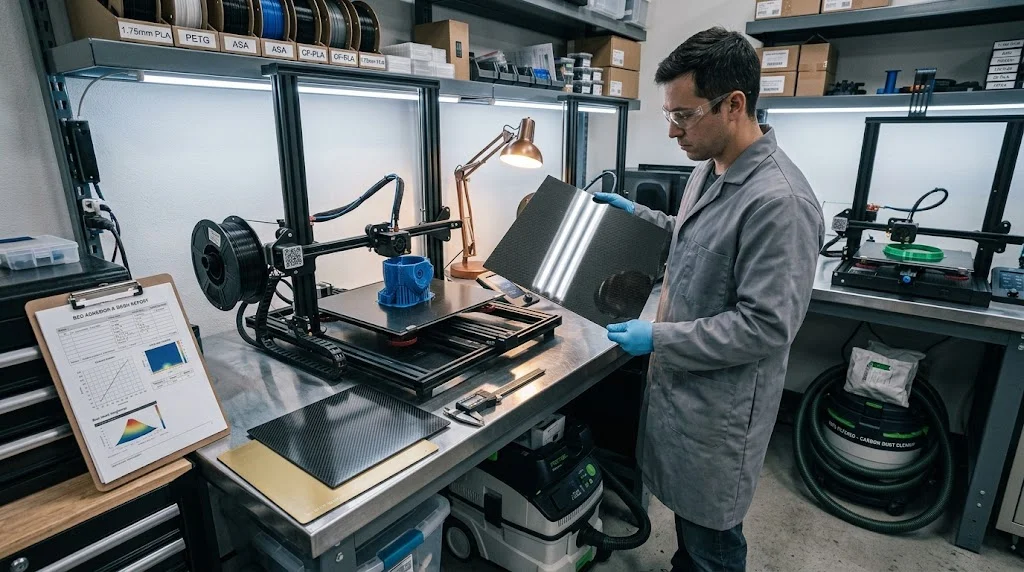
A carbon fiber build plate is a flat carbon fiber reinforced polymer sheet used as, or laminated onto, the build surface of an FDM 3D printer. The pitch is straightforward: cross-ply carbon laminate expands far less when heated than aluminum or steel, so a large plate holds its shape from 60 °C bed
Introduction
A carbon fiber build plate is a flat carbon fiber reinforced polymer sheet used as, or laminated onto, the build surface of an FDM 3D printer. The pitch is straightforward: cross-ply carbon laminate expands far less when heated than aluminum or steel, so a large plate holds its shape from 60 °C bed temperature up to 110 °C, and a stiff plate flexes less when the nozzle drags a corner across the first layer. The reality is more nuanced — the plate is only one part of a system that includes the heater, the surface coating and the leveling probe — and mismatched expectations about adhesion are the most common reason buyers switch back to spring steel within a month.
This guide compares the five bed materials you actually meet when shopping: cross-ply carbon fiber laminate, powder-coated PEI spring steel, borosilicate glass, cast aluminum tooling plate and G10 glass-epoxy laminate. It covers thermal expansion, heat-up behavior, first-layer adhesion, probe compatibility, cost, and the practical details of fitting a plate to Bambu Lab and Prusa machines.
What Is a Carbon Fiber Build Plate and Why Use One
A carbon fiber build plate is usually a 1-3 mm cross-ply laminate cut to bed size, sometimes with a textured release film or a thin PEI layer bonded to the printable face. The appeal comes from three physical properties. First, in-plane thermal expansion of a balanced cross-ply laminate sits between 0 and 2 x 10⁻⁶ per kelvin, against roughly 23 for aluminum and 11-12 for steel — so a 300 mm plate grows well under 0.1 mm across a full 25 to 110 °C sweep, while an aluminum plate of the same size grows about 0.6 mm. Second, the specific stiffness is high: a 2 mm carbon plate is stiffer than a 4 mm aluminum plate of the same weight, which matters on moving-bed machines where the bed itself accelerates. Third, the laminate is dimensionally stable after a proper stress-relief bake, so flatness survives repeated thermal cycles instead of degrading the way some glued assemblies do.
The trade-offs are real. Epoxy has a glass transition in the 120 to 180 °C range for standard systems, so continuous service above about 150 °C needs a high-Tg resin. The surface is non-polar and smooth, which is bad for PLA adhesion without help. And a bare carbon plate must never be cut or sanded without dust extraction — conductive carbon dust is both a health hazard and an electronics hazard inside a printer.
Carbon Fiber Build Plate vs PEI, Glass and G10: Bed Materials Compared
The table below compares the five materials on the numbers that decide print quality: expansion, heat conduction, service temperature, adhesion and typical cost for a 300 x 300 mm plate.
| Bed material | Thermal expansion (10-6/K) | Conductivity (W/m/K) | Practical max temp | Adhesion out of the box | Relative cost |
|---|---|---|---|---|---|
| Carbon fiber laminate (cross-ply) | 0 to 2 | 7 to 15 in-plane | 150-180 °C (resin Tg limited) | Poor for PLA, good with PEI film or glue | 3 to 6x |
| PEI spring steel (powder coated) | 11-12 (steel) | 30-45 | 170-180 °C (PEI limit) | Excellent for PLA, PETG, ABS | 1x baseline |
| Borosilicate glass | 3.3 | 1.0-1.2 | 300 °C+ | Fair, needs glue or hairspray | 0.8 to 1.5x |
| Cast aluminum tooling plate | 23 | 120-160 | 250 °C+ | Fair, needs PEI or adhesive sheet | 1 to 2x |
| G10 glass-epoxy | 11-18 | 0.6-0.9 | 130-150 °C | Good for PLA, insulating under the bed | 1.5 to 2.5x |
Two patterns matter more than the raw numbers. Aluminum heats fastest and spreads heat evenly, but it expands roughly ten times more than carbon, which is exactly what causes corner lift on large ABS parts. Glass stays very flat and survives high bed temperatures, but its low conductivity means slow, uneven heat-up and cold corners until the plate saturates. Carbon sits between glass and steel on heat-up speed while winning decisively on dimensional stability.
Surface Preparation and First Layers on a Carbon Fiber Build Plate
Adhesion is where most carbon fiber build plate installs succeed or fail. The cured epoxy surface has low surface energy, so treat it as a substrate rather than a printable face:
- Laminated PEI film: The most forgiving setup. A 0.1-0.15 mm PEI film bonded to the carbon plate gives spring-steel-like behavior with the flatness of carbon. Bake the assembly at 80-100 °C for an hour after bonding to drive out trapped moisture.
- Glue stick or liquid adhesive: Works directly on bare epoxy for PLA and PETG. Apply thin, reapply every few prints, and clean with isopropyl alcohol between coats so the layer does not build up into a wavy film.
- Texture coatings: Spray-on or dip textures add mechanical keying but wear unevenly. They are a reasonable temporary measure while you decide whether to laminate a permanent surface.
- Z-offset and mesh: Rigid plates do not flex under the probe like spring steel, so re-run the bed mesh after any plate swap. A 2 mm carbon plate on a strain-gauge or inductive probe system also shifts your first-layer reference by the plate thickness.
Also check sensor compatibility before mounting. Carbon laminate is electrically semi-conductive, which confuses some capacitive proximity sensors, while standard inductive sensors tuned for steel may reduce their detection range. Piezo and strain-gauge probing are unaffected. If your printer probes with an inductive sensor, verify detection on the actual plate corners before committing to a long print.
Choosing a Plate for Bambu, Prusa and Engineering Filaments
Fitment is where generic advice breaks down. Owners shopping for a carbon fiber plate bambu fitment need to match the exact bed size, keep overall stack thickness within the probe's adjustment range, and confirm the plate clears the front lip and the glass enclosure without lifting the bed off its heater. Prusa MK4 and XL owners face a similar constraint: the sheet is designed as a flexible removable part, so a rigid replacement must sit flat on the heater without a support frame, and the first-layer calibration must be re-run.
Filament choice drives the surface decision. Standard PLA at a 60 °C bed is happy on almost anything; PETG at 70-80 °C wants a textured face or adhesive; ABS and ASA at 100-110 °C benefit most from the low expansion of carbon, since that is where aluminum beds distort. Engineering filaments push the temperature question — prusament pc carbon fiber, for example, calls for bed temperatures around 110-120 °C with an enclosure, which sits close to the service limit of a standard-Tg epoxy plate. If your workload is polycarbonate blends, nylon or filled high-temperature polymers, specify a high-Tg carbon plate or bond a PEI surface rated for the same temperature.
For builders who would rather cut their own, flat carbon fiber plate sheets in 300 x 300 mm and 400 x 400 mm stock sizes are the usual starting point. Buy a stress-relieved, mirror-flat sheet from a supplier who can state the tolerance — an out-of-flat plate simply moves the problem from your heater to your mesh, and no amount of auto-leveling recovers a twisted laminate.
Frequently Asked Questions
Is a carbon fiber build plate worth it over a PEI spring steel sheet?
For small PLA and PETG printing, no — PEI spring steel is cheaper, adhesive-friendly out of the box and easier to remove. A carbon fiber build plate earns its cost on large beds, high-temperature materials and moving-bed machines, where low thermal expansion keeps corners down and high stiffness keeps first layers consistent. If your pain point is warping on ABS at 400 °C-scale bed sweep rather than part removal, the upgrade makes sense.
Do I need to change the z-offset when I install one?
Yes, if the total thickness under the probe changes. Any plate swap moves the printable surface relative to the nozzle, so re-run automatic bed leveling and set a fresh z-offset before the first print. Rigid plates also skip the slight flex that spring steel shows under probe pressure, so a mesh generated on spring steel will not transfer exactly — regenerate it on the plate you actually print on.
Can I cut or drill a carbon fiber plate at home?
Not without proper dust extraction and PPE. Cutting or sanding carbon laminate releases fine conductive dust that is harmful to breathe and can short electronics if it settles inside the printer. Use a shop vacuum with a HEPA filter attached at the tool, wear a fitted respirator, and do the work away from the printer. For most builders it is cheaper and safer to order the plate cut to bed size with a machined edge.
Conclusion
A carbon fiber build plate is a precision upgrade, not a universal one. Its case rests on measurable physics: near-zero in-plane expansion that holds flatness through a full bed-temperature cycle, and high stiffness that keeps the printable surface stable while the bed moves. Pair it with a laminated PEI face or a disciplined adhesive routine, verify probe compatibility before the first long print, and choose a resin system rated for the filaments you actually run. Buyers who match the plate to the machine and the material get the flat, repeatable first layers the technology promises; buyers who expect PEI-style adhesion from bare epoxy end up back on spring steel.
Browse our carbon fiber plate and sheet range or contact our team for flat stock sized to your bed, specify thickness, tolerance and surface finish — we supply cross-ply carbon fiber plate sheets to printer builders, laboratories and machine builders worldwide.
Part of topic
Related Articles
- Carbon Fiber Sheet Cutting Service: CNC Routed Parts and Tolerances
- Pultruded Carbon Fiber: Continuous Profiles and Their Mechanical Limits
- Carbon Fiber Tube Connector: Joining Methods and Hardware
- Carbon Fiber Tube for PC: Composite Structural Parts in Custom Builds
- 3K Carbon Fiber vs Carbon Fiber: Tow Size, Weave and Mechanical Trade-Offs
- Pultruded Carbon Fiber Tubes: Properties, Standard Sizes and Design Data
Interested in Our Products?
Contact our team for competitive pricing and technical specifications.
Get a QuoteRelated Products
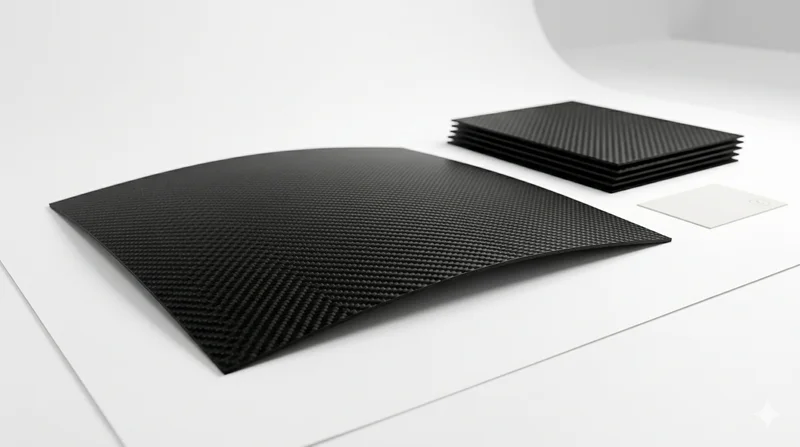
Carbon Fiber Plate — 3K Twill T700 1.5mm
Thin 1.5mm carbon fiber plate with 3K twill weave surface. Lightweight and stiff, commonly used for covers, panels, drone bodies, and applications requiring a premium aesthetic appearance.

Carbon Fiber Plate — 3K Twill T700 3.0mm
Medium-thickness 3.0mm carbon fiber plate offering significantly higher load capacity while maintaining attractive 3K twill finish. Suitable for structural brackets, reinforcement plates, and load-bearing panels.

Square Carbon Fiber Tube — 3K Twill T700
Square cross-section carbon fiber tube manufactured with 3K twill weave for torsional strength. Preferred for structural frames, trusses, and support columns where rectangular geometry offers design flexibility.

Carbon Fiber Pickleball Paddle
High-performance pickleball paddle with Toray T700 carbon fiber face and polypropylene honeycomb core. Delivers excellent power-to-weight ratio, spin generation, and vibration dampening for competitive play.
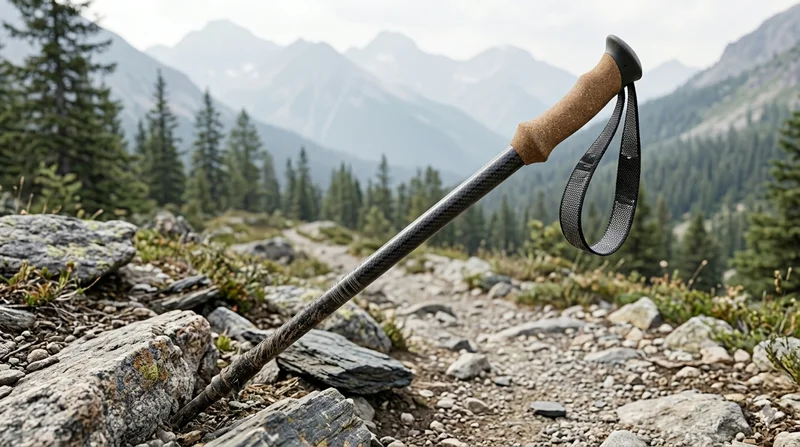
Carbon Fiber Trekking Pole
Lightweight carbon fiber trekking pole manufactured from high-grade carbon fiber tube. Weighs only 160g per pole while providing superior shock absorption and durability for hiking, trail running, and backpacking.