
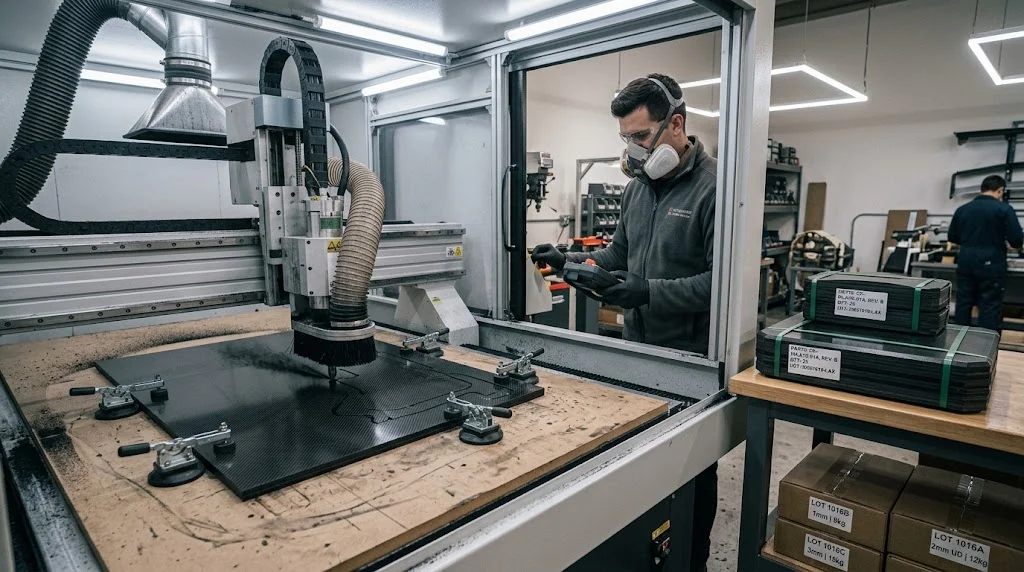
A carbon fiber sheet cutting service turns a flat stock panel into finished parts: flat plates, gussets, brackets, jig faces and panel blanks cut from cured CFRP sheet to your drawing. The three industrial methods on offer — CNC routing, waterjet cutting and laser cutting — produce very different ed
Introduction
A carbon fiber sheet cutting service turns a flat stock panel into finished parts: flat plates, gussets, brackets, jig faces and panel blanks cut from cured CFRP sheet to your drawing. The three industrial methods on offer — CNC routing, waterjet cutting and laser cutting — produce very different edge quality, tolerance and heat-affected zones, and choosing the wrong one is the most common reason custom cut carbon fiber parts arrive unusable. This guide compares the methods with real tolerance data, explains how carbon fiber sheet machining is priced, and lists the design rules that keep edges clean and cores intact.
The service is aimed at buyers who need parts, not material: engineers specifying mounting plates, restoration shops cutting one-off panels, and production teams ordering batches of identical blanks from a qualified carbon fiber sheet cutting service.
CNC Routing vs Waterjet vs Laser for Cutting Carbon Fiber Sheet
Each method removes material differently, and the difference shows at the edge:
- CNC routing: A diamond-coated or up-cut end mill on a CNC router follows a programmed outline. It is the workhorse for sheet up to about 20 mm thick, gives the best cost-to-quality ratio, and leaves a machinable edge. The downside is tool wear — carbide tooling dulls quickly against carbon, so batch runs schedule tool changes every 30-90 minutes of cut time, and that cost is in the quote.
- Abrasive waterjet: A 0.6-0.8 mm water stream entraining garnet abrasive erodes the sheet. No heat-affected zone, which matters for epoxy systems with a low glass transition temperature, and kerf is narrow. The exit side can show abrasive taper and a slightly rougher edge than routing, typically fine for structural parts but not for cosmetic faces.
- Laser cutting: A CO₂ or fiber laser burns through the sheet. It is fast and excellent for thin films and small intricate parts, but the heat degrades the resin along the cut edge — a charred, brittle zone several tenths of a millimetre wide that must be sanded back. For structural CFRP, laser cutting is generally specified only when no alternative fits, and reputable carbon fiber sheet machining providers will warn you before accepting the job.
| Method | Practical thickness range | Typical kerf | Edge taper | Heat-affected zone | Relative cost (small batch) |
|---|---|---|---|---|---|
| CNC routing | 0.5-20 mm | 2-3 mm (tool dia.) | < 0.05 mm | None | Baseline (1.0x) |
| Abrasive waterjet | 0.5-50 mm | 0.6-1.0 mm | 0.1-0.3 mm over 25 mm | None | 1.1-1.4x |
| Laser (CO₂ 150W+) | 0.5-6 mm | 0.15-0.3 mm | < 0.05 mm | 0.2-0.5 mm charred resin | 0.8-1.2x |
Tolerances a Carbon Fiber Sheet Cutting Service Can Hold
Tolerance depends on method, thickness and part size, not on the promise in the marketing copy. Realistic capabilities for finished outlines cut from flat sheet:
- Outer profile, CNC-routed, ≤5 mm sheet: ±0.1-0.2 mm on critical dimensions; ±0.3-0.5 mm on general profile over a 1000 mm part.
- Outer profile, waterjet, ≤25 mm sheet: ±0.2-0.5 mm plus taper allowance; specify a taper limit if the part stacks.
- Drilled or milled holes: H9-equivalent reamed holes achievable (±0.05-0.1 mm); laser-drilled holes should be avoided for bolted joints because of the charred wall.
- Flatness: As-cured sheet flatness is typically 0.5-1.0 mm over 1000 mm; CNC milling both faces brings it to 0.05-0.1 mm, at roughly 30-60% added cost.
Two tolerance rules prevent most disputes: put a datum scheme on the drawing (do not dimension from the rough cut edge), and mark which dimensions are critical so the cutting service programs inspection around them rather than treating the outline as cosmetic.
Edge Finish, Delamination and How to Design for Cutting
Delamination at the exit of a cut is the classic carbon fiber sheet machining failure. It happens when the cutting force or heat exceeds the interlaminar strength at the free edge, and it is design-controllable:
- Cut through-thickness in one pass where possible; a multi-pass deep cut forces the tool to rub previously cut surfaces.
- Keep fastener holes ≥3 sheet thicknesses from a cut edge; closer holes concentrate clamp load on a weakened edge.
- Specify up-cut vs down-cut tooling; up-cut mills clear chips but can lift top-ply fibres — the supplier's choice matters for cosmetic faces.
- Request a 0.2-0.5 mm chamfer or radius on cosmetic edges; a broken edge reads better than a raw cut and resists chipping in handling.
- Avoid multi-pass deep cutting; re-cutting the same slot forces the tool to rub previously cut surfaces and heat the edge.
For sandwich panels with foam or honeycomb cores, cutting requires a staged strategy: rout the face sheet, core and back sheet as separate operations or use a compression cutter, otherwise the core crushes and the face delaminates. State the core type and thickness when requesting the quote.
Pricing a Carbon Fiber Sheet Cutting Service
Costs break into three lines: setup (programming and fixture), machine time and finishing. A one-off bracket cut from stock 2 mm sheet typically runs $60-150 including programming. A batch of 50 identical plates drops to $8-20 per piece once the program and fixture exist. Critical-dimension inspection adds $30-80 per order depending on the report required. Edge chamfering or two-face milling adds 20-60% depending on area.
When comparing quotes, confirm what is included: material grade and lot, cure state of the sheet, whether deburring and chamfer are included, and the inspection report format. A cheap quote that skips the deburr line will cost more at assembly, and a quote that does not name the sheet grade cannot be verified against your structural assumptions.
Frequently Asked Questions
Can a carbon fiber sheet cutting service cut complex internal cutouts and sharp inside corners?
Internal cutouts are routine. Sharp inside corners (true zero-radius) are not possible with a rotating cutter — the tool leaves a radius equal to half its diameter. Design the minimum internal corner radius at 1.5-3 mm for a typical 3-6 mm sheet, or accept a broached corner as a secondary operation. Waterjet produces tighter inside corners than routing (down to ~0.8 mm) but still not a perfect sharp corner.
Should I send my own sheet material or let the supplier cut from stock?
Either works. Sending your own material guarantees the exact lot and grade, which matters for flight or motorsport parts under traceability rules. Letting the supplier use stock material is cheaper and faster, and for industrial brackets and fixtures the lot continuity is usually acceptable. If you supply material, agree scrap liability in writing — cutting on your sheet typically makes the supplier responsible only for gross negligence, not for all scrapped material.
How fast can custom cut carbon fiber parts be delivered?
Stock-material routed parts: 3-7 working days after drawing approval for small batches. Waterjet jobs: 5-10 days. New programming plus fixture fabrication for complex parts adds 1-2 weeks. One-off restoration panels without a nest plan often take 2-3 weeks total. Rush services exist but typically carry a 30-50% surcharge.
Conclusion
A carbon fiber sheet cutting service is a mature capability, but the outcomes separate sharply by method choice and drawing discipline. CNC routing is the default for most custom cut carbon fiber parts, waterjet wins on thick stock and heat-sensitive resins, and laser should be reserved for thin, non-structural work. Hold suppliers to stated tolerances on a datum-referenced drawing, design edges and corners the machine can actually produce, and the parts will arrive deburred, in tolerance and ready to assemble. Our carbon fiber sheet machining line covers CNC routing, waterjet cutting and two-face milling for industrial buyers worldwide — browse our sheet range or send us your drawing for a cutting quote.
Part of topic
Related Articles
- Carbon Fiber Build Plate: 3D Printer Bed Materials Compared
- Pultruded Carbon Fiber: Continuous Profiles and Their Mechanical Limits
- Carbon Fiber Tube Connector: Joining Methods and Hardware
- Carbon Fiber Tube for PC: Composite Structural Parts in Custom Builds
- 3K Carbon Fiber vs Carbon Fiber: Tow Size, Weave and Mechanical Trade-Offs
- Pultruded Carbon Fiber Tubes: Properties, Standard Sizes and Design Data
Interested in Our Products?
Contact our team for competitive pricing and technical specifications.
Get a QuoteRelated Products
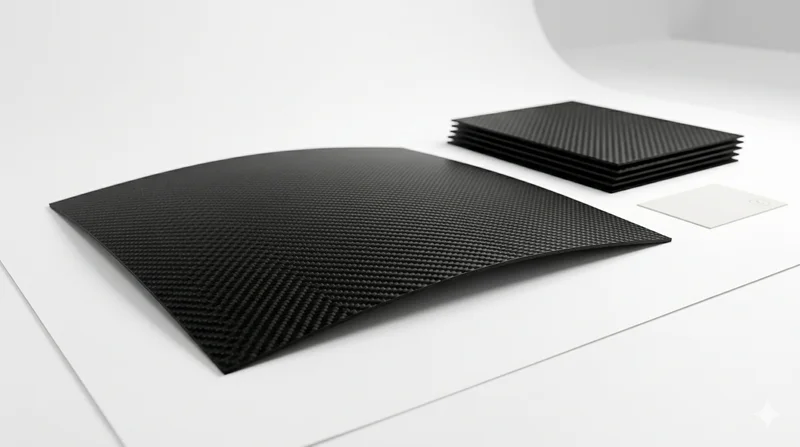
Carbon Fiber Plate — 3K Twill T700 1.5mm
Thin 1.5mm carbon fiber plate with 3K twill weave surface. Lightweight and stiff, commonly used for covers, panels, drone bodies, and applications requiring a premium aesthetic appearance.

Carbon Fiber Plate — 3K Twill T700 3.0mm
Medium-thickness 3.0mm carbon fiber plate offering significantly higher load capacity while maintaining attractive 3K twill finish. Suitable for structural brackets, reinforcement plates, and load-bearing panels.

Square Carbon Fiber Tube — 3K Twill T700
Square cross-section carbon fiber tube manufactured with 3K twill weave for torsional strength. Preferred for structural frames, trusses, and support columns where rectangular geometry offers design flexibility.

Carbon Fiber Pickleball Paddle
High-performance pickleball paddle with Toray T700 carbon fiber face and polypropylene honeycomb core. Delivers excellent power-to-weight ratio, spin generation, and vibration dampening for competitive play.
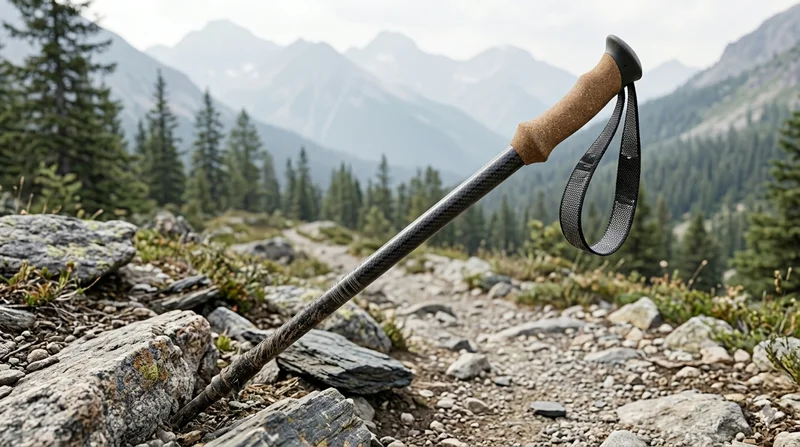
Carbon Fiber Trekking Pole
Lightweight carbon fiber trekking pole manufactured from high-grade carbon fiber tube. Weighs only 160g per pole while providing superior shock absorption and durability for hiking, trail running, and backpacking.