
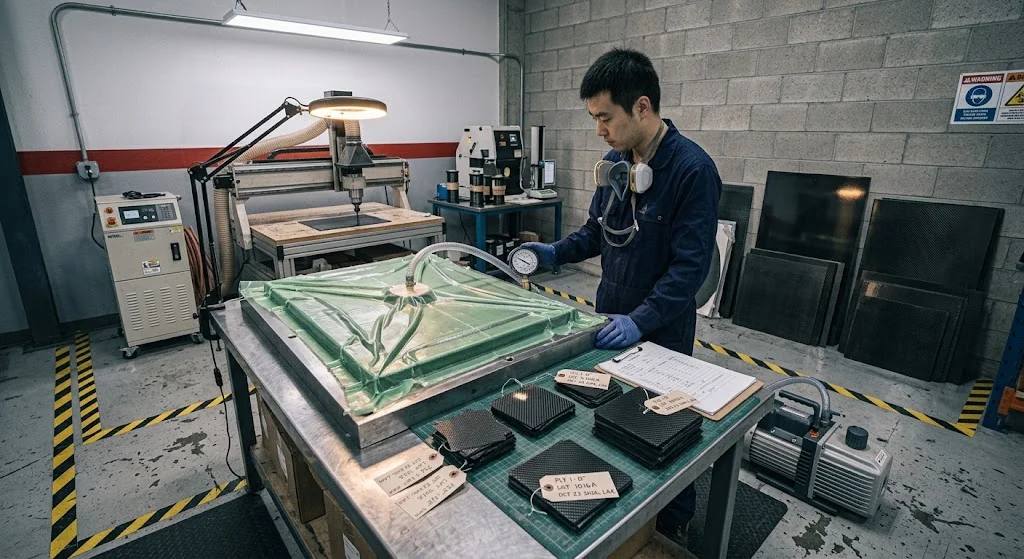
Learning how to make carbon fiber plate at small batch scale is mostly a lesson in controlling three variables — pressure, temperature and cleanliness — with equipment that fits in a two-bay workshop. Industrial plates come off press lines and autoclaves; a small batch builder works with a mold, a v
Introduction
Learning how to make carbon fiber plate at small batch scale is mostly a lesson in controlling three variables — pressure, temperature and cleanliness — with equipment that fits in a two-bay workshop. Industrial plates come off press lines and autoclaves; a small batch builder works with a mold, a vacuum pump and a oven, and the gap between the two shows up as porosity, thickness variation and edges that wander.
This article walks through carbon fiber plate manufacturing for runs of roughly 10-500 pieces: how to choose between wet layup and prepreg, the layup-to-cure sequence with real numbers, how to cut carbon fiber sheet without delaminating it or loading the dust collector with fibers, and the inspection habits that make the next plate match the first one — the essence of making carbon fiber parts in repeatable small batches.
How to Make Carbon Fiber Plate Laminates: Wet Layup vs Prepreg
Both routes make a plate; they differ in how resin content is controlled. Wet layup saturates dry fabric by hand with mixed epoxy — cheap in tooling, sensitive to operator technique, and typically landing at 55-65% resin by weight. Prepreg comes with resin already metered onto the fiber at roughly 35-45%, so the plate is lighter and more uniform, but you need cold storage and a cure cycle that develops full properties.
| Factor | Wet layup + vacuum bag | Prepreg + vacuum / press |
|---|---|---|
| Resin content (by weight) | 55-65%, operator dependent | 35-45%, metered at the film |
| Typical void content | 2-5% with good bagging | <1-2% under 0.7 MPa vacuum |
| Thickness tolerance (per 3 mm plate) | ±0.15-0.3 mm | ±0.05-0.1 mm |
| Cure | 60-80 °C, 2-4 h, ambient vacuum | 80-120 °C step cure, 1-3 h |
| Shelf life / setup | Room-temp storage, mix on demand | Frozen storage, thaw before use |
| Relative cost per plate | 1x | 2-3x material |
For a first product, wet layup on a flat mold with good bagging practice is the faster path to a working plate; for repeat orders where thickness tolerance feeds a machined assembly, prepreg pays for itself in scrapped parts avoided.
Carbon Fiber Plate Manufacturing Steps at Small Batch Scale
The sequence matters more than any single step. Cut plies oversized by 15-20 mm per side; alternate 0°/90° for a balanced plate and consider one ±45° pair if the plate will be bolted and loaded in shear. Work on a polished or sealed mold, wear nitrile gloves to keep skin oil off the ply, and keep mixed resin within its pot life — viscosity rise after the working window is the quiet cause of dry patches.
- Release: two coats of release agent, buffed, or a PTFE film — missed spots weld the laminate to the mold and end the batch early.
- Bleeder and breather: size the bleeder to absorb excess resin without touching dry ply; a starved laminate and a resin-starved corner both start here.
- Vacuum: pull to at least 0.08 MPa (about -0.8 bar) and hold a leak-down test — dropping more than 0.01 MPa in 5 minutes means find the leak before cure.
- Cure and post-cure: cure at the resin's schedule, then post-cure 1-2 h at 120-150 °C for heat-deflection; skipping the post-cure is why plates soften in a hot car or enclosure.
- Demold and rest: demold after cooling below 40 °C and let plates sit 24 h before machining — residual stress releases slowly and flatness improves with rest.
Record every plate: ply count, resin batch, bag time, peak temperature and dwell. Small batch carbon fiber plate manufacturing lives or dies on that sheet of paper, because the second plate is where process drift starts to show.
How to Cut Carbon Fiber Sheet: Tools and Dust Control
Cutting is where plates get ruined and lungs get endangered. Carbon dust is abrasive, conductive and does not belong in a workshop's air — treat it like machining dust, not like sawdust. For straight cuts, a shearing saw with a fine-tooth carbide blade at 3000-6000 rpm, a firm workpiece clamp and a light per-pass depth outperform any router on edge quality.
- Tooling: carbide or diamond-rimmed blades; sharp edges cut, dull edges crush and delaminate the trim line.
- Dust control: HEPA-shrouded extraction at the tool, sealed shop vacuum, and a P100 respirator — never compressed air to blow down surfaces.
- Clamping: sacrificial backing board under the cut prevents exit-side breakout; do not over-clamp, which prints crush marks into the face.
- Holes and internals: step-drill or milling with a compression bit, peck to clear chips, and de-burr both faces before handling.
If you plan more than a few dozen plates, budget a simple CNC router with a dust shoe: it turns cutting from a skilled manual operation into a repeatable program, which is the real economics of small batch making carbon fiber parts.
Frequently Asked Questions
How flat can a small-batch carbon fiber plate be held?
On a polished mold with even bagging and a controlled cure, 0.2-0.5 mm over a 300 mm span is realistic; after stress-relief grinding, 0.05-0.1 mm is achievable. Flatness is set at cure, not at cutting — machining a warped plate only removes the evidence.
Do I need an autoclave to make carbon fiber plates?
No. Vacuum-bagged wet layup or prepreg in a convection oven reaches structural quality for most fixtures, jigs and brackets. An autoclave earns its place only when void content below 1% or very thick sections are contract requirements.
What resin should I use for how to make carbon fiber plate at home scale?
Room-temperature laminating epoxy with a 30-60 minute pot life is the forgiving choice; follow the supplier's glass-transition data rather than marketing claims, and add the post-cure if the plate will ever sit above 60 °C in service.
Conclusion
How to make carbon fiber plate at small batch scale reduces to disciplined process control: choose wet layup or prepreg against your tolerance, hold vacuum and cure numbers, cut with extraction and sharp tooling, and log every plate so drift is caught on the second part rather than the fiftieth. Do that and small runs produce plates that machine, bond and perform like production material.
YongXian supplies cured carbon fiber plate, sheet and cut-to-size blanks for small batch programs, plus the tube and rod to build around them. Browse our carbon fiber plate range or contact our engineering team with your thickness, tolerance and quantity.
Part of topic
Related Articles
- How to Make Carbon Fiber Tubes: Filament Winding vs Roll Wrapping
- Carbon Fiber Plate Manufacturing Process: Ply Stack to Finished Panel
- How Carbon Fiber Is Made: From PAN Precursor to Composite
- How to Cut Carbon Fiber Plate: Tools, Feed Rates and Dust Safety
- How to Cut Carbon Fiber Sheets Without Delamination
- Making Carbon Fiber Parts: From Layup to Curing
Interested in Our Products?
Contact our team for competitive pricing and technical specifications.
Get a QuoteRelated Products

Round Carbon Fiber Tube — 3K Plain Weave T700
Standard round carbon fiber tube manufactured from Toray T700 grade fiber with 3K plain weave. Offers balanced strength and stiffness for general industrial applications including robotics, automation, sports equipment, and aerospace structures.

Carbon Fiber Pickleball Paddle
High-performance pickleball paddle with Toray T700 carbon fiber face and polypropylene honeycomb core. Delivers excellent power-to-weight ratio, spin generation, and vibration dampening for competitive play.

Square Carbon Fiber Tube — 3K Twill T700
Square cross-section carbon fiber tube manufactured with 3K twill weave for torsional strength. Preferred for structural frames, trusses, and support columns where rectangular geometry offers design flexibility.
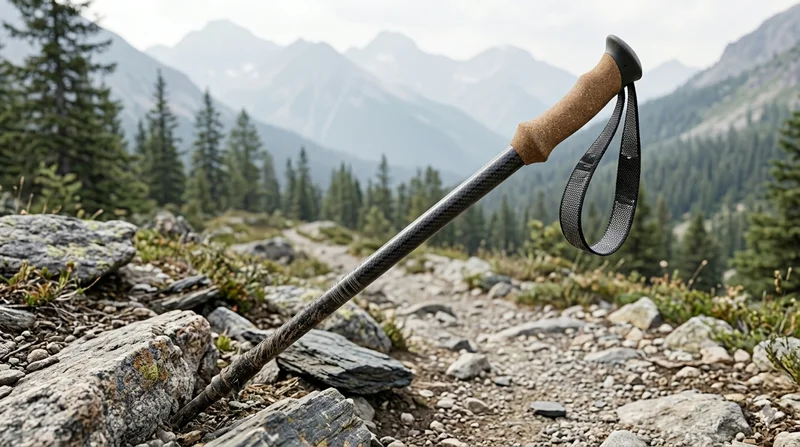
Carbon Fiber Trekking Pole
Lightweight carbon fiber trekking pole manufactured from high-grade carbon fiber tube. Weighs only 160g per pole while providing superior shock absorption and durability for hiking, trail running, and backpacking.

Carbon Fiber Plate — 3K Twill T700 3.0mm
Medium-thickness 3.0mm carbon fiber plate offering significantly higher load capacity while maintaining attractive 3K twill finish. Suitable for structural brackets, reinforcement plates, and load-bearing panels.