
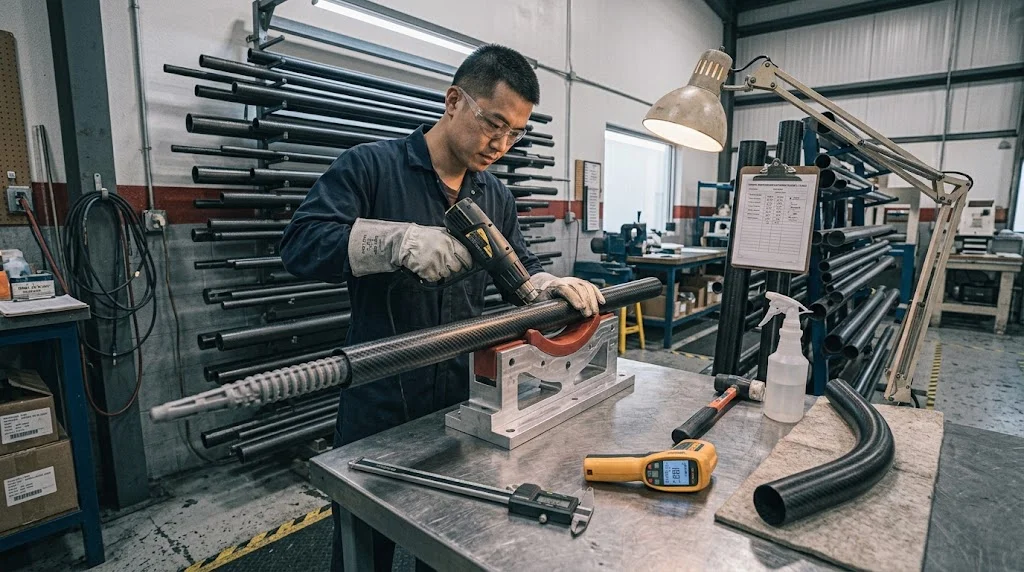
Knowing how to bend carbon fiber tube stock saves a project — and getting it wrong destroys a $60 tube in two seconds. A cured tube carries its fibers straight along the axis, so bending forces the outer face into tension and the inner face into compression while the thin matrix strains to hold them
Introduction
Knowing how to bend carbon fiber tube stock saves a project — and getting it wrong destroys a $60 tube in two seconds. A cured tube carries its fibers straight along the axis, so bending forces the outer face into tension and the inner face into compression while the thin matrix strains to hold them together. The surface strain of a bend is roughly the outside diameter divided by twice the bend radius, and epoxy fails near 2 percent strain: that is why a 25 mm tube cold-bent tighter than about 600-700 mm radius shows white stress marks and, one push further, delaminates.
This guide explains which bend methods actually work on which tubes, the practical minimum radii, a repeatable heat-bend process, what to change for carbon fiber rod, and when the honest answer is to order a carbon fiber tube custom bent at the factory instead of bending it yourself.
Why Cold Bending a Cured Tube Fails
Roll-wrapped prepreg tube is the common case: 0° plies dominate the wall for stiffness, and the cured epoxy has almost no elongation left. Once local strain passes its limit, the first signs are fine white lines on the outer radius and a faint hollow note in the tap test; the next push opens interlaminar cracks you cannot see until the tube fails in service. Thin walls make it worse — below about 1.2 mm wall thickness the tube kinks on the inner radius before the fibers reach their limit. The table summarizes the realistic options.
| Method | Works on | Practical min radius | Main risk |
|---|---|---|---|
| Cold bend over a form | not recommended on cured epoxy | about 25-30x OD, rarely clean | whitening, delamination |
| Rubber mandrel + heat | thermoplastic tubes (PP, PA) | 6-10x OD | overheating, surface scorch |
| Internal expanding mandrel | thin-wall thermoplastic tube | 4-8x OD | crushing, ovality |
| Molded curve (over mandrel during cure) | prepreg tube, any radius | design choice | tooling cost |
Radius multiples are against the outside diameter: a 25 mm tube at 10x means a 250 mm centerline radius. Anything below 15x on a cured thermoset tube should be treated as a factory operation, not a workshop one.
How to Bend Carbon Fiber Tube With Heat: Step by Step
Heat bending works because a thermoplastic matrix softens and lets fibers slide past each other instead of straining. Identify the resin first — a cheap frame tube is usually polypropylene and softens near 170 °C, engineering nylon closer to 210 °C; cured epoxy will simply burn before it bends.
- Support the core: slide a silicone or rubber mandrel into the tube so the wall cannot ovalize or wrinkle on the inner radius; a snug fit with a light smear of soap solution helps insertion.
- Heat evenly: rotate the tube in front of a heat gun or in a forced-air oven, aiming for a soft, uniform zone 3-4 times the bend arc length — never a single hot spot.
- Bend slowly over the form: pull around a radius jig at roughly 10-20 degrees per second; speed is what creates wrinkles on the inside of the curve.
- Cool restrained: hold the tube on the form until it returns to room temperature — releasing early is where springback undoes your angle.
- Inspect: tap-test along the bend for a dull note, check ovality with calipers at three points, and look for surface whitening before the part goes into service.
Bends held within 1-2 degrees of the jig are achievable this way; anything tighter than 6x OD needs a mold rather than a jig.
How to Bend Carbon Fiber Rod and Thin-Wall Tube
How to bend carbon fiber rod follows the same physics with less forgiveness: solid or pultruded rod has almost continuous 0° fiber, so it springs back 0.5-1 degree after a bend and shows stress whitening earlier than a tube. Rods under 8 mm can be formed cold over a generous radius with slow, repeated passes — bend a little, release, check, repeat — while larger cross-sections want the heat treatment. Thin-wall tube (under 1.2 mm) is the worst case: it kinks before it cracks, so support the inner radius with a mandrel every time. Never bend at a weld-like point load or clamp in vise jaws without soft pads; local crushing is permanent and invisible under the weave.
When to Order a Carbon Fiber Tube Custom Bent
There is a bright line: if the design radius is under about 15x OD, the tube wall is under 1.2 mm, or the batch is more than a handful, stop bending and order the curve. A carbon fiber tube custom bend is laid up over a mandrel inside a two-piece mold and cured in that shape, so the fibers are placed where the load will be instead of being forced there afterward — the same logic as how to make carbon fiber tube for frames in the first place. Expect tooling cost on the first piece, a 3-5 week lead for a small batch, and a part with no residual strain and no risk of a hairline crack appearing months later. Ask the factory for a minimum radius recommendation with your diameter and wall thickness; a good supplier will tell you honestly when cold-forming is fine.
Frequently Asked Questions
What is the minimum bend radius for carbon fiber tube?
For cured epoxy roll-wrapped tube, treat anything under 25-30x the outside diameter as off-limits cold, and expect cosmetic whitening even approaching that. Thermoplastic tubes with a rubber mandrel reach 6-10x OD with heat; molded curves go tighter because the shape is set during cure rather than forced afterward.
Will a bent tube spring back or crack later?
A heat-bend on thermoplastic tube that is cooled on the form holds its angle with under 1 degree of springback. A cold-bent cured tube may look fine and still carry interlaminar microcracks that grow under vibration — that is why structural applications should use molded bends instead of post-cure forming.
Can you bend a tube after it is already installed?
Only on thermoplastic stock, only with internal support, and only if you can protect nearby parts from the heat gun. On cured epoxy the answer is no — remove the tube, verify the fit on the bench, and if the geometry is wrong, remake or re-order rather than loading a cracked tube into service.
Conclusion
How to bend carbon fiber tube without cracking it comes down to matching method to matrix: never cold-form cured epoxy, heat-bend thermoplastic tubes over a supported mandrel, treat rod and thin-wall stock with extra patience, and hand radii under 15x OD to the factory as molded curves. When in doubt, a custom bent tube costs less than a failed assembly.
YongXian manufactures carbon fiber tube in roll-wrapped and pultruded grades, bends thermoplastic tube to customer radii, and tooled curved sections for larger programs. Browse our carbon fiber range or send your radius and wall specs to our engineering team.
Part of topic
Related Articles
- How to Bend Carbon Fiber Rod: Heat Forming, Cold Passes, and Custom Curves
- Carbon Fiber Sheet Manufacturing Process Explained
- How to Make Carbon Fiber Plates at Small Batch Scale
- How to Make Carbon Fiber Tubes: Filament Winding vs Roll Wrapping
- Carbon Fiber Plate Manufacturing Process: Ply Stack to Finished Panel
- How Carbon Fiber Is Made: From PAN Precursor to Composite
Interested in Our Products?
Contact our team for competitive pricing and technical specifications.
Get a QuoteRelated Products

Round Carbon Fiber Tube — 3K Plain Weave T700
Standard round carbon fiber tube manufactured from Toray T700 grade fiber with 3K plain weave. Offers balanced strength and stiffness for general industrial applications including robotics, automation, sports equipment, and aerospace structures.

Carbon Fiber Pickleball Paddle
High-performance pickleball paddle with Toray T700 carbon fiber face and polypropylene honeycomb core. Delivers excellent power-to-weight ratio, spin generation, and vibration dampening for competitive play.

Square Carbon Fiber Tube — 3K Twill T700
Square cross-section carbon fiber tube manufactured with 3K twill weave for torsional strength. Preferred for structural frames, trusses, and support columns where rectangular geometry offers design flexibility.
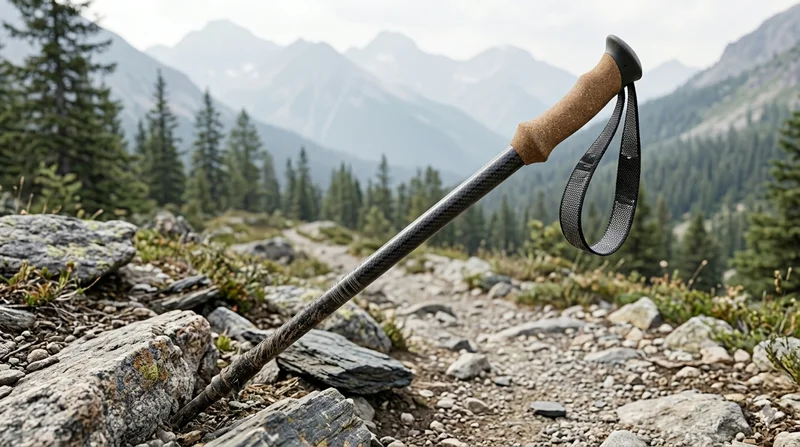
Carbon Fiber Trekking Pole
Lightweight carbon fiber trekking pole manufactured from high-grade carbon fiber tube. Weighs only 160g per pole while providing superior shock absorption and durability for hiking, trail running, and backpacking.

Round Carbon Fiber Tube — 3K Twill
Lightweight and ultra-stiff round tubes ideal for drone frames, robotics, and structural applications.