
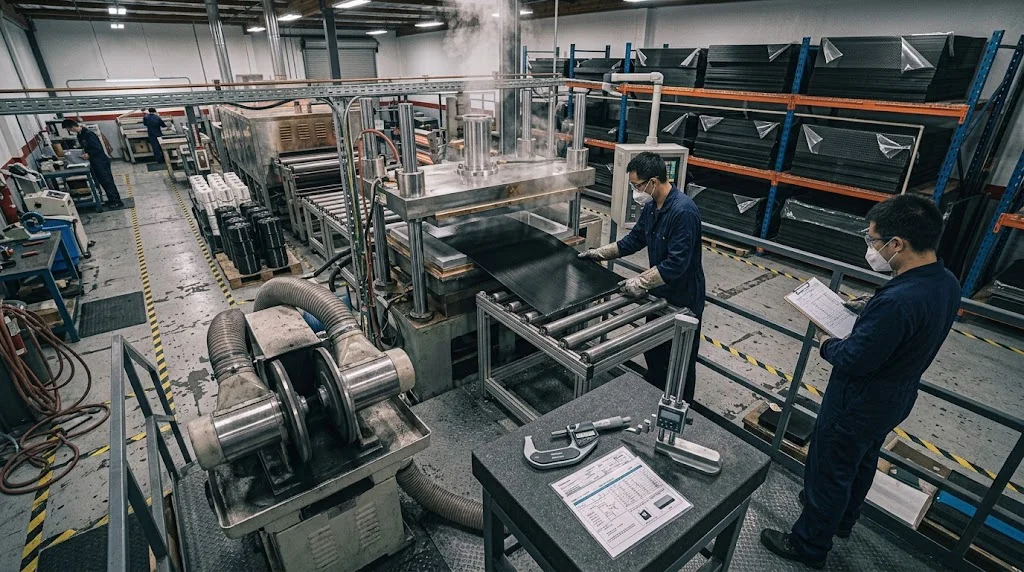
The carbon fiber sheet manufacturing process looks simple on a datasheet — fabric in, flat black plate out — but every specification you actually use (thickness tolerance, void content, flatness, glass transition) is decided in five controlled stages, and each stage has a failure mode that polishing
Introduction
The carbon fiber sheet manufacturing process looks simple on a datasheet — fabric in, flat black plate out — but every specification you actually use (thickness tolerance, void content, flatness, glass transition) is decided in five controlled stages, and each stage has a failure mode that polishing cannot hide. Industrial sheets are not "pressed carbon"; they are engineered laminates whose cure and finish are tracked batch by batch.
This article explains the process at plant scale: how prepreg and dry-fabric routes feed layup, how carbon fiber plate manufacturing choices at the material stage set the mechanical floor, how press and autoclave cures differ when you make carbon fiber sheet in volume, and how grinding, inspection and cut-to-size turn a cured slab into a plate you can machine to ±0.1 mm.
Inside the Carbon Fiber Sheet Manufacturing Process: Plant Flow
A sheet line runs in stages, and each stage has numbers that show up later as performance. The table below reflects a typical epoxy sheet run of 300-1000 pieces.
| Stage | Equipment | Key parameter | Typical value |
|---|---|---|---|
| Material preparation | Frozen store, cutter | Resin content, ply count | Prepreg 35-45% by weight; 8-24 plies |
| Layup | Automated ply placement or manual bench | Orientation schedule | Balanced 0/90, ±45 skins where needed |
| Debulk | Roller, vacuum stack | Compaction before cure | 0.08-0.095 MPa, per 3-4 plies |
| Cure | Hot press or autoclave | Peak temperature, pressure | 120-135 °C, 0.4-0.7 MPa |
| Grind to thickness | Double-disc grinder | Thickness tolerance | ±0.05-0.1 mm on 2-10 mm plate |
| Inspect | C-scan, ultrasonic, flatness gauge | Void content, delamination | <2% void; no indications >6 mm |
Skip a checkpoint and the omission reappears later: poor debulk shows as wrinkles under the grinder, an under-pressurized cure shows as porosity that paint cannot fill, and a rushed inspection ships a delamination that grows in service.
Carbon Fiber Plate Manufacturing: Materials and Layup Design
The mechanical floor of a sheet is set before any heat is applied. Fabric choice, resin system and the orientation schedule together decide stiffness, impact behavior and how the plate machines.
- Fabric: 3K twill at 200-300 g/m² is the standard face material — drapable over slight contours, familiar weave for visible parts; plain weave and unidirectional plies enter when stiffness per kilo matters more than looks.
- Resin: toughened epoxy with Tg of 120-180 °C depending on service; automotive-adjacent sheets specify the higher end because a dark plate in a summer cabin soaks to 80-90 °C.
- Orientation: balanced 0/90 for plate-like stiffness; adding ±45° surface plies resists torsion and cleans up edge stability after grinding.
- Net vs near-net: near-net layup (few oversize plies, trimmed close) saves grind time but demands accurate cut files; fully oversized layup is more forgiving and typical for first articles.
Ask any manufacturer how to make carbon fiber sheet for a structural application and the answer starts here: void content and fiber volume (typically 55-60%) are locked in material preparation, not cured in the press.
Cure Routes: How to Make Carbon Fiber Sheet by Press or Autoclave
Two cure platforms dominate sheet production, and the tradeoff is pressure, cycle time and capital — not quality slogans.
- Hot press: matched metal platens at 0.4-0.7 MPa and 120-135 °C give short cycles (60-120 minutes) and excellent thickness control because the mold enforces the dimension; sheets up to about 12 mm are routine, and the grind allowance is built into the tool gap.
- Autoclave: 0.4-1.0 MPa air pressure over a bagged laminate handles larger panels and complex shapes with one asset; cycles run 2-5 hours and flatness depends more on the caul plate than on the autoclave itself.
- Out-of-autoclave vacuum cure: acceptable for non-critical panels at 0.08-0.1 MPa, but expect 2-5% void content and thickness scatter unless the prepreg is engineered for OOA use — this is why cheap vacuum-only sheet lives in display products.
Volume decides the economics: a press line amortizes tooling over thousands of plates, while an autoclave earns its keep when one oven must cure mixed work — sheets, fairings and sandwich panels — on the same day.
Finishing: Grinding, Inspection and Cut-to-Size
A cured slab becomes a product at the grinder and the inspection bench. Double-disc grinding removes the resin-rich top layer, brings the plate to nominal thickness and often both faces at once; the removed depth per side (0.2-0.5 mm typical) must be planned at layup, or the fiber fraction at the surface drops and the plate shows polish swirl. After grinding: ultrasonic inspection for voids and delamination, flatness measurement across diagonals, edge trimming to drawing, and a peel-protective film so the finish survives shipping. Cut-to-size CNC routing closes the chain — nesting your parts on the stock sheet is where the customer feels the process working, because a flat, in-tolerance plate drops out of the machine with edges that need only light deburring.
Frequently Asked Questions
What thickness tolerance does the carbon fiber sheet manufacturing process hold?
Ground structural sheet is commonly held at ±0.05-0.1 mm on 2-10 mm plates, with flatness of 0.2-0.5 mm per meter depending on layup and stress relief. Plates that skip grinding run wider, often ±0.3 mm, because cure shrinkage varies across the tool.
How long does one cure cycle take in production?
On a hot press, 60-120 minutes including heat-up and cool-down under pressure; autoclave cycles for thick stacks run 2-5 hours plus bagging time. Multi-step cures with a high-temperature post-cure add an hour but raise the usable Tg.
Can the manufacturer make carbon fiber sheet to my drawing and tolerance?
Yes, within limits: specify thickness, tolerance, flatness, resin Tg and annual volume; first articles add tooling time. For sheets destined for machining into parts, ask for the grind stock allowance in the quote — it is often the difference between a plate that finishes cleanly and one that goes out of flat on the last cut.
Conclusion
The carbon fiber sheet manufacturing process is a chain of controlled stages — material prep, layup, debulk, pressurized cure, grinding and inspection — each with numbers that either get recorded or come back as scrap. When you evaluate a plate, judge the process behind it: documented layup, void content on the certificate, and tolerance held at the grinder rather than promised at the door.
YongXian runs epoxy sheet production to these controls and supplies ground-flat carbon fiber plate and sheet in standard and custom sizes, with cut-to-size machining for production programs. Browse our carbon fiber sheet range or contact our engineering team with your thickness, tolerance and volume.
Part of topic
Related Articles
- How to Bend Carbon Fiber Rod: Heat Forming, Cold Passes, and Custom Curves
- How to Bend Carbon Fiber Tube Stock Without Cracking
- How to Make Carbon Fiber Plates at Small Batch Scale
- How to Make Carbon Fiber Tubes: Filament Winding vs Roll Wrapping
- Carbon Fiber Plate Manufacturing Process: Ply Stack to Finished Panel
- How Carbon Fiber Is Made: From PAN Precursor to Composite
Interested in Our Products?
Contact our team for competitive pricing and technical specifications.
Get a QuoteRelated Products

Round Carbon Fiber Tube — 3K Plain Weave T700
Standard round carbon fiber tube manufactured from Toray T700 grade fiber with 3K plain weave. Offers balanced strength and stiffness for general industrial applications including robotics, automation, sports equipment, and aerospace structures.

Carbon Fiber Pickleball Paddle
High-performance pickleball paddle with Toray T700 carbon fiber face and polypropylene honeycomb core. Delivers excellent power-to-weight ratio, spin generation, and vibration dampening for competitive play.

Square Carbon Fiber Tube — 3K Twill T700
Square cross-section carbon fiber tube manufactured with 3K twill weave for torsional strength. Preferred for structural frames, trusses, and support columns where rectangular geometry offers design flexibility.
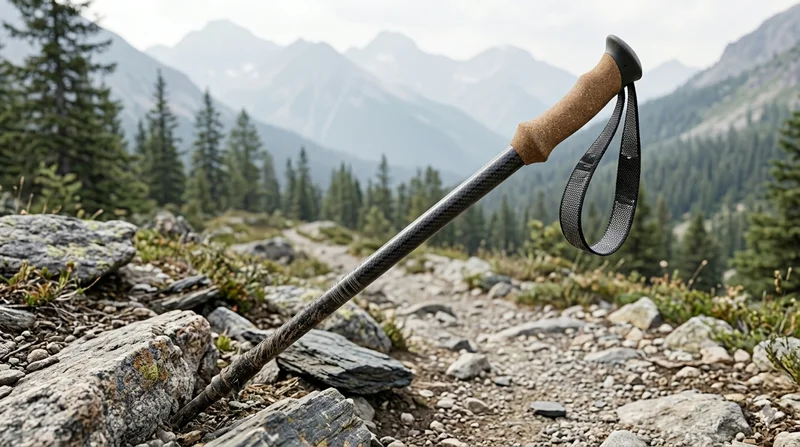
Carbon Fiber Trekking Pole
Lightweight carbon fiber trekking pole manufactured from high-grade carbon fiber tube. Weighs only 160g per pole while providing superior shock absorption and durability for hiking, trail running, and backpacking.

Carbon Fiber Plate — 3K Twill T700 3.0mm
Medium-thickness 3.0mm carbon fiber plate offering significantly higher load capacity while maintaining attractive 3K twill finish. Suitable for structural brackets, reinforcement plates, and load-bearing panels.