
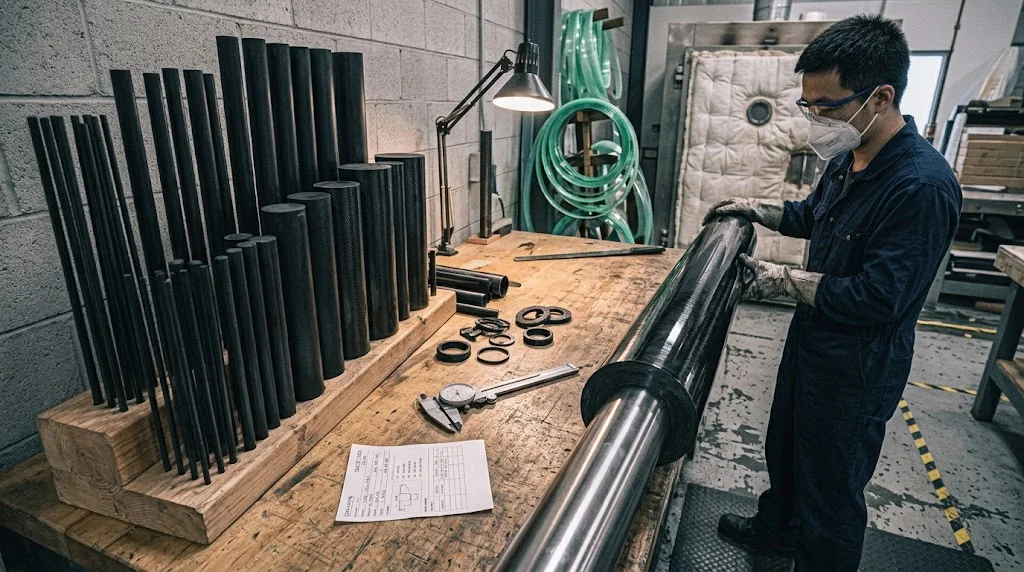
Choosing between pultruded vs roll wrapped carbon fiber is the first decision behind almost every tube and rod purchase, yet the two processes are almost never explained side by side in a way a buyer can act on. Pultrusion drags continuous fibers through a resin bath and a heated die to make solid r
Introduction
Choosing between pultruded vs roll wrapped carbon fiber is the first decision behind almost every tube and rod purchase, yet the two processes are almost never explained side by side in a way a buyer can act on. Pultrusion drags continuous fibers through a resin bath and a heated die to make solid rod and simple tube at high line speed; roll wrapping lays pre-impregnated sheet onto a mandrel and cures it, which costs more per metre but gives control over wall thickness, fibre angle and finish that pultrusion cannot match. This guide compares the two processes on the properties that actually show up in an assembly — stiffness, roundness, impact behaviour, tolerances and price — then walks through when a pultruded carbon fiber rod wins, when roll-wrapped construction is worth the premium, and how to write a carbon fiber tube custom enquiry that gets quoted correctly the first time.
Both processes use the same families of carbon fibre and epoxy; the difference is where the fibers end up relative to the load. That single geometric fact drives every performance difference below.
Pultruded vs Roll Wrapped Carbon Fiber: The Core Difference
In pultrusion, nearly all fibers run axially: rovings and sometimes a thin surface veil are pulled through resin and a heated die that sets the profile continuously. The result is a part with extremely consistent cross-section and very high axial stiffness per gram, but almost no off-axis fiber — hoop strength and transverse strength depend on whatever thin braided or wrapped surface layer the producer adds. In roll wrapping, prepreg sheet is wrapped at chosen angles around a steel or aluminium mandrel, bagged, and cured, so the fiber orientation is designed rather than inherited from the process.
| Property | Pultruded | Roll wrapped |
|---|---|---|
| Fiber direction | almost fully axial | designed angles, typically 0/±45/90 |
| Wall thickness control | fixed by die, limited range | ply count chosen per order |
| Roundness and surface | good, die-dependent, slight seam possible | excellent, controlled by mandrel finish |
| Crush and hoop strength | lower without a braided sleeve | higher, 90-degree plies resist crushing |
| Cost per metre | low, high line speed | higher, labor-intensive layup |
| Best format | solid rod, small tube, spars | hollow tube, large diameter, custom profiles |
Read the table as a design statement rather than a scorecard: the axis of the fiber is the product. If your load is axial, pultrusion already puts material where it works; if your load includes bending in every direction, clamping pressure or internal pressure, roll wrapping earns its price.
When a Pultruded Carbon Fiber Rod Wins
Pultruded rod is the default for stiff, lightweight, axially loaded parts: drone frame bracing, robotic linkages, kite spars, tent poles, antenna whips, golf club shafts and reinforcing strips. Solid pultruded rod costs a fraction of roll-wrapped equivalents, holds diameter tightly because the die sets it, and machines like a dense plastic — cut it with a diamond wheel and it finishes cleanly. Two limits matter. First, solid rod has no hollow section, so anything that must slide over a sleeve or carry wiring inside needs tube. Second, pure axial layup chips at the edge under point clamps: a bolted joint on thin pultruded tube can crush the wall unless you add a steel insert or switch to a roll-wrapped wall with hoop plies.
- Pick pultruded rod for: bracing, pushrods, spars, pins, stiffeners, and any part loaded along its length.
- Pick pultruded tube for: low-cost lightweight standoffs and non-critical frames where crush loads are modest.
- Avoid pultruded for: clamp-heavy joints, pressurised tubes, and large diameters where flat spots from the die matter.
When Roll Wrapped Construction Is Worth the Premium
Roll wrapping answers the three weaknesses of pultrusion at once. Hoop and angle plies make the wall resistant to crushing, so hose clamps and through-bolts do not split it. Ply count sets wall thickness exactly, so a 1.5 mm wall stays 1.5 mm instead of being limited to whatever dies exist. And the mandrel controls roundness and surface finish, which is why camera booms, drive shafts, sailing spars and precision instrument tubes are almost always roll wrapped. For carbon fiber tube custom projects — non-round sections, co-cured fittings, painted or polished outside surfaces, bonded end inserts — roll wrapping is usually the only process that can hold the print.
The premium is real: roll-wrapped tube commonly costs two to four times pultruded tube of the same diameter. The purchase decision is whether the assembly needs the hoop strength, the wall control, or the finish. If it needs none of the three, pultruded stock is the honest answer and the saving goes into other parts of the build.
Tolerances, Lengths and What to Specify
Both processes ship to commercial tolerances, but the numbers differ. Pultruded rod typically holds diameter within plus or minus 0.1 mm and length within a millimetre or two after cut-to-length. Roll-wrapped tube holds diameter within about plus or minus 0.2 mm, wall thickness within about 10 percent, and straightness that depends on post-cure tensioning — worth requesting on long shafts. When you request carbon fiber tube custom work, state five things: outer diameter, wall thickness or ply schedule, length and cut tolerance, fibre grade and target modulus, and the load case in one sentence. Suppliers quote accurately from that list; a drawing alone often triggers a conservative quote padded for uncertainty.
Cost Drivers and Buying Tips
Three levers move price more than any others. Diameter: both processes get expensive fast above about 50 mm because material and tooling scale with circumference. Length: stock lengths of pultruded rod are cheap; special lengths add a cutting setup. Order quantity: roll wrapping has real setup time for mandrels and bagging, so pricing improves sharply past twenty pieces. A practical pattern for prototypes is to buy pultruded stock first to validate fits, then move the final design to roll-wrapped tube once loads are measured. Mixing the two in one assembly is normal — pultruded rod for the bracing, roll-wrapped tube for the main spar — and a supplier who sells both can usually supply both lines.
Frequently Asked Questions
Is pultruded carbon fiber stronger than roll wrapped?
Along the axis, pultruded stock is excellent because nearly every fiber points at the load. Off-axis, in crush, and under hoop tension, roll-wrapped layups win decisively because they contain angle and 90-degree plies. Neither is universally stronger; the load direction decides.
Can roll wrapped tube be made in custom diameters?
Yes — the mandrel defines the inner diameter, so almost any round bore is possible, and wall thickness is set by ply count. Non-round sections need a shaped mandrel, which adds tooling cost but is routine for production quantities.
Why does my pultruded tube crush under a hose clamp?
Axial fibers offer little resistance to radial crushing: the wall has almost no hoop reinforcement. Either switch to a roll-wrapped wall with 90-degree plies, or distribute the clamp load with a rubber sleeve or a longer fitting.
Conclusion
The pultruded vs roll wrapped carbon fiber question has a clean answer once the load direction is known: axial and cost-sensitive, buy pultruded; multi-directional, clamp-loaded or tolerance-critical, buy roll wrapped. Specify wall, diameter, length and modulus explicitly on custom enquiries, prototype on pultruded stock where possible, and reserve roll wrapping for the parts that genuinely need engineered fiber angles.
YongXian supplies both pultruded carbon fiber rod and roll-wrapped tube, and produces carbon fiber tube custom orders with controlled layups, cut to your lengths. Browse our carbon fiber range or send your tube specification for a quote.
Part of topic
Related Articles
- Pultruded vs Wrapped Carbon Fiber: Performance and Cost
- How to Cut Carbon Fiber Rods Cleanly: Tools, Dust Safety, and Tolerances
- How to Bend Carbon Fiber Rod: Heat Forming, Cold Passes, and Custom Curves
- How to Bend Carbon Fiber Tube Stock Without Cracking
- Carbon Fiber Sheet Manufacturing Process Explained
- How to Make Carbon Fiber Plates at Small Batch Scale
Interested in Our Products?
Contact our team for competitive pricing and technical specifications.
Get a QuoteRelated Products

Round Carbon Fiber Tube — 3K Plain Weave T700
Standard round carbon fiber tube manufactured from Toray T700 grade fiber with 3K plain weave. Offers balanced strength and stiffness for general industrial applications including robotics, automation, sports equipment, and aerospace structures.

Square Carbon Fiber Tube — 3K Twill T700
Square cross-section carbon fiber tube manufactured with 3K twill weave for torsional strength. Preferred for structural frames, trusses, and support columns where rectangular geometry offers design flexibility.

Carbon Fiber Pickleball Paddle
High-performance pickleball paddle with Toray T700 carbon fiber face and polypropylene honeycomb core. Delivers excellent power-to-weight ratio, spin generation, and vibration dampening for competitive play.

Carbon Fiber Trekking Pole
Lightweight carbon fiber trekking pole manufactured from high-grade carbon fiber tube. Weighs only 160g per pole while providing superior shock absorption and durability for hiking, trail running, and backpacking.
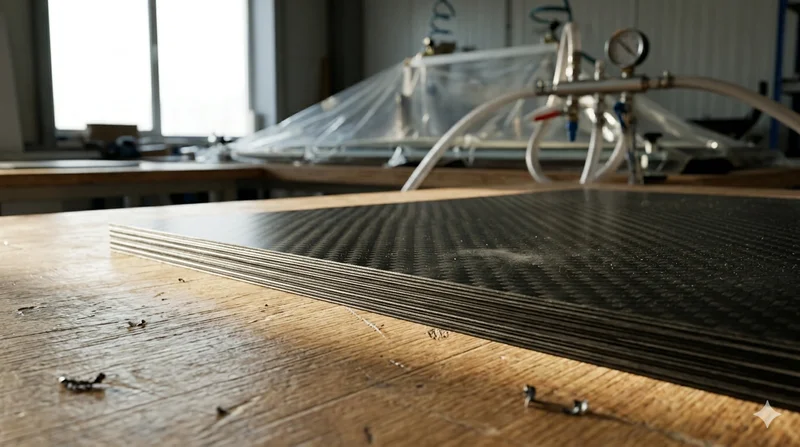
Carbon Fiber Plate — 3K Twill T700 3.0mm
Medium-thickness 3.0mm carbon fiber plate offering significantly higher load capacity while maintaining attractive 3K twill finish. Suitable for structural brackets, reinforcement plates, and load-bearing panels.