
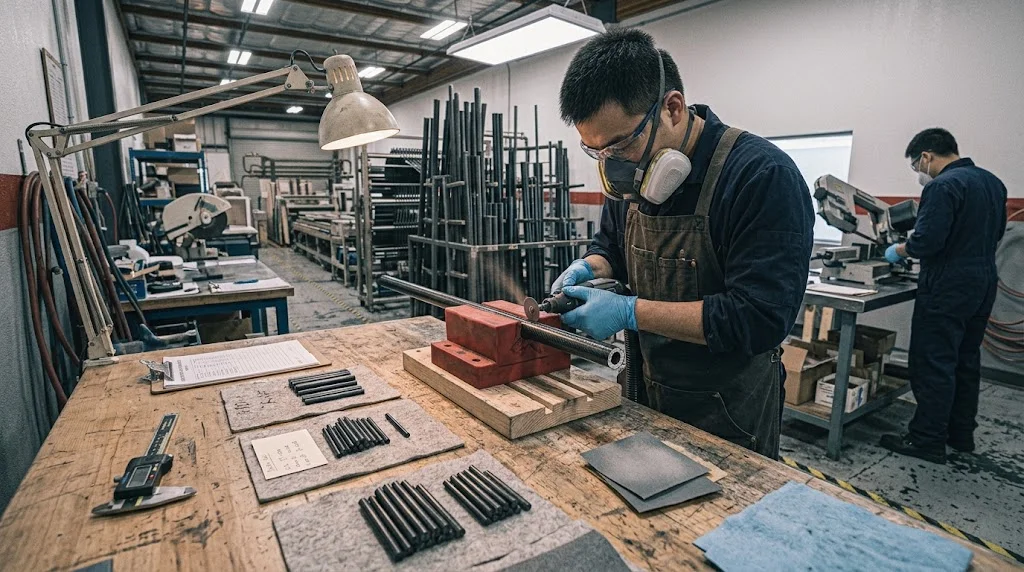
Knowing how to cut carbon fiber rod cleanly separates a usable part from a splintered stub that has to be thrown away. Pultruded rod is almost pure axial fiber held in a brittle epoxy matrix: the same property that makes it stiff makes the exit edge fray into whiskers if the cut is rushed, and the d
Introduction
Knowing how to cut carbon fiber rod cleanly separates a usable part from a splintered stub that has to be thrown away. Pultruded rod is almost pure axial fiber held in a brittle epoxy matrix: the same property that makes it stiff makes the exit edge fray into whiskers if the cut is rushed, and the dust that comes off the blade is abrasive, electrically conductive, and unpleasant to breathe. This guide explains why carbon cuts nothing like metal, compares the tooling that actually works, walks through a repeatable cut step by step, sets the dust-safety rules that should not be negotiated, and extends the method to how to cut carbon fiber plate and to cutting carbon fiber rod for drone frames in batches.
The method below works for standard-modulus pultruded rod from 2 mm to about 25 mm, and with lighter feeds for hollow tube. High-modulus fiber is more brittle and chips more easily, so treat its edges with extra patience.
Why Cutting Carbon Fiber Rod Behaves Nothing Like Metal
Metal chips away under a tool edge; carbon fractures between fibers while the matrix smears. Three consequences decide your setup. First, the exit side is where damage happens: unsupported fibers lift and whisker as the cut finishes, so the blade needs a backing surface or a scoring pass. Second, the matrix is abrasive — a steel blade that slices aluminum all day will go dull after a few carbon cuts, which raises heat and makes fraying worse. Third, the dust is not sawdust: carbon particles are conductive enough to short unprotected electronics on the bench, which is why wet wiping and vacuum extraction matter as much as the cutting itself.
| Tool | Best for | Practical tolerance | Main risk |
|---|---|---|---|
| Diamond cutoff wheel (0.8-1.2 mm) | rod 2-20 mm, clean ends | plus or minus 0.3 mm | heat if fed too slow |
| Fine-tooth bandsaw (14-18 TPI) | rod and tube up to 25 mm | plus or minus 0.5 mm | exit fraying without backing |
| Lathe with carbide parting insert | short production runs, faced ends | plus or minus 0.1 mm | vibration on long slender rod |
| Abrasive chop saw, thin diamond blade | thick rod, rough cuts | plus or minus 1 mm | dust plume, burned edges |
| Tube shears | thin-wall tube only | plus or minus 0.5 mm | crushes solid rod |
A diamond wheel on a handheld rotary tool is the default workshop answer: cheap, precise enough, and kind to the fiber. Match the wheel to a diamond grit designed for composites rather than masonry, and keep a second wheel for metal so the two never share grit load.
How to Cut Carbon Fiber Rod Step by Step
The sequence below is the one production shops repeat dozens of times a day; every step exists because skipping it produces a specific, predictable defect.
- Measure and mark twice: mark the cut line with a fine pencil or silver marker, then check the mark against the drawing — once the wheel touches carbon there is no correction pass.
- Clamp with soft jaws: hold the rod in padded vise jaws or a dedicated cut jig a few millimeters from the cut line; clamping too far away lets the free end whip and fray on exit.
- Back the exit side: press the rod against a sacrificial block of wood or aluminum so fibers are supported at the moment the wheel breaks through.
- Cut at steady moderate speed: let the diamond do the work at roughly 1-2 mm of feed per second; leaning on the tool packs dust into the cut, spikes the temperature, and burns the resin.
- Deburr immediately: break the edge with 240-400 grit paper and a light chamfer, then wipe with a tack cloth before the rod goes into an assembly.
Rods cut this way keep square ends within a third of a millimeter and show a clean ring of fiber at the cut face instead of a fringe. If the end still whiskers after deburring, the wheel is dull or the feed was too aggressive — change the wheel before cutting the next piece.
Dust Safety: The Rules That Are Not Optional
Carbon dust is the part of this operation people skip and later regret. Particles are sharp, conductive, and stay airborne longer than wood dust. At minimum, wear a P100 or FFP3 respirator, run a vacuum shroud on the cutting tool, and keep a wet wipe or HEPA vacuum at the bench for cleanup. Never blow the bench down with compressed air — that aerosolizes the fine fraction straight into the breathing zone and spreads conductive dust across every exposed circuit. Shop clothes pick up particles that later scratch finished parts, so change out of cutting clothes before handling cosmetic work. Filings collected from dry cutting should be bagged for disposal, not swept into a general bin next to a grinder.
How to Cut Carbon Fiber Plate With the Same Setup
How to cut carbon fiber plate follows the same physics with a different edge strategy. Thin sheet up to about 1.5 mm can be scored along a straightedge with a diamond or carbide wheel, then snapped over a table edge — the score guides the fracture and leaves a clean line. Thicker plate wants a CNC router with a diamond dust router bit at moderate spindle speed and a climb-cut finishing pass, or the same fine-tooth bandsaw used for rod, guided against a fence. The exit-fraying rule is stricter on plate because the cut edge is often the visible edge: always support the offcut and finish with a light sand rather than filing aggressively, which pulls fibers out of the matrix.
Carbon Fiber Rod for Drone Frames: Batch Cutting
Carbon fiber rod for drone frames and standoff stacks is usually 2-6 mm pultruded stock cut to repeating lengths, often dozens of identical pieces per build. A simple jig — a stop block clamped to a cutting guide — turns the single-cut method into a repeatable process and holds length variation within about plus or minus 0.5 mm, which is what frame alignment needs. Sort finished pieces by length before assembly; even good cutting leaves a tail of pieces at the tolerance limit, and mixing those into a frame shows up as a twisted arm. Builders who need tighter control order carbon fiber custom rod cut to length at the factory, where the stock is cut on a controlled saw and the ends can be faced in the same setup.
Frequently Asked Questions
What is the best tool to cut carbon fiber rod at home?
A handheld rotary tool with a thin diamond cutoff wheel, a padded vise, and a sacrificial backing block covers almost every home scenario from 2 mm to about 15 mm rod. Add a P100 respirator and a vacuum; the tool is cheap, but the dust controls are what make the cut safe.
Why does my rod fray on one end but not the other?
That is exit-side damage: the fibers lose support as the cut finishes and lift into whiskers. Back the exit against a sacrificial block, clamp close to the cut line, and slow the final millimeter of feed; those three changes remove fraying in almost every case.
Can I use a hacksaw or scissors to cut carbon rod?
A fine-tooth metal hacksaw blade works in an emergency on rod under about 8 mm if you back the exit and accept a rougher face, but it dulls quickly and wanders off-square. Scissors and tube shears crush solid rod and should only be used on thin-wall tube, never on pultruded stock.
Conclusion
How to cut carbon fiber rod cleanly comes down to four decisions: pick a diamond or fine-tooth tool instead of a steel blade, support the exit side, feed steadily without forcing the cut, and treat the dust as a real hazard rather than housekeeping. Apply the same edge discipline to plate, move to a jig when drone-frame batches start, and hand tight-tolerance cut-to-length work to the factory when the parts have to match.
YongXian supplies pultruded carbon fiber rod and tube, can cut stock to your length tolerances, and produces carbon fiber custom rod and plate for drone, robotics, and industrial programs. Browse our carbon fiber range or send your cut list to our engineering team.
Part of topic
Related Articles
- Pultruded vs Roll Wrapped Carbon Fiber: A Buyer Guide
- Pultruded vs Wrapped Carbon Fiber: Performance and Cost
- How to Bend Carbon Fiber Rod: Heat Forming, Cold Passes, and Custom Curves
- How to Bend Carbon Fiber Tube Stock Without Cracking
- Carbon Fiber Sheet Manufacturing Process Explained
- How to Make Carbon Fiber Plates at Small Batch Scale
Interested in Our Products?
Contact our team for competitive pricing and technical specifications.
Get a QuoteRelated Products

Round Carbon Fiber Tube — 3K Plain Weave T700
Standard round carbon fiber tube manufactured from Toray T700 grade fiber with 3K plain weave. Offers balanced strength and stiffness for general industrial applications including robotics, automation, sports equipment, and aerospace structures.

Square Carbon Fiber Tube — 3K Twill T700
Square cross-section carbon fiber tube manufactured with 3K twill weave for torsional strength. Preferred for structural frames, trusses, and support columns where rectangular geometry offers design flexibility.

Carbon Fiber Pickleball Paddle
High-performance pickleball paddle with Toray T700 carbon fiber face and polypropylene honeycomb core. Delivers excellent power-to-weight ratio, spin generation, and vibration dampening for competitive play.

Carbon Fiber Trekking Pole
Lightweight carbon fiber trekking pole manufactured from high-grade carbon fiber tube. Weighs only 160g per pole while providing superior shock absorption and durability for hiking, trail running, and backpacking.

Round Carbon Fiber Tube — 3K Twill
Lightweight and ultra-stiff round tubes ideal for drone frames, robotics, and structural applications.