
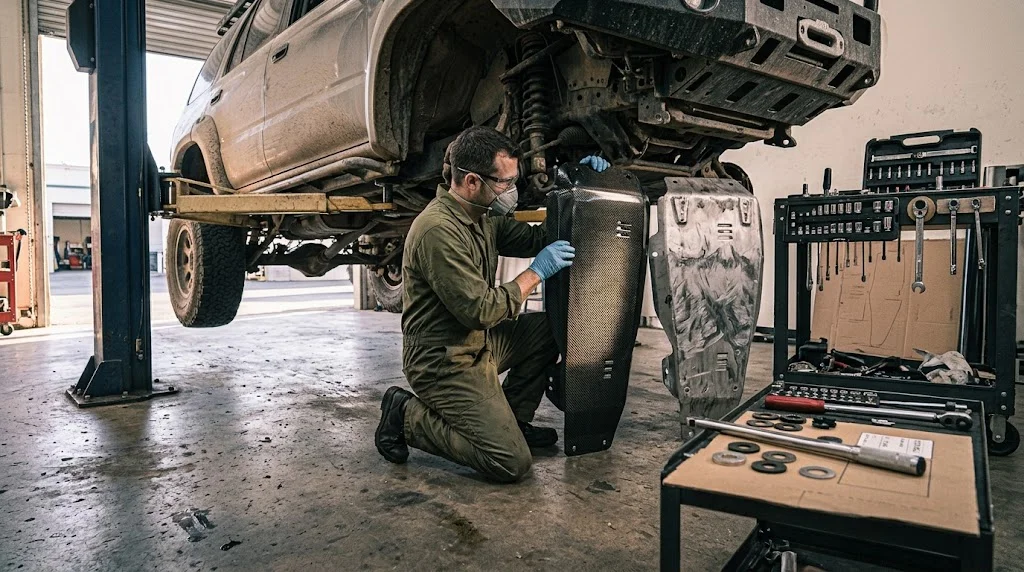
The carbon fiber skid plate vs aluminum debate starts under the vehicle, where a plate has to survive grinding rocks, hidden stumps and the occasional cross-axle hit. A 6 mm aluminum 5052 plate spanning the belly of a mid-size 4x4 weighs roughly 18-22 kg, while a carbon fiber skid plate of similar s
Introduction
The carbon fiber skid plate vs aluminum debate starts under the vehicle, where a plate has to survive grinding rocks, hidden stumps and the occasional cross-axle hit. A 6 mm aluminum 5052 plate spanning the belly of a mid-size 4x4 weighs roughly 18-22 kg, while a carbon fiber skid plate of similar stiffness lands near 9-12 kg — half the mass hung low on the chassis, with a different failure mode on each side of the comparison.
This guide compares carbon fiber skid plate vs aluminum across density, abrasion, impact and heat, then works through carbon fiber plate vs fr4 for lighter guards, custom carbon fiber parts for cars, and carbon fiber rod vs steel hardware — plus the fastening details that decide whether an expensive plate survives its first season on the trail.
Carbon Fiber Skid Plate vs Aluminum: Head-to-Head Data
Neither material is simply stronger; the useful comparison is stiffness per kilogram, wear rate against grit, and what happens at the moment of a hard strike. Carbon laminate carries load well in the fiber directions and shrugs off point loads that would dent aluminum, but it is anisotropic and abrades differently. Aluminum is isotropic, forms small dents instead of cracks, and can be straightened in the field with basic tools.
| Property | Carbon fiber laminate | Aluminum 5052 / 6061 | What it means under the car |
|---|---|---|---|
| Density | 1.55-1.60 g/cm3 | 2.70 g/cm3 | Same coverage at roughly half the weight |
| Flexural strength | 450-700 MPa | 190-290 MPa | Carbon resists belly strikes with less thickness |
| Abrasion behavior | Resin wears, fibers expose | Surface gouges, material smears | Rock grinding favors aluminum on repairability |
| Impact behavior | Delamination, no visible dent | Dents and work-hardens | Carbon damage hides until inspection |
| Heat tolerance | Resin softens near 120-180 C | Holds to 300 C and beyond | Exhaust routing decides the material |
| Typical plate cost | $180-450 | $60-160 | Carbon premium only pays where grams matter |
Read the weight row first: cutting 8-10 kg from the lowest point of the vehicle improves handling and reduces the load on the front suspension, which is the main argument people reach for when they pick carbon before they ever scrape a rock.
Abrasion, Impact and Heat in Real Off-Road Use
Skid plates fail in three ordinary ways: slow abrasion from sand and gravel, point impact from a sharp rock, and heat soak if the plate sits close to the exhaust or a transfer case. Each failure mode favors a different material, which is why fleet operators usually mix plates by position rather than committing the whole underbody to one material.
- Abrasion: aluminum loses material steadily but predictably; a scarred plate can be flipped or re-drilled, while carbon wears through the resin first and then exposes fibers that chip.
- Sharp impact: a direct hit that dents 3 mm of aluminum usually leaves carbon visually intact but may have split the laminate internally — tap-test the area before reusing it.
- Heat zones: keep carbon at least 150 mm from exhaust bends; the epoxy matrix starts to soften well before the metal around it would care.
- Fastener creep: aluminum holes elongate under vibration; carbon holes crush if overtightened, so use oversized washers and torque to spec.
The practical pattern is carbon for large flat panels that only see sand and light scraping, aluminum for the front skid, rocker edges and anything within reach of the exhaust.
Carbon Fiber Plate vs FR4: Why FR4 Is Not Armor
FR4 — the glass-epoxy laminate used for circuit boards — turns up in cheap guard plates because it is stiff, flat and inexpensive per sheet. In a carbon fiber plate vs fr4 comparison for real protection, FR4 loses on every axis that matters: it is heavier than carbon at similar stiffness, it splinters rather than delaminates, and its resin system is brittle under cold impact. FR4 makes sense as an electrical insulator plate or a light splash guard; it does not belong under a vehicle that lands on a ledge.
Custom Carbon Fiber Parts for Cars: When the Premium Pays
Off-the-shelf plates rarely fit twice. Custom carbon fiber parts for cars earn their price on vehicles with aftermarket exhausts, relocated tanks or long-travel suspension, where a generic plate either fouls the routing or leaves the oil pan exposed. A one-off panel built from a template costs roughly three times a stamped aluminum piece, but it protects exactly the geometry you own.
- Bring a template: cardboard or 3 mm MDF traced under the vehicle beats any measurement taken off a forum.
- Specify the layup: quasi-isotropic 3-4 mm with a abrasion-resistant veil on the outer face handles daily gravel better than a bare structural layup.
- Plan the holes: have the supplier place and reinforce mounting holes during lamination rather than drilling them afterward.
Carbon Fiber Rod vs Steel: Mounts, Brackets and Fasteners
Structure around the plate still has to be chosen deliberately. In a carbon fiber rod vs steel comparison for spreader bars and bumper brackets, steel wins on cost, weldability and impact toughness; carbon rod wins where a brace must add stiffness without adding a kilogram high on the chassis. Use steel for anything that will be bent back after a hit, carbon for straight braces loaded only in tension or compression, and isolate the two with nylon washers so galvanic corrosion does not eat the aluminum mount beneath.
Frequently Asked Questions
Is a carbon fiber skid plate vs aluminum worth it on a daily-driven 4x4?
For a vehicle that sees weekend trails and daily commuting, carbon usually earns back its price through 8-10 kg saved low on the chassis and through quieter panels that do not drum at highway speed. If the truck spends its life on rocky routes where the plate is a consumable, aluminum at a fraction of the cost is the rational buy.
How do I inspect a carbon plate after a hard strike?
Tap the panel across its area with a coin: a sharp, consistent click means the laminate is sound, a hollow or dull spot suggests internal separation. Look for white creases along the impact line, check that mounting holes have not become oval, and retire the plate if you find delamination near a fastener.
Can carbon and aluminum plates be mixed on one vehicle?
Yes, and it is the common setup: a carbon center panel with aluminum leading edges and rock sliders. Isolate every contact point with washers or a thin polymer tape, use stainless or titanium hardware, and re-check torque after the first hundred kilometers because the two materials settle differently under vibration.
Conclusion
The carbon fiber skid plate vs aluminum choice follows the terrain: carbon wins on weight, stiffness and corrosion resistance, aluminum wins on abrasion tolerance, field repair and price. Most builds end up mixing the two by position, which protects the budget and the underbody at the same time.
YongXian supplies carbon fiber sheet, plate and CNC-cut blanks for underbody armor and custom brackets, including carbon fiber plate cut to your template. Browse our carbon fiber range or contact our engineering team with your vehicle geometry and expected annual volume.
Part of topic
Related Articles
- Carbon Fiber Rod vs Steel Rod: Weight, Stiffness and Cost
- Carbon Fiber Plate vs FR4: When Composite Wins
- Carbon Fiber vs Aluminum Drone Frames: Weight, Cost and Crash Data
- Pultruded vs Roll Wrapped Carbon Fiber: A Buyer Guide
- Pultruded vs Wrapped Carbon Fiber: Performance and Cost
- How to Cut Carbon Fiber Rods Cleanly: Tools, Dust Safety, and Tolerances
Interested in Our Products?
Contact our team for competitive pricing and technical specifications.
Get a QuoteRelated Products

Round Carbon Fiber Tube — 3K Plain Weave T700
Standard round carbon fiber tube manufactured from Toray T700 grade fiber with 3K plain weave. Offers balanced strength and stiffness for general industrial applications including robotics, automation, sports equipment, and aerospace structures.
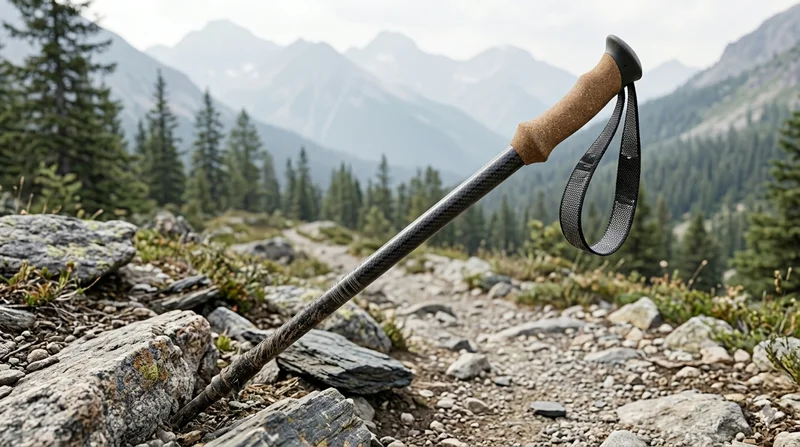
Carbon Fiber Trekking Pole
Lightweight carbon fiber trekking pole manufactured from high-grade carbon fiber tube. Weighs only 160g per pole while providing superior shock absorption and durability for hiking, trail running, and backpacking.

Carbon Fiber Pickleball Paddle
High-performance pickleball paddle with Toray T700 carbon fiber face and polypropylene honeycomb core. Delivers excellent power-to-weight ratio, spin generation, and vibration dampening for competitive play.

Square Carbon Fiber Tube — 3K Twill T700
Square cross-section carbon fiber tube manufactured with 3K twill weave for torsional strength. Preferred for structural frames, trusses, and support columns where rectangular geometry offers design flexibility.

Carbon Fiber Plate — 3K Twill T700 3.0mm
Medium-thickness 3.0mm carbon fiber plate offering significantly higher load capacity while maintaining attractive 3K twill finish. Suitable for structural brackets, reinforcement plates, and load-bearing panels.