
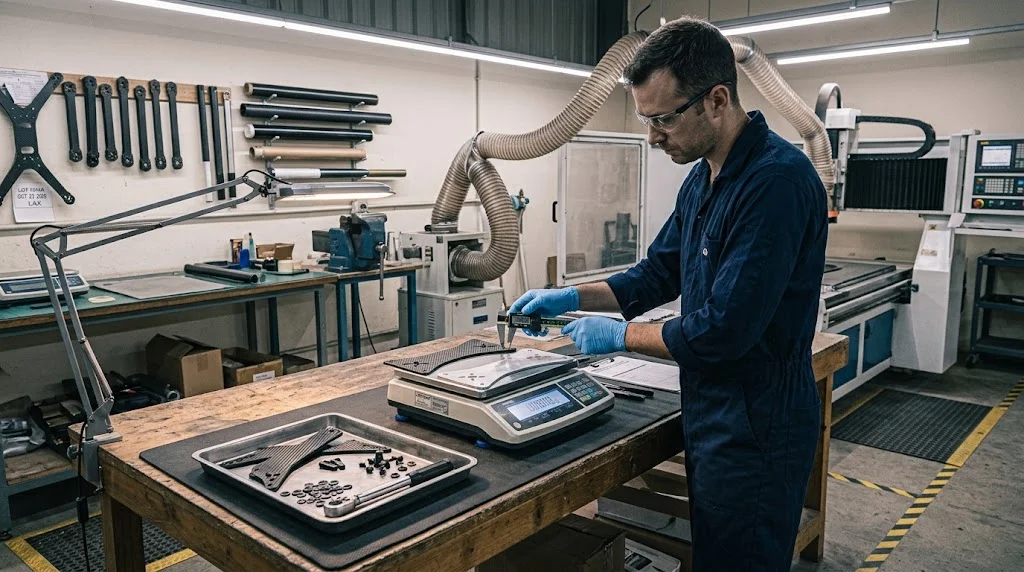
The carbon fiber vs aluminum drone question settles quickly once both frames sit on a scale: a 250 mm class carbon quad frame in 4 mm plate weighs 110-135 g, while the same geometry machined from 6061-T6 aluminum comes in at 185-230 g. That 70-100 g sits under the battery, so it changes hover effici
Introduction
The carbon fiber vs aluminum drone question settles quickly once both frames sit on a scale: a 250 mm class carbon quad frame in 4 mm plate weighs 110-135 g, while the same geometry machined from 6061-T6 aluminum comes in at 185-230 g. That 70-100 g sits under the battery, so it changes hover efficiency, agility and the loads on your mount — but grams alone do not decide a build.
This guide compares carbon fiber vs aluminum drone frames on density, stiffness, impact behavior, repair cost and electrical grounding, then shows where a carbon fiber drone chassis earns its premium, where an aluminum chassis still wins, and how a 4mm carbon fiber drone frame should be cut and fastened to survive more than one season.
Carbon Fiber vs Aluminum Drone Frames: Head to Head Data
The comparison is less about raw strength than about specific stiffness and damage tolerance. Quasi-isotropic carbon laminate ends up with a Young's modulus close to aluminum's, but at less than half the density, so stiffness per gram runs about 2.5 times higher. Aluminum keeps three real advantages: it is isotropic, it dents before it breaks, and it conducts — which makes it a natural ground plane for the electronics stack.
| Property | Carbon laminate (0/90) | Aluminum 6061-T6 | What it means in flight |
|---|---|---|---|
| Density | 1.55-1.60 g/cm3 | 2.70 g/cm3 | 250 mm frame mass: 110-135 g vs 185-230 g |
| Tensile strength | 600-900 MPa | 310 MPa | Carbon tolerates higher spike loads before yielding |
| Elastic modulus | 60-70 GPa | 69 GPa | Near-identical absolute stiffness, 2.5x better per gram |
| Failure mode | Delamination, fiber break | Plastic bending | Al bends and keeps flying; carbon can fail without warning |
| Conductivity | Anisotropic, weak | Excellent | Al chassis grounds ESCs and shields the flight controller |
| Typical frame cost | $45-120 | $15-45 | Carbon premium pays back only where grams matter |
Notice the modulus row: absolute stiffness is nearly identical, so the two frames feel similar in hover. Almost every difference you actually feel — transport weight, acceleration, mount load — comes out of the density row instead.
Weight and Flight Time: What 100 Grams Buys
On a fixed 250 mm build with the same battery, removing 70-100 g of all-up weight is worth roughly 4-6% more hover time and a visible improvement in punch-out recovery, because the motors spend less of their thrust budget carrying structure.
- Hover efficiency: every 100 g saved shifts the hover throttle point down about 1-2%, which compounds over a long survey or mapping sortie.
- Agility: lower frame mass reduces rotational inertia around the roll axis, so rate response improves most in quick direction changes rather than in top speed.
- Transport and mounts: airframes, gimbal brackets and delivery pods see lower inertial loads in transit, which matters more for folded designs carried to the field.
- Vibration: a stiff carbon plate raises the first bending mode above the prop-pass band, so the flight controller sees cleaner gyro data and can run higher filter settings.
The gains are real but bounded: frame mass is only 8-15% of all-up weight on a typical quad, so carbon will not rescue a build that is wrong on battery or payload.
Carbon Fiber Drone Frames in a Crash: Repair vs Replace
This is where the two materials part company. An aluminum drone chassis dents, bends and often flies again after being straightened on a bench; a carbon fiber drone chassis absorbs impact by delaminating, and the damage is invisible under the top skin until the plate buckles in the air.
- Cheap crashes: a bent aluminum arm costs a few minutes of straightening, while a delaminated carbon arm should be cut open or replaced — flying it is a gamble.
- Field repair: aluminum can be backed with a plate and bolted home; carbon repair needs epoxy, vacuum or clamp time and cure before the next flight.
- Spare parts cost: a carbon arm runs $12-30, an aluminum arm $5-15, but carbon frames fail less often in ordinary hard landings because they flex and recover within their elastic range.
- Fatigue: aluminum has a finite fatigue life at vibration loads; undamaged carbon laminate does not fatigue in the same way, which favors carbon on high-hour airframes.
Practical rule: race and freestyle builds crash weekly, so keep two spare carbon arms in the case; inspection and mapping platforms rarely crash, so the carbon premium buys durability rather than repairability.
Building a 4mm Carbon Fiber Drone Frame Chassis
Cutting the plate wrong wastes the material. Use a CNC router or a waterjet with a sacrificial backing board, run the spindle at moderate speed with a compression bit, and keep dust extraction on — carbon dust is abrasive and conductive. Drill mounting holes with a backing block so the exit side does not blow out, and never clamp the plate directly in steel jaws.
Fastening is the second failure point. Bolt carbon to aluminum through nylon or titanium hardware with isolation washers, because direct contact galvanically corrodes the aluminum and stains the clear coat. Torque M3 fasteners to about 1.2 Nm; beyond that you are crushing the laminate rather than clamping it. Where an arm meets the plate, add a second ply or an aluminium doubler on the impact side, and keep motor wire routes away from hole edges that can wick moisture into the laminate.
Where Aluminum Still Wins on a Drone Chassis
Aluminum remains the right answer when cost, repairability or shielding dominate. Delivery drones that get dented daily, airframes carrying noisy ESCs that need a ground plane, and prototypes where geometry changes every week all favor machined aluminum: it is cheaper per part, easier to rework on site, and forgiving of over-torqued bolts. The realistic hybrid is an aluminum center plate with carbon arms — you keep the stiffness where it matters and the repairability where crashes happen.
Frequently Asked Questions
Is a carbon fiber vs aluminum drone frame worth the extra cost?
For race, freestyle and inspection platforms where 70-100 g affects flight time and handling, yes — the premium of $30-70 over an aluminum frame pays back in flight performance and transport weight. For heavy-lift or daily-delivery builds that crash often and fly short missions, aluminum or a hybrid center plate is usually the smarter buy.
How long does a 4mm carbon fiber drone frame last?
With isolated fasteners and no hard crashes, a 4 mm plate frame outlasts the electronics, easily covering 300-500 flights. Service life collapses after a visible delamination: once you see a white crease or hear a hollower tap, the plate should be retired or cut open to check the core area.
Can I mix an aluminum chassis with carbon fiber drone frames?
Yes, and it is a common hybrid: carbon arms on an aluminum center plate cut most of the weight while keeping a repairable core. Use isolation washers and nylon or titanium bolts at every carbon-to-aluminum joint, and re-check torque after the first flight because the two materials settle differently under vibration.
Conclusion
The carbon fiber vs aluminum drone decision comes down to what you are optimizing: carbon wins on mass, stiffness per gram and fatigue life, aluminum wins on cost, repairability and grounding. Most builders end up with a hybrid, and that is a rational answer rather than a compromise.
YongXian supplies carbon fiber sheet, plate, tube and CNC-cut blanks for drone programs, including 4mm carbon fiber drone frame stock cut to your drawing. Browse our carbon fiber range or contact our engineering team with your frame geometry and annual volume.
Part of topic
Related Articles
- Carbon Fiber Rod vs Steel Rod: Weight, Stiffness and Cost
- Carbon Fiber Plate vs FR4: When Composite Wins
- Carbon Fiber Skid Plate vs Aluminum: Off-Road Protection Compared
- Pultruded vs Roll Wrapped Carbon Fiber: A Buyer Guide
- Pultruded vs Wrapped Carbon Fiber: Performance and Cost
- How to Cut Carbon Fiber Rods Cleanly: Tools, Dust Safety, and Tolerances
Interested in Our Products?
Contact our team for competitive pricing and technical specifications.
Get a QuoteRelated Products

Round Carbon Fiber Tube — 3K Plain Weave T700
Standard round carbon fiber tube manufactured from Toray T700 grade fiber with 3K plain weave. Offers balanced strength and stiffness for general industrial applications including robotics, automation, sports equipment, and aerospace structures.
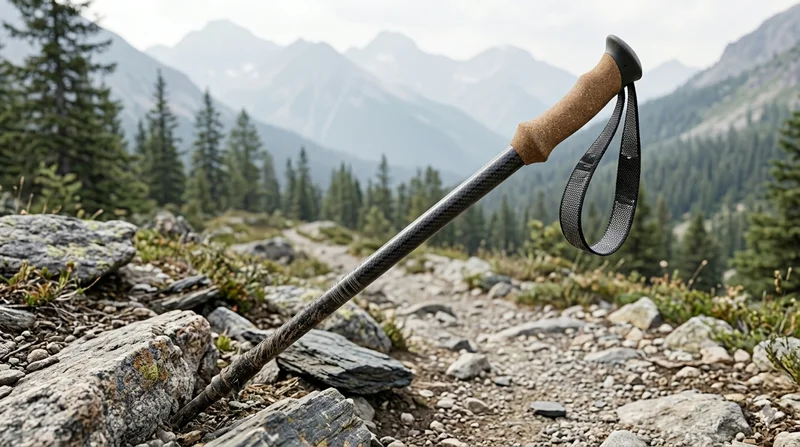
Carbon Fiber Trekking Pole
Lightweight carbon fiber trekking pole manufactured from high-grade carbon fiber tube. Weighs only 160g per pole while providing superior shock absorption and durability for hiking, trail running, and backpacking.

Carbon Fiber Pickleball Paddle
High-performance pickleball paddle with Toray T700 carbon fiber face and polypropylene honeycomb core. Delivers excellent power-to-weight ratio, spin generation, and vibration dampening for competitive play.

Square Carbon Fiber Tube — 3K Twill T700
Square cross-section carbon fiber tube manufactured with 3K twill weave for torsional strength. Preferred for structural frames, trusses, and support columns where rectangular geometry offers design flexibility.

Round Carbon Fiber Tube — 3K Twill
Lightweight and ultra-stiff round tubes ideal for drone frames, robotics, and structural applications.