
A carbon fiber fabric tube is built from woven cloth rolled around a mandrel, not from continuous roving pulled through a die — and that single process difference explains almost every performance and cost gap against pultruded rod. Woven fabric carries load in two in-plane directions, tolerates off
Introduction
A carbon fiber fabric tube is built from woven cloth rolled around a mandrel, not from continuous roving pulled through a die — and that single process difference explains almost every performance and cost gap against pultruded rod. Woven fabric carries load in two in-plane directions, tolerates off-axis bending better than unidirectional pultrusion, and gives the familiar twill or plain weave surface that customers expect on visible parts. This article walks through roll-wrap construction step by step, compares it with filament winding, explains how fabric orientation and resin choice change tube behavior, and finishes with what to ask any carbon fiber fabric supplier before releasing a purchase order.
The scope is commercial roll-wrap tube in the common diameters, from hobby stock up through industrial shafts; prepreg autoclave aerospace tube is mentioned only where the process differs enough to matter to a buyer comparing quotes.
How a Carbon Fiber Fabric Tube Is Made: Roll-Wrap Versus Filament Winding
Roll-wrap production starts with a polished steel or aluminum mandrel sized to the tube's inner diameter. Prepreg fabric — cloth already impregnated with resin — is rolled onto the mandrel under tension, plies stacked to the designed thickness, then the assembly is bagged and oven-cured, or wet-wound and cured in an oven without a bag. The result is a tube with helical or hoop fabric layers, a smooth inner bore, and wall thickness set by ply count rather than by die geometry. Filament winding instead drives continuous roving onto a rotating mandrel at programmed angles; it excels at very large diameters and high hoop strength but produces a less uniform surface and is usually chosen for pressure vessels rather than precision shafts.
- Roll-wrap: best surface finish, tight diameter tolerance, ideal for shafts, arms, and visible structural tubes.
- Filament winding: lowest cost per meter at large diameter, strong in hoop direction, coarser surface.
- Pultrusion: constant cross-section only, unidirectional fibers, cheapest for simple rods and bars.
For a buyer comparing three quotes, the first question is which of these three processes each quote actually describes — "carbon tube" alone is not a specification.
Fabric Orientation and Structural Response
Because a carbon fiber fabric tube carries load in two directions, layup schedule drives performance more than fiber grade does. A quasi-isotropic schedule — zero, plus-minus forty-five, ninety — behaves predictably under combined bending and torsion and suits robot arms and drive shafts. A bias-heavy schedule at plus-minus forty-five maximizes torsional stiffness per gram and suits propeller shafts and tool spindles. A hoop-dominant schedule resists internal pressure and crushing and suits protective sleeves. The same outer diameter and wall thickness can swing torsional stiffness by thirty percent or more just by re-arranging ply angles, which is why suppliers who only publish diameter and wall thickness leave buyers guessing.
| Layup family | Best property | Typical use | Relative cost |
|---|---|---|---|
| Quasi-isotropic (0/±45/90) | balanced biaxial stiffness | robot arms, drive shafts | baseline |
| Bias-dominant (±45 heavy) | torsional stiffness per gram | prop shafts, tool spindles | +5-10% |
| Hoop-dominant (90 heavy) | crush and pressure resistance | protective sleeves, cans | +10% |
| Hybrid carbon-glass | impact tolerance, cost | field-repairable arms | -15% |
Resin Systems and Service Temperature
Most commercial roll-wrap carbon fiber fabric tube uses epoxy, chosen for adhesion to carbon and for room-temperature or oven cure that keeps mandrel cost low. Standard toughened epoxies handle continuous service near eighty to one hundred twenty degrees Celsius; higher-temperature systems — bismaleimide or cyanate ester — push that ceiling but double or triple the material cost and usually require autoclave cure that only larger suppliers offer. For ambient machine frames and robot arms, standard epoxy is the right answer; for engine-bay shafts or anything near a heat source, ask for the glass transition temperature of the cured system with the certificate, not a marketing range.
What a Carbon Fiber Fabric Supplier Should Disclose
Before releasing a purchase order, a credible carbon fiber fabric supplier should disclose at least five items: the fabric style and areal weight (for example 3K twill at two hundred grams per square meter), the resin system and its glass transition temperature, the layup schedule or at least the fiber orientation family, the inner and outer diameter tolerance with measuring method, and the lot-level void content or a mechanical test report. Suppliers who cannot answer the layup question are usually reselling stock tube from an unnamed mill; that is acceptable for prototype brackets and risky for rotating parts, where a single delamination becomes a safety issue. Also confirm whether the tube is sanded, painted, or left with the peel-ply finish, because that choice drives both price and downstream bonding preparation.
For buyers sourcing carbon fiber fabric manufacturers in India or China, the same checklist applies — process transparency matters more than factory geography, and a mill that will share a cut-end sample from the actual production lot saves a failed first article later.
Frequently Asked Questions
How does a carbon fiber fabric tube compare to pultruded rod of the same outer size?
The fabric tube wins on torsional stiffness, off-axis load handling, and surface finish; the pultruded rod wins on axial stiffness per gram and price for simple sections. Choose fabric tube for shafts and arms, rod for straight spars and braces.
Can a carbon fiber fabric supplier cut tubes to my drawing?
Most will, usually with a diamond saw and a charge per cut; confirm the end-face squareness tolerance and whether deburring is included. For rotating parts, specify squareness explicitly — a few degrees of end error turns into vibration at speed.
What finish should I specify for a bondable carbon fiber fabric tube?
Specify peel-ply finish or a light sanded surface, then wipe with solvent before bonding. Painted or clear-coated tubes need the coating sanded off at the bond zone first, which adds a processing step and risks contaminating the laminate if done carelessly.
Conclusion
A carbon fiber fabric tube earns its price through two-direction fabric, controlled roll-wrap layup, and a disclosed resin system — ask for fabric style, layup family, glass transition temperature, and tolerance method before comparing quotes. YongXian roll-wraps and machines fabric tube to drawing, with layup schedules disclosed per order — browse fabric tube stock or send your shaft drawing for a layup proposal.
Part of topic
Related Articles
- Carbon Fiber Rigid Plate: Layup, Thickness, and Stiffness
- Carbon Fiber Tubes Material Properties: Modulus, Strength and Density Reference
- Carbon Flash vs Carbon Fiber: Paint Finish or Real Composite?
- Aramid Fiber vs Carbon Fiber: Toughness vs Stiffness Compared
- Carbon Fiber Rod vs Steel Rod: Weight, Stiffness and Cost
- Carbon Fiber Plate vs FR4: When Composite Wins
Interested in Our Products?
Contact our team for competitive pricing and technical specifications.
Get a QuoteRelated Products

Round Carbon Fiber Tube — 3K Plain Weave T700
Standard round carbon fiber tube manufactured from Toray T700 grade fiber with 3K plain weave. Offers balanced strength and stiffness for general industrial applications including robotics, automation, sports equipment, and aerospace structures.

Carbon Fiber Pickleball Paddle
High-performance pickleball paddle with Toray T700 carbon fiber face and polypropylene honeycomb core. Delivers excellent power-to-weight ratio, spin generation, and vibration dampening for competitive play.
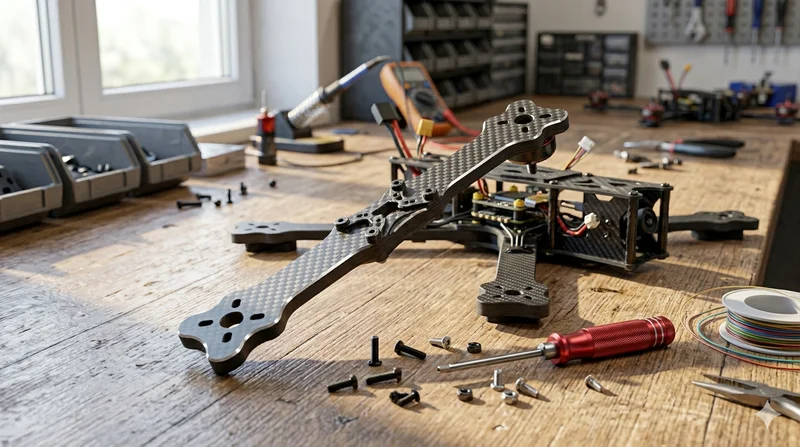
Carbon Fiber Drone Arm
Precision-molded carbon fiber drone arm combining unidirectional fiber for stiffness and woven layers for torsional strength. Designed for FPV, photography, and industrial drone platforms. Each arm is CNC-machined to exact specifications.

Square Carbon Fiber Tube — 3K Twill T700
Square cross-section carbon fiber tube manufactured with 3K twill weave for torsional strength. Preferred for structural frames, trusses, and support columns where rectangular geometry offers design flexibility.

Round Carbon Fiber Tube — UD Unidirectional T700
Unidirectional (UD) round tube with all fibers aligned axially for maximum longitudinal stiffness. Ideal for applications requiring high bending rigidity with minimal weight, such as shafts, struts, and structural reinforcements.