
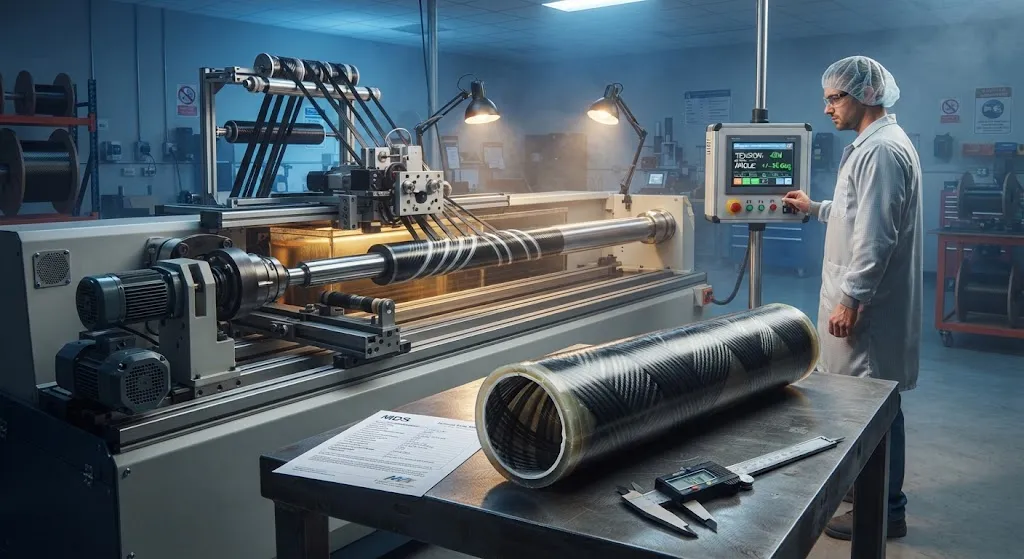
Filament wound epoxy tubes properties determine whether a lightweight tube can carry a drive torque, hold internal pressure, or resist bending on a long span. A filament wound epoxy tube is built by winding continuous glass, carbon, or aramid fibers around a rotating mandrel at a controlled angle wh
Introduction
Filament wound epoxy tubes properties determine whether a lightweight tube can carry a drive torque, hold internal pressure, or resist bending on a long span. A filament wound epoxy tube is built by winding continuous glass, carbon, or aramid fibers around a rotating mandrel at a controlled angle while the fiber passes through an epoxy resin bath, then curing the laminate at elevated temperature. The result is a near-net-shape cylinder whose mechanical behavior is engineered at the fiber level rather than inherited from a metal stock size. Because the winding angle, fiber volume fraction, and resin system are all programmable, the same tube geometry can be manufactured with very different strength and stiffness profiles to suit different loads.
For design engineers, the practical question is always the same: which filament wound epoxy tubes properties should drive the material selection, and how trustworthy is the data sheet that claims to report them? This article answers both. It explains the FW tube mechanical data that matters, maps each property to the test method behind it, shows how winding architecture changes the numbers, and provides a composite tube datasheet reading guide that keeps procurement and design conversations grounded in real material behavior.
Filament Wound Epoxy Tubes Properties: The Core Mechanical Data
The mechanical properties of a filament wound epoxy tube are directional. Hoop layers wound near 90 degrees to the tube axis carry circumferential stress from internal pressure, while helical layers wound at 45-65 degrees carry axial load and bending. A typical datasheet reports properties in both directions, and the winding schedule determines how the numbers split. The table below shows representative filament wound epoxy tubes properties for two common material systems at roughly 60-65 percent fiber volume fraction:
| Property | E-Glass / Epoxy FW Tube | Carbon / Epoxy FW Tube | Test Method |
|---|---|---|---|
| Tensile strength, axial (MPa) | 250-450 | 600-1,200 | ASTM D2105 |
| Tensile modulus, axial (GPa) | 25-40 | 70-140 | ASTM D2105 |
| Hoop tensile strength (MPa) | 500-900 | 900-1,800 | Split-disk / NOL ring |
| Compressive strength, axial (MPa) | 250-400 | 500-900 | ASTM D695 (modified) |
| Flexural modulus (GPa) | 20-35 | 60-120 | ASTM D790 / D4476 |
| Torsional shear strength (MPa) | 40-80 | 80-160 | ASTM D5448 |
| Density (g/cm³) | 1.9-2.1 | 1.5-1.6 | ASTM D792 |
Two observations matter for design. First, the carbon system is stiffer and stronger in every direction, but its lower strain-to-failure means stress concentrations and joint details must be handled with more care. Second, the gap between axial and hoop values is the signature of a filament wound tube — a rolled or pultruded product with the same fiber would show a different balance. These filament wound epoxy tubes properties are not defects; they are the tunable design variables of the process.
FW Tube Mechanical Data: How Winding Architecture Changes the Numbers
Every row in the datasheet traces back to three process decisions: winding angle, fiber volume fraction, and resin system. Understanding this linkage lets an engineer predict how a tube will behave before ordering custom tooling.
- Winding angle: A predominantly hoop-wound tube maximizes burst resistance but has low axial strength; a helical-dominant schedule trades burst pressure for bending and compression capacity. Most structural tubes use a balanced helical pattern with hoop overwraps.
- Fiber volume fraction: Raising fiber content from 55 to 65 percent increases modulus and strength roughly in proportion, while reducing the resin-rich interlayer that governs interlaminar shear. Datasheet values are meaningless without the fiber volume fraction they were measured at.
- Resin system: Standard bisphenol-A epoxy gives good fatigue and corrosion performance; high-temperature and toughened epoxy variants shift the glass transition temperature and damage tolerance, changing the useful service envelope rather than the room-temperature stiffness.
- Mandrel and cure: Cure cycle and mandrel surface finish set dimensional tolerances, surface roughness, and residual stress, which appear as ovality, straightness, and shrinkage values on the composite tube datasheet.
A qualified manufacturer reports FW tube mechanical data with the process parameters attached. If a data sheet lists strength without fiber volume fraction or winding angle, the numbers cannot be reproduced and should not be used for design allowables.
Reading a Composite Tube Datasheet: Parameters That Matter
A complete composite tube datasheet contains more than strength and modulus. For engineering procurement, the following parameters separate a usable document from a marketing sheet:
- Test method references: Every reported value should name the standard it was measured to, because tensile values change with specimen configuration and strain rate.
- Fiber volume fraction and void content: The two numbers that validate whether the laminate matches the intended winding process.
- Glass transition temperature: Sets the maximum service temperature; strength data measured at room temperature overstates performance at 80-100 degrees Celsius.
- Dimensional and geometric data: Inner and outer diameter, wall thickness tolerance, straightness, and ovality — the values that control fit-up and joint design.
- Environmental knockdowns: Retention factors after moisture exposure, thermal cycling, or ultraviolet aging, which a designer applies before setting allowables.
Buyers should also ask for the batch-to-batch variation recorded during qualification. Epoxy wound tube properties that look excellent in one sample can carry a coefficient of variation of 8-12 percent across production batches, and the datasheet should state the basis (single coupon, batch average, or A-basis) behind each number.
Design Allowables and Environmental Effects
Designing against published filament wound epoxy tubes properties requires applying reduction factors before any calculation. Fiber-dominated properties such as axial tensile strength see modest environmental degradation, while matrix-dominated properties — interlaminar shear, transverse strength, and compressive strength — can drop 20-40 percent when the resin is plasticized by moisture at elevated temperature. Compression is particularly sensitive because the matrix stabilizes the fibers against micro-buckling.
For structural applications, engineers typically derate the room-temperature dry values by 15-25 percent for environmental effects and then apply the safety factor required by the governing code, commonly 2.0-2.5 for pressure service or 1.5-2.0 for general structural use. The result is that a tube with a datasheet tensile strength of 800 MPa may carry a design allowable of only 350-500 MPa. None of these reductions are a criticism of the material; they are the same discipline applied to metals, and they keep filament wound epoxy tubes properties honest in service.
Frequently Asked Questions
What are the typical filament wound epoxy tubes properties compared to aluminum?
A carbon/epoxy FW tube at 60 percent fiber volume fraction typically reaches an axial tensile strength of 600-1,200 MPa with a density of 1.5-1.6 g/cm³, while 6061-T6 aluminum offers about 290 MPa tensile strength at 2.7 g/cm³. In specific strength — strength divided by density — the carbon tube is roughly 3-5 times better. Stiffness is the more nuanced comparison: a high-modulus carbon/epoxy tube can match or exceed aluminum modulus in the fiber direction while weighing about 40 percent less, but the transverse and shear properties are lower, so the comparison only holds when the tube is loaded in the direction of the fibers.
How accurate are FW tube mechanical data values from manufacturer data sheets?
Published values are accurate for the specific specimen, winding schedule, and fiber volume fraction they were measured on, and they typically carry a coefficient of variation of 8-12 percent across batches. The common failure is extrapolation: assuming a 60 percent fiber volume fraction datasheet applies to a tube wound at 55 percent, or that room-temperature values hold at 100 degrees Celsius. For safety-critical work, order a qualification batch and verify the numbers on your own test coupons before committing to design allowables.
Which filament wound epoxy tubes properties govern bending and torsion applications?
For bending, the axial tensile and compressive strengths plus the axial modulus govern, and because compression strength is usually lower than tension in fiber-dominated laminates, the compression value often sets the limit. For torsion, the in-plane shear strength and the helical winding angle dominate; a 45-degree helical layer is the most efficient for pure torque. In both cases, interlaminar shear strength acts as a secondary limit near joints and end fittings, so a datasheet that omits it is incomplete for structural design.
Conclusion
Filament wound epoxy tubes properties are directional, process-dependent, and fully documented when the manufacturer takes the engineering seriously. The FW tube mechanical data that matters — axial and hoop strength, modulus, fiber volume fraction, glass transition temperature, and environmental retention — is only useful when tied to test methods and winding parameters. By reading a composite tube datasheet critically, applying environmental and safety derating factors, and verifying batch variation, engineers can design with filament wound epoxy tubes as confidently as with rolled metal stock.
When your project needs filament wound epoxy tubes with verified mechanical data, review our filament wound tube and composite product range or contact our engineering team with your load case and service conditions, and we will specify the winding schedule and qualification testing to match.
Part of topic
Related Articles
- Filament Wound Epoxy Tubes Advantages: Over Metal and Pultruded Alternatives
- Carbon Fiber Tube Strength: Analysis Methods and Design Allowables
- Carbon Fiber Drone Blades and Propellers: Stiffness, Balance and Noise Reduction
- Fiberglass Filament Wound Tubes: Cost-Effective Alternative to Carbon Fiber
- Filament Wound Epoxy Tube Design: Wall Thickness, Fiber Angle and Load Optimization
- Filament Wound Epoxy Tubes: Testing Standards and Quality Assurance
Interested in Custom Carbon Fiber Products?
Contact our team for competitive pricing and technical specifications.
Get a QuoteRelated Products
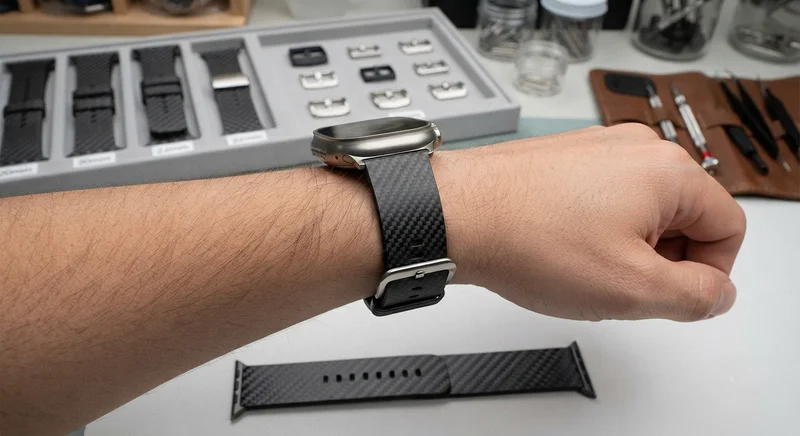
Carbon Fiber Watch Strap — 20mm/22mm Quick-Release
Premium carbon fiber watch strap with quick-release spring bars. Woven from T700 3K twill prepreg with a flexible resin system that conforms to the wrist. Available in 20mm and 22mm lug widths, compatible with Apple Watch, Samsung Galaxy Watch, Garmin, and traditional mechanical watches. Features a stainless steel buckle and carbon fiber keepers. The natural weave pattern makes each strap unique.
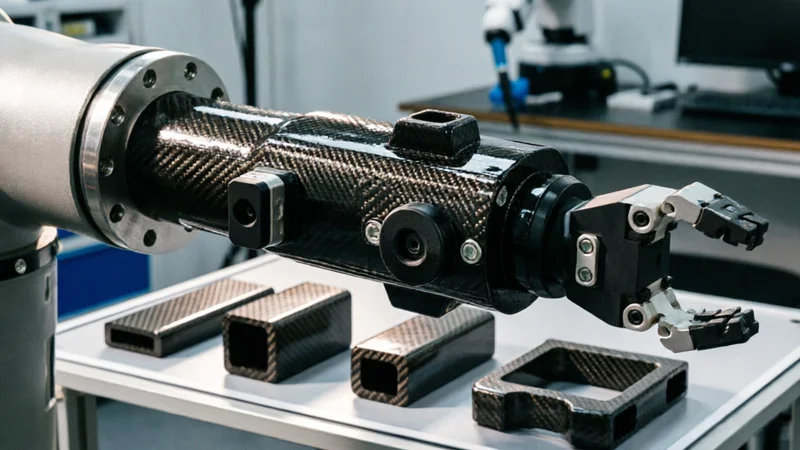
Carbon Fiber Robot End Effector Link — Custom Shape & Sensor Integration
Custom-shaped carbon fiber end effector links for robotic arms. Designed for automation integrators and research labs requiring lightweight, rigid connections between the robot wrist and gripper/tool. Can incorporate sensor mounting bosses, cable routing channels, and quick-change interfaces.

Custom Carbon Fiber Musical Instrument Parts
Carbon fiber components for musical instrument manufacturing offering superior dimensional stability, low weight, and consistent acoustic properties. We produce carbon fiber bows, guitar necks, violin chin rests, drum shells, and wind instrument bodies. Carbon fiber instruments are immune to humidity changes and temperature fluctuations that affect wooden instruments.
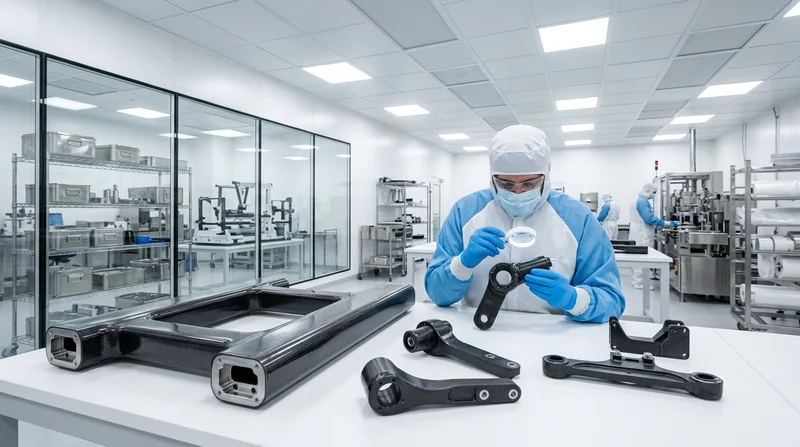
Custom Carbon Fiber Medical Device Components
Medical-grade carbon fiber components manufactured for imaging equipment, surgical instruments, and patient support systems. Carbon fiber's radiolucency (X-ray transparency) and high strength-to-weight ratio make it ideal for CT scanner beds, wheelchair frames, surgical robot arms, and MRI-compatible accessories. Biocompatible resin systems available.
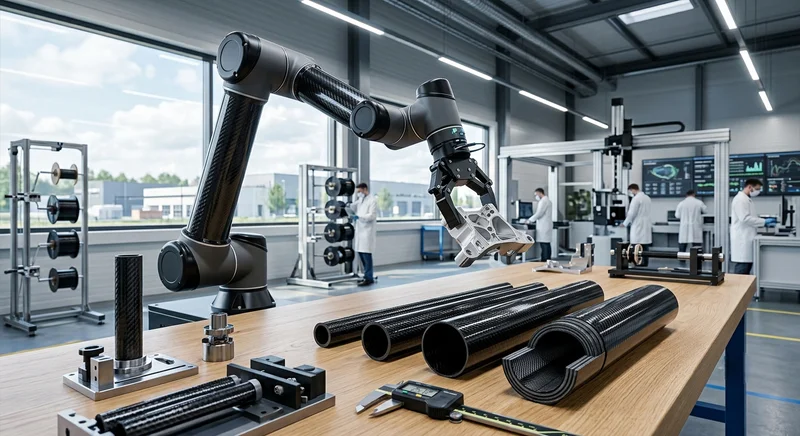
Carbon Fiber Robotic Arm Tube — High-Stiffness Lightweight Replacement
Precision-wound carbon fiber tubes for robotic arm links, replacing steel or aluminum in collaborative robots (cobots) and industrial manipulators. Achieve 3× the specific stiffness of aluminum with significant weight reduction, enabling faster acceleration and higher payload capacity.