
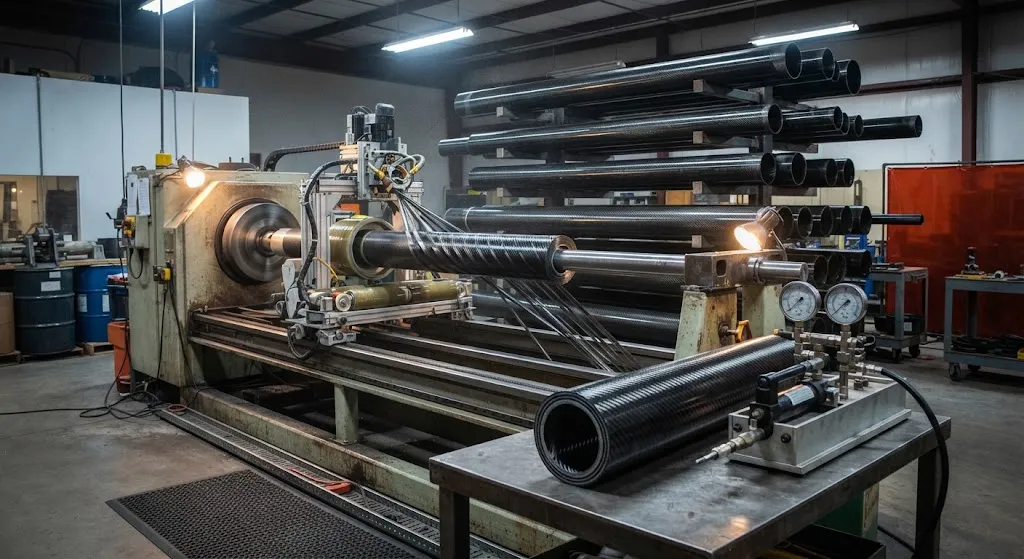
Filament wound epoxy tubes are manufactured by winding continuous carbon or glass fiber, impregnated with epoxy resin, onto a rotating mandrel at controlled angles. The process is one of the oldest and most reliable in composite manufacturing, and its advantages over metal tubes — and over pultruded
Introduction
Filament wound epoxy tubes are manufactured by winding continuous carbon or glass fiber, impregnated with epoxy resin, onto a rotating mandrel at controlled angles. The process is one of the oldest and most reliable in composite manufacturing, and its advantages over metal tubes — and over pultruded composite tubes — are specific and measurable. Filament wound epoxy tubes advantages include hoop strength that exceeds pultruded sections, fatigue performance that outlasts steel in cyclic applications, corrosion resistance that eliminates coating maintenance, and the ability to tailor stiffness and strength independently in the hoop and axial directions. For engineers selecting a tube for pressure vessels, drive shafts, marine masts, or structural columns, understanding where filament winding wins — and where it does not — prevents both over-specification and premature failure.
This article quantifies the filament wound epoxy tubes advantages over metal and pultruded alternatives, explains the winding parameters that create them, and maps each advantage to the applications where it pays back in service.
How Filament Winding Creates Its Advantages
The defining feature of filament winding is fiber angle control. A filament wound epoxy tube is built from helical and hoop layers: helical windings at angles of 10-60 degrees carry axial loads, while hoop windings near 88-90 degrees carry internal pressure. Because the manufacturer can vary the winding angle, layer count, and fiber type layer by layer, the finished tube is engineered rather than standardized — the strength distribution is written into the wall during manufacturing, not approximated afterward.
The process also delivers the highest fiber volume fractions achievable in tube manufacturing. Winding under tension compacts the fiber tows, typically reaching fiber volume fractions of 60-70%, which directly translates into higher stiffness and strength per millimeter of wall. Because the fibers are continuous and aligned with the load path rather than cut or draped, there are no butt joints or splices to act as weak points.
Filament Wound Epoxy Tube Advantages Over Metal
The comparison with metal tubes is where filament wound epoxy tubes deliver their most dramatic gains. The table below compares a filament wound carbon epoxy tube with steel and aluminum tubes of equivalent stiffness:
| Property | Filament Wound Carbon/Epoxy | Steel (4130) | Aluminum (6061-T6) |
|---|---|---|---|
| Density | 1.55-1.60 g/cm³ | 7.85 g/cm³ | 2.70 g/cm³ |
| Tensile strength | 1200-2400 MPa (fiber dominated) | 670-760 MPa | 310 MPa |
| Specific stiffness | 60-100 GPa per unit density | ~26 | ~26 |
| Fatigue endurance | High, no fatigue limit drop typical of metals | Finite, S-N curve drops | Finite, notch sensitive |
| Corrosion resistance | Excellent, no coating needed | Requires plating or paint | Anodizing or paint |
| Weight for equivalent stiffness | Base | ~2.4-2.8 times | ~1.5-1.8 times |
Three advantages matter most in practice. First, weight: a filament wound carbon epoxy tube of equivalent bending stiffness weighs roughly 40-60% of an aluminum tube and 35-45% of a steel tube. Second, fatigue: metals accumulate damage at stress concentrations and fail by crack growth, while composite tubes distribute load across thousands of fibers, giving them fatigue endurance that often outlasts metal components in cyclic service. Third, corrosion: epoxy matrices and carbon fibers are intrinsically corrosion resistant, eliminating the coating, plating, and inspection burden that metal tubes carry in marine and chemical environments.
Filament Wound versus Pultruded Tubes
Pultruded tubes are the main composite alternative, and the choice between the two processes depends on loading direction. A pultruded tube aligns all fibers axially, maximizing axial stiffness and bending strength at low cost. A filament wound epoxy tube trades some axial performance for hoop strength and multi-directional capability. The comparison below summarizes the trade-offs:
| Criterion | Filament Wound Epoxy Tube | Pultruded Tube |
|---|---|---|
| Hoop strength | High (hoop windings at 88-90°) | Low (matrix-dominated, ~30-50 MPa) |
| Axial strength | Good (helical layers) | Excellent (all fibers axial) |
| Internal pressure rating | High — the standard choice for pressure vessels | Low — not rated for pressure |
| Fiber volume fraction | 60-70% | 65-75% |
| Cost per meter | Higher (process slower, mandrels required) | Lower (continuous, high speed) |
| Length capability | Mandrel-limited, typically 1-12 m | Continuous, any length |
| Design flexibility | Angle, layer, and fiber tailorable per application | Fixed axial alignment |
The practical rule: if the load is predominantly axial bending or column compression with little internal pressure, a pultruded tube delivers comparable performance at lower cost. If the tube carries internal pressure, torque, or multi-directional loads, filament winding is the correct process — pultruded tubes fail in the hoop direction at pressures far below their axial capacity.
Design Tailoring and Application Fit
The layer-by-layer control of filament winding supports a range of application-specific optimizations that neither metal nor pultrusion offers:
- Torque transmission: Windings at ±45 degrees maximize shear capacity for drive shafts and torsion members; carbon epoxy drive shafts can save 60-70% weight versus steel.
- Pressure containment: Hoop-dominated layups handle internal pressure efficiently; filament wound carbon epoxy tubes are the standard structure for compressed gas and high-pressure hydraulic applications.
- Bending and buckling: Hybrid layups with axial and helical layers optimize column and beam performance, including stiffness tailoring along the length.
- Thermal management: The low coefficient of thermal expansion of carbon fiber (near zero in the fiber direction) suits precision shafts and masts in temperature-varying environments.
- Integration: Metal end fittings can be wound-in or bonded during manufacture, eliminating bolted joints and their stress concentrations.
In aerospace actuation shafts, marine drive shafts, offshore riser systems, and sporting goods, these tailoring options convert the filament wound epoxy tube from a commodity tube into a designed structural member — the advantage that most clearly separates the process from its alternatives.
Limitations to Design Around
Filament wound epoxy tubes also carry constraints that an informed designer plans around. Cost per meter is higher than pultrusion because winding is slower and each diameter needs a mandrel. Length is limited by mandrel availability, typically 1-12 meters for most production. The surface finish is functional rather than cosmetic — winding produces a textured fiber surface unless a surface veil or finishing layer is added. And the axial modulus of a helical-dominated layup is lower than a pultruded tube's, so axial-stiffness-critical applications may favor pultrusion or a hybrid. None of these limitations removes the process's advantages; they define where those advantages pay back.
Frequently Asked Questions
Why are filament wound epoxy tubes better than metal tubes?
Filament wound epoxy tubes offer three structural advantages over metal: weight — an equivalent-stiffness carbon epoxy tube weighs roughly 40-60% of an aluminum tube; fatigue — fibers distribute cyclic load and avoid the crack-growth failure mode of metals; and corrosion resistance — epoxy and carbon need no coating in marine or chemical service. For pressure and torque applications, the strength-to-weight ratio of a wound tube exceeds both steel and aluminum.
Can a filament wound epoxy tube replace a pultruded tube?
Only where the load requires it. If the application is predominantly axial bending or compression with no internal pressure, a pultruded tube is cheaper and equally effective. If the tube carries internal pressure, torque, or multi-directional loads, filament winding is the correct choice because hoop windings provide strength in directions pultrusion cannot. Review the loading direction before choosing.
What winding angles are used for pressure versus torque?
Pressure vessels use hoop windings at 88-90 degrees combined with helical layers at 10-30 degrees to carry the axial pressure load. Torque transmission uses ±45 degree helical windings, which place fibers along the principal shear directions. Hybrid layups combine angles to satisfy mixed load cases, which is why filament wound tubes are specified layer by layer.
Are filament wound epoxy tubes corrosion resistant?
Yes. The epoxy matrix and carbon fibers are intrinsically resistant to corrosion, saltwater, and most chemicals, so filament wound tubes need no coating, plating, or anodic protection in marine and chemical environments. This eliminates the maintenance burden of metal tubes and is one of the primary reasons the process dominates offshore and marine applications.
Conclusion
Filament wound epoxy tubes advantages are concrete and measurable: hoop strength that pultrusion cannot match, weight savings of 40-60% versus aluminum, fatigue endurance beyond metal in cyclic service, and corrosion resistance that removes whole maintenance programs. The process earns these advantages through winding angle control and high fiber volume fraction, and it pays them back in pressure vessels, drive shafts, masts, and structural columns where load is multi-directional. Where the load is purely axial, pultrusion remains the economical choice — which is why both processes belong in an engineer's toolkit.
YongXian manufactures filament wound carbon fiber tubes for pressure, torque, and structural applications. Explore our carbon fiber tube range or contact our engineering team with your diameter, pressure, and load requirements for a design recommendation.
Part of topic
Related Articles
- Carbon Fiber Tube Strength: Analysis Methods and Design Allowables
- Filament Wound Epoxy Tubes: Mechanical Properties and Material Data Sheets
- Carbon Fiber Drone Blades and Propellers: Stiffness, Balance and Noise Reduction
- Fiberglass Filament Wound Tubes: Cost-Effective Alternative to Carbon Fiber
- Filament Wound Epoxy Tube Design: Wall Thickness, Fiber Angle and Load Optimization
- Filament Wound Epoxy Tubes: Testing Standards and Quality Assurance
Interested in Custom Carbon Fiber Products?
Contact our team for competitive pricing and technical specifications.
Get a QuoteRelated Products
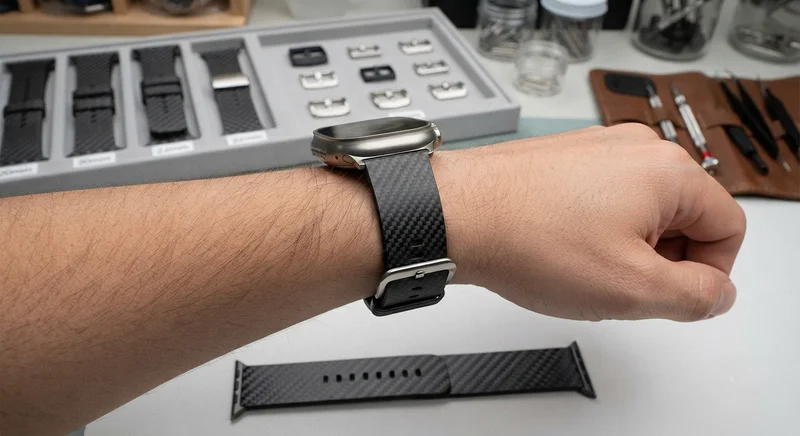
Carbon Fiber Watch Strap — 20mm/22mm Quick-Release
Premium carbon fiber watch strap with quick-release spring bars. Woven from T700 3K twill prepreg with a flexible resin system that conforms to the wrist. Available in 20mm and 22mm lug widths, compatible with Apple Watch, Samsung Galaxy Watch, Garmin, and traditional mechanical watches. Features a stainless steel buckle and carbon fiber keepers. The natural weave pattern makes each strap unique.
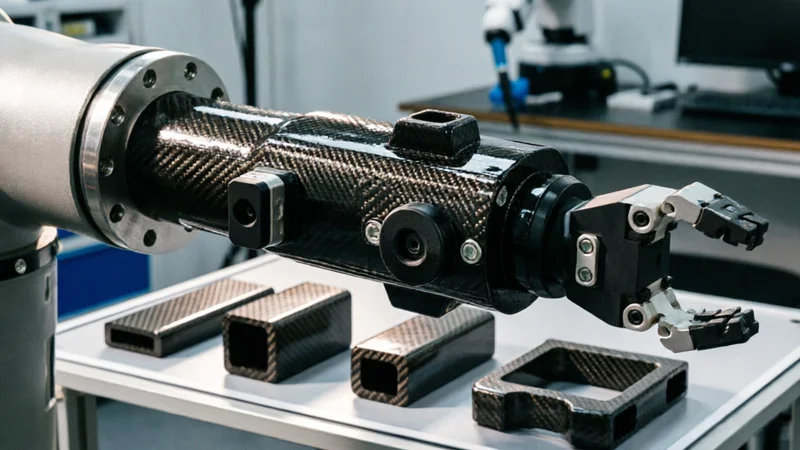
Carbon Fiber Robot End Effector Link — Custom Shape & Sensor Integration
Custom-shaped carbon fiber end effector links for robotic arms. Designed for automation integrators and research labs requiring lightweight, rigid connections between the robot wrist and gripper/tool. Can incorporate sensor mounting bosses, cable routing channels, and quick-change interfaces.

Custom Carbon Fiber Musical Instrument Parts
Carbon fiber components for musical instrument manufacturing offering superior dimensional stability, low weight, and consistent acoustic properties. We produce carbon fiber bows, guitar necks, violin chin rests, drum shells, and wind instrument bodies. Carbon fiber instruments are immune to humidity changes and temperature fluctuations that affect wooden instruments.
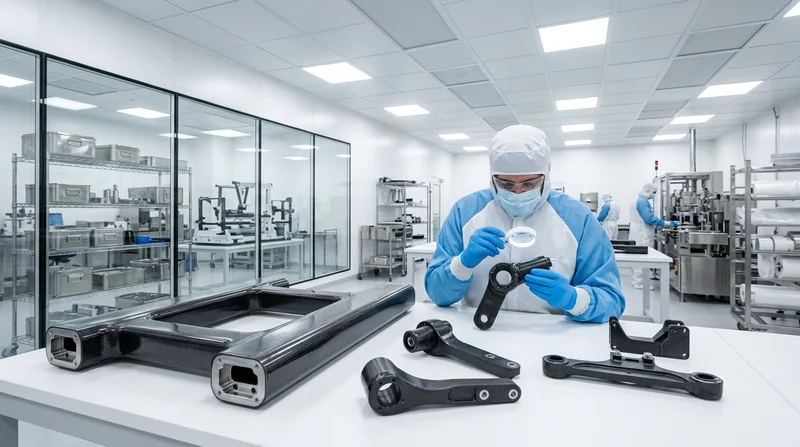
Custom Carbon Fiber Medical Device Components
Medical-grade carbon fiber components manufactured for imaging equipment, surgical instruments, and patient support systems. Carbon fiber's radiolucency (X-ray transparency) and high strength-to-weight ratio make it ideal for CT scanner beds, wheelchair frames, surgical robot arms, and MRI-compatible accessories. Biocompatible resin systems available.
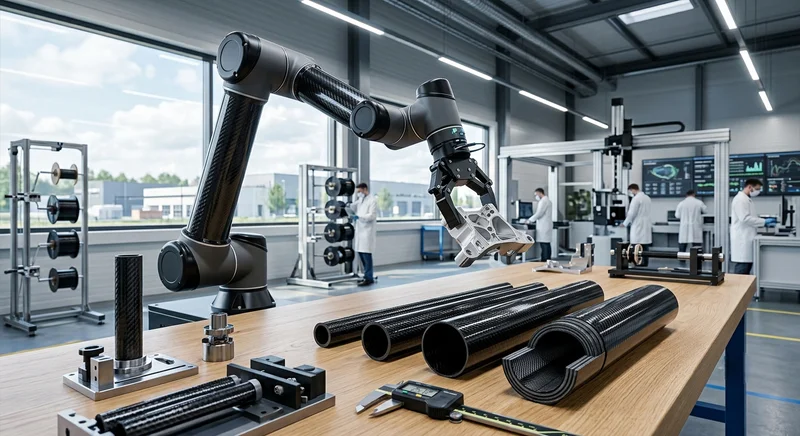
Carbon Fiber Robotic Arm Tube — High-Stiffness Lightweight Replacement
Precision-wound carbon fiber tubes for robotic arm links, replacing steel or aluminum in collaborative robots (cobots) and industrial manipulators. Achieve 3× the specific stiffness of aluminum with significant weight reduction, enabling faster acceleration and higher payload capacity.