
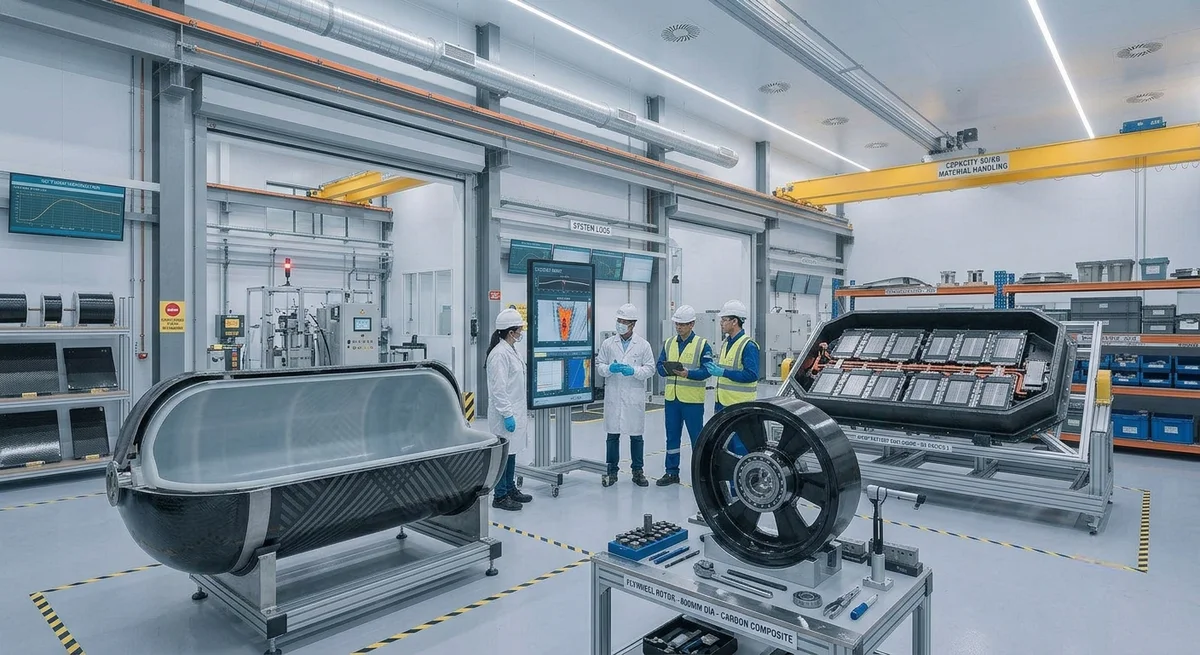
Explore how carbon fiber composites are enabling next-generation energy storage systems — from high-speed flywheels to lightweight battery enclosures and Type IV hydrogen pressure vessels.
Introduction
The global transition to renewable energy sources — solar, wind, and hydro — has created an urgent need for efficient, durable, and scalable energy storage solutions. Carbon fiber reinforced polymers are playing an increasingly critical role across three major energy storage technologies: mechanical flywheel systems, lithium-ion battery enclosures, and hydrogen pressure vessels. Each application leverages a different combination of carbon fiber's unique properties — high specific strength, exceptional fatigue resistance, thermal stability, and corrosion immunity. The global market for carbon fiber in energy storage applications is projected to grow from $1.8 billion in 2025 to $4.7 billion by 2032, representing a CAGR of 14.7%.
Carbon Fiber Flywheel Energy Storage
Flywheel energy storage systems (FESS) store kinetic energy in a rotating mass. Carbon fiber composite rotors have revolutionized this technology by enabling rotational speeds of 30,000–60,000 RPM — impossible with steel rotors due to centrifugal stress limitations.
| Parameter | Steel Rotor | Carbon Fiber Rotor | Advantage |
|---|---|---|---|
| Max Rotational Speed | 8,000–15,000 RPM | 30,000–60,000 RPM | 4× higher |
| Energy Density | 5–15 Wh/kg | 40–100 Wh/kg | 5–7× higher |
| Specific Strength | 0.2–0.5 MPa·m³/kg | 1.5–3.0 MPa·m³/kg | 5–10× higher |
| Burst Safety | Catastrophic fracture | Progressive delamination | Inherently safer |
| Service Life | 15–20 years | 25–30 years | +50% |
| Round-Trip Efficiency | 85–90% | 93–97% | +5–8% |
Key Applications and Technical Requirements
- Flywheel Rotors (Mechanical Storage): High-modulus carbon fibers (M40, M46, or T800 grade) are wound using filament winding or tape layup processes. Fiber volume fractions of 60–70% with epoxy or BMI resin matrices. The rotor operates in a vacuum enclosure to minimize windage losses. Typical rotor diameters range from 300 mm (for UPS systems) to 2,000 mm (for grid-scale storage of 100 kWh–5 MWh).
- Battery Enclosures (Electrochemical Storage): Carbon fiber composite enclosures for EV and stationary storage battery packs offer 40–55% weight reduction compared to steel enclosures (from 80 kg to 35–45 kg for a 100 kWh pack). Critical properties include fire resistance (UL 94 V-0 rating), electromagnetic shielding (50–80 dB attenuation at 1 GHz), and impact protection (surviving 50 g frontal crash loads per ECE R100).
- Type IV Hydrogen Pressure Vessels (Chemical Storage): Carbon fiber filament-wound over a polymer liner (typically HDPE or PA6) operating at 350–700 bar. A 70 MPa Type IV tank for hydrogen storage uses approximately 20–25 kg of T700S-grade carbon fiber, storing 5–6 kg of H₂. The tank weight is 60–75% lower than a comparable Type I (all-metal) vessel and 30–40% lighter than Type III (metal liner with carbon wrap).
Market Growth and Commercial Drivers
The carbon fiber energy storage market is driven by three parallel trends: grid-scale battery deployment (projected 680 GWh by 2030), hydrogen infrastructure buildout (1,200+ hydrogen refueling stations globally by 2027), and flywheel-based grid stabilization systems (1.5 GW installed capacity by 2028). Carbon fiber demand from these three sectors is expected to reach 45,000–55,000 metric tons annually by 2032.
Frequently Asked Questions
Why is carbon fiber preferred for flywheel rotors over high-strength steel?
Carbon fiber's specific tensile strength (strength-to-density ratio) is 5–10 times higher than steel, allowing rotors to spin at speeds exceeding 30,000 RPM without catastrophic failure. Additionally, carbon fiber rotors exhibit progressive delamination failure modes rather than brittle fracture, enabling early detection of damage through vibration monitoring. The lower density also reduces parasitic bearing losses by 30–50%, improving overall system efficiency.
What fire safety standards apply to carbon fiber battery enclosures?
Carbon fiber battery enclosures must meet UL 94 V-0 (vertical burn test with zero flaming drips), thermal runaway propagation resistance per UN 38.3 and UL 2580 (exposure to 300°C flame for 3 minutes minimum), and ECE R100 crash safety standards. Fire-retardant epoxy resin systems with phosphorus-based or mineral additives are typically used, achieving a limiting oxygen index (LOI) of 35–45% compared to 20–22% for standard epoxy.
How long do Type IV carbon fiber hydrogen tanks last?
Type IV carbon fiber hydrogen tanks are designed for a service life of 15–20 years in stationary applications and 10–15 years in transport applications. They must pass 15,000+ pressure cycles (from 2% to 100% of service pressure) per ISO 19881 and ECE R134 standards. Periodic inspection intervals (visual, acoustic emission, and proof testing) are required every 2–5 years depending on jurisdiction and application. The carbon fiber wrap does not degrade through contact with hydrogen gas under normal operating conditions.
Part of topic
Related Articles
- Carbon Fiber Mooring for Floating Offshore Wind: Fatigue and Corrosion in Deep Water
- Carbon Fiber Bicycle Frame Optimization: Layup Design and Manufacturing for Competitive Racing
- Carbon Fiber CFRP Retrofit for Infrastructure: Bridge and Building Seismic Strengthening
- Carbon Fiber Medical Imaging Equipment: Lightweight Gantry and Couch Structures for MRI/CT
- Carbon Fiber EV Battery Enclosures: Crash Safety and Electromagnetic Shielding Design
- Carbon Fiber Structures for Low-Altitude Economy: UAV Airframes and eVTOL Components
Interested in Custom Carbon Fiber Products?
Contact our team for competitive pricing and technical specifications.
Get a QuoteRelated Products
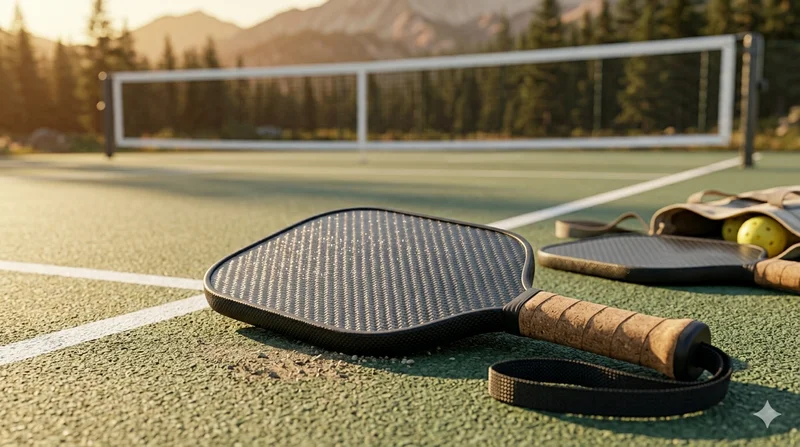
Carbon Fiber Pickleball Paddle
High-performance pickleball paddle with Toray T700 carbon fiber face and polypropylene honeycomb core. Delivers excellent power-to-weight ratio, spin generation, and vibration dampening for competitive play.
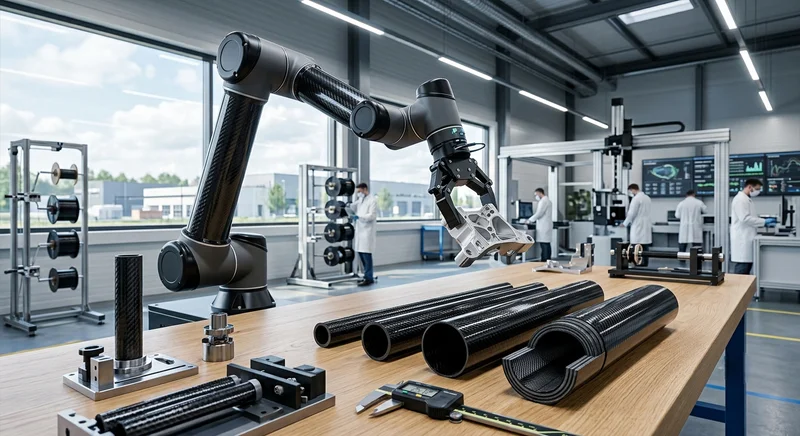
Carbon Fiber Robotic Arm Tube — High-Stiffness Lightweight Replacement
Precision-wound carbon fiber tubes for robotic arm links, replacing steel or aluminum in collaborative robots (cobots) and industrial manipulators. Achieve 3× the specific stiffness of aluminum with significant weight reduction, enabling faster acceleration and higher payload capacity.
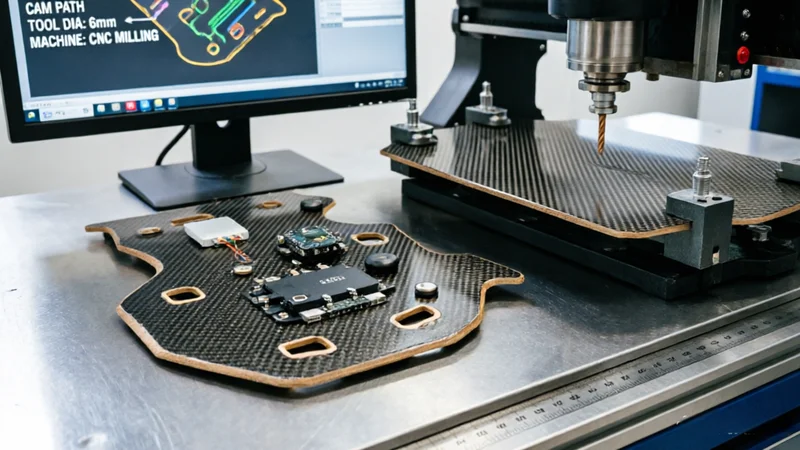
Carbon Fiber Drone Frame Base Plate — 3K Twill T700
CNC-machined carbon fiber base plates for drone frame assemblies. Cut from 3K twill weave T700 prepreg with precision CNC routing. Pre-drilled mounting patterns compatible with common flight controller and power distribution board layouts. Available in 1.5mm to 5mm thickness.
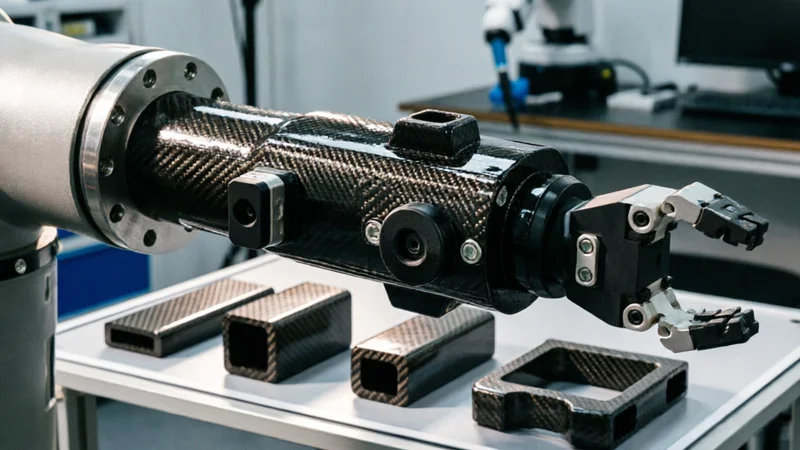
Carbon Fiber Robot End Effector Link — Custom Shape & Sensor Integration
Custom-shaped carbon fiber end effector links for robotic arms. Designed for automation integrators and research labs requiring lightweight, rigid connections between the robot wrist and gripper/tool. Can incorporate sensor mounting bosses, cable routing channels, and quick-change interfaces.
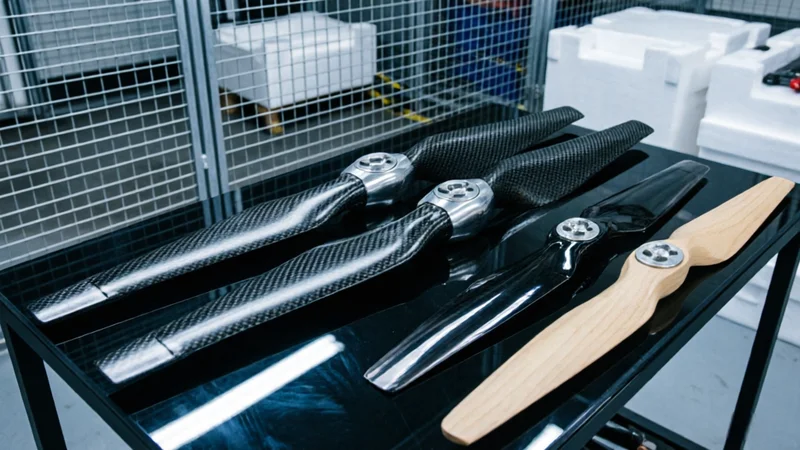
Carbon Fiber Drone Propeller — High-Performance Prepreg Molded
Prepreg-molded carbon fiber propellers for industrial and racing drones. Optimized airfoil design with balanced blade geometry for maximum thrust efficiency. 3-5× stiffer than nylon/plastic props, reducing blade flutter and improving flight stability. Available in common sizes or custom diameter/pitch.