
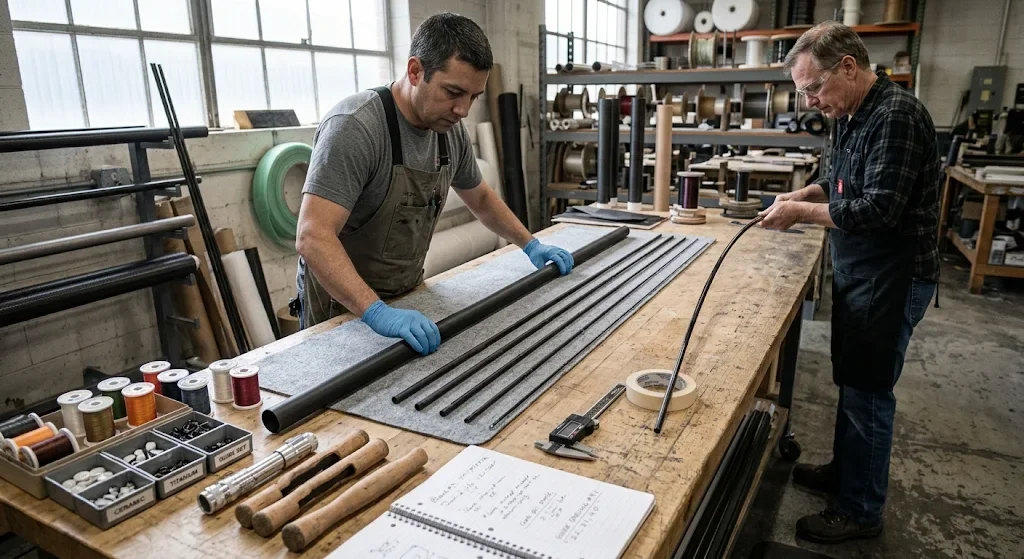
Choosing a carbon fiber rod for fishing starts with the blank, not the reel seat or the paint scheme. For custom builders, the blank determines how the rod loads, how it recovers, how much feedback reaches the angler's hand, and whether the finished build suits the target species. Carbon fiber fishi
Introduction
Choosing a carbon fiber rod for fishing starts with the blank, not the reel seat or the paint scheme. For custom builders, the blank determines how the rod loads, how it recovers, how much feedback reaches the angler's hand, and whether the finished build suits the target species. Carbon fiber fishing rods are popular because they combine low weight with fast response, but not every high-modulus blank is the right answer for every application.
This article focuses on blank selection for builders who want predictable results. Whether you plan to build a finesse spinning rod, an inshore casting rod, or a travel rod for mixed use, the key is to match taper, power, resin system, and component layout to the fishing style. If you are preparing to buy fishing rod carbon fiber blanks online or from a factory, a clear specification checklist will save time and reduce rework.
Understand Action, Power, and Modulus Before You Buy
Action describes where the blank bends, while power describes how much force it takes to load the blank. A fast-action blank bends mostly near the tip and is useful for quick hook sets and precise lure control. A moderate-action blank bends deeper into the midsection and can protect light lines during fights. Power ranges from ultralight to heavy and should be selected according to lure weight, line class, and fish size.
Modulus is often misunderstood. Higher-modulus carbon fiber can improve sensitivity and reduce weight, but it may also make a blank feel crisp or less forgiving if the design is not balanced. For many builders, the best carbon fiber fishing rods are not the stiffest possible rods. They are the rods with the right recovery speed and durability for the intended job. A bass jig rod, a trout spinning rod, and a surf travel rod may all use carbon fiber, yet their ideal blanks are very different.
| Fishing Application | Suggested Action | Suggested Power | Blank Priority | Builder Note |
|---|---|---|---|---|
| Finesse trout spinning | Fast to moderate-fast | Ultralight to light | Sensitivity and smooth loading | Avoid overly brittle high-modulus tips |
| Bass jig or worm casting | Fast | Medium-heavy | Hook-setting authority | Check butt strength for cover fishing |
| Inshore lure fishing | Moderate-fast | Medium | Balance of cast distance and control | Consider corrosion-resistant hardware |
| Travel multi-piece rod | Moderate-fast | Medium | Ferrule fit and recovery consistency | Inspect joint alignment before wrapping |
Blank Inspection Checklist for Custom Builders
When you buy fishing rod carbon fiber blanks, inspect more than the catalog description. A good blank should have straightness, smooth finish transitions, and consistent wall quality. Roll the blank on a flat surface to check for visible curves or twist. Flex it gently to feel for dead spots, sudden changes in taper, or weak recovery. For multi-piece blanks, confirm ferrule overlap, seating feel, and alignment marks.
- Length and cut points: Know the finished rod length and how much will be trimmed at the butt or tip.
- Lure and line rating: Match the rating to real fishing conditions, not optimistic marketing numbers.
- Blank weight: Lower weight helps balance, but it should not come at the cost of durability.
- Finish type: Sanded, painted, or clear finishes affect wrapping prep and final appearance.
- Component compatibility: Confirm reel seat bore, guide train plan, and grip dimensions before ordering parts.
Builders often focus on guide brands and decorative wraps, but the blank-to-component match is what makes the rod fish well. A sensitive blank paired with a heavy reel seat can feel dull in hand. A powerful blank with an undersized guide train may hurt casting performance. Treat the build as a system.
Sourcing Carbon Fiber Fishing Rod Blanks
The best sourcing route depends on your volume and quality targets. Hobby builders may prefer small quantities from established distributors because support and return policies are convenient. Small brands and OEM buyers usually benefit from factory-direct discussions, especially when they need consistent tapers across repeat orders. In either case, ask for sample blanks first and document the specifications that perform well.
For export buyers, confirm packaging, labeling, and minimum order quantities before placing a larger order. A reliable supplier should explain material options, recommended actions for common fishing styles, and lead times for restocking. If your goal is to develop a product line of carbon fiber fishing rods, consistency matters more than a one-time low quote. Keep test notes on casting feel, lifting power, and recovery so future batches stay aligned with your brand.
Frequently Asked Questions
What makes a good carbon fiber rod for fishing?
A good rod balances sensitivity, strength, recovery, and comfort for a specific fishing style. The best blank is not always the lightest or highest modulus. It is the one that loads smoothly, sets hooks effectively, and holds up under the lure weights and fish sizes you expect.
Should beginners buy fishing rod carbon fiber blanks in high modulus only?
Not necessarily. High-modulus blanks can feel very responsive, but they may be less tolerant of design mistakes or rough handling. Many builders get better results from balanced intermediate or mixed-modulus blanks, especially for all-purpose rods.
What information should I send to a blank supplier before ordering?
Share the target species, lure weight range, line range, preferred action, finished length, and whether the rod is one-piece or multi-piece. This helps the supplier recommend suitable carbon fiber fishing rods blanks and reduces the risk of ordering the wrong taper.
Conclusion
A successful custom build depends on choosing the right carbon fiber rod for fishing at the blank stage. Focus on action, power, modulus, straightness, and component compatibility before you think about cosmetics. Careful inspection and clear communication with suppliers make it much easier to buy fishing rod carbon fiber blanks that perform as expected. To review related composite materials and custom manufacturing options, visit YongXian carbon fiber products or contact us through the inquiry page.
Part of topic
Related Articles
- Carbon Fiber Toe Plates: Rocker Design in Footwear
- Carbon Fiber Drones (carbon fiber drones): Airframes, Payloads, and Cost Impact
- Best Carbon Fiber Rod: Application-Based Picks
- The Crust Carbon Fiber: What the Term Means in Searches
- Carbon Fiber Rod for Drone: Spars, Arms, and Sizing
- Remote Control Blue Carbon Fiber Drones: Frames, Finishes, and Buying
Interested in Our Products?
Contact our team for competitive pricing and technical specifications.
Get a QuoteRelated Products

Round Carbon Fiber Tube — 3K Plain Weave T700
Standard round carbon fiber tube manufactured from Toray T700 grade fiber with 3K plain weave. Offers balanced strength and stiffness for general industrial applications including robotics, automation, sports equipment, and aerospace structures.

Square Carbon Fiber Tube — 3K Twill T700
Square cross-section carbon fiber tube manufactured with 3K twill weave for torsional strength. Preferred for structural frames, trusses, and support columns where rectangular geometry offers design flexibility.

Round Carbon Fiber Tube — 3K Twill
Lightweight and ultra-stiff round tubes ideal for drone frames, robotics, and structural applications.

Round Carbon Fiber Tube — UD Unidirectional T700
Unidirectional (UD) round tube with all fibers aligned axially for maximum longitudinal stiffness. Ideal for applications requiring high bending rigidity with minimal weight, such as shafts, struts, and structural reinforcements.

Carbon Fiber Plate — 3K Twill T700 3.0mm
Medium-thickness 3.0mm carbon fiber plate offering significantly higher load capacity while maintaining attractive 3K twill finish. Suitable for structural brackets, reinforcement plates, and load-bearing panels.