
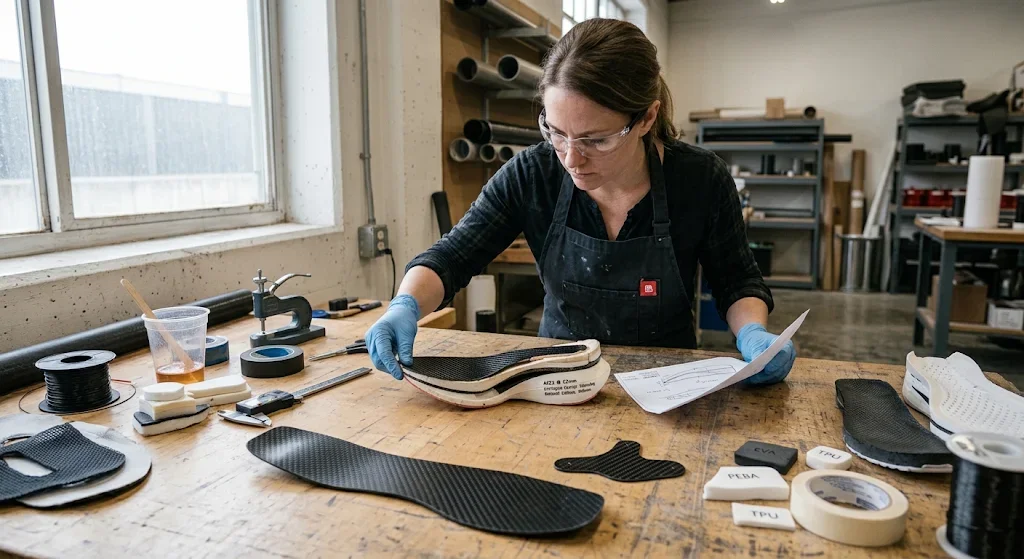
A carbon fiber plate toe is more than a stiff insert placed under the forefoot. In modern performance and medical footwear, toe plate geometry works together with rocker design to guide how the foot rolls from midstance to push-off. When the plate is shaped, positioned, and tuned correctly, it can r
Introduction
A carbon fiber plate toe is more than a stiff insert placed under the forefoot. In modern performance and medical footwear, toe plate geometry works together with rocker design to guide how the foot rolls from midstance to push-off. When the plate is shaped, positioned, and tuned correctly, it can reduce unwanted bending at the metatarsophalangeal joints, support a smoother gait cycle, and help the shoe deliver a consistent feel across sizes. Designers also use a carbon fiber plate for big toe reinforcement when they need targeted stiffness without making the entire forefoot overly rigid.
For footwear brands and OEM teams, the challenge is balancing propulsion, comfort, and durability. Carbon fiber offers high stiffness-to-weight performance, but rocker footwear succeeds only when material properties match the last, outsole curvature, foam stack, and intended user. This guide focuses on practical design considerations for toe plates and rocker systems.
Why Use a Carbon Fiber Plate Toe in Rocker Footwear?
Rocker soles are designed to reduce the need for extreme toe dorsiflexion during late stance. A carbon fiber toe plate supports that goal by limiting localized flex under the forefoot while allowing the rocker profile to do the rolling work. This combination is common in running shoes, hiking footwear, recovery shoes, and certain orthopedic applications.
| Design Goal | Role of Toe Plate | Role of Rocker Geometry | Result |
|---|---|---|---|
| Smoother transition | Controls forefoot bend | Guides heel-to-toe roll | More consistent gait feel |
| Energy management | Stores and returns elastic response | Maintains forward momentum | Efficient toe-off sensation |
| Joint offloading | Reduces localized flex demand | Shifts motion path | Lower strain in targeted cases |
| Lightweight structure | High stiffness at low mass | Works with foam/outsole | Performance without heavy parts |
The key point is integration. A stiff plate in a flat sole can feel harsh, while a well-matched rocker can make the same plate feel natural. Testing should evaluate the shoe as a system, not the plate alone.
Rocker Design Variables That Matter
Toe plate performance depends on where stiffness begins, how gradually it transitions, and how the outsole curves under the forefoot. Small geometry changes can alter perceived comfort and push-off timing.
- Rocker apex position: Moving the apex forward or backward changes when the foot starts to roll. The plate should support that timing rather than fight it.
- Toe spring angle: Higher toe spring can reduce the need for toe bend, but too much can feel unstable for some users.
- Plate length: A full-length plate behaves differently from a forefoot-only plate. Toe-focused designs can preserve midfoot flexibility.
- Thickness and layup: Carbon fiber thickness, fiber orientation, and laminate stack determine bending stiffness and torsional response.
- Foam interaction: Soft midsoles compress around the plate. The effective stiffness experienced by the wearer is a combination of plate and foam.
Carbon Fiber Plate for Big Toe Support
A carbon fiber plate for big toe applications is often used when designers want targeted control under the first ray or hallux area. This can be relevant in footwear concepts aimed at reducing excessive big-toe bending, improving forefoot stability, or tuning pressure distribution. The design should avoid creating a hard edge that concentrates load.
Good practice includes tapering edges, smoothing transitions, and validating fit across sizes. If the plate is too narrow, it may not align with the wearer’s anatomy; if it is too wide or too stiff, it can interfere with natural gait. Prototype testing should include walking, jogging, and lateral movements when appropriate for the shoe category.
| Specification Area | Typical Options | What to Validate |
|---|---|---|
| Material | Carbon fiber laminate, hybrid composite | Stiffness, fatigue, weight |
| Geometry | Forefoot insert, big-toe reinforcement zone | Alignment with last and outsole rocker |
| Edge treatment | Tapered, chamfered, encapsulated | Comfort, pressure hotspots |
| Interface | Bonded, molded-in, pocketed | Durability and squeak/noise control |
Testing and Manufacturing Considerations
For production programs, define performance targets before selecting the plate. Useful checks include flexural stiffness, cyclic fatigue, bond strength, and in-shoe wear testing. Because footwear sizes change length and curvature, a single plate geometry may not perform identically across the full size run. Brands often use graded thicknesses or size-specific tooling to keep the ride consistent.
Manufacturing teams should also consider moisture, temperature, and abrasion at interfaces. A carbon plate that performs well in lab bending tests can still fail in the field if edges delaminate or if bonding surfaces are not prepared correctly. Clear drawings, tolerances, and inspection criteria reduce variation between development samples and mass production.
Frequently Asked Questions
Does a carbon fiber toe plate always make a shoe faster?
No. A carbon fiber plate can improve stiffness and transition in the right rocker system, but speed or efficiency depends on the full shoe design, including foam, geometry, fit, and the user’s movement pattern.
When should a brand use a carbon fiber plate for big toe support?
It is useful when the design goal requires targeted forefoot control near the first ray or hallux area. The plate should be shaped and tested carefully to avoid pressure points and to maintain natural comfort.
Can the same toe plate be used across all shoe sizes?
Sometimes, but not always. As shoe length and rocker curvature change, stiffness and placement can feel different. Many programs use size breaks, adjusted thickness, or size-specific plate designs.
Conclusion
A well-designed carbon fiber plate toe works best when it complements rocker geometry, midsole compression, and the intended movement pattern. For targeted concepts, a carbon fiber plate for big toe zone can provide focused support without over-stiffening the whole forefoot. The most reliable results come from system-level prototyping, wear testing, and clear production specifications. To discuss composite plate options for footwear applications, visit YongXian products or contact us for a custom quote.
Part of topic
Related Articles
- Carbon Fiber Rods for Fishing: Blank Selection for Builders
- Carbon Fiber Drones (carbon fiber drones): Airframes, Payloads, and Cost Impact
- Best Carbon Fiber Rod: Application-Based Picks
- The Crust Carbon Fiber: What the Term Means in Searches
- Carbon Fiber Rod for Drone: Spars, Arms, and Sizing
- Remote Control Blue Carbon Fiber Drones: Frames, Finishes, and Buying
Interested in Our Products?
Contact our team for competitive pricing and technical specifications.
Get a QuoteRelated Products

Round Carbon Fiber Tube — 3K Plain Weave T700
Standard round carbon fiber tube manufactured from Toray T700 grade fiber with 3K plain weave. Offers balanced strength and stiffness for general industrial applications including robotics, automation, sports equipment, and aerospace structures.

Square Carbon Fiber Tube — 3K Twill T700
Square cross-section carbon fiber tube manufactured with 3K twill weave for torsional strength. Preferred for structural frames, trusses, and support columns where rectangular geometry offers design flexibility.

Carbon Fiber Plate — 3K Twill T700 3.0mm
Medium-thickness 3.0mm carbon fiber plate offering significantly higher load capacity while maintaining attractive 3K twill finish. Suitable for structural brackets, reinforcement plates, and load-bearing panels.
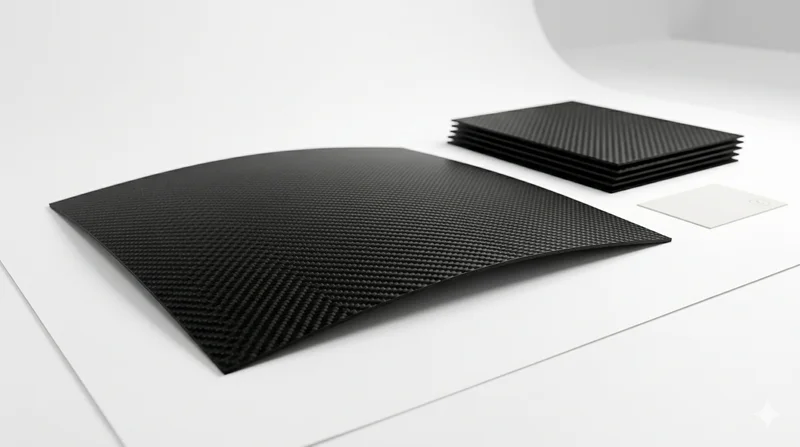
Carbon Fiber Plate — 3K Twill T700 1.5mm
Thin 1.5mm carbon fiber plate with 3K twill weave surface. Lightweight and stiff, commonly used for covers, panels, drone bodies, and applications requiring a premium aesthetic appearance.
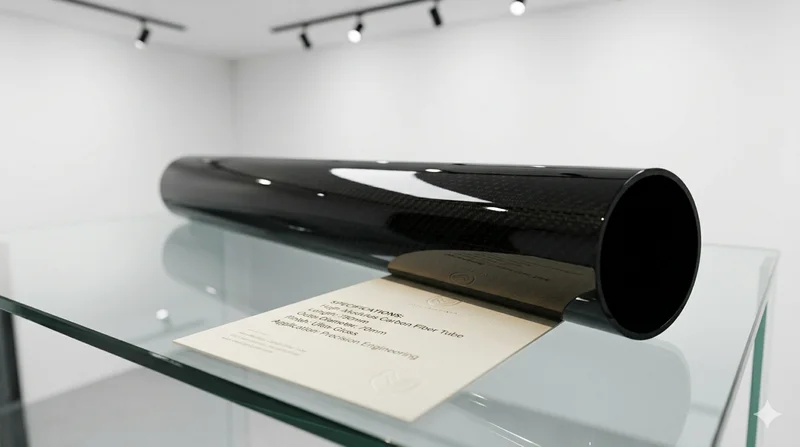
High Modulus Round Carbon Fiber Tube — M40
High modulus round tube manufactured with M40 grade fiber (tensile modulus 400 GPa). Designed for applications where maximum stiffness-to-weight ratio is critical, such as optical systems, precision machinery, and aerospace structures.