
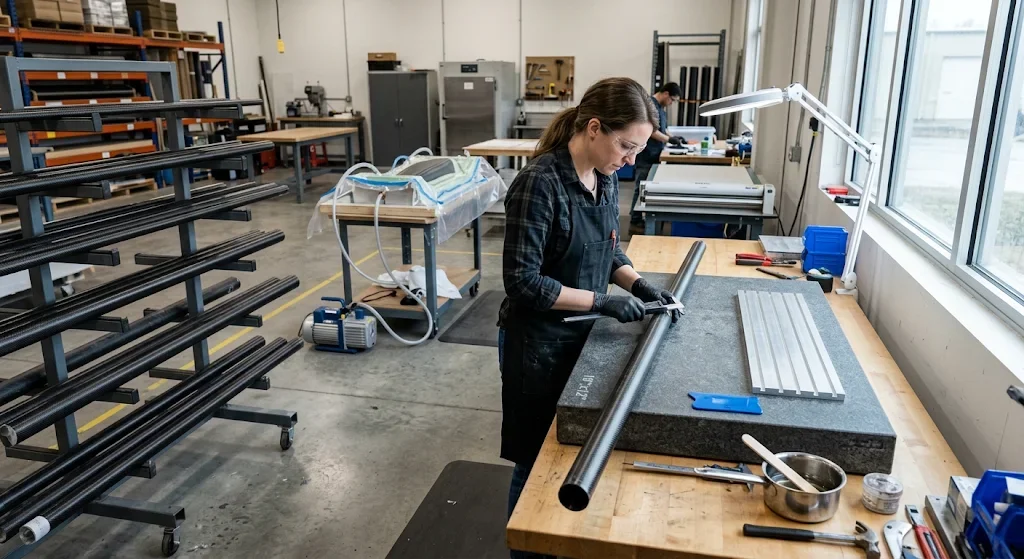
The carbon fiber rod for drone builds is usually the structural spine of the airframe, whether it acts as a wing spar or as the arm behind a propulsion unit. Because the rod replaces a beam, sizing it correctly means converting a load case into a diameter and a layup, not simply choosing a length af
Introduction
The carbon fiber rod for drone builds is usually the structural spine of the airframe, whether it acts as a wing spar or as the arm behind a propulsion unit. Because the rod replaces a beam, sizing it correctly means converting a load case into a diameter and a layup, not simply choosing a length after the fact. A deflection problem found after the wing is built costs far more than a deflection calculation done before the first ply is laid. When builders search for a carbon fiber rod for drone, the hidden questions cluster around two engineering decisions: how thick the rod must be to absorb the bending moment, and whether the joining method between the rod and the airframe preserves that stiffness. Both need numbers before a purchase order is placed.
Carbon Fiber Rod for Drone: Sizing for Spars and Arms
Static and dynamic bending govern the sizing math. A motor of mass m mounted at arm length L creates a bending moment that scales with both weight and rotational inertia, so the design moment is larger than the simple m*g*L figure used for first estimates. For a 200 g motor at a 300 mm arm the static moment is roughly 0.59 N·m, while the inertial component during acceleration and turbulence can exceed ten times that value. The deflection of a cantilevered rod scales with the inverse cube of diameter for the same material and span. Doubling the rod diameter reduces deflection by a factor of roughly eight. With a carbon fiber rod modulus around 230 GPa, a 6 mm rod and a 10 mm rod of the same family deliver noticeably different deflection under the same load, which is why sizing by diameter rather than by generic stiffness class matters.
| Rod role | Typical diameter | Tensile strength | Mass per meter | Primary load |
|---|---|---|---|---|
| Drone wing spar / main spar | 6-8 mm | ~3,500 MPa | ~17-24 g/m | Bending under aerodynamic load |
| Drone arm (mid class) | 5-6 mm | ~2,500 MPa | ~22-30 g/m | Bending plus crash energy |
| Drone arm (high torque) | 8-10 mm | ~2,200 MPa | ~30-40 g/m | Motor inertia and hard landing |
| Alternative: aluminum rod | 6-10 mm | ~310 MPa | ~90-140 g/m | Same bending requirement |
The aluminium comparison shows why the carbon fiber rod for drone replaces a metal arm in performance builds: specific strength of carbon fibre is roughly ten to twenty times that of aluminium, while the rod adds crash energy absorption without proportional mass. For carbon builds the rod is not just lighter, it is proportionally stiffer per gram, which is the metric that matters when the arm must survive a hard landing.
- Load case first: list motor inertia, aerodynamic loads, and crash energy before choosing diameter.
- Deflection check: use the cantilever deflection formula and verify against the required control precision.
- Crash energy: account for kinetic energy of the arm itself, not only the applied load.
- Mass budget: offset added mass against the performance gain rather than assuming linear benefit.
Carbon Fiber Rod for Drone: Build Checks and Supplier Selection
Once the sizing numbers are fixed, the build checks move to materials and procurement. A carbon fiber rod for drone from a quality supplier should arrive with the layup record, fibre volume fraction, and cure schedule, because undeclared layup is the most common source of a rod that performs below its nominal stiffness. Buyers should also confirm that the rod is produced for unidirectional or quasi-isotropic loading as specified, since a spar and an arm carry loads in different directions. The long tail of the search, such as carbon fiber for drone frame or 4mm carbon fiber drone frame, tends to attract builders who already own a frame concept and need the structural answer rather than a shopping list. Content that covers the sizing math once serves those readers directly, and the same numbers feed the FAQ blocks that capture the commercial intent layer.
Frequently Asked Questions
What diameter carbon fiber rod does a drone arm need?
It depends on the bending moment and the required deflection. For small propulsion platforms, 5-8 mm rods are common; high torque or long arm designs push toward 8-10 mm. The deflection check against the load case is the deciding factor, not the nominal stiffness class alone.
Can a carbon fiber rod for drone be joined to the airframe?
Bonded layup is preferred because inserts and mechanical fasteners reduce effective stiffness. When metal inserts are unavoidable, use them at the load introduction points and keep the fibre path continuous.
How much lighter is a carbon fiber rod for drone than an aluminum alternative?
Depending on grade and diameter, roughly five to eight times lighter for the same structural function, which translates into higher usable payload or a smaller arm for the same performance.
Conclusion
Sizing a carbon fiber rod for drone is a load case exercise before it is a procurement exercise. Get the bending moment, run the deflection check, and let the rod diameter follow from the numbers rather than from habit. YongXian supplies carbon fiber rods and arms for drone builds that pass those checks, so send the airframe drawing and load requirements before ordering. browse carbon fiber drone rods or send your build drawing for sizing advice.
Related Articles
- Carbon Fiber Rods for Fishing: Blank Selection for Builders
- Carbon Fiber Toe Plates: Rocker Design in Footwear
- Carbon Fiber Drones (carbon fiber drones): Airframes, Payloads, and Cost Impact
- Best Carbon Fiber Rod: Application-Based Picks
- The Crust Carbon Fiber: What the Term Means in Searches
- Remote Control Blue Carbon Fiber Drones: Frames, Finishes, and Buying
Interested in Our Products?
Contact our team for competitive pricing and technical specifications.
Get a QuoteRelated Products

Round Carbon Fiber Tube — 3K Plain Weave T700
Standard round carbon fiber tube manufactured from Toray T700 grade fiber with 3K plain weave. Offers balanced strength and stiffness for general industrial applications including robotics, automation, sports equipment, and aerospace structures.

Square Carbon Fiber Tube — 3K Twill T700
Square cross-section carbon fiber tube manufactured with 3K twill weave for torsional strength. Preferred for structural frames, trusses, and support columns where rectangular geometry offers design flexibility.

Round Carbon Fiber Tube — 3K Twill
Lightweight and ultra-stiff round tubes ideal for drone frames, robotics, and structural applications.

Round Carbon Fiber Tube — UD Unidirectional T700
Unidirectional (UD) round tube with all fibers aligned axially for maximum longitudinal stiffness. Ideal for applications requiring high bending rigidity with minimal weight, such as shafts, struts, and structural reinforcements.

Carbon Fiber Plate — 3K Twill T700 3.0mm
Medium-thickness 3.0mm carbon fiber plate offering significantly higher load capacity while maintaining attractive 3K twill finish. Suitable for structural brackets, reinforcement plates, and load-bearing panels.