
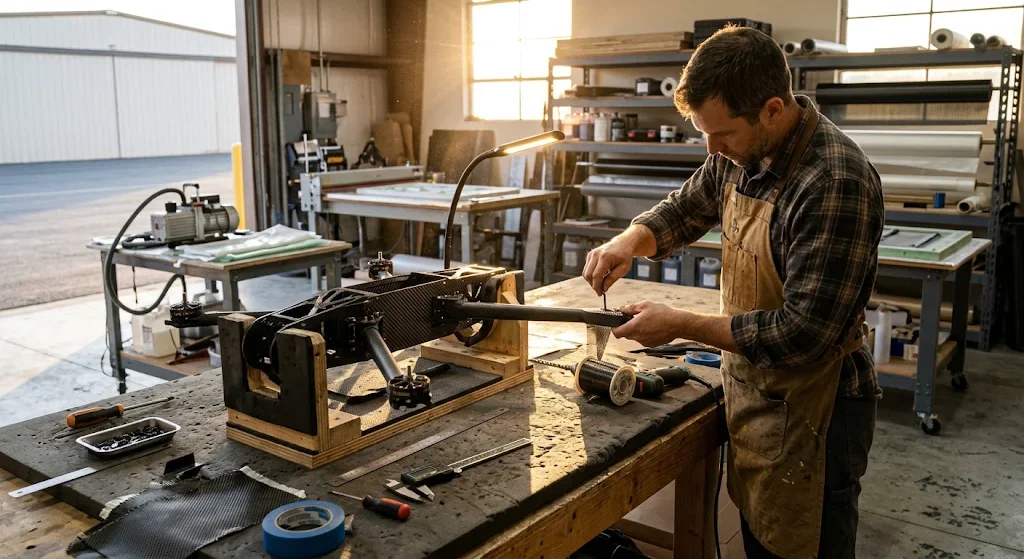
When you search for remote control blue carbon fiber drones, the question underneath is usually about ownership rather than raw chemistry. Most builders arriving at this topic already hold a frame concept in CAD, or have already bought a generic carbon fiber drone frame and want the same structure i
Introduction
When you search for remote control blue carbon fiber drones, the question underneath is usually about ownership rather than raw chemistry. Most builders arriving at this topic already hold a frame concept in CAD, or have already bought a generic carbon fiber drone frame and want the same structure in blue. The engineering scope is identical to any other carbon fiber drone frame build: quantify motor mount bending moment, arm stiffness, arm mass, and crash energy absorption before committing laminate and lay-up.
This guide maps material and finish decisions for remote control blue carbon fiber drones, then walks through carbon fiber control arms sizing, and closes with the purchasing checks that keep a blue build from quietly becoming a weight penalty.
Choosing Remote Control Blue Carbon Fiber Drones: Frame Structure
Blue carbon fiber drone frames are usually a coated or wrapped laminate rather than a different resin system. A deep blue wrap over a carbon fiber frame changes the outer layer without altering fibre direction, which means bending stiffness scales with thickness exactly as a clear laminate would. The structural variable to watch is the interface between the wrapped outer ply and the unlaminated core: wraps add a film that is acceptable for appearance and moderate loads, but motor mount shear still has to be designed into the core or the wrap.
- Flight stability: blue film wrap adds roughly 0.3 to 0.6 grams per square centimetre over a carbon fiber frame; on a 200 gram arm that is 60 to 120 grams of apparent weight before resin or fibre changes.
- Motor mount stiffness: total arm stiffness is fibre plus film, so motor mount deflection should be checked against the same bending moment as the clear version, with a safety factor on the film layer.
- Crash survivability: wraps protect appearance at the cost of slightly different impact response; for hard crashes a resin tinted or powder coated carbon fiber frame is usually the stronger choice.
| Build choice | Lay-up | Finish | Mass penalty |
|---|---|---|---|
| Clear laminate | Quasi-isotropic | Clear coat | Base |
| Blue wrap | Quasi-isotropic | Blue film wrap | +0.3-0.6 g/cm2 |
| Blue resin tint | Quasi-isotropic | Blue epoxy tint | +0.5-1.0 g/cm2 |
| Blue powder coat | Unidirectional over core | Powder blue | +0.8-1.5 g/cm2 |
Whichever route a builder takes, the load path from motor mounts through the carbon fiber frame to the arms stays the same, and the blue surface should never be placed where it interferes with bonding, trimming, or insert bearing.
Finishes for Remote Control Blue Carbon Fiber Drones: Paint, Wrap, and Resin Tint
Three finish families dominate blue remote control carbon fiber drone builds. Film wrap is the fastest route and gives a deep uniform colour, but it adds a soft outer layer that must be designed around. Resin tint shifts the whole laminate and adds density, so it suits builders who want the colour throughout rather than on the surface. Powder coat is the heaviest option and the most damage tolerant, which matters for frames that take hard landings. For a blue build where the frame also carries the motor load, clear or tinted systems are usually preferred over pure wrap, because the fibre and resin interface carries shear directly.
The finish decision also drives purchasing: suppliers who stock blue in wrap, tint, or coat will quote differently, and the price gap is small against the engineering risk of a finish that softens under motor heat. A finish that cannot hold motor mount shear is not a finish, it is a cosmetic layer over a weaker structure.
Carbon Fiber Control Arms and Blue Drone Frames
Control arms are where the secondary intent of the query often lands. A blue carbon fiber frame paired with carbon fiber control arms is the natural long-term configuration, because arms and frame share lay-up language and avoid mixing aluminium inserts into a carbon structure. Sizing follows the same logic as any carbon fiber arm build: wall thickness must carry the bending moment from the motor mount, and the arm tip must survive crash energy. When the frame is blue, arm colour is usually specified at purchase so the assembly looks intentional rather than patched.
For buyers, the practical sequence is to pick arm stiffness first, then frame diameter, then finish. Changing finish after arms are ordered is cheap; changing arm stiffness after a blue wrap is not.
Frequently Asked Questions
Does a blue finish reduce the strength of a carbon fiber drone frame?
No, not materially. A wrap adds film mass and a softer outer interface, so design for the film layer. A resin tint or powder coat replaces the outer ply and keeps the fibre load path intact. Strength loss, when it exists, comes from poor surface preparation before coating, not from the colour itself.
Can I use carbon fiber control arms with a blue carbon fiber frame?
Yes. Carbon fiber arms and carbon fiber frames are compatible in load path. Specify arm wall thickness against the motor mount moment and keep insert bearing design consistent between arms and frame.
Which finish is best for hard crash builds on a blue remote control drone?
Powder coat over an unidirectional outer ply is the most impact tolerant, while a blue wrap is the lightest cosmetic option. For hard crashes, prefer a tinted or coated carbon fiber frame over a wrapped one.
Conclusion
Choosing remote control blue carbon fiber drones comes down to treating the blue finish as a design layer, not a cosmetic afterthought. Frame structure, motor mount loads, and carbon fiber control arms sizing all follow normal carbon fiber engineering, and the finish must be chosen with the same load case in mind. YongXian stocks carbon fiber drone frames and arms for buyers who want a blue build specified properly: browse carbon fiber drone frames or send your frame drawing for finish and load advice.
Related Articles
- Carbon Fiber Rods for Fishing: Blank Selection for Builders
- Carbon Fiber Toe Plates: Rocker Design in Footwear
- Carbon Fiber Drones (carbon fiber drones): Airframes, Payloads, and Cost Impact
- Best Carbon Fiber Rod: Application-Based Picks
- The Crust Carbon Fiber: What the Term Means in Searches
- Carbon Fiber Rod for Drone: Spars, Arms, and Sizing
Interested in Our Products?
Contact our team for competitive pricing and technical specifications.
Get a QuoteRelated Products

Round Carbon Fiber Tube — 3K Plain Weave T700
Standard round carbon fiber tube manufactured from Toray T700 grade fiber with 3K plain weave. Offers balanced strength and stiffness for general industrial applications including robotics, automation, sports equipment, and aerospace structures.

Square Carbon Fiber Tube — 3K Twill T700
Square cross-section carbon fiber tube manufactured with 3K twill weave for torsional strength. Preferred for structural frames, trusses, and support columns where rectangular geometry offers design flexibility.

Round Carbon Fiber Tube — 3K Twill
Lightweight and ultra-stiff round tubes ideal for drone frames, robotics, and structural applications.

Round Carbon Fiber Tube — UD Unidirectional T700
Unidirectional (UD) round tube with all fibers aligned axially for maximum longitudinal stiffness. Ideal for applications requiring high bending rigidity with minimal weight, such as shafts, struts, and structural reinforcements.

Carbon Fiber Plate — 3K Twill T700 3.0mm
Medium-thickness 3.0mm carbon fiber plate offering significantly higher load capacity while maintaining attractive 3K twill finish. Suitable for structural brackets, reinforcement plates, and load-bearing panels.