
The search for carbon fiber suppliers in UAE usually starts the same way: an engineering team needs material for a drone frame batch, a platform repair, or a facade strengthening job, and a search returns dozens of trading websites quoting similar prices per kilogram. What separates a supplier that
Introduction
The search for carbon fiber suppliers in UAE usually starts the same way: an engineering team needs material for a drone frame batch, a platform repair, or a facade strengthening job, and a search returns dozens of trading websites quoting similar prices per kilogram. What separates a supplier that can carry a project from a listing that goes quiet after the deposit is the structure behind the offer — who actually stocks the fiber, which mill it came from, what documentation ships with the consignment, and how the material physically reaches a workshop in Dubai, Abu Dhabi or Sharjah without sitting three weeks in customs.
This article maps that structure. It explains why the Emirates consumes far more carbon fiber than it produces, how aviation, oil and gas, and construction specifications differ from each other, what free-zone storage and duty rules mean for landed cost and lead time, and how to qualify a vendor before committing volume — whether you need a carbon fiber tube supplier for pultruded profiles, a fabric converter, or a fiberglass carbon fiber supplier that carries both E-glass and carbon lines for hybrid layups.
Why Gulf Projects Depend on Carbon Fiber Suppliers in UAE
The UAE has almost no carbon fiber production: no PAN precursor lines, no oxidation ovens, no tow conversion plants. Everything on sale in the Emirates arrives as finished fiber, fabric, or profile — from Japan, China, Korea, Europe, and the United States — which shapes buyer behavior in three ways:
- Import-dependence creates stock risk. A supplier that holds physical inventory in a free-zone warehouse can ship within days; a supplier that holds only quotations inherits the mill's production queue plus ocean freight. When a repair window on an offshore platform closes in two weeks, the difference decides whether the project proceeds.
- Specification discipline is the norm, not the exception. Aviation MRO work, sour-service oil and gas components, and seismic strengthening of concrete structures each flow down named standards to the material layer. A supplier that cannot produce a certificate of conformance with the lot number already on it will slow the job long before price becomes relevant.
- Logistics geography favors Jebel Ali. DP World's Jebel Ali terminal handles the majority of the country's containerized imports, with free-zone storage that suspends duty until goods clear to the mainland. For a buyer comparing carbon fiber suppliers in UAE options, warehouse location inside JAFZA versus a mainland bonded store changes both cash exposure and delivery time.
None of this means imported material is inferior. It means the Emirates market rewards suppliers who combine mill relationships with local stock, documentation, and a delivery record into a single, verifiable offer.
What Separates Reliable Carbon Fiber Suppliers in UAE from Trading Houses
Ask five suppliers for the same 3K twill and the price spread will often land within ten percent of each other. The useful questions are the ones that expose the supply chain behind the number:
- Mill identity and lot traceability. A credible supplier names the producer, the production line, and the lot number without a follow-up email, and can repeat that answer for material already sitting in the warehouse, not only for fresh orders.
- Certificates that travel with the goods. EN 10204 type 3.1 inspection certificates for metal-adjacent components, resin content and laminate mechanical reports for composites, and — for aerospace programs — an AS9100 or EN 9100 quality system covering the supplying entity.
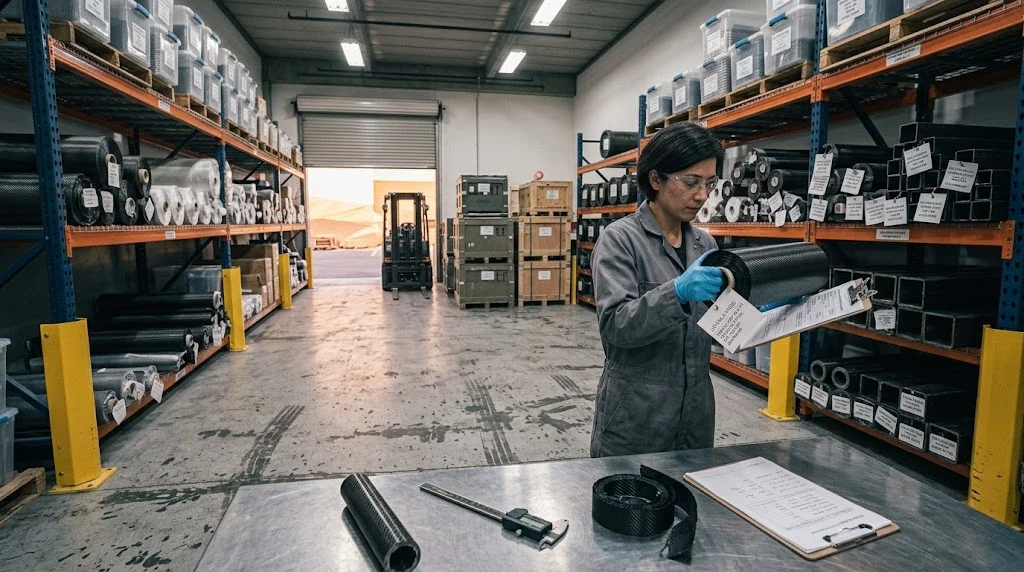
- Physical stock versus paper stock. Ask for the warehouse address and, better, a visit or a photo of the actual rack with batch labels. Free-zone warehouses in Jebel Ali and KIZAD are open to customer audits; an importer who cannot arrange one is reselling someone else's inventory at a markup.
- Handling and storage practice. Prepreg needs cold chain, woven fabric needs dry storage off the floor, and pultruded profiles need straight racks rather than bundles that induce bow. How a supplier stores material predicts how it arrives.
A trading house can be a legitimate part of the chain — provided it is honest about being one. The danger is paying converter pricing for a reseller's paperwork.
Sector Requirements: Aviation, Oil and Gas, Construction
The three demand centers that drive UAE consumption specify different things from the same catalog. The table summarizes what a purchase specification typically pins down:
| Sector | Typical forms | Key specification | Reference standard | Indicative lead time |
|---|---|---|---|---|
| Aviation MRO and components | Prepreg fabric, honeycomb sandwich, pultruded stringers | Standard-modulus tow, 3K twill, fiber volume 55-60% | AS9100 supplier quality, EN 9100 | 2-4 weeks stocked, 6-10 weeks program material |
| Oil and gas | Pultruded rod, repair laminate, instrument housings | Tensile strength at least 1,400 MPa, glass transition matched to service temperature | ISO 23936-2 for materials in sour service contact | 3-5 weeks |
| Construction strengthening | Unidirectional fabric, CFRP plate, CFRP rebar | Tensile modulus 210-240 GPa, elongation at break above 1.5% | ACI 440.2R design guidance, EN 13706 for pultruded profiles | 3-6 weeks |
The practical consequence: an aviation buyer and a construction buyer can receive visually identical black rolls and still be served incorrectly if the supplier ignores the specification behind the order. State the standard in the RFQ, not just the fiber grade, and require the certificate language in the quotation itself.
Free Zones, Customs and Lead Time Through Jebel Ali
Most carbon fiber entering the country moves through Jebel Ali, and the route it takes after arrival shapes landed cost more than the headline per-kilogram price does:
- Free-zone suspension of duty. Goods stored in JAFZA or another free zone carry no import duty and no VAT until they clear to the mainland, where the GCC common external tariff of 5 percent plus 5 percent VAT applies. For material that will be re-exported as finished parts, staying in the zone avoids the duty event entirely.
- Sea versus air. Sea freight from East Asia to Jebel Ali runs roughly 18-25 days on the water plus 3-7 days for clearance; air freight lands in 3-6 days but multiplies freight cost several times over. Low-value, high-volume fabric favors sea; a repair kit for a stopped line favors air, and a supplier with stock in country can skip both.
- Documentation speed. Commercial invoice, packing list, certificate of origin, and — where the program requires it — the material certificate package. Missing paperwork, not missing fiber, is the usual cause of a two-week port dwell.
When you compare landed quotes, ask each bidder to state their Incoterm, warehouse location, and whether duty and VAT are already inside the number. The cheapest ex-works quotation frequently becomes the most expensive delivered one.
Qualifying a Carbon Fiber Tube Supplier for Repeat Orders
One-off purchases tolerate improvisation; repeat supply does not. Qualification for ongoing orders — whether the item is pultruded tube, cut fabric, or machined plate — follows a short, disciplined sequence:
- Write a specification, not a shopping list. State fiber class, form, dimensional tolerance, resin system, and the acceptance test method. A carbon fiber tube supplier quoting against a named tolerance can be compared to one quoting against a guess.
- Order a qualification lot first. A small lot run through your incoming inspection — dimensions, straightness, visual class, and a mechanical spot check — costs a fraction of discovering a process drift on the second production shipment.
- Confirm documentation at goods receipt, not after payment. Certificates that arrive separately from the material create leverage problems; certificates that travel in the same carton do not.
- Track delivered performance. On-time rate, certificate accuracy, and packaging condition over the first three orders tell you more than any sales meeting.
Buyers who blend glass and carbon in hybrid structures should apply the same discipline to their fiberglass carbon fiber supplier: confirm fiber type per roll, resin compatibility, and areal weight tolerance, because a hybrid layup fails at its weakest interface rather than its strongest layer.
Frequently Asked Questions
Do UAE suppliers hold stock or order from mills on demand?
Both models are common, and most suppliers run a hybrid: fast-moving standard items — 3K twill, plain weave, common pultruded diameters — held as physical free-zone stock, while aerospace grades and non-standard widths arrive against mill lead times of 6-10 weeks. The qualification question is which model each quoted item sits under. Ask whether the specific lot offered is on a rack today or on a production schedule, and price the difference in lead time rather than assuming the quotation implies stock.
What import duty and VAT apply to carbon fiber entering the UAE?
Most carbon fiber and composite materials enter under the GCC common external tariff, commonly 5 percent import duty, plus 5 percent VAT on clearance to the mainland. Goods held in a free zone defer both until they leave the zone, and re-export from the zone avoids the mainland duty event. The exact HS classification for your form — tow, fabric, or finished profile — should be confirmed before shipping, because the duty rate follows the classification, not the marketing description.
How long does it take to qualify a new composite supplier for a program?
For a standard-modulus grade already used in a similar application, 6-12 weeks is typical: documentation review, a qualification lot, mechanical testing against your acceptance protocol, and a first-article inspection. Where the program demands AS9100 registration, add the audit cycle for the supplying entity — the material test is usually faster than the quality system approval. Keeping one qualified grade in reserve protects the schedule when a new source slips.
Conclusion
Sourcing in the Emirates is not fundamentally different from sourcing anywhere else — it is the same evaluation of stock, documentation, and delivery behavior, run under import-dependent conditions where warehouse location and paperwork speed carry more weight. The suppliers that hold up over time are the ones that answer lot identity questions on the first reply, ship certificates in the carton, and treat a qualification lot as a normal step rather than an obstacle.
The practical starting point is an RFQ that names the standard, the tolerance, and the Incoterm, sent to vendors willing to be audited in their warehouse. Explore our carbon fiber products — including fabric, tube, rod, and plate profiles supplied to customers worldwide — or contact our engineering team with your specification and annual volume, and we will help you structure the order around your program's documentation and lead-time requirements.
Part of topic
Related Articles
- Carbon Fiber Sheet 4x8: Large-Format Panels for Tooling and Construction
- Carbon Fiber Tubes USA: Domestic Suppliers and Lead Times
- Carbon Fiber Rod Supplier: Pultruded vs Roll-Wrapped Quality Comparison
- Carbon Fiber Tubes: Stock Range, Fiber Orientation and Joint Design
- Carbon Fiber Rod Price: Volume Discounts and Custom Diameter Economics
- Carbon Fiber Suppliers USA: Domestic Sourcing for Defense, Aerospace and Motorsport
Interested in Our Products?
Contact our team for competitive pricing and technical specifications.
Get a QuoteRelated Products

Round Carbon Fiber Tube — 3K Plain Weave T700
Standard round carbon fiber tube manufactured from Toray T700 grade fiber with 3K plain weave. Offers balanced strength and stiffness for general industrial applications including robotics, automation, sports equipment, and aerospace structures.

Square Carbon Fiber Tube — 3K Twill T700
Square cross-section carbon fiber tube manufactured with 3K twill weave for torsional strength. Preferred for structural frames, trusses, and support columns where rectangular geometry offers design flexibility.
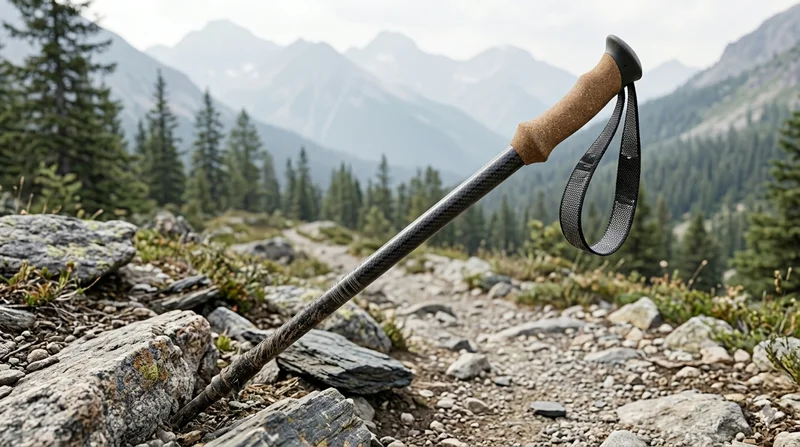
Carbon Fiber Trekking Pole
Lightweight carbon fiber trekking pole manufactured from high-grade carbon fiber tube. Weighs only 160g per pole while providing superior shock absorption and durability for hiking, trail running, and backpacking.

Carbon Fiber Pickleball Paddle
High-performance pickleball paddle with Toray T700 carbon fiber face and polypropylene honeycomb core. Delivers excellent power-to-weight ratio, spin generation, and vibration dampening for competitive play.

Round Carbon Fiber Tube — 3K Twill
Lightweight and ultra-stiff round tubes ideal for drone frames, robotics, and structural applications.