
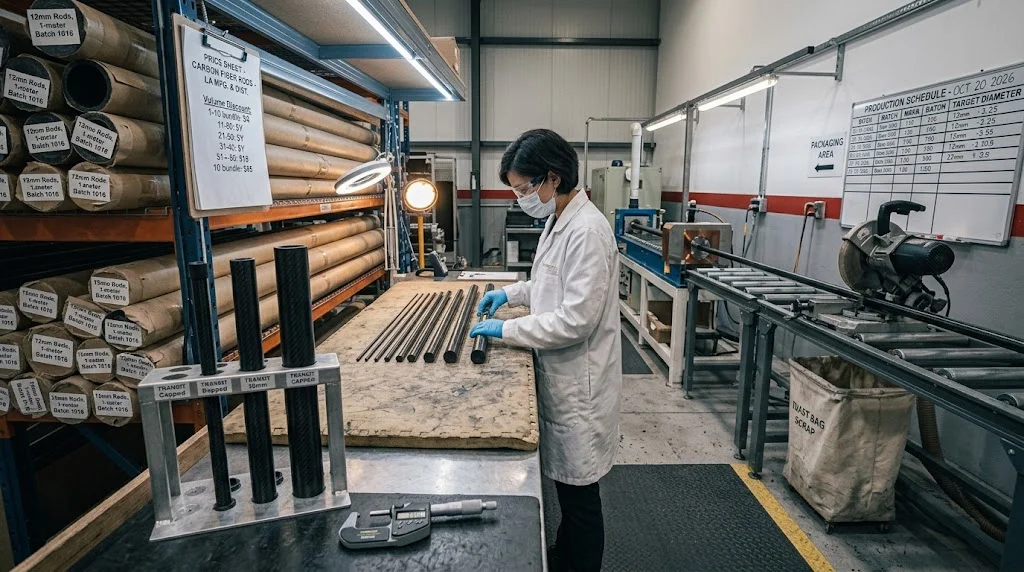
The carbon fiber rod price is one of the most frequently searched numbers in the composites market, and one of the least meaningful when quoted alone. A carbon fiber rod sold by the meter can vary by a factor of five for reasons that have nothing to do with the global price of carbon fiber: diameter
Introduction
The carbon fiber rod price is one of the most frequently searched numbers in the composites market, and one of the least meaningful when quoted alone. A carbon fiber rod sold by the meter can vary by a factor of five for reasons that have nothing to do with the global price of carbon fiber: diameter tolerance, resin system, fiber grade, production route, and how many meters you order at once. Buyers who compare two quotations on headline price alone routinely end up paying more for the part that failed incoming inspection.
This article breaks the number apart. It explains what drives the carbon fiber rod price at the material level, gives indicative pricing by diameter for standard pultruded rods, shows the volume discount tiers that carbon fiber rod suppliers actually apply, compares pultruded against filament-wound manufacturing economics, and lists the costs that never appear on a quotation but always appear on a production line. The goal is to let you model a delivered cost — not a sticker price — before you commit to a supplier.
What Drives the Carbon Fiber Rod Price
Four variables set the floor price before any supplier adds margin:
- Diameter and cross-section area: Rod consumption of carbon fiber scales roughly with the cross-sectional area, so price per meter rises with the square of diameter. A 6 mm rod costs materially less than twice a 3 mm rod only because fixed process costs are spread over more material; the material itself scales with area, which is why 12 mm rods cost four to five times 6 mm rods per meter, not two times.
- Fiber grade: Standard modulus T300-class tow and intermediate modulus T700-class tow do not carry the same cost. The gap is typically 30-60% at the fiber level, and it passes through to the rod. Most structural applications need standard modulus; specifying a higher grade than the load case requires is the most common way to overspend.
- Resin system: Epoxy is the default for pultruded structural rod. Vinyl ester and phenolic systems price lower but trade off toughness and glass transition temperature. For room-temperature structures the difference is usually small; for elevated-temperature service it decides whether the rod holds its properties at all.
- Production route: Pultrusion is a continuous process with low labor content per meter, which is why it dominates the standard-diameter market. Filament winding and pulwinding suit larger diameters and hollow sections, at higher unit cost and higher tooling cost per size.
Supplier margin, freight and packaging sit on top of this floor. They are negotiable. The four variables above are not.
Carbon Fiber Rod Price by Diameter and Length
The table below gives indicative 2026 pricing for standard pultruded carbon fiber rods — T300-class tow, epoxy resin, 0° unidirectional fiber architecture — supplied in meter-length stock. Treat these as planning figures, not quotations.
| Diameter | Price per meter, small volume (10-50 m) | Price per meter, mid volume (50-500 m) | Price per meter, large volume (500 m+) | Typical application |
|---|---|---|---|---|
| 3 mm | $1.20-2.20 | $0.90-1.60 | $0.70-1.20 | Drone frames, RC, sensor arms |
| 4 mm | $1.80-3.20 | $1.40-2.40 | $1.10-1.90 | Robotics links, tent poles |
| 6 mm | $3.50-6.50 | $2.80-5.00 | $2.20-4.00 | Arches, braces, arrow shafts |
| 8 mm | $6.00-11.00 | $4.80-8.50 | $3.80-6.80 | Structural bracing, tooling shafts |
| 10 mm | $9.50-17.00 | $7.50-13.50 | $6.00-10.50 | Machine frames, test fixtures |
| 12 mm | $14.00-25.00 | $11.00-20.00 | $8.50-15.00 | Heavy bracing, industrial shafts |
Two patterns matter more than the absolute numbers. First, the drop from small to large volume is roughly 30-40%, not the 70-80% that buyers sometimes expect from bulk pricing in other markets — because material dominates the cost and material does not get cheaper with volume, only the process overhead does. Second, custom diameters outside the table above add a tooling charge that typically runs $50-300 per size depending on diameter, which is why carbon fiber rods for sale in odd sizes carry a noticeable step up in price per meter.
MOQ and Volume Discount Tiers
Carbon fiber rod suppliers structure discounts around run length, not order value, because a pultrusion line is set up per size and a changeover costs production time. The tiers that show up repeatedly across suppliers:
- Sample tier, 1-10 m: Highest per-meter price, often 1.5-2x the mid-volume band. Justified by line setup and cut-to-length handling. Worth paying once for qualification; not worth paying repeatedly for prototypes that could share a run.
- Small production tier, 10-50 m: The baseline band in the table above. Suitable for prototypes and low-rate production where a supplier stocks the size as standard inventory.
- Contract tier, 50-500 m: A 15-25% reduction from baseline, typically requiring a single shipment or a scheduled release schedule. This is where most industrial buyers land.
- Program tier, 500 m and above per size per year: A 25-40% reduction, usually against a blanket order with quarterly releases and an agreed tolerance specification. It requires committing annual volume, which is why it is offered only after a qualification lot has passed.
The lever most buyers miss is consolidating sizes. Ordering 50 m each of four diameters gets four sample-tier prices. Ordering 200 m of one diameter and keeping the others in stock from a distributor gets one contract-tier price plus small orders — usually a lower total spend for the same build.
Pultruded vs Filament-Wound Rod Economics
The production route changes both the price and the properties, and the two are linked:
- Pultruded rod: Continuous fiber pulled through a resin bath and a heated die at 0.3-1.5 m/min. Fiber volume fraction lands at 60-70%, giving axial tensile strength of 1200-1800 MPa and modulus of 100-150 GPa for standard tow. This is the lowest-cost route per meter for solid round rod and the reason the pricing table above is dominated by pultruded product.
- Filament-wound rod: Fiber wound onto a mandrel at controlled angles then cured. It suits hollow sections, larger diameters, and off-axis fiber orientations, at a unit cost typically 40-80% above pultruded for the same diameter because the process is batch-wise rather than continuous.
- Pultruded tube: For applications needing stiffness-to-weight rather than pure axial strength, a pultruded tube of larger outer diameter often costs less per unit of bending stiffness than a solid rod, even at a higher per-meter price. This comparison is missed more often than it should be.
For solid round rod in standard diameters, pultrusion wins on price and on consistency, and there is rarely a technical reason to pay the filament-winding premium.
Hidden Costs on Carbon Fiber Rods for Sale
The quotation is not the delivered cost. The line items that appear after it:
- Cut-to-length and chamfering: Standard stock ships in 1 m or 2 m lengths. Cut-to-length, chamfering, or facing operations typically add $0.30-1.50 per piece depending on tolerance.
- Tolerance upgrades: Standard diameter tolerance is ±0.1-0.2 mm on tubes and ±0.1 mm on rods. Precision applications — optical benches, measuring arms — need tighter bands and a stated measurement method, which suppliers price separately.
- Tooling for custom sizes: One-time die or mandrel cost of $50-300 per size, amortized or charged upfront.
- Freight and packaging: Rods ship in tubes or bundles; long lengths carry dimensional freight surcharges. On small orders this can be 10-20% of the material cost.
- Scrap from machining: Carbon rod must be cut with abrasive tooling and dust extraction. Buyers machining in-house without extraction equipment discover the cost in filtration and cleanup, not in the rod invoice.
Ask every carbon fiber rod supplier to quote delivered, cut-to-length, and tested against your tolerance — not bare stock — before comparing. That single change turns four incomparable numbers into one usable decision.
Frequently Asked Questions
Why does the carbon fiber rod price rise so sharply with diameter?
Because fiber consumption scales with cross-sectional area, which grows with the square of diameter, while process overhead per meter is roughly constant. Doubling diameter quadruples the material in the rod. The visible effect is that a 12 mm rod costs four to five times a 6 mm rod per meter rather than twice — and it is also why large-diameter buyers should evaluate a pultruded tube of equivalent bending stiffness before assuming a solid rod is the cheaper answer.
Is it worth paying for T700-class fiber in a carbon fiber rod?
Only when the load case requires it. T700-class tow raises tensile strength substantially at a 30-60% fiber cost premium, but most rod applications are stiffness-driven rather than strength-driven, and standard modulus fiber already delivers 100-150 GPa of axial modulus. Pay the premium where a strength check governs the design; otherwise specify standard modulus and spend the difference on diameter, where the stiffness return per dollar is higher.
What is the practical minimum order for a custom-diameter carbon fiber rod?
Most carbon fiber rod suppliers set custom diameters at 20-50 meters minimum, plus a tooling charge of $50-300. Below that, you are effectively paying sample-tier pricing on a size that exists only for you, which is why consolidating to an existing stocked diameter is usually cheaper even if the stocked diameter is slightly larger than your theoretical optimum. Confirm both the run length and the tolerance band in the quotation before committing.
Conclusion
The carbon fiber rod price is a function of area, fiber grade, resin, production route and run length — and only the last of those is negotiable in practice. Diameter sets the material cost, grade and resin set the property envelope, pultrusion sets the process economics, and volume tier sets the discount. Reading a quotation against those five variables, then adding cut-to-length, tolerance upgrades, tooling and freight, produces a delivered cost you can actually compare across suppliers.
For standard and custom pultruded rods, explore our carbon fiber rod and profile range, supplied in stock diameters and custom sizes to customers worldwide. Contact our engineering team with your diameter, length, tolerance and annual volume — we will quote a delivered price with the volume tier that fits your program rather than a bare per-meter figure.
Related Articles
- Carbon Fiber Tubes: Stock Range, Fiber Orientation and Joint Design
- Carbon Fiber Suppliers USA: Domestic Sourcing for Defense, Aerospace and Motorsport
- Carbon Fiber for Aerospace: Grade Selection for Flight-Critical Parts
- Carbon Fibre Sheet UK: Grades, Suppliers and Cutting Services
- Spare Parts Carbon Fiber: Replacement Components for Racing and Restoration
- Carbon Fiber Sheets Price: What You Pay by Grade, Thickness and Quantity
Interested in Our Products?
Contact our team for competitive pricing and technical specifications.
Get a QuoteRelated Products

Round Carbon Fiber Tube — 3K Plain Weave T700
Standard round carbon fiber tube manufactured from Toray T700 grade fiber with 3K plain weave. Offers balanced strength and stiffness for general industrial applications including robotics, automation, sports equipment, and aerospace structures.
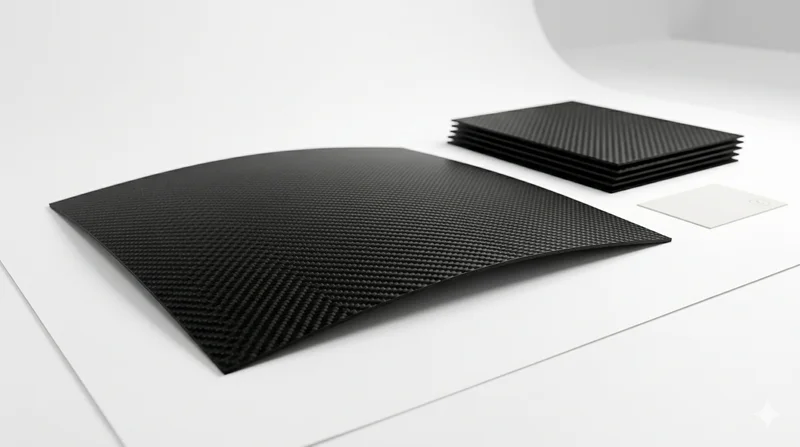
Carbon Fiber Plate — 3K Twill T700 1.5mm
Thin 1.5mm carbon fiber plate with 3K twill weave surface. Lightweight and stiff, commonly used for covers, panels, drone bodies, and applications requiring a premium aesthetic appearance.

Carbon Fiber Pickleball Paddle
High-performance pickleball paddle with Toray T700 carbon fiber face and polypropylene honeycomb core. Delivers excellent power-to-weight ratio, spin generation, and vibration dampening for competitive play.

Square Carbon Fiber Tube — 3K Twill T700
Square cross-section carbon fiber tube manufactured with 3K twill weave for torsional strength. Preferred for structural frames, trusses, and support columns where rectangular geometry offers design flexibility.
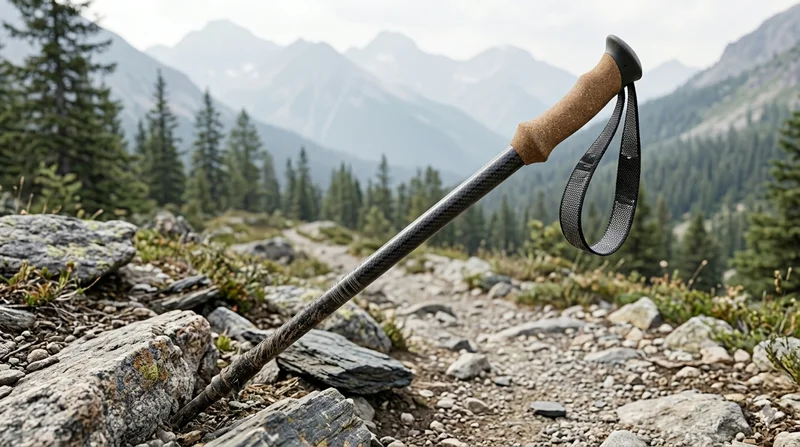
Carbon Fiber Trekking Pole
Lightweight carbon fiber trekking pole manufactured from high-grade carbon fiber tube. Weighs only 160g per pole while providing superior shock absorption and durability for hiking, trail running, and backpacking.