
Carbon fiber tubes are the most widely specified composite profile in industry, and most buying mistakes happen before the first calculation is run: a buyer picks a wall thickness from a photograph, assumes the layup, and discovers at assembly that the tube cannot be bonded, clamped or cut the way t
Introduction
Carbon fiber tubes are the most widely specified composite profile in industry, and most buying mistakes happen before the first calculation is run: a buyer picks a wall thickness from a photograph, assumes the layup, and discovers at assembly that the tube cannot be bonded, clamped or cut the way the drawing assumed. This guide covers the three decisions that actually determine whether a tube works — the stock range you can order from, the fiber orientation inside the wall, and the joint at each end — with numbers you can put into a design.
We publish it because these questions arrive daily at every carbon fiber tube manufacturers page, and because carbon fiber tube strength is quoted far more often than it is understood.
Stock Range of Carbon Fiber Tubes
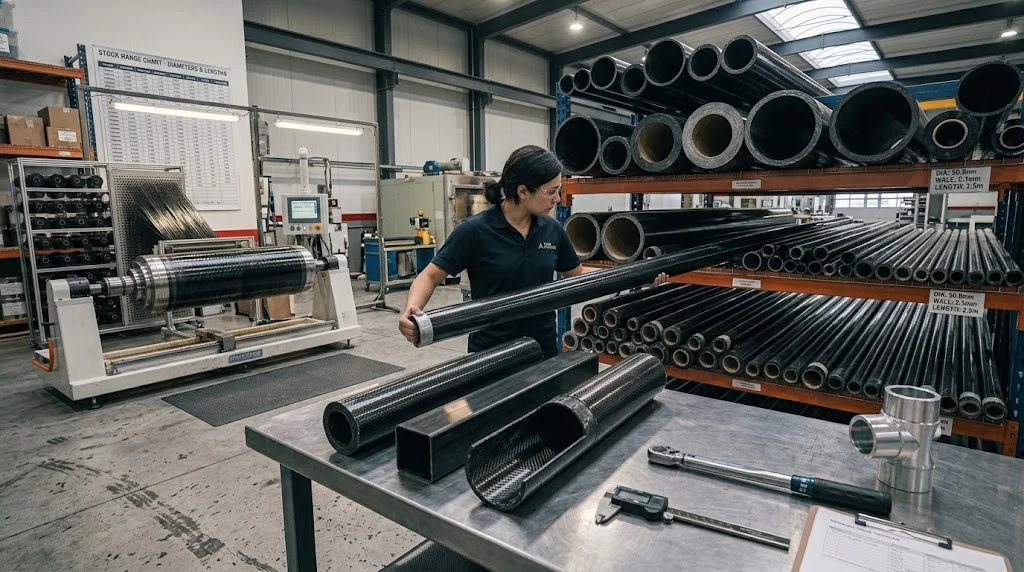
Most manufacturers hold pultruded and roll-wrapped stock in a repeatable size grid. The table below is a representative range — confirm against any supplier's current inventory, since tooling availability, not capability, limits what ships next day.
| Process | Outer diameter range (mm) | Wall thickness (mm) | Standard lengths | Typical tolerance on OD | Where it wins |
|---|---|---|---|---|---|
| Pultruded round | 3-100 | 0.5-5.0 | 1 m, 2 m, 3 m | ±0.1-0.3 mm | Straight 0° structures, lowest cost per meter |
| Roll-wrapped round | 6-300 | 1.0-15.0 | 1 m, 2 m, 4 m | ±0.1-0.2 mm | Balanced strength, insert bonding, machined ends |
| Filament-wound round | 25-600 | 1.5-20.0 | up to 6 m | ±0.3-0.5 mm | Large pressure and offshore sections |
| Pultruded square / rectangular | 10-100 (flange) | 1.0-5.0 | 1 m, 3 m | ±0.2 mm | Frames, gantries, bolted structures |
| Round-square hybrid profiles | 20-150 | 1.5-6.0 | 1-3 m | ±0.2-0.4 mm | Sliding fits, camera masts, robotic arms |
Three notes on the grid. First, thin-wall small-diameter tube (below 1.0 mm wall) is almost always roll-wrapped, because pultrusion cannot hold ovality on fine sizes. Second, very thick walls above 12 mm are usually built up in several cure cycles, which shows as a faint spiral seam. Third, carbon fiber tubes near me — the search every buyer runs first — is really a question about stock location and lead time, not capability: a manufacturer with regional warehousing ships common sizes in 3-5 days, while a fully custom layup runs 3-6 weeks.
Carbon Fiber Tube Strength by Fiber Orientation
A tube's strength is not a property of the material; it is a property of the layup. Four orientation families show up in practice:
- 0°-dominant (pultruded): Fiber runs along the axis. Axial tensile strength reaches 1200-1800 MPa with modulus of 100-150 GPa for standard tow, but hoop strength and split resistance are weak — a pultruded tube crushed by an over-tightened clamp fails by splitting along the fiber direction.
- Hoop (90°) reinforcement: Filament-wound or roll-wrapped hoop layers raise internal-pressure and crush resistance by 2-4x, at a small cost in axial stiffness. This is the correct default for tubes that will be clamped.
- Angle-ply (+/-45°): Optimized for torsion. A +/-45-dominated tube can carry 40-70% more torque per gram than a 0° tube of the same mass, which is why drive shafts and robotic wrist tubes use it.
- Quasi-isotropic (0/90/+/-45): Balanced behavior for general structures where load direction is not fixed. Slightly heavier than a purpose-optimized layup, but predictable in every direction.
Reported carbon fiber tube strength figures should always be read against the test direction and the matrix. Compressive strength (900-1400 MPa) runs roughly 60% of tensile because the matrix and fiber micro-buckling govern; interlaminar shear (40-70 MPa) is the number that fails first in a badly bonded joint.
Joint Design for Carbon Fiber Tubes: Where They Actually Fail
Most field failures are joint failures. Four patterns cover nearly every application:
- Adhesive bond line: The preferred method. Lap length of 2-3x the tube diameter with a 0.1-0.3 mm bond line, surface prepared by grit blasting or peel ply removal plus solvent wipe. A bonded joint loaded in shear typically sustains 20-35 MPa; loaded in peel it sustains a fraction of that, so design the overlap to keep the load in shear.
- Mechanical clamps and set screws: Acceptable only against hoop-rich walls and only with a load-spreading sleeve. Clamp pressure above roughly 0.3 MPa at the wall crushes the laminate locally — add a split aluminium or PEEK collar, and never tighten a stainless set screw directly onto carbon.
- Bonded threaded inserts: Aluminium or steel inserts glued into the tube end convert a fragile laminate edge into a serviceable thread. Wall engagement of at least 1.5x the thread nominal diameter keeps pull-out above 5 kN for M8 inserts in a 30 mm tube.
- Pin and shear-lug joints: A pin through the tube is acceptable only with a metal sleeve inside the bore, because bearing stress at the pin hole (allow 25-40 MPa for carbon against steel) exceeds the laminate's bearing capacity quickly.
Surface preparation decides the outcome more than adhesive brand does. Uncleaned, oily or glossy-as-molded surfaces lose 40-60% of achievable bond strength, which is why a joint that "looks perfect" fails at half the predicted load.
Cutting, Drilling and Finishing
Tubes must be cut square to be jointed at all. Use an abrasive disc or a fine-tooth carbide blade with dust extraction, a mandrel-supported hole saw for large bores, and step reamers for bolt holes; then chamfer both edges and seal them. Unsealed, cut edges wick moisture and abrade under handling, and they are also where the first delamination starts when a tube is dropped. Tolerance upgrades — OD ±0.05 mm, wall ±0.05 mm, ovality under 0.05 mm — are available on roll-wrapped sizes and are effectively mandatory for telescoping and optical applications.
If one tube must slide inside another, tolerance is the whole design: a fit that is snug at 20 C will bind after a day in the sun, because carbon and the mating part expand at different rates. Keep stock tolerance for prototypes and brackets, and specify the upgraded band from the first drawing for sliding fits, optical rails and instrument masts.
Frequently Asked Questions
How strong is a carbon fiber tube compared with steel or aluminium?
On a strength-to-weight basis, carbon laminate outperforms both: tensile strength of 1200-1800 MPa at a density of 1.55-1.6 g/cm³ gives roughly 750-1150 kN·m/kg, against about 400-500 for structural steel and 150-300 for aluminium alloys. In absolute terms, however, a thin-wall carbon tube has less section than a steel tube of the same outer diameter, so design for stiffness and buckling first, then check strength.
What wall thickness should I order for a structural carbon fiber tube?
Start from buckling, not from feel: for a column under axial load, wall thickness is set by the radius-to-thickness ratio, and most designers land between 1.5 mm and 5 mm for spans under 2 m. Confirm the load path — 0°-dominant pultrusion for pure bending and tension, hoop-rich roll-wrap where clamps or internal pressure appear, +/-45 where torque governs. Ask your carbon fiber tube manufacturers for the actual layup, not just the outer diameter.
Can carbon fiber tubes be welded, threaded or glued?
They cannot be welded — the matrix decomposes before the fiber softens. Threads should be cut into bonded metal inserts rather than directly into the laminate. Gluing is the primary joining method and works extremely well when surfaces are prepared: grit blast or peel ply, solvent wipe, and a bond line held at 0.1-0.3 mm. Avoid structural tape and press-fit alone; both fail by creep under sustained load.
Conclusion
Ordering carbon fiber tubes gets easier once the three decisions are separated: pick from the stock grid before paying for custom tooling, match fiber orientation to the load path rather than to a catalog adjective, and design each end as a real joint with shear, bearing and peel accounted for. Do that, and the tube will fail where you predicted — in the structure, at the load you designed for — instead of at the clamp, the glue line or the cut edge.
Our stock and made-to-order program covers the full range in the table above: browse our carbon fiber tubes and profiles for standard diameters and walls, or contact our engineering team with your drawing, layup requirement and annual volume — we quote carbon fiber tube strength data, tolerance bands and delivered lead time together, so you can compare us against any other carbon fiber tube manufacturers on the same numbers.
Part of topic
Related Articles
- Carbon Fiber Rod Price: Volume Discounts and Custom Diameter Economics
- Carbon Fiber Suppliers USA: Domestic Sourcing for Defense, Aerospace and Motorsport
- Carbon Fiber for Aerospace: Grade Selection for Flight-Critical Parts
- Carbon Fibre Sheet UK: Grades, Suppliers and Cutting Services
- Spare Parts Carbon Fiber: Replacement Components for Racing and Restoration
- Carbon Fiber Sheets Price: What You Pay by Grade, Thickness and Quantity
Interested in Our Products?
Contact our team for competitive pricing and technical specifications.
Get a QuoteRelated Products

Round Carbon Fiber Tube — 3K Plain Weave T700
Standard round carbon fiber tube manufactured from Toray T700 grade fiber with 3K plain weave. Offers balanced strength and stiffness for general industrial applications including robotics, automation, sports equipment, and aerospace structures.
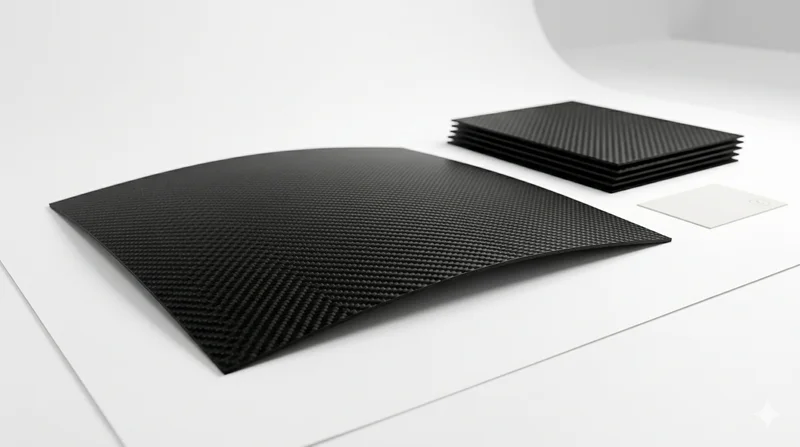
Carbon Fiber Plate — 3K Twill T700 1.5mm
Thin 1.5mm carbon fiber plate with 3K twill weave surface. Lightweight and stiff, commonly used for covers, panels, drone bodies, and applications requiring a premium aesthetic appearance.

Carbon Fiber Pickleball Paddle
High-performance pickleball paddle with Toray T700 carbon fiber face and polypropylene honeycomb core. Delivers excellent power-to-weight ratio, spin generation, and vibration dampening for competitive play.

Square Carbon Fiber Tube — 3K Twill T700
Square cross-section carbon fiber tube manufactured with 3K twill weave for torsional strength. Preferred for structural frames, trusses, and support columns where rectangular geometry offers design flexibility.
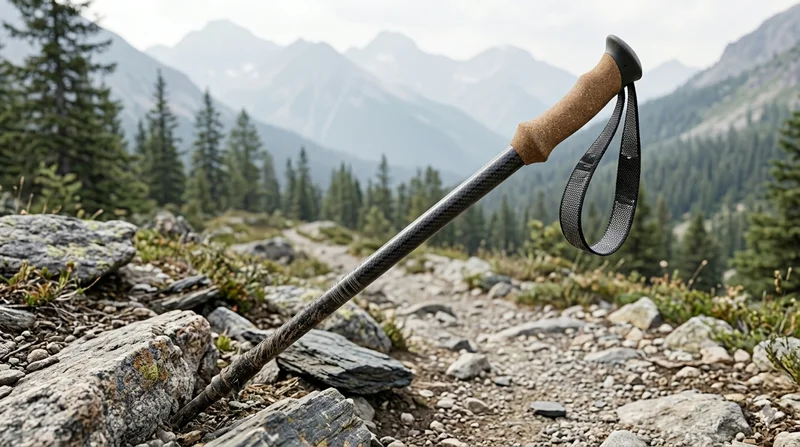
Carbon Fiber Trekking Pole
Lightweight carbon fiber trekking pole manufactured from high-grade carbon fiber tube. Weighs only 160g per pole while providing superior shock absorption and durability for hiking, trail running, and backpacking.