
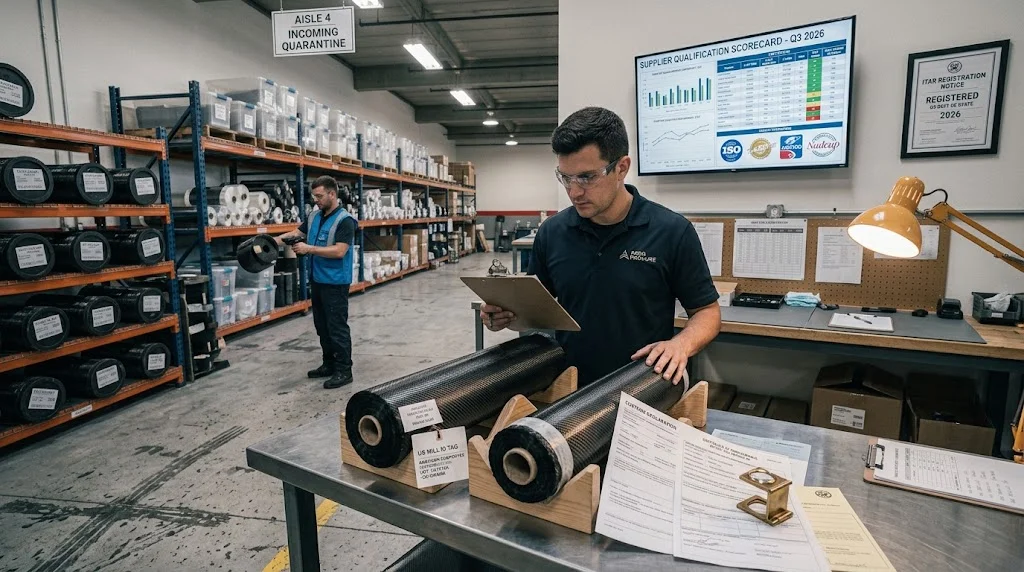
When a buyer starts comparing carbon fiber suppliers USA programs, the conversation rarely stays about modulus and tow size. Domestic sourcing for defense, aerospace and motorsport has become a documentation problem as much as a materials problem: the fiber must meet a named specification, and the b
Introduction
When a buyer starts comparing carbon fiber suppliers USA programs, the conversation rarely stays about modulus and tow size. Domestic sourcing for defense, aerospace and motorsport has become a documentation problem as much as a materials problem: the fiber must meet a named specification, and the buyer must be able to prove where it came from, which lot it came from, and whether it was handled by a party registered under the relevant export controls. Both requirements have tightened since 2021, as prime contractors flowed domestic-content clauses further down the supply chain and enforcement around controlled carbon fiber precursor and tow became more rigorous.
This article maps the US supply landscape. It covers who actually manufactures fiber on American soil, who converts that fiber into fabric and intermediate forms, what certifications separate a qualified carbon fiber supplier from an unvetted distributor, and how domestic pricing compares with Japanese, European and Chinese alternatives once lead time, freight, and requalification cost are included. The result is a framework you can apply directly to the next RFQ — whether you need IM7-class tow for a flight structure or cut-to-size twill for a motorsport bodywork cell.
Why Programs Specify US Carbon Fiber Manufacturers
Three forces push qualified work toward domestic sources, and they reinforce each other:
- Export control and registration: High-strength and high-modulus carbon fiber and its precursor are controlled under the Wassenaar framework, typically classified under ECCN 1C010. Defense programs add ITAR registration and screening obligations for any party touching technical data. A US-registered supplier collapses three layers of compliance review into one.
- Traceability and lot consistency: Aerospace and motorsport programs specify a single qualified lot through qualification testing, then expect every production roll to match it. Domestic suppliers holding AS9100 and NADCAP accreditation maintain the lot records, in-process controls, and first-article documentation that make an audit answerable in days rather than weeks.
- Lead time and working capital: Ocean freight, customs clearance and a customs broker's queue routinely add 6-10 weeks to an imported order. Against a 4-8 week domestic window, the difference is not only calendar time — it is inventory sitting in transit and the production slots that schedule around it.
None of these arguments claim imported fiber is technically inferior. Japanese and European mills produce excellent material. The point is that for a US program with compliance obligations, the total cost of a domestic roll is usually lower than the total cost of an imported roll once qualification, freight and delay risk are priced in.
US Carbon Fiber Manufacturing Landscape: Who Makes What
The US does not have dozens of carbon fiber producers. It has a small number of integrated manufacturers, each with a distinct position in the market, plus a larger layer of converters who buy tow and turn it into fabric, prepreg, pultruded profile or cut part.
- Integrated American manufacturers: Hexcel, Toray Composites America and Solvay's composite materials operations run pan-to-prepreg or pan-to-tow lines on US soil, producing standard-modulus and intermediate-modulus fiber grades that most aerospace programs already have design allowables for. Zoltek, operating in Missouri, occupies the large-tow and industrial grade segment — the volume that automotive, wind and infrastructure programs specify.
- Converters and fabricators: A layer of US converters buys domestic or imported tow and produces woven fabric, unidirectional tape, pultruded profiles and cut kits. Their value is not fiber production; it is converting a mill lot into the exact form your layup consumes, with domestic content and lot segregation preserved.
- Distributors and trading houses: Some hold physical inventory in the US and can ship within days. Others hold paper and source from whichever mill is cheapest that quarter. The distinction matters: a distributor with a warehouse and a lot-traceability system is a legitimate part of a domestic supply chain, while a trading house that never inspected a roll is not.
The practical test is simple. Ask the supplier to name the mill, the production line, and the lot number of the material they are quoting. A carbon fiber supplier that answers immediately is a converter or a stocking distributor. One that cannot answer is a reseller, and your compliance team will eventually discover that fact on its own.
Qualifying Carbon Fiber Suppliers USA: Certifications and Documentation
Certifications are not a formality in this market — they are the mechanism by which a prime contractor accepts your material without re-testing it. The core set looks like this:
- AS9100: The aerospace quality management standard. Non-negotiable for defense and aerospace programs; a supplier without it cannot be added to most approved-vendor lists regardless of material quality.
- NADCAP accreditation: For composites, chemical processing and special processes. It signals that process controls — cure cycles, fiber handling, storage of frozen prepreg — have been audited against a specific checklist rather than self-declared.
- ITAR registration and EAR compliance: Required where technical data or controlled fiber grades cross company boundaries. Registration alone does not qualify a supplier, but its absence disqualifies them immediately on defense work.
- ISO 9001 and lot traceability documentation: Baseline for industrial and motorsport programs where AS9100 is not demanded but lot-to-lot consistency still has to be demonstrable through certificates of analysis and conformance.
- Domestic content declarations: Written statements of country of origin for fiber, precursor and conversion, retained for the life of the program. This is what your customer's compliance team will request, and a domestic supplier already has the paperwork filed.
Requesting this documentation before awarding an RFQ costs a day. Requalifying a supplier six weeks into a production ramp costs a quarter.
Domestic vs Imported Carbon Fiber: Indicative Pricing
The table below summarizes indicative 2026 ranges for the grades most frequently specified by US programs. Treat them as direction, not quotation — actual pricing depends on grade, volume, and contract length.
| Criterion | US Domestic Supply | Japan / Korea | Europe | China |
|---|---|---|---|---|
| Standard modulus 12K tow, indicative per kg | $18-28 | $14-22 | $17-26 | $9-16 |
| Intermediate-modulus aerospace grade, indicative per kg | $40-70 | $35-60 | $38-65 | $22-40 |
| Typical lead time, mill or distributor stock | 4-8 weeks | 8-14 weeks | 8-12 weeks | 10-16 weeks |
| Practical minimum order quantity | 50-200 kg | 300-1000 kg | 250-800 kg | 500-2000 kg |
| Domestic content eligibility | Yes, with declaration | No | No | No |
| Requalification cost and duration | Minimal | 3-9 months | 3-9 months | 4-12 months |
The headline price gap of 20-40% between domestic and Chinese tow is real. It is also the smallest line in the total cost of ownership. Requalification testing, freight, customs, and the inventory carried to buffer a 12-week lead time typically consume more than the unit price saving on any program that runs less than roughly two years at moderate volume.
How to Run an RFQ Across Multiple Carbon Fiber Suppliers
A well-run RFQ does more than collect prices. It produces a comparison your quality and compliance teams can sign off on. The sequence that works in practice:
- Issue a specification, not a shopping list. State tensile modulus and strength, tow size, sizing chemistry compatibility with your matrix resin, form (tow, fabric, pultruded profile), and the acceptance test standard. Suppliers can then quote a matched material instead of a substitute.
- Request mill name, line and lot documentation in the quote itself. Suppliers who answer in the first reply separate themselves from those who need three follow-ups.
- Order a qualification lot before a production lot. One small lot tested against your incoming-inspection protocol is cheaper than a production lot that fails on the second roll.
- Price the total delivered cost. Add freight, duty, customs broker fees, and the inventory cost of the longer lead time to each quotation before comparing.
- Score suppliers on documentation and responsiveness, not only price. A supplier who returns your RFQ in three days with certificates attached is signaling how they will behave when a line is stopped waiting for material.
For most programs the resulting shortlist is two or three names: one integrated domestic manufacturer for flight-critical or export-controlled grades, one stocking distributor for standard grades and prototype quantities, and one backup for continuity.
Frequently Asked Questions
Are there enough US carbon fiber manufacturers to support a dual-source strategy?
Yes for standard and intermediate-modulus grades, with qualification. The integrated American manufacturers produce overlapping grade families, so a program can qualify a primary and a secondary source without leaving domestic supply. The constraint appears at the extremes — very high-modulus grades above roughly 400 GPa tensile modulus, and certain large-tow industrial grades — where domestic production is thinner and qualification must be planned earlier. Dual-sourcing is realistic; it simply has to be designed into the qualification schedule rather than added later.
Does buying domestic carbon fiber guarantee ITAR compliance?
No. Domestic manufacture and export-control compliance are related but separate. A US-produced fiber can still be handled by a party that is not ITAR-registered, and technical data can still be shared improperly. What domestic sourcing does is remove the multi-jurisdiction screening that an offshore purchase requires: you still need the supplier's registration status, your own internal classification of the material, and written records of every party who touches the technical data. Treat the domestic flag as a simplification of compliance, not a substitute for it.
How quickly can a new carbon fiber supplier be qualified for production?
For a standard-modulus grade already used in a similar application, 6-12 weeks is typical: documentation review, a qualification lot, mechanical testing against your acceptance protocol, and a first-article inspection. For a new grade in a flight-critical structure, the path runs through your design allowables process and can take 6-12 months, most of which is testing rather than supplier onboarding. The distinction explains why most programs keep at least one already-qualified grade in reserve for schedule recovery.
Conclusion
Sourcing carbon fiber domestically is not a purity test. It is a decision to trade a modest unit-price premium for documentation that is already assembled, lead times that fit a production schedule, and a supply chain that sits inside one regulatory jurisdiction. For defense, aerospace and motorsport programs — where requalification costs more than the fiber and a stopped line costs more than both — that trade is usually the correct one.
The practical starting point is an RFQ that asks for mill identity, lot documentation and total delivered cost rather than headline price alone. Explore our carbon fiber products — including tow, woven fabric, and pultruded profiles supplied to customers worldwide — or contact our engineering team with your specification, form factor and annual volume, and we will help you map the sourcing options that fit your program's compliance profile.
Part of topic
Related Articles
- Carbon Fiber Tubes: Stock Range, Fiber Orientation and Joint Design
- Carbon Fiber Rod Price: Volume Discounts and Custom Diameter Economics
- Carbon Fiber for Aerospace: Grade Selection for Flight-Critical Parts
- Carbon Fibre Sheet UK: Grades, Suppliers and Cutting Services
- Spare Parts Carbon Fiber: Replacement Components for Racing and Restoration
- Carbon Fiber Sheets Price: What You Pay by Grade, Thickness and Quantity
Interested in Our Products?
Contact our team for competitive pricing and technical specifications.
Get a QuoteRelated Products

Round Carbon Fiber Tube — 3K Plain Weave T700
Standard round carbon fiber tube manufactured from Toray T700 grade fiber with 3K plain weave. Offers balanced strength and stiffness for general industrial applications including robotics, automation, sports equipment, and aerospace structures.
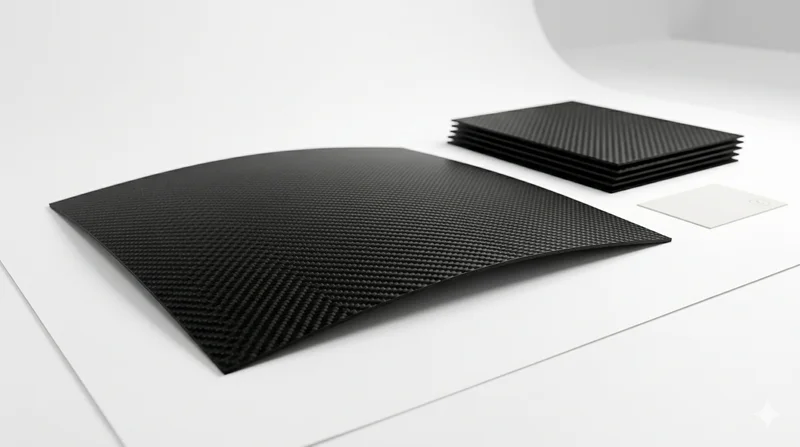
Carbon Fiber Plate — 3K Twill T700 1.5mm
Thin 1.5mm carbon fiber plate with 3K twill weave surface. Lightweight and stiff, commonly used for covers, panels, drone bodies, and applications requiring a premium aesthetic appearance.

Carbon Fiber Pickleball Paddle
High-performance pickleball paddle with Toray T700 carbon fiber face and polypropylene honeycomb core. Delivers excellent power-to-weight ratio, spin generation, and vibration dampening for competitive play.

Square Carbon Fiber Tube — 3K Twill T700
Square cross-section carbon fiber tube manufactured with 3K twill weave for torsional strength. Preferred for structural frames, trusses, and support columns where rectangular geometry offers design flexibility.

Carbon Fiber Trekking Pole
Lightweight carbon fiber trekking pole manufactured from high-grade carbon fiber tube. Weighs only 160g per pole while providing superior shock absorption and durability for hiking, trail running, and backpacking.